


Way back in January, which was at least three or four years ago by my count, I promised that I'd keep a running post with the capsule reviews I tuck into my movie listings posts.
I did not. Till now.
I haven't fiddled with these reviews much, just clarified a couple points, smoothed over some phrasing, and fixed obvious typos. Some movies have been upgraded or downgraded after a rewatch, and that's noted here.
American Doctor
Poh Si Tang’s documentary about three U.S. surgeons who travel to Gaza to perform emergency procedures on Palestinian victims of the Israeli invasion at Nasser Hospital will stir you up, especially if you’re the sort of comfortable coward like me who generally avoids visual evidence of the ongoing genocide. Seriously, I took so many deep breaths during this film, when I wasn’t outright flinching. But this doc doesn’t just worthily acknowledge an important subject; it’s a compelling study of three very different men who share the same humanitarian commitment. Blunt Jewish-American orthopedic surgeon Mark Perlmutter begins the film by demanding that Tang not blur images of dead children. Palestinian-American E.R. physician Thaer Ahmad is a family man who’s denied re-entry to Gaza. And then there’s the quietly charismatic trauma surgeon Feroze Sidhwa. The film covers both their personal lives (Ahmad’s daughters are impossibly adorable; Sidhwa shares why he’s undateable), their media appearances (Perlmutter tries to learn from the more diplomatic Sidwa), and their ethical motivations. Anyway, you wouldn’t think it would need to be said, but here goes: Don’t bomb hospitals and don’t murder children. A-
Arco
Arco is a boy from the distant future, where people live in fantastical homes on stilts, high above the Earth, and have developed the ability to travel through time. He’s too young for such a journey, so he steals his older sister’s rainbow cape and the gem that powers time travel and winds up in a less-distant future–about 50 years from now. Things have and haven’t changed—the world looks similar, except that domes go up around houses to protect them from extreme weather, and working parents communicate with their children via hologram while robots do the caretaking. Here Arco meets a lonely girl named Iris, and they develop a cute friendship; she sketches the world he describes to her while he tries to teach her the language of birds. But three weird brothers find Arco’s jewel, potentially leaving him stranded. While pleasant enough, this Ghibli-derivative toon from French illustrator Ugo Bienvenu never quite lives up to the promise of its intricate world-building. The human faces are oddly inexpressive and the dubbed voices—especially those of Will Ferrell, Andy Samberg, and Flea—don’t help any. Cute and thoughtful, but curiously inert. B
Backrooms
More film-studenty than anyone impressed at director Kane Parsons’s tender age of 20 wants to let on, this unexpected budget horror hit is ambiguous enough for us all to project our own sense of entrapment on its unrelentingly yellow liminal space. Postmodern capital, the male psyche, miscellaneous trauma, the internet—whatever’s recursively hemming you in, we all feel lost within some labyrinth right now, and much credit to Parsons for tapping into that timely sensibility. But movies, pesky damn things, will have characters, and stories, and dialogue, and, well… Chiwetel Ejiofor (as an extremely divorced furniture store owner) and Renate Reinsve (as a therapist I personally would not recommend) do what they can with some leaden dialogue by Will Soodik, who does not have youth and inexperience as an excuse. Doesn’t help that Parsons ratchets up the drama whenever a bit of the ol’ flattened affect would accentuate the eeriness. Backrooms is an A minus haunted house padded out into a B minus movie, so let’s just say… B
Blue Heron
What if your child is just somehow… broken? That’s the question that haunts both Blue Heron, the debut feature from Sophy Romvari, and the filmmaker herself. The offspring in question is an older brother whose death Romvari already grieved in her short film Still Processing (something of a sensation in that limited way that arty short films can be sensations) and who is called Jeremy (Edik Beddoes) in this light fictionalization of her childhood in British Columbia. The movie is largely told from the perspective of eight-year-old Sasha (Eylul Guven), Sophy’s stand-in. Shortly after relocating from Hungary, her parents notice their eldest son acting out in ways that are alternately banal and dangerous. Later in the film, Sasha revisits the past as an adult, believing that by understanding it she can somehow alter it, and her efforts only accentuate her family’s helplessness in the face of Jeremy’s behavior. Blue Heron is a film about memory—less concerned with its accuracy than with how it shapes us, as well as how it’s shaped itself but home movies and photos and other artifacts. Like Charlotte Wells’s Aftersun it gropes toward a past it can’t quite recapture, though Jeremy is far more enigmatic than the father in that film. “Art is not therapy” is generally a solid rule of thumb, but exceptions can be made for artists who understand that therapy is about asking questions, not answering them. When the film ends, you get the sense that Romvari is, yes, still processing. A
Carolina Caroline
I’m a single-issue voter, and that issue is: Hot people should be allowed to rob banks. Don’t the cops have anything better to do than hassle sexy criminals? But no, nigh on 60 years after Hollywood ditched the Hays Code, criminals still typically get their comeuppance in the final reel. It’s baked into the genre now. So when restless small-town girl (Samara Weaving) hits the road with shady drifter (Kyle Gallner) in the latest from buzzy director Adam Carter Rehmeier, you know a happy ending ain’t in the cards. As with any hustler movie, Carolina Caroline is best when focusing on the details of the trade—I almost believe I could scam a cashier out of a $20 after watching this; in addition I admire how its finale ducks cruel fatalism and dull moralism both. Weaving’s solid career in horror and crime flicks does make me wonder if she harbors “serious” film aspirations. Not saying she has to, but I am curious. B
The Christophers
In the latest from Steven Soderbergh, Jessica Gunning and James Corden are the bumbling children of a reclusive, once-celebrated London painter (Ian McKellan); they enlist a touch-up artist (Michaela Coel) to quietly finish a legendary series of works that the old man abandoned so they can cash in when he dies. McKellan is perfectly garrulous as Julian Sklar, a cynical retiree who records Cameos all day and who once regularly eviscerated fledgling artists on a TV show called Art Fight, while Coel is the laconic foil who draws him out in unexpected ways. And Ed Solomon’s script genuinely wants to discuss art—the impulses behind it, the reception of it, questions of authorship—in more complex ways than the usual ”creative process” mystification clichés. But the warmth the film reaches for in the soppier third act feels a bit beyond Soderbergh these days, despite the actors’ best efforts. That’s the thing with the director’s later films—regardless of how well-crafted and effective they are, they can feel like arbitrary exercises. You sometimes get the sense that Soderbergh would have just as happy if he made a different film than the one you’re watching. That distance adds an unnecessary chill to The Christophers, but for as long as it’s two great actors squaring off against one another the movie is entertaining as hell. B+
Coyote vs. Acme
When a fed-up Wile E. Coyote belatedly recognizes that defective Acme products are the source of all his woes, he seeks out Kevin Avery (Will Forte), a lawyer who specializes in settling animated clients’ product-liability cases fast and cheap. But the fired-up Coyote, along with Avery’s idealistic niece (Lana Condor), decide to stick it to The Man. Or rather, The Rooster—as Acme’s CEO, Foghorn Leghorn reveals himself as the evil bully we always knew he was, and it’s a hoot to watch him intimidate his lawyer, an obligingly game John Cena. If much of the comedy here leans on nostalgia, the old bits remain good ones. And while there’s a reason classic Looney Tunes didn’t exceed 10 minutes, Bugs and Daffy and Porky and Tweety all turn up at opportune moments. The human/toon interaction is as seamless as it should be, with Forte a serviceable enough straight man that I won’t compare him to Bob Hoskins. Though having avoided mentioning Who Framed Roger Rabbit? as long as I could, I couldn't help but notice that this film flirts with the other’s idea of cartoons as manic chaos agents but never quite plunges in. As for the anti-corporate storyline, it could be a critique of animal testing if it wanted to. (It’s a stretch, I say, I say, a stretch to claim it’s metaphorically calling out Big Tech’s beta-testing.) What stage of capitalism have we reached when a solid piece of entertainment like this becomes a cause célèbre simply because biz pinheads nearly binned it as a tax write off? I’m just glad it gives today’s kids the opportunity to learn who Peter Lorre was the same way that I did. B+
Digger
Spoilers ahoy, because this frustrating puzzle-box of a film is unintelligible without them. The gaudy, artificial production design has you asking within minutes if Alejandro G. Iñárritu’s latest is some kind of elaborate put-on. And of course, it is: It’s soon revealed that we’re watching a stage production about a catastrophic climate crisis. But that’s not all! It’s revealed much later (in a gush of exposition that Jesse Plemons is almost good enough to pull off) that this all really happened several decades earlier, and the broad cartoonishness of the staged farce (or is it a satire?) will be cathartic for the traumatized survivors in the audience. Digger is the sort of film that anticipates your every objection—there was a reason for all that loud overacting, and how dare you deny imaginary future generations the balm of watching the men who destroyed the Earth suffer. But back here in 2026, there are still two hours of loud overacting to sit through: As the president, John Goodman’s ferocity level basically starts at the climax of Barton Fink and ratchets up from there, while Sandra Hüller is wasted as a shrill half-sister. As for Tom Cruise’s performance as oil tycoon Digger Rockwell, that’s a meta text in itself: Here’s the dumpy, balding, little old man he might well have become had he not gone to such neurotically/professionally motivated extremes to preserve himself. And the film’s ultimate message is that no matter how dystopian the future may get, audiences will still crave spectacle—and Tom Cruise. B-
Disclosure Day
In this movie we believe aliens exist, empathy is strength, TV brings people together, truth wins out in the end, some kind of vague god-related thing—I’m sorry, but what are we doing here? Spielbergologists will no doubt thematically connect this latest, closest encounter with the extraterrestrial to his past work in ways that are meaningful to them, but for this skeptical admirer it was two-plus hours of drab auteurist tics livened occasionally by technical feats no other living (or maybe dead) director could execute. Plotwise, former cybersecurity wiz Josh O’Connor has the proof of a government/corporate coverup, and he’s ready to tell the world. He’s somehow linked with Emily Blunt, a weather gal for a Kansas City TV station who’s gifted with mystical abilities by ETs. Both leads are swell, even if Blunt’s attempts at naïveté aren’t wholly convincing and O’Connor can’t always summon enough shades of earnest to avoid monotony, But Colin Firth and Coleman Domingo, as rival spymasters of sorts, find no pleasure in their roles, and Eve Hewson, as O’Connor’s girlfriend, a former novitiate, dispenses religious doubts with a sense of obligation that shortchanges both spirituality and science—and hell, fantasy as well. And then there’s the finale. Ultimately, your view of Disclosure Day may come down to whether you find Spielberg’s nostalgic faith in the transformative power of mass spectacle touching or deluded—or, let’s face it, self-aggrandizing. B-
The Drama
I’m not big on the “hypothetical movie.” You know, “What would you do if [some outlandish situation arose]?” and so on—just something a little too “Chuck Klosterman dorm-room conversation” about the whole idea. The latest from Kristoffer Borgli does have a great premise, though, the specifics of which I’d advise you steer clear of if it’s not too late: When sweet Emma (Zendaya) shares a secret about her past, fussy Charlie (Robert Pattinson) wonders if he should call off their wedding. As with his last film Dream Scenario, which tormented Nicolas Cage for involuntarily showing up in people’s dreams, Borgli is fascinated with the unforgiving, punitive instinct in people to the point where it feels like a personal obsession. The characters here are so judgmental—especially best friend Rachel, played as a one-note scold by Alana Haim—I started to judge people for being too judgy. Which is maybe the point? Who can say? Borgli seems torn between riding the dark comedy wherever it takes us and making some vague statements about honesty in relationships or whatever. When The Drama does work, it’s to the two stars’ credit: Pattinson works well in uptight nerd mode, Zendaya is finally growing into movie stardom, exercising greater control over her overly expressive teen-TV face. B
The End of Oak Street
Blame Spielberg, I guess. The ’80s were obsessed with the ’50s as a prelapsarian past to celebrate and/or deconstruct, so why shouldn’t the ’80s become the equivalent of the ’50s for blockbuster-minded cinephiles? Writer/director David Robert Mitchell (It Follows) gives us a seemingly happy nuclear family where All Is Not As It Seems: Mom (Anne Hathaway) is secretly writing a novel about a woman desperate to ditch her family, and Dad (Ewan McGregor, looking oddly like Jim Walsh at times and still questing for that elusive American accent) is the too-cheery husband hiding that he’s been laid-off. When a chunk of their idyllic neighborhood is wormholed into prehistory, they must overcome their differences to etc. etc. etc. The genuinely scary dinosaurs do get to do some chomping, making meals of an unexpected character or two, and I’m especially fond of the raptors that are more Harryhausen harpies than Jurassic Park escapees. If elevated horror is a thing (bracket your objections for the moment), Mitchell seems to be going for elevated popcorn movie here, but he repeatedly edges toward uncontained violence and then backs away—the all-too-adequate fingerprints of producer J.J. Abrams (the Stray Cats to Spielberg’s Elvis) are all over this product. I’m just glad the wonderful Maisy Stella, as the teen daughter, is getting work, even if she’s not given much to do besides cry, run, and flirt sapphically with the girl next door. B-
EPiC: Elvis Presley in Concert
Elvis Presley and Baz Luhrmann share a common flaw: an inability to trust the music. For Elvis, this showed through in the compulsive bad jokes he told onstage; this was the behavior of a guy who got away with whatever he wanted for too damn long but also doubted he deserved the attention he received. For Luhrmann, there’s no such psychological complexity: He just has a short attention span. And so what’s billed as “Elvis in Concert” is interspersed, overlaid, and just plain interrupted by Elvis backstage, Elvis in historical clips, Elvis in rehearsal, and Elvis trying to come up with interesting answers to the same boring questions from reporters he’s been asked for 15 years. EPIC never finds its groove because groove is anathema to Luhrmann’s schlock postmodernism—we get multiple onstage climaxes with too little foreplay, and with performances edited anachronistically together, it’s slightly distractingly to see Elvis fluctuate in weight, intensity, and sartorial finesse. As in life, the King’s charisma struggles to emerge from someone else’s vision of him. Still, the live stuff is killer, if more reliant on showmanship than grit. And we get documentary evidence of Elvis’s favorite simile (“feels like Bob Dylan slept in my mouth”) and of the license his mere presence continued giving women of all ages to be horny on main. Precious lord, did that man kiss a lot of ladies. And not on the cheek either. B
Exit 8
Sorry, but I don’t want to hear anybody call the arty-ass (ahem, contemplative) cin-e-mah that I recommend “boring” ever again, not with this repetitive video-game adaptation making Béla Tarr look like Baz Luhrmann. After learning that he knocked up his ex-girlfriend, our hero, the Lost Man, is trapped in a subway tunnel and has to uncover the rules that will allow him to escape to the surface via, yes, Exit 8. Every time he screws up, it’s back to Exit 0. And screw up he does: I know “watching people play video games” is now a supposedly fun thing to do, but is “watching people play video games badly”? The production design is suitably alienating in a Cineplex Kubrick way, but the genuinely freaky moments are too few. Oh, and Exit 8 is About Something: the importance of protecting children and assuming adult responsibility, a lesson that maybe people who spend a lot of time watching others play video games will find more educational than I did. B-
Father Mother Sister Brother
A character in a Jim Jarmusch film earnestly declaring “Who wants to be a square and live a conventional life?” is like if Hitchcock had a character say “I only care about two things: blondes and voyeurism.” And in this quiet triptych (love that word) of family life, the director does fiddle with that notion of “hip” and “square” some. But his primary concern is with the breakdown of intergenerational communication. “Father” is Tom Waits, a loner and an enigma to his two button-down children (Adam Driver, Mayim Bialik), much as he is to us all. During a short and awkward visit to his house (a rarity, we learn) he putters and mutters Waitsily as they survey him with incomprehension. “Mother” is Charlotte Rampling, as icy and elegant as ever. Her two daughters—stylish hipster fraud Lilith (Vicky Krieps) and meekly even-tempered Timothea (Cate Blanchett)—compete for maternal approval at their annual tea party. “Sister Brother” are twins Skye (Indya Moore) and Billy (Luka Sabbat), who sort through old photos and together learn more about their parents, whose plane recently went down in the Azores. (It’s Billy who vocalizes the line I quoted above.) There’s not just thematic overlap between these vignettes—shared words and phrases emerge, in different contexts, and in each segment some skate rats pass by, providing an unexplained slow-mo epiphany. Jarmusch calls this an “anti-action film,” and though it’s at times a little too static, we could all use a little well-constructed stasis right about now. B+
The Furious
If you judge a martial arts movie by how many "remember that part where?"s come up in conversation afterwards (and what better measure is there?), Kenji Tanigaki’s ingenious and gory slugfest really racks 'em up. This review could easily degenerate into just a list of those moments if I didn’t want to give too much away, so let me just mention as a for instance the scene where one attacker has a knife at the throat of our hero—who’s resting on the back of another guy who has a knife at the throat over our other hero. The plot, for better or for worse, concerns a mysterious, mute handyman (Xie Miao) and an investigative journalist (Joe Taslim) whose daughter (a spunky Yang Enyou, who gives as good as she gets) and wife (Jeeja Yanin), respectively, are kidnapped by child traffickers with connections to the upper echelons of society. Up to the rescue of the imprisoned tykes, Tanigaki serves up some inventive mayhem, but The Furious earns its name with the finale, which revs into fifth gear as the two good guys face off against three baddies (and I promise you won’t be able to guess which). Here’s the kind of fight choreography that makes you wonder why we settle for such flat, rote combat in so many action flicks. I mean, the damage that these gentlemen can do with their legs alone is astonishing. A-
Gail Daughtry and the Celebrity Sex Pass
A David Wain movie is an extremely known quantity. How funny you’ll find it, the ways in which you’ll find it funny, which actors will pop by, credited and un- —these factors are preordained. In the scattershot Zucker Brothers tradition (though the sensibility is crass in a hip way rather than a crude way), basically every line is a joke, or arrives in the form of a joke, and maybe a third of ’em land, though all the jokes have to be told regardless because my third may not be yours. As far as plot goes: When her boyfriend unexpectedly hooks up with his “celebrity sex pass,” Jennifer Aniston, the titular Gail (Zoey Deutch) takes off for L.A. with her gay friend Otto (Miles Gutierrez-Riley), where to settle the score she decides she has to bang John Hamm. Along the way they’re befriended by a would-be agent (Ben Wong), a paparazzo (Ken Marino), and John Slattery (John Slattery) and you start to realize (Daughtry Gail? Otto? Hey, wait a minute…) this is also a Wizard of Oz parody. There are also goons out to recapture Important Documents for a wicked witch (Sabrina Impacciatore). It’s all an amusing mess, and everyone is game, especially Deutch, adorably wide-eyed but never naive or virginal. B
Hadestown: The Musical
This is an impressive work. Taking a little narrative license (nobody tell Emily Wilson), Anaïs Mitchell’s Tony-gobbling musical weaves (as though Fates-like) the myths of Hades/Persephone and Orpheus/Eurydice together with a little au courant class politics, and its five leads embody striking characters. Our guide in silver, André De Shields is a dapper, precise Hermes. Amber Gray is a flask-tippling, fed-up Persephone, while wide-eyed Eva Noblezada is a delightful Eurydice. And Patrick Page plays Hades as a baritone silver fox, a mix of Leonard Cohen and Logan Roy. Only Reeve Carney as Orpheus is a bit of a chore —if I ruled Hell, I’d be like, “Take the girl and GTFOH with that corny Jeff Buckley falsetto.” And as a film, this impressively guides us around the stage and, like the production itself, acknowledges the rowdy audience. I’ll even allow the conclusion’s chin-up crimes against Aristotle (we’re not drawn to tragedy because we hope it’ll turn out differently, but because we know it won’t). But my problem is the same that I have with most contemporary stage musicals: Where da hooks at? Maybe after a few spins through the soundtrack I could hum a bar or two, but that’s not how musicals work. At least it’s not how they’re supposed to. B
Her Private Hell
If you walk into a Nicolas Winding Refn film in 2026 expecting a return to the noir coherence of Drive, that’s on you, pal. For the past decade, the atmospheric Dane has made a career of bathing the latest it girls in bisexual lighting, which, hey, nice work if you can get it. His lead babes this time are Sophie Thatcher and, as her former bestie and current stepmom, Havana Rose Liu. They dwell in a futuristic Limbo of an apartment complex and film b-movie sci-fi with other foxy gals for dad/hubby, the disrespectfully named Johnny Thunders (Dougray Scott). Meanwhile, Charles Melton is an American serviceman searching for his daughter, resulting in one action sequence very much worth staying awake for. Also of interest in the Leather Man, a hellish creature that cracks women open like lobster tails. Despite my general annoyance with much of this, I recall a few moments with something like pleasure. Then I remember how everyone speaks in a stilted delivery that can be misheard as Lynchian. C+
The History of Concrete
A partial list of topics un- or just semi-related to concrete that are covered over the course of John Wilson’s first feature film: the structure of Hallmark movies, preserving corpses’ tattoos, DMX’s criminal record, the difficulty of financing your passion project, the debate over affordable housing, and a monthlong 3,100-mile foot race around a Queens high school. This is very much not where to start with Wilson for newbs: You may well find his affected speech patterns, his reliance on punny street signs or emotionally expressive dogs as punchlines, and his willfully tangential storytelling to be flat-out maddening. But if you already appreciate how Wilson chronicles the absurdity of our jobs and lives and preoccupations with a comedy that rarely stoops to condescension (in part because he’s well aware of the absurdity of his own job and life and preoccupations), then you won’t pass up what’s essentially but not exactly a solid but not transcendent extended episode of How to With John Wilson. And you’ll even learn a little something about concrete, if that’s really what you’re here for. B+
Hokum
More like ho-hum. Writer/director Damian McCarthy’s previous feature, Oddity, was constrained but effective, reaching its conclusion with the fatalist logic of a folktale. But though this attempt at an atmospheric chiller is focused on one locale, it sprawls too far both narratively and thematically. Adam Scott is Ohm Bauman, a blocked novelist with a bad attitude who travels to Ireland to spread his parents’ ashes at the site of their honeymoon, finish his damn book, and, yes, grapple with C H I L D H O O D T R A U M A. And wouldn’t you just know it, he stays in one of those old hotels with a room no one must enter because it’s haunted by a witch. There’s no shortage of events in Hokum: provincial oddballs drift in and out of the story with various motives and preoccupations, Bauman flashes back to harsh images from childhood, there’s even a suicide attempt. Yet through it all, Scott doesn’t just seem annoyed with the other characters—he seems irritated to be in this movie in the first place, and there’s something all too contagious about his peevishness. If he’s wondering when we can just get this nonsense over with and move on, why shouldn’t you and I as well? C
Hope
I had high (sorry) hopes for Na Hong-jin’s “space monster fucks shit up” blockbuster, reportedly the most expensive South Korean production in history. But Hope is such a poorly assembled mess I started to wonder if somehow I was to blame: Had I somehow forgotten how to watch a movie? Which is frustrating because when Hope isn’t tedious it can be thrilling—for exactly two extended action sequences—and Jung Ho-yeon in particular is a strong screen presence. But once cops take down the monster, less than halfway through the film, Na displays an inability to distinguish between suspense and spinning your wheels—what we in the music-crit biz call “filler.” And even Hope’s admirers admit that the CGI is horrific (and not in a good way). So where’d the money go? Let’s just say I hope (that word again) Michael Fassbender and Alicia Vikander got to take a nice vacation. C+
If I Go Will They Miss Me
Walter Thompson-Hernández expanded his prize-winning short about the emotional distance between a father, just released from prison, and his imaginative son into a poetic full-length. The boy (Bodhi Dell) is obsessed with Greek gods (as boys will be); the dad (J. Alphonse Nicholson) shuts down in response to pressure and expectations. Charles Burnett and Barry Jenkins are obvious touchstones here (why shouldn’t they be?), and Thompson-Hernández embraces the humor of everyday life as well as the pain. The film wraps itself up a little too neatly. But Danielle Brooks is excellent as the boy’s mother and Nicholson is such a presence I might actually start watching Lanterns. B+
I Love Boosters
Every time I see a movie with Keke Palmer or LaKeith Stanfield in it, I think about how much of our time directors waste by making movies without Keke Palmer or LaKeith Stanfield in them. In Boots Riley’s Seussian celebration of art, communism, and Oakland, Palmer’s Corvette is part of a crew of high-end shoplifters, along with Naomi Ackie’s Sade and Taylour Paige’s Mariah, who draw the ire of girlboss designer Christy Smith (Demi Moore). Aided by Poppy Liu as a Chinese factory worker, Eiza González as a dirtbag leftist, and a device powered by dialectical materialism, they struggle to forge a global, multi-racial, working-class alliance. The film’s design team, led by Everything Everywhere All at Oncecostumer/Tierra Whack collaborator Shirley Kuratais, is playing a game no one else even knows the rules of, and the whole shebang is funny as hell. Of course, if you slow down and try to puzzle it all out… wait, why are you doing that? If I have a better time at the movies this year, I’ll be a very lucky man indeed. As for Stanfield—I’m not gonna give it away, but he’s in this. Damn is he in this. A- [Original grade: A]
The Invite
We all know couples like Angela and Joe. As played by Olivia Wilde and Seth Rogan, they’re perpetually bickering over things you can’t believe either cares all that much about, as though following a preordained script. We’re less likely to know a couple like Hawk and Pina, embodied by two of our most ageless actors, Edward Norton and Penelope Cruz. The older couple has frequent, explosive sex upstairs, which irritates Joe, intrigues Angela, and becomes a topic of intense discussion when Hawk and Pina come downstairs one night for dinner. Over the course of one exhausting, hilarious, and loquacious evening, Joe and Angela are forced to confront some truths about their relationship. Joe falls back on wisecracks, Angela turns positively giddy at the thought of experiencing orgasms like Pina’s, and composer Devonte Hynes’s strings ratchet up the tension throughout. I can’t say I wholly agree with the film’s final assessment of their relationship—for all its pyrotechnics, the Will McCormack/Rashida Jones script doesn’t give us much beyond the surface, even when it purports to peek underneath. But what a surface it is. Norton is on a nice later career run and Cruz is just a fuckin’ movie star whatever she does. And as for Wilde the director, she makes a few awkward shot choices but the screwball-paced dialogue guides us through a (mostly) single-set film that’s rarely stagey and only as claustrophobic as it’s meant to be. I’m ready to pretend Don’t Worry Darling never happened if she is. A-
Is God Is
Part buddy comedy, part Tarantinonian meditation on revenge, part 21st century Southern Gothic, Aleshea Harris’s adaptation of her Obie-winning play glides onto the screen like it was written for it. Kara Young and Mallori Johnson are Racine and Anaia, far-from-identical twins with burn-scarred bodies (Racine’s arm, Anaia’s face and chest) who communicate telepathically when need be. A demand from their long-lost mother (Vivica A. Fox) that they wreak vengeance on the father who burned them all sends the women on a quest, where they encounter colorful foes: Erika Alexander as a storefront preacher, Mykelti Williamson as a silent lawyer, and Janelle Monae as their dad’s bougie, abused new wife. Boots Riley regular Young (the communism explainer from I’m a Virgo and Crying Black Mother in I Love Boosters) is fiery and commanding as the twin seduced by the pleasures of wrath and violence, while Johnson balances her out in the harder role as the more empathetic sister. And as the final boss, Sterling K. Brown plays against type with sociopathic aplomb. This one deserved a bigger push—from the studio, from critics, from its audience. A-
Is This Thing On?
At last, Bradley Cooper makes the tedious relationship drama we all knew he had in him. A Star Is Born had Gaga; Maestro went down swinging. But this is a grownup movie about grownup stuff for grownups, as filtered through the sensibility of a guy who spent his 40s dating Irina Shayk and Gigi Hadid. (If it tanks, the Times will surely scold us all once again for not going to see serious adult films.) Will Arnett and Laura Dern are Alex and Tess. He’s in finance, she’s a former U.S. Olympic volleyball star, and I’m sure we can all relate to their lives. When we meet the married couple, they’ve decided to separate, though we won’t know why until an argument later in the film where they somberly fling lines like “You checked out first!” at each other. One night, to avoid paying a $15 cover, Will puts his name down on an open mic list, and he is reborn onstage; he’s befriended by other comics and (we’re told) develops a newfound sexual magnetism as he processes his new life confessionally onstage. Arnett capably exudes middle-aged surrender when necessary, and Dern is always a welcome presence, but there’s no sense that these people were together for 26 years. Meanwhile Andra Day and Cooper play one of those couples you always wish would break up already, and guess what? They’re even less fun to be around than in real life. Most annoyingly, Is This Thing On? plays into the noxious idea that art is therapy, and that audiences are obliged to play along as people onstage work through their shit. Why should I pay $15 to hear what a professional should charge $150/hour to listen to? C+
I Want Your Sex—read full review here
Though he occasionally dabbles in condescending “what’s wrong with the kids?” nonsense here, Gregg Araki is mostly simply up to his old tricks—unleashing an anarchic freak on an unwitting innocent who’s out of his depth and seeing how it all splatters from there. The chaos agent here is Olivia Wilde’s Erika Tracy, an exhibitionist installation artist encased in revealing and/or tight outfits who emits bitchy aphorisms she doesn’t even pretend to mean. Her prey is Cooper Hoffman’s Elliot, a would-be podcaster in his late 20s as normie as Erika is extra. Madcap S&M antics ensue, Elliot submitting with docile glee until their dynamic is monkeywrenched by his romantic feelings and Erika’s erratic behavior. Araki’s flirtation with broad commercial comedy can be indistinguishable from ordinary product: Wilde’s character edges a little too much toward Horrible Bosses, and I’ve seen people compare the buttplay here to Deadpool’s (ouch, now that’s the wrong kind of pain). But the film’s success rests on its stars’ willingness to go to extremes. You should know better than to expect something as wholesome as “sex positivity” from Araki; if I Want Your Sex has anything close to that horrifying hallmark of bad movies, “a point,” it’s an insistence that sex is and should be messy, dangerous, and life-altering. But let’s be honest: Erika would be a bit much in the bedroom for most of an audience that’s snickering at Elliot’s timidity. If Araki really does want kids to fuck more, I’m not sure this is the best route. B+
Late Fame
Director Kent Jones, who provided Mary Kay Place with a late-career star turn in Diane, does the same here for the equally deserving (though more steadily employed) Willem Dafoe. The perfectly named Ed Saxberger (Dafoe) is a longtime postal worker (surely he should be retired by now?) whose static life hiccups back into gear when he’s introduced to a group of young literati who are obsessed with a slim volume of poetry he published in 1979. As he attempts to process the fandom of a rich devotee (Edmund Donovan) and begins finding fault with his blue-collar pals, Ed falls for the very actressy actress (Greta Lee) who’s sort of the den mother to these lost poseurs. (“You must have been beautiful when you were young,” she tells him with oblivious cruelty.) More commonly visible these days in broad character roles for Yorgos Lanthimos and Robert Eggers, Dafoe reminds us here he’s one of those actors who draws you in more deeply the less he says, and he sinks comfortably into the role of a man prickling with emotional pins and needles as if he’d let a part of himself go numb. A gentle movie in which no one is mocked even as their foolishness is noted, Late Fame is the sort of character study that finds virtue in restraint. And (spoiler) it ends with a character headed to Minneapolis for a role in The Winter’s Tale (at the Guthrie, I presume). B+ [Original grade: A-]
Leviticus
A small Australian town dominated by a fundamentalist sect has found a monstrous way to rid itself of gay teens: Following a creepy ritual, a demonic being in the image of the person you most desire appears and murders you. Writer/director Adrian Chiarella ratchets a good deal of tension from this scenario. Teens Naim and Ryan (Joe Bird and Stacy Clausen), already navigating the non-supernatural push and pull of a furtive, budding relationship, now have to wonder if the being who looks like their lover is actually a murderous entity. Both leads are compelling, but the mood is less scary than glum. As is the fashion with horror movies these days, Leviticus doesn’t give a shape to sublimated fears but instead literalizes terrors we’re already conscious of. “What if ‘conversion therapy’ psychologically tortured and killed kids?” isn’t a hypothetical, after all—it does just that. B-
Maddie's Secret
The best thing about John Early’s directorial debut is his own performance as Maddie Ralph, a sweetly obliging woman whose bulimia resurfaces when her online cooking videos unexpectedly go viral. That star turn—stylized yet credible—allows Early to execute a precisely calibrated balance of melodramatics and laughs. It’s a pointed contrast to the supporting characters: Maddie’s Secretserves us the sort of supporting actors you might expect from a hip comedy (Kate Berlant as a horny, obsessive lesbian, Conner O’Malley as a sleazy food show producer, and so forth) while Kristen Johnson flaunts a virtuosic lack of subtlety as Maddie’s horrific mom. Maddie’s Secret occasionally feels like a tonal exercise, a challenge to see how thoroughly Early can sentimentalize bad taste without toppling into camp or kitsch, though that's no small feat. People with actual eating disorders should proceed with caution, of course, though I’m plenty curious what they make of all this. B+
Michael
This is the story of a sweetly eccentric young fellow who merely wants to collect exotic animals, visit children in hospitals, and share his incredible talents with the world. With the help of agent (and, incidentally, the film’s executive producer) John Branca (Miles Teller), our hero wriggles free of his abusive, domineering father (Colman Domingo) and embarks on his first solo tour in 1988, finally his own man—presumably it was all smooth sailing from there. A glitzy extended ad for the disgraced superstar’s estate, Michael follows in the footsteps of the modern music biopic not only as a form of brand management, but as a means of score-settling—from NWA to Elton John, every star wants to be a victim nowadays. Michael has a made-to-order villain in Jackson paterfamilias Joseph, but with his grotesque prosthetics and Nixonian hunched shoulders, Domingo is actually more cartoonish than Mike Myers is in his brief borscht-belt turn as CBS head Walter Yetnikoff. The lesson of Michael Jackson’s life is that the further you retreat into escapist fantasy the more inescapably your neuroses surface, and that plays out with his fandom: The more irreparably Jackson’s reputation is tarnished, the more his worshippers demand a portrait of a saint’s life. And so they get as lousy a movie as they deserve. Shout out to Janet Jackson, who refused to participate and therefore simply doesn’t exist in this Michaelverse. C
Naza
“After Oct. 7th,” an Israeli soldier tells journalist/filmmaker Yuval Abraham, “everyone kept saying: ‘There are no innocent people in Gaza.’” NAZA (the term is a euphemism that Israeli military and intelligence use for civilian casualties, a shortening of “nezek agavi,” or collateral damage) documents the horrific results of that thinking. From rooftops overlooking Tel Aviv, always at night, Abraham interviews 24 anonymous soldiers and intelligence officers, their faces obscured and voices digitally altered, as they discuss the IDF’s decision to attack civilian targets, sharing their personal rationalizations but expressing no regrets. Critically evaluating what’s at its core a work of journalism can feel downright obtuse—what does it mean to debate the aesthetic merit of a significant exposé? Yet Abraham and Rachel Szor, who previously captured the brutality of West Bank settlers in their Oscar-winning doc No Other Land, make striking artistic choices. They understand the power of cinematic distance: With the camera focused on modern, bustling, dazzling Tel Aviv, watching its inhabitants going about their lives, Gaza feels both a world away and perpetually present, especially as televisions blare recriminations and denouncements from Netanyahu and other Israel leaders—the same people who will condemn Naza and call for a prosecution of its makers and its sources. A-
Never After Dark
Shogun’s Moeka Hoshi has gone from diplomatically translating the anjin to straightforwardly communicating with spirits. In this atmospherically creepy ghost story, Hoshi plays Airi, a medium who, traveling with the shade of her dead sister (Kurumi Inagaki), specializes in ridding homes of pesky unalive malingerers. Her MO: She ritually allows her own out-of-body spirit to travel beyond the veil of the living, assists the dead with whatever unfinished business has delayed their departure, and collects her fee. But when what seems to be a routine ghostbust goes sideways when Airi, whose one-time failure of nerve haunts her, commits to exorcising a ghost (Mutsui Yoshioka) unlike any she’s encountered before. Writer/director Dave Boyle works within the genre without simply ticking off boxes, and without getting too gory—though if you have any sort of dental anxieties, a scene or two might grab ya by the roots. B
Normal
Look, I’m genuinely happy that Bob Odenkirk has found his unlikely place as an everyman action hero. And his latest, directed by action-comedy pro Ben Wheatley, even has a dubious local angle: It’s based in Minnesota (though shot in Winnipeg). Fun cast too: Henry Winkler as the mayor of a small town that’s made a deal with the yakuza and Lena Headey as a rough and tumble bar owner in addition to Odenkirk as the interim sheriff who stumbles across this shady situation and tries to set things right. As the town rallies to protect its golden goose, there are a few neat twists, a few bloody fun moments, and even kind of a political message—how else can small towns survive in this economic climate? But I’ve personally had my fill of the kind of action flicks that settle for quirky instead of delivering actual laughs. B-
Nirvanna the Band the Show the Movie
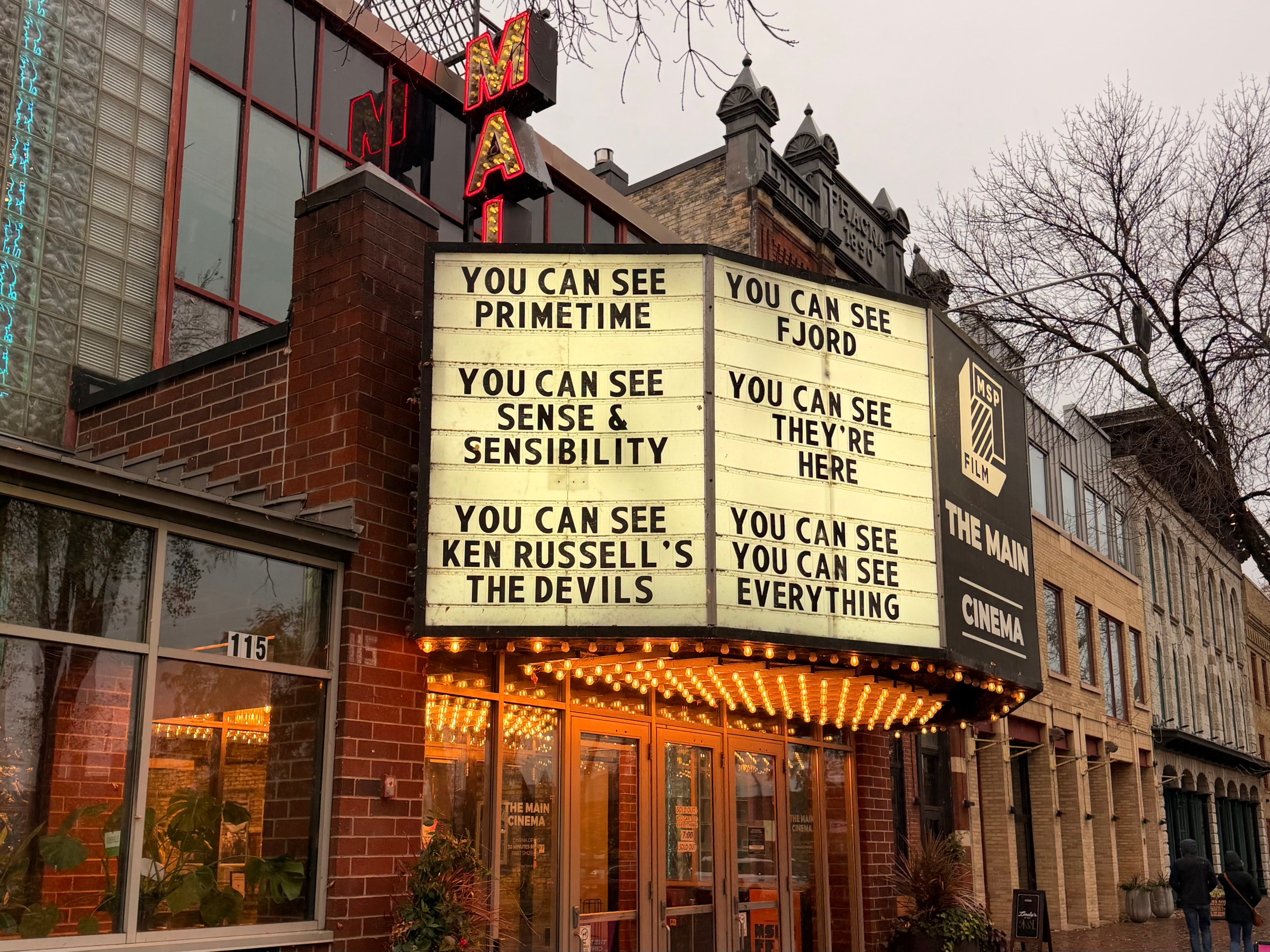
Matt Johnson cashes in the cred he earned with his 2023 film Blackberry to turn his ‘00s cult web series with Jay McCarrol into perhaps the most relentlessly Canadian hit comedy movie since Strange Brew. The two jokesters play their fictionalized selves, with Matt devising increasingly desperate plans to score their musical duo a gig at a Toronto rock club as Jay grudgingly goes along. When Matt invents a time machine, the fellas find themselves back in 2008 (when their show first streamed), and the trail of period clues leading to the moment when Matt realizes he’s not in 2025 anymore are perfect. As time travelers will do, Matt and Jay soon foul up the time line by interacting with their former selves and must undergo a series of hilarious convolutions to set things right. The Main was a-hootin’ when I saw this, with a guy behind me shouting “Oh no! OH NO!” in anticipation of one gag. (Though there was no reaction quite like the theater-wide groan when a certain music vlogger appeared on screen.) But the movie’s heart is its investment in Toronto as a place, evident as Matt and Jay interact with ordinary Torontonians and tourists and leading to climactic gag that involves the CN Tower, miles of electrical cord, and a police chase. You think studios will take the hint and start green-lighting more low-budget romps like this from funny weirdos? Nah, me either. B+
No Other Choice
Park Chan-wook sure knows how to end a damn movie—if at any point you find the macabre comedy of No Other Choice a bit unfocused, rest assured that it will end with as much bleak finality as Decision to Leave, though on a far less romantic note of doom. We begin with handsome paper-factory manager Man-Su (Squid Game album Lee Byung-hun) outside his gorgeous home, grilling eel to celebrate his pretty wife Mi-ri’s (Son Ye-jin) birthday. As they huddle together with daughter and son, and their two dogs dart between their legs in the lovely autumn light, you just know an ax is gonna fall. Sure enough, the new American owners toss Man-Su out on his ear, forcing him to endure a patronizing session where the newly unemployed are coached to chant that their firing is not their fault. But masculinity doesn’t untangle that easily. Battling guilt, jealousy, alcoholism, pride, and sheer purposelessness as he fails to find a new job, Man-Su decides he must murder his competition. Unlike Park’s usual protagonists, though, Man-su has a hard time acclimating to murder. He’s not just squeamish and inept, he’s hobbled by empathy—he might be able to kill these guys, but he can’t stand to see their feelings hurt. Working with cinematographer Woo-hyung Kim, Park’s technique dazzles with acrobatic unpredictability here, with tricky dissolves that wash us nimbly between scenes and perspectives. And by the time Man-Su gets his final reward Park’s kill-or-be-killed metaphor has left all subtlety behind, as it damn well should. A-
Obsession
I’ll say this for the “must see” horror flick of the summer—you should probably see it. Which is more than I say about most of the lukewarm bloodbaths (some of them not even Oz Perkins’s fault) that are regularly touted as the best thing to happen to the screen since the chainsaw. Michael Johnston’s Bear is so hapless he can’t acknowledge his crush on pal/co-worker Nikki (Inde Navarrette) even when she asks him about it point blank. So, like so many doomed losers before him, he makes a magical wish for her love, an overturning of the natural order that goes wrong is ways both predictable and un-. Like any effective horror movie, there are all sorts of psychosexual subtexts you can tease out of this scenario—the (male) anxiety that true love is smothering, the (again male) desire to efface female personality—but though YouTube-weaned auteur Curry Barker has a genre-adept’s knack for pacing and execution, Obsession doesn’t have much conceptual play. But it also doesn’t give us the easy “slay girl” catharsis of, say, Companion, and what truly sets it apart is Navarrette’s committed performance of a woman trapped in a man’s fantasy. B+
The Odyssey—read full review here
What we tend to forget about The Odyssey is that it’s maybe 10% cool mythological shit like one-eyed giant cannibals and sinister witches and gods punishing impudent mortals and like 90% about exchanging gifts with your hosts and telling very long stories to impress them. What’s remarkable about Christopher Nolan’s The Odyssey is that it honors this aspect of the epic while delivering the supernatural adventure film moviegoers want. Yet as always, Nolan is so transparent in his ideology you can almost believe he’s making an argument, when like any storyteller he’s just using fiction to justify his beliefs. Which, as always, is that we are always one well-told tale away from chaos. Whether the gods are real or not, warns the David Brooks of the cineplex, if we don’t honor them we will undermine the customs that hold our society together. Hey man, I just came here for the Cyclops. B+
One Night Only—read full review here
The misguided concept here is that the U.S. has banned premarital sex except for one night of the year (uh… ha ha ha?), but “The Purge meets-cute with The Lobster” isn’t even a good idea in theory. When the big night rolls around, Owen (Callum Turner) learns that his girlfriend (Maya Hawke) would rather experiment with their hunky neighbor. As he dejectedly searches for a substitute partner, he repeatedly bumps into Allie (Monica Barbero), who stiff-arms him because she’s determined to find true love. At times, One Night Only seems to have been made as court-ordered punishment (blink twice if you’re in danger, Monica). At others—particularly the finale, which pretends to be a meaningful riff off An Affair to Remember—Gluck and co. clearly think they’re on to something clever. And yet, One Night Only does accurately capture our own cinematic dystopian present. First off, it’s all titillation, dangling two hotties in various states of undress for us to gawk at as they endlessly talk about sex (and not in a fun, French art-film kinda way) instead of just, you know, doing it. Then there’s the excessive stunt casting and indulgence in celebrity in-jokes and its New York City overrun with brands like Durex, Buck Mason, Dunkin Donuts, Duolingo, and CitiBike. It’s not a spoiler to say that Owen and Allie wind up together (you can’t spoil something that’s never been fresh) or that they’re forced to wait another year to consummate their relationship. But I wonder if anyone involved here even realizes that this happy ending is essentially an argument for state-sponsored celibacy. C-
The Only Living Pickpocket in New York
They don’t make ‘em like this anymore, as writer/director Noah Segan takes ostentatious pains to remind us throughout the nonetheless endearing character study. John Turturro is the titular thief, an easygoing Bronx elder who cares attentively for his comatose wife, plies his trade while causing as few waves as he can, and smooths over any rough patches by slipping you a few high-denomination bills. But then he robs the wrong target (a highly connected jerkoff played to the douchey hilt by Will Price) and, well, you know how that goes. Hey, did you know that New York is the greatest city in the world? And did you know it used to be so much better? From its thirdhand soundtrack funk score to its broad borough-by-borough characterizations to its cute oldguyisms (they say “Esty” for “Etsy” etc.), this movie lays it on t-h-i-c-k. Is there Steve Buscemi? You know it, bud. But Turturro’s presence holds it together; he’s just one our greatest onscreen hangs, somehow a more calming presence the more evidently he’s masking his melancholy. And I can’t help but cherish the moments of screentime he shares with Giancarlo Esposito, who plays his onetime foe and now ally in the police department. You really expect me not feel a certain way at the sight of an aged Buggin’ Out and Pino Frangione seated calmly side by side on a subway? B
Pillion
Who says BDSM can’t be romantic? In Harry Lighton’s directorial debut, Harry Melling is Colin, a meek little gay fella who sings in a barbershop quartet at the local with his dad while his dying mom tries to fix him up with someone nice before she passes. Enter the opposite of her hopes and dreams: an impossibly chiseled Alexander Skarsgård as a biker named Ray. Under Ray’s laconic tutelage, Colin dives happily into his new submissive leather ‘n’ chains lifestyle, and the first half of Pillion is both warmly affectionate and flat-out hilarious. It loses its way for a bit in the midsection until Colin starts quietly asserting himself, hoping to get to know the Ray behind his dom exterior. The result is a crowdpleaser that doesn’t untangle its kink. If only it had opened here on Valentine’s Day weekend like it did in so many other cities. A-
The Plague
AITA for wanting to punch a 12-year-old boy in the face? That’s a question I asked myself during The Plague, Charlie Polinger’s smart directorial debut about a nasty and yet ordinary set of bullies at a water polo camp. Sweet little Ben (Everett Blunck), whose family is new to town, just wants to fit in, but that means ostracizing nerdy Eli (Kenny Rasmussen). The other boys say Eli’s rash is a symptom of The Plague, a disease which wavers in their minds somewhere uncertain between joke and truth, tending toward the latter whenever they get scared. Because Polinger maintains a kid’s eye view, he can capture the complicated group dynamics of bullying, detailed quirks of adolescent insecurity and sexuality, and the ineffectual interventions of grownups. (“That is the most depressing pep talk ever,” Ben tells the camp leader, played by Joel Edgerton, after a convoluted “it gets better” speech.) There’s something about the relentlessness of The Plague that feels a bit off to me—adolescent boys can be monsters, but that’s not all they can be. And setting The Plague at a water polo camp makes me consider the old line that The Lord of the Flies is less a look into the human capacity for evil than an indictment of the British public school system. Still, The Plague is craftily unsettling for anyone who’s ever been a tween boy, cared about a tween boy, or had eczema. Oh, and the punchable face belongs to skateboarder Kayo Martin, who plays the boys’ ringleader Jake with such shifty, credible malice I can’t tell if he’s a natural actor or just naturally hateable. B+
Possible Love
Mi-ok and Sang-woo meet cute. Sort of. After she drops her wedding ring in the dark outside of a funeral, he gallantly flips on the headlights of his Porsche to find it. He’s tall, handsome, rich, and married to Ye-ji, a pretty, stylish documentarian who’s in town making a film about the aftermath of an industrial plant’s layoffs two years earlier. Mi-ok’s husband, the taciturn, haunted Ho-seok soon catches the filmmaker’s eye—he’s the subject her doc needs, she senses. Ye-ji befriends Mi-ok after the laborer’s wife proves a surprisingly articulate interview, and soon the two couples are awkwardly socializing across the class divide, until Mi-ok and Ye-ji become intimate with each other’s husbands in unexpected ways. And everything that the camera doesn’t surveil is peeped by 10-year-old Cheol, Mi-ok and Ho-seok’s son, whose unspoken anxieties manifest in a twitchy nose and a reluctance to participate in taekwondo. Writer/director Lee Chang-dong’s brilliant study of class in Korean society, the ethics of telling someone else’s story, the complex ways labor shapes our identities, and the varieties of marital love is nuanced at times, but also willing to be obvious, as though to remind us that life isn’t always subtle. As Ye-ji, Cho Yeo-jeong (the rich mom in “Parasite”) is a case study in the limits of good intentions, Zo In-sung’s Sang-woo is the sort of privileged guy who’s charming as long as he’s getting his way, and Sul Kyung-gu draws us into Ho-seok’s dark moods without striking a false note. But the film belongs to Jeon Do-yeon, the star of Lee’s Secret Sunshine (2007). As Mi-ok, she’s unexpectedly enlivened by Ye-ji’s camera, witty enough to cover up an embarrassing revelation with a blithe aphorism like “This is like a house from a novel I haven’t read,” savvy enough to recognize the limitations of her new friendship. You want a pull quote? “As insightful about the power dynamics of documentary filmmaking as You Can See Everything, more astute about the mechanics of desire between two couples than The Invite, and eight full minutes shorter than The Odyssey.” A
Power Ballad
Paul Rudd is Rick Power, a never-was turned wedding-band singer in Ireland. Nick Jonas is Danny Wilson, an erstwhile boy-bander desperate to reach the next stage in his career. The two bond over one boozy night of jamming and co-writing and part on good terms; a while later Rick hears Danny singing his song—a career-reviving smash hit—over loudspeakers in a mall and it’s on. Writer/director John Carney is the kind of sentimentalist who prizes moments of connection over happy endings, and the early scenes are warm and believable, but Power Ballad loses its way amid Rick’s search for validation and Danny’s degeneration into a two-dimensional villain. I do believe the song (written by Carney collaborator Gary Clark, who was once—heh heh—in a pop band called Danny Wilson) could be a hit, but I don’t mean that as a compliment. After all, Carney is the same guy who spent a whole film trying to convince me that Glen Hansard was a great songwriter. And the more I think about it, the more it bothers me that this is about a guy named Power who writes a ballad. Anyway, the most interesting character here is Power’s teen daughter Aja (a perfect little in-joke of a name), who tells her dad, “Women don’t want love songs anymore.” He: “What do they want?” She: “Revenge.” B-
Primetime
If you were born too late to experience the ass-end of the Bush era, Lance Oppenheimer presents the grubby sanctimony of 2006 in all its garish, digitally green-tinted horror for you. In this maybe too engaging dark comedy about one of that moment’s most telling cultural artifacts, NBC’s Chris Hansen (Robert Pattinson, rehearsing for Batman or maybe auditioning for Ahab) creates a national phenomenon by luring online creeps in front of the TV camera with the promise of hooking up with minors. Yet this is not really a story best told from within—Hansen’s troubled marriage and professional ambitions are of limited interest, and David Osit’s smart 2025 doc Predator is much better at tracing the legacy of To Catch a Predator. Not only does god write lousy theater, but he inspires screenwriter Ajon Singh to overcompensate for his divine sloppiness with too-tautly structured character arcs, so Merritt Wever’s Nicorette-chomping producer Andie Bender ponders whether she should jump ship to NBC and Skyler Gisondo’s twinky decoy Dan Plum strives to balance his thespian ideals against his tawdry job. And while I appreciate that Primetime assumes we all retrospectively view this once-celebrated bottom-feeder phenomenon as a grotesque relic, its strengths (especially Pattison’s magnetic performance) are more parodic than insightful. Is it really that much less scummy to snicker at these crass vigilantes than it was for TV viewers to cheer for the downfall of the creeps Hansen and his crew entrapped? B
Project Hail Mary
Anyone who has a heart will love this adorably techno-optimistic film about Ryan Gosling buddying up with an intelligent alien who looks like a rock as they save the galaxy together. I guess so, anyway—I’m extrapolating from the fact that even a soulless monster like me thought it was pretty cute. Interstellar parasites are gobbling up the stars, including our sun, and as will happen when the Earth is in danger, only a middle school science teacher can save the day. Ryland Grace (which sounds like a name Gosling would give if he wanted to check into a hotel in secret) is recruited by a grim German bureaucrat (the great Sandra Hüller, who deserves all the Hollywood blockbuster cash that comes her way) to research these solar gluttons. His insights prove so invaluable he’s sent on a suicide mission to the only star that’s proven impervious to the baddies to learn how to counteract them. There he meets an alien scientist on the same quest for his own world, who he dubs Rocky, and both species work together to etc. etc. as their unique friendship and so on and so forths. Drew Goddard’s script, adapted from the much-loved Andy Weir novel, has the same plucky scientific spirit as Goddard’s script of Weir’s The Martian, and Gosling remains likeable as ever, though I do wish he’d find some new ways to be likeable. The pleased laughter all around me at the screening was so delightful I felt left out a little. Maybe someday when the wizard grants me a heart I’ll give this another go. B
Resident Evil
If video game movies we must have (not like we get to decide) better this gory schlock slapstick than the klutz existentialism of the tedious Exit 8. (Both share a plot point—pregnant girlfriend—if that means anything.) Zach Cregger keeps it simpler here than in Barbarian or Weapons, which means Resident Evil is a little dumber than those (derogatory) but also means Resident Evil is a little dumber than those (complimentary). Austin Abrams (the addict from Weapons) is our dumbass hero, a driver dispatched with a high-priority delivery to the hospital in snowy Raccoon City. His cargo, I sincerely hope you won’t be astounded to learn, is the crucial ingredient needed to synthesize an antidote to a man-made contagion sweeping the land. Symptoms typically include zombie catatonia, grasping tentacles, and blob-like absorption of other humans, but there are also acid-puking ghoulies and one tubby fella with an exploding, critter-infested gut. The script could occasionally try a tiny bit harder (how much Abrams muttering “fuck” do we need?) but in a world of forced MCU quippery that’s a venial sin. And in keeping with the source material, the stakes are both enormous (the end of the world!) and virtually negligible (game over). B
Rose of Nevada
Of all the young guys in movies these days who look like Callum Turner and George McKay, Callum Turner and George McKay are two of the better ones. Director Mark Jenkin had a promising if narrative-averse breakthrough in 2022 with the folk horror tone poem Enys Men. And the setup here—two young men sail on a cursed Cornish fishing boat that transports them back in time—isn’t just intriguing, but makes for a solid metaphor of how dying towns survive on the backs of the youth who remain behind. But excuse me if Rose of Nevada is a little too vibes-first for Mr. What Happens Next? here. Once the two men develop opposing reactions to their fate—Turner’s Liam sees this as an opportunity to become the family man he never was, while McKay misses his present-day family and is desperate to return—we’ve learned about all we’re going to from these characters. All that remains to be experienced is atmospherics, film presence, spooky tension, and storms at sea. Which ain’t nothing. B
The Samurai and the Prisoner
Despite his surname, Kiyoshi Kurosawa is not the sort of fella you’d expect to assay a historical drama—psychological horror is his beat. But the period setting, swordmanship, and concerns with archaic codes of honor here don’t keep The Samurai and the Prisoner from sitting comfortably within the director’s oeuvre. In the 16th century, the rebellious Araki Murashige (Masahiro Motoki) is walled off within his castle, besieged by the warlord Oda. After he endungeons Oda’s emissary, the cunning Kuroda Kanbei (Masaki Suda), Murashige is forced to investigate a series of strange crimes on his grounds. As he slowly traces the traitor within his circle, matters are complicated by the lord’s aversion to bloodshed, which strikes many of his allegiants as dishonorable. Now in his 70s, Kurosawa may be straining a bit in the service of something monumental—the pacing is doggedly unrushed, bordering occasionally on sluggish. But the framing is impeccable, Motoki and Suda are subtle and compelling as the strategically dueling title characters, and the film takes on the shape of a fable, its moral underlined by a slightly twisty and abrupt ending. B+
Scarlet
Damn, Hamlet is everywhere these days. In this Japanese revision, the vengeful prince is a princess named Scarlet, who no sooner confronts her murderous uncle than she awakens in the Otherworld, the land of the dead. Its a desolate place where bandits rule and a silent dragon emerges from the sky occasionally to reduce the dead to nothingness with an electrical storm. Here she’s aided and annoyed by a 21st century medic who can’t understand why her thoughts be bloody. Though Scarlet may be melancholy, she hardly dithers like Shakespeare’s hero—her tragic flaw is that she’s too vengeful, and the real question isn’t whether she’ll have her revenge, but whether she’ll let her rage destroy her. As is often the case with writer and animator Mamoru Hosoda, best known for The Girl Who Leapt Through Time and Summer Wars, the spectacle here can overpower the story. But that doesn’t trip Scarlet up because spectacle is what Hosoda’s after—an animated take on the traditional Hollywood epic, filled with epic battles and pulsing crowds. A-
Send Help
Sam Raimi the schlock lover and gross-out king is back, and he hasn’t had this much fun since Drag Her to Hell—there are moments of eyeball-gouging here worth the price of admission alone. Rachel McAdams is nerdy office worker Linda, a spreadsheet wiz who’s been screwed over by her new boss, fratty nepo baby Bradley (Dylan O’Brien). En route to a Thailand business meeting, their plane crashes (an understatement—Raimi gleefully rips apart the aircraft and its occupants), with only Linda and Bradley surviving. Naturally, Linda, a Survivor fanatic, thrives in their new island home, while Bradley struggles. If that makes Send Help sound like a late entry in the eat-the-rich movie trend of a few years back, well, kinda, yes, but Raimi is less overwrought and, well, European about class conflict. McAdams is an underutilized comic actress who deserves more roles like this and O’Brien builds off his success in last year’s Twinless—if modern Hollywood wasn’t so inherently tedious he’d have Glen Powell’s career, though selfishly I’d rather have him making the movies he does. (It’s also the second movie in a row where he shows his butt.) Send Help is the best kind of horror comedy, where rather than fearing what awful thing might come next, you look forward to it. What you might dread instead is that the movie could stumble into opposites-attract territory, with Linda and Bradley learning a little something about each other and finding l-u-v. Rest easy. Raimi didn’t save up all his Dr. Strange money just to piss it away on a romcom. A-
Sense and Sensibility
We can debate our preferred Pride and Prejudice or wonder why no Emma has surpassed Clueless, but for most people Ang Lee’s 1995 film is Sense and Sensibility. Director Georgia Oakley’s damp, darkened, lived-in Jane Austen faces this challenge head-on—perhaps too deliberately—battling our memories of sun-dappled landscapes and cute bonnets with a lowkey naturalism. Tossed out of their home by an elder half-brother after their father’s death, the Dashwood sisters set about finding husbands, as Austen heroines must do. The elder Elinor (Daisy Edgar-Jones) is constrained in her relations with her beloved Edward (George Mackay, putting his woodenness to good use) by her good sense, while a romantic sensibility allows the younger Marianne (Esmé Creed-Miles) to be swept away by the dashing Willoughby (a suitably caddish Frank Dillane). Edgar-Jones has a face made for period pieces, but there’s something inappropriately waifish and younger sisterly about her Elinor, and she struggles to achieve an outward representation of her propriety. Creed-Miles fares better, in part because Oakley favors her sensibility to Elinor’s sense—I often felt the director might prefer to be mucking around in something a little more Brontëan. In fact, this affair can feel unduly heavy when Fiona Shaw’s Mrs. Jennings isn’t around to liven things up, but we do get a real warmth between the sisters, and the two dance scenes are such standouts Oakley really should do a musical next. In short, no one gets in the way of the source material, and the film gets the job done. After all, how many truly terrible Austen adaptations that don’t star Dakota Johnson are there? B
Silent Friend
Look folks, this is a two-and-a-half-hour movie about a solitary ginkgo tree and its effects on three different people at three different moments in time. (Whispering to my date: That’s the Silent Friend.) I will refrain from calling the movie “meditative” because too many reviewers already have, and the adrenaline junkies among you know what that critic’s euphemism really means. But I’m the guy writing the review here, and I was engrossed in Hungarian writer/director Ildikó Enyedi’s essay of sorts on the interrelationship between humans and their natural environment, a milder exploration of some of the same themes as Richard Powers’s novel The Overstory. Tony Leung Chiu-wai (in a role written explicitly for him) is a Hong Kong professor marooned at a solitary German university during Covid. Luna Wedler becomes that university’s first female student at the turn of the 20th century, and she explores her sexuality by studying photography. Enzo Brumm is a first-gen university student, just off the farm, studying poetry and out of step with the free-living ’70s, who falls for a botanist and winds up caring for her geranium while she’s off hiking with her latest lover. Each is an outsider in some way, each suffers from loneliness and detachment while exploring new ways of connection, each illustrates the blurred lines behind human technology and natural systems of. And Leung’s presence, already indelible in Wong Kar-Wai’s films decades ago, has only deepened with age. A-
The Social Reckoning
As both fans and foes are aware, Aaron Sorkin has two modes of dialogue, and The Social Reckoning overindulges in each. In 2019-20, Facebook whistleblower Frances Haugen (Mikey Madison) and WSJ muckraker Jeff Horwitz (Jeremy Allen White), while building a case against the social media company’s corrosive effects, banter in rat-a-tat faux screwballisms that confuse velocity and wit. (I'm guessing Horwitz's supposedly amusing/charming inability to use basic tech will just remind anyone under 50 of their boss who doesn't know how to open a PDF.) A year later, Jeremy Strong’s stiff-necked Mark Zuckerberg and Bill Burr’s “Charlie,” a mythical colleague turned gadfly, hurl tiresome paragraphs of pontification at one another about whether Facebook should better moderate its content until—spoiler for anyone who’s slept through the past decade—Janu-anu-anuary 6, 2021. Because The Social Network was too “your weird Boomer uncles explain the internet” for me, I don’t consider this flat-footed sorta-sequel a desecration, though David Fincher’s sense of style is missed. If Jesse Eisenberg played Zuckerberg like Jesse Eisenberg, Strong plays him like Strong, and while the former was more entertaining, at least the latter doesn’t ask for our sympathy. In fact, mediocre as it is, The Social Reckoning might have a positive effect. I’m assuming plenty of Aaron Sorkin fans also spend an inordinate percentage of their golden years sharing angry liberal memes on Facebook, and if nothing else, this film makes you hate Facebook passionately. So maybe some of them will quit in disgust? A boy can dream. C+
Spider-Man: Brand New Day
Look, we all know what’s wrong with the MCU. Too long, too constructed to promote future installments, just plain too familiar. But I’m not here to relitigate all that. I’m here to tell people who might be in the mood for a Spider-Man movie whether they should see this Spider-Man movie, and my answer is a resounding “Uh, sure.” It is the one currently in theaters, after all, and it’s downright sleek compared to the Spider-Man: No Way Home, which was overstuffed with Spiders-Men, supervillains, and multiverse nonsense. Peter Parker’s existence (Tom Holland) has been magicked away from everyone’s memory, and as he watches his once-gf MJ (Zendaya) and once-bff Ned (Jacob Batalon) live blissful Peter-free lives at MIT, he throws himself into his work. He debates attempting to reintroduce himself while tracking a mysterious entity that leaps from body to body in search of some government secret and dealing with some freakily increasing spidery tendencies. Along the way, he encounters Florence Pugh’s Black Widow (says “potatoes” amusingly), Mark Ruffalo’s Hulk (bigger than ever), (a little too much of) Jon Berenthal’s Punisher, and, of course, Sadie Sink, who plays Jean Grey with an intense school-shooter vibe. Because this is Spider-Man, the fights are less monotonous than the MCU norm, though I was a bit fatigued by the time we got to the climatic battle with the evil ninjas. And as for future installments, I’m sure the device Peter invents that inhibits superpowers won’t be used against the good guys in future films. B
The Stranger
"Great butts" may not be a comment you’d expect to hear about a Camus adaptation, but it’s hardly the first time I’ve made it about a François Ozon film. The libertine French director’s Meursault is Benjamin Voisin, who made his mark in Ozon’s Summer of 85 and then held his own at the center of the 2021 Balzac adaptation Lost Illusions. Voisin has the look of a lippy sensualist, whether he’s enduring his mother’s funeral, distractedly fucking the woman who inexplicably adores him, or sealing his fate by shooting an Arab. In other words, he seems impeccably French in attitude and style, as does the film itself, shot as it is in a stylized black and white by cinematographer Manu DacosseI—Dennis Levant even shows up to do his weird-little-guy act. And if the film’s requisite 21st century postcolonial framing can feel a little studied, so can the novel’s postwar absurdism, non? (Another sign of the times: When I typed “Is Meursault” and Google completed “autistic” before I got it—apparently there’s a whole literature on the question.) A-
Teenage Sex and Death at Camp Miasma
Jane Schoenbrun’s latest had me hooked before the end of the opening credits sequence, which guides us through the cultural impact of an imaginary slasher series, right down to a fake New Yorker cartoon. Trash connoisseurs tend to be polemicists for their own niche fetishes—boys with toys and a rulebook for playing with them—but Schoenbrun is more intrigued with how pop culture psychologically embeds itself within our identities. They’re also, refreshingly, less respectful of their source material, and happy to indulge in fountains of blood, incongruous needle drops, and a willingness to cringe at the film’s tendency to wink at us. Here Hannah Einbinder is Kris, an indie director fluent in gender-ese and the theoretics of desire who has a shot to resurrect the played-out Camp Miasma series, centered on the unkillable, lake-dwelling trans serial murderer Little Death (Jack Haven). During a trip to recruit the reclusive star of the original installment, Billy Pressley (Gillian Anderson), for the new film, Kris must confront her own trashy sexual fantasies, and I gotta say, it gets pretty hot. Where Shoenburn’s moody, neon-saturated I Saw the TV Glow floated the idea of pop obsession as a fraught portal to self-awareness, this gloriously garish meta-slasher more simply encourages us to learn to revel in the tawdriness of our own unchosen, mass culturally imprinted desires. The leads are perfectly chosen, with a resonance for certain audiences beyond these roles, and the supporting cast balances avatars of contemporary cool like Eva Victor and Sarah Sherman with recognizable character actors like Dylan Baker and the unmistakably Lynchian Patrick Fischler. We’re offered plenty to ponder about the gaze (and, I suppose, the gays), and Teenage Sex may wax a little too therapeutic and, well, polemical in the homestretch. But it’ll take a second viewing for me to care about all that, ‘cause I was preoccupied laughing as hard as the theater of delighted 20-somethings around me. That’s the thing: This works first as entertainment, and also as a tale of sexual bonding that doesn't quite reduce to a love story. Lowering its stakes even as it ratchets up the tension, Teenage Sex is surprisingly tender for a movie that ends with its stars bloodier than Sissy Spacek at the prom. A-
Tony
A portrait of the artist as a young fraud. Looking like all of the Strokes rolled into one, Dominic Sessa plays Anthony “Call Me Tony” Bourdain as an intense, pretentious kid who confidentially mispronounces “bildungsroman,” slouches as though he’s perpetually passing through a low door frame only he can see, and lies as reflexively as only someone who hasn’t yet figured out who he is can. When his crush (Emilia Jones) heads to Cape Cod for the summer, the tousled lad stalks after her, pretending he won a writing fellowship while washing dishes at a touristy seafood joint. Tony succeeds because it’s less a biopic than a coming-of-age story, with the young Bourdain forced to choose between the devil on one shoulder (Leo Woodall’s hard-drinkin’, tail-chasin’, smack-shootin’, bar-fightin’ Sal) and the angel on the other (the restaurant’s somber, devout, and meticulous chef, played by Antonio Banderas). It falters because the choice that kept him alive and set him on his path is, well, just less fun to watch. Sessa has the charisma to play the young Bourdain (even if he’s just a few clicks away from his turn in The Holdovers—what happens when he has to play a 21st century adult?) and I’ve come to savor Banderas’s late career, in which he underplays as dramatically as he once overheated during the peak of his Hollywood stardom. B+
Two Prosecutors
The law moves slowly, they say, but not nearly as slowly as the latest from Ukrainian director Sergei Loznitsa. Across a series of prolonged scenes, a young, idealistic prosecutor in the 1930s Soviet Union (Aleksandr Kuznetsov) uncovers the false imprisonment and torture of an upstanding Party member by the secret police and decides to bring it to the attention of the higher ups. Loznitsa captures the banality of totalitarianism, with lots of waiting around for meetings and chummy backslapping as each authority figure humors our naive hero along the way. We humor him as well, knowing as we do that everything the prosecutor disdains is according to Stalin’s design. The conclusion, which splits the difference between tragic inevitability and delayed predictability, doesn’t shock, but does satisfy in its grim way. B+
Verity
“I can’t tell if you’re just very calm or you’re in shock,” Josh Hartnett’s Jeremy Crawford says to Dakota Johnson’s Lowen Ashleigh as she mops blood off her face following a grisly traffic accident, and who among us hasn’t wondered the same about a Dakota Johnson character before? (Lowen later admits, “I have resting bored face.” We get it, girl. You can’t act.) In this eye-roll of a Colleen Hoover adaptation, Lowen, a struggling novelist, has been recruited to finish the work of best-selling author Verity Crawford (Anne Hathaway), who has been rendered mute and immobile by an accident (OR HAS SHE?) Lowen stays with the Crawfords in their fancy Vermont home while working on the book. Lowen discovers a SECRET JOURNAL wherein Verity confesses to CRIMES! (OR DOES SHE?) Lowen masturbates in a tub. Lowen repeatedly says “wow” in that dopey, unphased way we’ve come to expect/dread from Johnson. While I’d blame Hoover for the plot, which would have gotten her laughed out of the 19th century by bona fide Gothic credibility-stretchers, Michael Showalter’s diffident direction, which aspires to no stylistic flair at all, is the real culprit—it’s like he’s trying to keep this dumb thing on the rails, which takes misunderstanding the assignment to all new levels of incomprehension. And now, if you’ll promise to believe me when I say there’s little or nothing more where this comes from, I’ll leave you with the only good line in the movie: “You deserve to rock in your sad little robot bed, you selfish Machiavellian cunt.” C-
Wild Horse Nine
It’s 1973 and a rheumy, cadaverous, yet jaunty skull of a man, dressed gaudy and inescapably American, taunts two pretty young Chilean leftists in an airport, predicting the worst for their beloved new Marxist president. Later in the film, Chris Carlisle (John Malkovich) will share even grimmer visions of Salvador Allende’s fate—he’s a CIA lifer who helped take out Lumumba in the DRC and Árbenz in Guatemala before that, even JFK back home, and he knows how this shit plays out. In addition to blurting out coup details, Chris is also increasingly forgetful and working on a tell-all memoir, upsetting his boss (Steve Buscemi again, looking here like a stateside Gary Oldman), and his partner/buddy Lee (Sam Rockwell, squinting in a My Name Is Earl daze and saying “fuck” a lot). Chris and Lee travel to “Easter Island” to see “the big heads”—or rather, Rapa Nui to see the Moai, as the culturally sensitive keep reminding them—bantering for banter’s sake all the while. So yeah, it’s a Martin McDonagh movie, convinced as ever that the more men obfuscate through digression and anecdote and overall verbal irrelevancies the more they reveal about their relationships with each other. But though Malkovich gives it his all, this time I’m not so sure. For starters, fuck the CIA. We’ve all fallen for onscreen scumbags in the past, but McDonagh forgets to make these guys intriguing enough that we overlook how reprehensible they are. It’s like he thinks that the fact that they’re speaking the lines he wrote for them is enough to make us care. Like hell it is. Rapa Nui does look gorgeous though. B-
You Can See Everything
Do Nathan Fielder and Lance Oppenheim provide insight into the opaque mens rea of luminous fraudster Elizabeth Holmes? Does their film “speak … uncannily to the pathos and destabilizing confusions of the present moment”? Is it “a secret history of the tech industry”? To quote the great philosopher Lou Costello, “I! DON’T! KNOW!” Before it’s timely or significant or groundbreaking or whatever superlative you want to hurl, You Can See Everything is fun, challenging us to keep our psychological balance as we’re consistently wrongfooted. Like all documentaries, You Can See Everything strives for a narrative that approximates the truth. And like all fiction,You Can See Everything revels in the pleasure of being duped. (We’re not the first moderns to endure an epistemic crisis, after all; let’s hope we’re not the last.) Yet it feels uniquely of its moment, in the way a great horror flick reflects our most persistent fears in titillating ways. Fielder (or “Fielder”) plays the skeptic or dupe as the story requires, his increasing obsession with what Holmes is “really” thinking a synecdoche for our collective fascination with the unknowable about celebrities. Here’s proof that you can have a real-world parasocial relationship, and for once I understand the pleasure that rubberneckers must derive from true-crime podcasts. Fielder is Odysseus strapped to the mast as he sails past the sirens, taking a long gaze into an abyss that stares back into him with impossibly enormous blue irises, and he learns nothing—except maybe that you can never trust a guy who consumes YouTube at 2x speed. But you already knew that, right? A
Your Mother Your Mother Your Mother
It’s a surefire plot: a big tough guy is tasked with caring for an infant. Yet Mahershala Ali and director Bassam Tariq, reuniting after fleeing Disney’s fumbled Blade reboot, don’t play this dilemma for laughs. Ali’s Latif is a devout Muslim and a hitman who has struck a fragile ethical balance that allows him to reconcile these roles. When his wife dies, and the refrigerated breast milk is gone, Latif frantically searches for a way to feed his formula-allergic infant, while also caring for a teen daughter (terrific newcomer Adia) with a nascent furry streak (“That squirrel porn nonsense is clouding your heart,” he tells her) and a son (Jahleel Kamara) who’s developing an unsettling taste for first-person shooters and Rambo movies. To top it off, Latif is tasked with protecting his boss’s skeevy, worthless son (a thoroughly reprehensible Abubakr Ali) from a self-righteous Christian cult leader (John Cho, with a grill) who suspects the sleazeball of child trafficking. Latif considers himself a protector, but as his job increasingly endangers his family, he doubts his uprightness. DP Katelin Arizmendi exploits the film’s digital sheen, moving us through a grimy Houston and brilliantly capturing the varied palettes of Black faces with extreme close ups. And Your Mother Your Mother Your Mother is the rare American film that takes faith seriously. Most that pretend to (Angel Studios schlock, say) fashion it into a sentimental weapon of self-righteousness, but the world of Latif’s mosque feels like a real place filled with real people. Oh, and the action scenes do kick ass. A-