



What we tend to forget about The Odyssey is that it’s maybe 10% cool mythological shit like one-eyed giant cannibals and sinister witches and gods punishing impudent mortals and like 90% about exchanging gifts with your hosts and telling very long stories to impress them. What’s remarkable about Christopher Nolan’s The Odyssey (I’ll get to its vexing flaws soon enough) is that it honors this aspect of the epic while delivering the supernatural adventure film moviegoers want.
At the core of both Homer’s and Nolan’s Odyssey is the concept of xenia, the established ancient Greek custom of welcoming strangers, spoken of in the film as “Zeus’s law.” This is the story of a guy (Matt Damon, plenty grizzled and glum, and we’ll get to that too) who keeps showing up in strange places hoping the inhabitants will honor these hallowed norms rather than munching on his crew. Back home in Ithaca, a horde of loutish suitors has overrun our absent hero’s palace, testing the acceptable boundaries of “guest” while angling to get with his wife (an imperious Anne Hathaway), taunting his kid (a twerpy Tom Holland), and even kicking his dog (not cool, Polybus).
Nolan is for sure a “themes” guy, and The Odyssey is like a greatest hits of his faves. Ithaca is a Bronze Age Gotham City, in need of a hero to set it right. Like Leo DiCaprio’s Cobb in Inception, Odysseus is a guilt-ridden schemer, brooding over what we owe the dead, who finds it easier to live in dreams (i.e., the lotus-fueled amnesia bestowed by the nymph Calypso). And the Trojan horse is our hero’s A-bomb, the sacking of Troy his Hiroshima. Odysseus has become Death, the destroyer of Troy, the latest protagonist through which our fussiest small-c conservative auteur channels his own obsession with order.
Ten years after the fall of Troy, the exploits of Odysseus are already the stuff of legends, intoned in the royal halls of Ithaca (by Travis Scott, because Nolan is one of those cool teachers who wants you to know that oral poetry is really like rap, did you ever think of that?) When Scott’s bard opens the film by singing of the Achaeans’ great victory, everyone is like, “Ugh, do we have to have to hear the story about the damn horse again?”
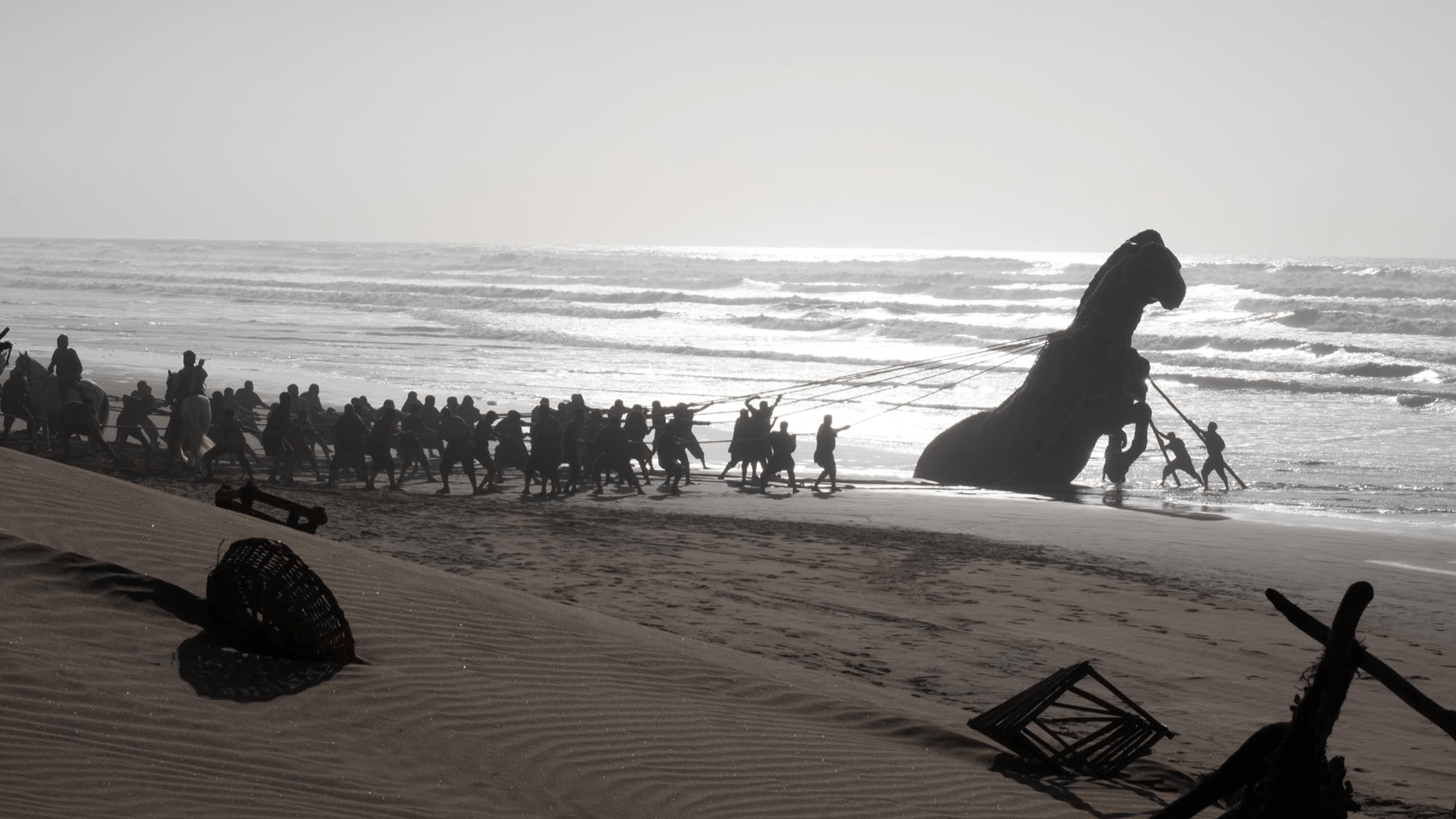
Then we see that majestic gift, half-buried in the sands, soon to be discovered by a galloping Trojan army patrol. Later we’ll witness the squalor of the duplicitous and no doubt stinky Greeks smuggled within, but for now it’s a stark image that allows Nolan to establish his epic bona fides, just as the sea that Odysseus sails is truly wine-dark. Nolan spared no effort to make The Odyssey look like The Odyssey.
While family and foe alike muse over rumors of Odysseus’s fate (for as we’re told, “All we know of the world is traveler’s tales”), the hero himself only dimly recalls his adventures. Then, after seven years of clouding his past, Calypso (Charlize Theron, in a thankless role and looking kinda like Maria Bello) allows him to remember. Since Calypso barely touches Odysseus here, that must’ve been a long seven years. Anyone who hated the sex scene in Oppenheimer (I thought it was pretty funny myself) will be happy to learn that The Odyssey is remarkably chaste. In part, to be fair, because its lovers, Odysseus and Penelope, are separated by fate until the very end.
Yet if The Odyssey may occasionally offer itself as a love story, it’s as a horror movie that it excels, the biggest hint to its grotesquerie the Scarecrow scenes in Batman Begins. Stomping gigantical monsters, zombie armies rising out of Hell, transformative body horror—The Odyssey honors the fantastical elements with the innovative delight of an A24 wunderkind without ever going full Harryhausen.
Importantly, Nolan’s Odyssey operates in two different worlds, and Odysseus leaves behind the concrete world of kings, their fiefdoms, their wars, and their betrayals when he travels off course en route from Troy. He enters instead a supernatural realm populated by figures as lonely as they are wicked.
Operating a 60-foot puppet, the great Bill Irwin shows Andy Serkis how it’s done as Polyphemus the Cyclops, a creature solitary, pathetic, and deformed. As otherworldly a being as her Minority Report precog, Samantha Morton’s villainous Circe is a proto-Moreau whose isle is full of exotic creatures like lions and cheetahs that were once men. And the Hades that Odysseus visits to learn his fate is truly hellish, a blasted heath that Ludwig Göransson soundtracks with the sort of black whorling synths that Pitchfork’s Philip Sherburne would award Best New Music.
Even Nolan’s Laestrygonians, here demonic/robotic armored knights rather than man-eating creatures, slashing at boats with broad swords (first nerd with a “plate armor didn’t even exist then” gets a Batman slap) work cinematically. True, Scylla is a bit sketchy here, and the effects of Charybdis are scarier than its appearance, but even great Nolan nods.
Only a true rationalist like Nolan would call a world where Samantha Morton mauls and massages the maws and husks of men until they’re reduced to swine “a time of apparent magic,” as the opening placard does here. But The Odyssey embraces its hero’s skepticism. Though they’re mentioned plenty, with piety or defiance, the gods themselves may or may not exist in Nolan’s Odyssey. We get no scaly Poseidon or fleet Hermes or white-bearded Zeus. Even Athena (Zendaya, alternating between her serious face and her disappointed face) may just be Odysseus’s Mr. Snuffleupagus. (I won’t spoil it, but there is one very good god-related fake-out late in the film that had me nodding “Nice one, Chris.”)
That real world is where Nolan tries too hard, bestowing numerous speeches upon Telemachus and Penelope in an effort to create psychological depth, to little avail. Because she’s a true movie star, Hathaway holds her own as the second wife in a row not to die in a Nolan movie (three’s a trend), but as the outmatched prince, Holland is both typecast and miscast. This son of Odysseus is not unready but unworthy, with the raw material of a king wholly lacking. And while Robert Pattinson is charismatically oily as the suitor Antinous, the only interesting man in Ithaca, did he really need an added backstory to make him more villainous?
If the hallmark of great directors is how much they can get away with, Christopher Nolan is a very good director. Granted, some of my cavils are just personal taste, and I unfairly retained a fresh memory of Lawrence of Arabia in 70mm from the night before my Odyssey screening. But if you’re gonna make the kind of movies they just don’t make any more, you’ve gotta hold your own against the movies they used to make. Over three hours, the quibbles start to add up.
Ahem. Cinematographer Hoyte van Hoytema jostles the camera too much during fight scenes rather than letting the action do the work. Editor Jennifer Lamp too often overlays voiceover from a character in a previous scene onto a new setting when a crisp cut would feel more appropriate. And surely it would be more powerful not to introduce Odysseus in flashbacks before we see him in the present?
A bigger problem: The dialogue is as tin-eared as the trailer might have had you suspect. Nolan credits Emily Wilson’s excellent Homer translation for encouraging his colloquialism, but his writing feels less relaxed than lazy. There was always something phony about the Britishisms and faux classicism of the old-time Hollywood historical epic, but these techniques at least created a distance, a sense that we were entering a different world. Nolan finds no stylized replacement, and so we get Odysseus moaning “Ten years on this fucking beach. Let’s go home.”
As befits a cast-of-thousands epic, The Odyssey is overrun with familiar faces. John Leguizamo is the film’s soul as the loyal blind swineherd Eumaeus, while Mia Goth is perfect as the duplicitous slave Melantho. And as Sinon, who denounces Odysseus from hell, Elliot Page redeems a figure synonymous with treachery in Virgil and Dante in a scene that brought me as close to feeling something as I ever have during a Christopher Nolan film.
The cloddish bro whose inadequacy helped spark the whole 10-year slugfust? That’s Jon Bernthal's meatheaded Menelaus, clearly unworthy of Lupita Nyong'o’s noble Helen, who he has disfigured upon her recapture. Then again, we’re told reclaiming Helen was just a pretext for Agamemnon to open new trade routes. Seems that Odysseus is not the only crafty one among the Achaeans.
All but faceless in his black armor, Agamemnon himself is truly imposing on the battlefield, an effect slightly undercut when he later relates his tragic fate in the voice of Benny Safdie, much like Rick Moranis peeping out from underneath a Darth Vader helmet.
And then there’s Matt Damon. As Homer tells us often, Odysseus is wily. Concentrate on that word, close your eyes, and tell me if Matt Damon ever materializes. A quintessentially passive male movie star, Damon is a guy stuff happens to. Damon has been resourceful on screen—we all saw him MacGyver his way home from Mars. Yet when he has played a conniver, whether Colin Sullivan in The Departed or Tom Ripley, his outward sincerity has concealed his lies, a technique not available to him here.
I’m not sure who in the Nolanverse, which includes only 12 actors or so, could play the hero—Tom Hardy’s too modern and knowing, Christian Bale’s become a bore, no one would believe Cillian Murphy could string that bow. Pattinson’s Antinous is honestly the most Odyssean character here. Ah well, Damon it is.
But if Damon’s shoulders are stooped, it’s partly because he’s bearing the weight of Nolan’s thesis. The spectacle here barely conceals a melancholy heart. The old world is ending, and we hear whispers of a warlike “sea people” who will soon arrive to ravage the Greek kingdoms.
There are some sick kills within the halls of Ithaca when Odysseus returns to rout the suitors, but his homecoming doesn’t feel triumphant. The hero slays his guests because the old order is dead; he himself ended it in fire when he betrayed the hospitality of the Trojans with his sinister gift. Just as Batman’s emergence creates the Joker, the Trojan horse makes the turmoil of Ithaca possible.
As always, Nolan is so transparent in his ideology you can almost believe he’s making an argument, when like any storyteller he’s just using fiction to justify his beliefs. Which, as always, is that we are always one well-told tale away from chaos. Whether the gods are real or not, warns the David Brooks of the cineplex, if we don’t honor them we will undermine the customs that hold our society together.
This is silly. If a society crumbled every time a leader broke the rules, anarchy would reign supreme. How does Nolan think societies are built in the first place? But the guy fetishizes order the way Tarantino does tootsies. A self-aware control freak, his politics are at least somewhat temperamental. If Inception and Dunkirk imposed a formal constraint on time and space, Tenet was an attempt at a narrative anagram, which is truly a symptom of what I believe the Greeks called hubris.
The irony is that Greek civilization as we celebrate it was yet to come. Philosophy, mathematics, democracy, homosexuality—in contrast to these great innovations Odysseus and his cohort were a brutish, superstitious folk. Gone would be the world where a general sacrifices his daughter to the gods to bless his overseas adventure, where women are chattel and slaves even less, a world neither you nor I would be eager to RETVRN to. We can only hope that millennia from now, whoever sings of our own heroes’ exploits does so in horror of our barbaric customs as well.
GRADE: B+