



If there’s one thing I learned at the movies this year, it’s that you can’t protect your kids, no matter how hard you try.
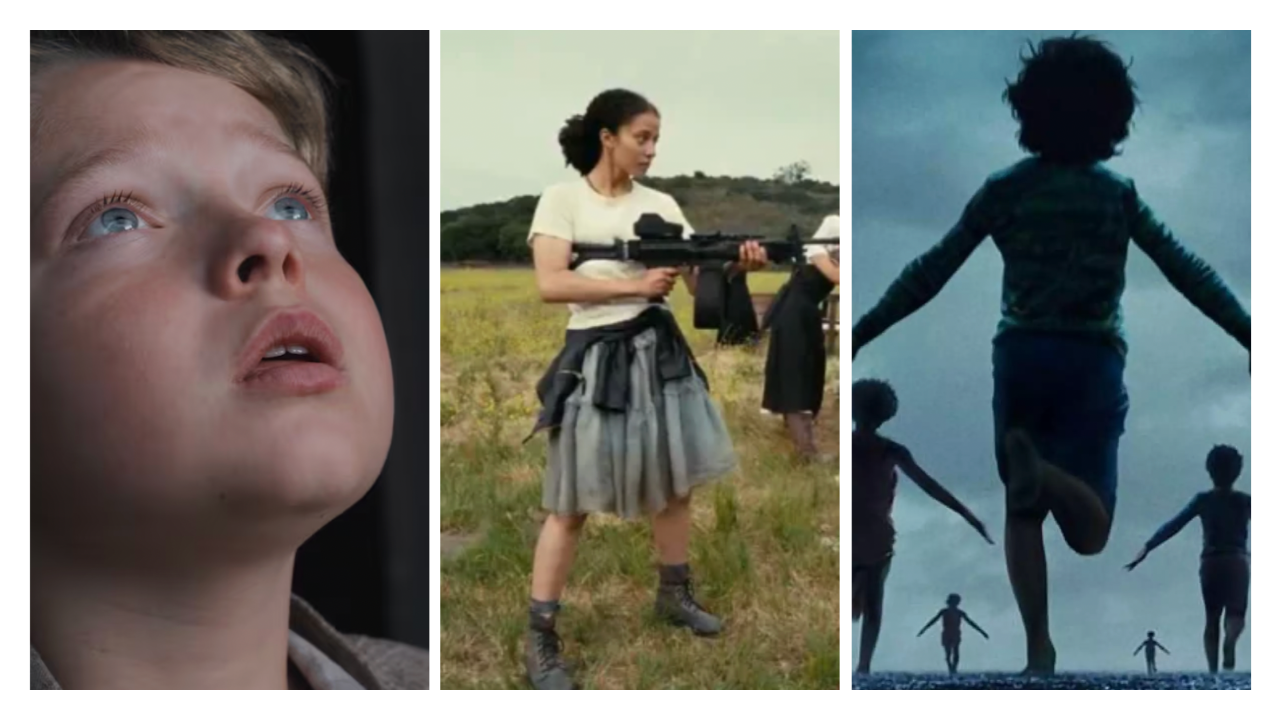
Ask the parents of Weapons, whose children mysteriously disappear one night.
Or ask the hapless Bob Ferguson (Leonardo DiCaprio) from One Battle After Another, his Nissan Sentra puttering away through the rolling hills of California as he seeks to rescue his daughter Willa, only to discover that she herself has gunned down her pursuer.
Or ask Hamnet’s Agnes Shakespeare (Jessie Buckley), the nature mystic so certain of her powers she believes she will save her daughter from the plague, but instead has to watch her valiant son surrender his life to save his sister’s.
You could even ask the mother of 27-year-old Soviet journalist Irina Dolinina, one of the subjects in Julia Loktev’s epic 324-minute documentary My Undesirable Friends: Part I – Last Air in Moscow. The older woman is so inured to the impossibility of change in Russia that just she wishes her dissenting daughter would get another job (while also worrying that her Ira might not find a suitable husband).
Or—OK, OK, you get the idea. I don’t want to cram every movie into my thesis. So many great movies from 2025 don’t fit into this neat little paradigm. Payal Kapadia’s All We Imagine as Light quietly dramatizes the tension between modernity and tradition in contemporary India. In Alain Guiraudie’s freaky, nasty Misericordia, you never know who’ll fuck who next. There’s James Sweeney’s topsy-turvy comedy, Twinless, Jafar Panahi’s meditation on vengeance, It Was Just an Accident…. I could go on.
Still, once you enter the theater with this theme in your head you’ll see it in the least likely places. Final Destination: Bloodlines? A grandmother hides away in a cabin and a mother abandons her children, both convinced that so long as they stay alive Death will not come after their family. 40 Acres? Danielle Deadwyler drills her children in the ways of safety in a postapocalyptic world, but soon they stray from her path regardless.
As a dying planet slips back toward fascism, “What have real-life parents got to protect their kids from in 2025?” is too dumb a question to even ask. Last year’s movies were an expression of our collective fear that we’ve left our children no future—and in that they’re also an expression of our collective guilt.
Yet the words that summed up this year of onscreen parental helplessness best did not come from a mother or a father. Eva Victor’s Sorry, Baby ends by rendering its title starkly literal: Victor’s Agnes expresses her regrets to an infant for the inevitable horrors to come as she grows up. She’s apologizing for life itself.
***
In real-life parental guilt is complex and multilayered, almost inexpressible. It’s the sort of guilt Mary Bronstein’s frenetically anxious If I Had Legs I’d Kick You explores, with Rose Byrne’s Linda a mother who, try as she might, simply cannot solo-parent a child with an eating disorder.
Last year’s movies found a quick and easy way to dramatize parental failure: abandonment. The drama of One Battle After Another stems from the disappearance of Teyana Taylor’s Perfidia Beverly Hills, who rats out her comrades before going into hiding. But while missing moms were hardly the norm, flawed movie dads were everywhere you looked in 2025—except with their families.
Sometimes, their absence was a matter of circumstance. Joel Edgerton’s Idaho logger Robert Grainier, from Clint Bentley’s historical reverie Train Dreams, is drawn away by work only to return home to a tragedy from which he never recovers. After Armando (Wagner Moura), the central figure in Kleber Mendonça Filho’s ’70s-set thriller The Secret Agent, runs afoul of the wrong Brazilian bureaucrat, he goes underground, leaving his Jaws-obsessed son behind with grandparents.
But more often, these guys just kinda suck. If we are indeed living through a “crisis of masculinity,” as the thinkpieces tell us, the year’s movies seem to ask, “Were we ever not?” In Kelly Reichert’s The Mastermind, Josh O’Connor’s J.B. Mooney bungles an art heist and goes on the lam, leaving his family, including his worshipful older son, behind. As the world around him bustles with political fervor, J.B. flounders in his antisocial nonconformity, sinking into isolation on the fringes before the authorities whisk him away.
With his flashy but not wholly effective Frankenstein, Guillermo del Toro exhumed the ultimate pop tale of paternal abandonment in 2025, and if any spawn ever had the right to exclaim “I never asked to be born,” it’s Frankenstein’s hapless creature, enacted with almost too much pathos by Jacob Elordi.
Victor Frankenstein is the ultimate deadbeat dad, unwilling to claim his progeny as his own. Victor, meet Marty Mauser. Marty Supreme is a postwar parable about American exceptionalism and its brash jerky energy, about a man who runs from fatherhood and responsibility because he believes he has a higher calling.
What’s funny about Marty is that his ambition is wildly out of scale with his goals: Here’s a guy who thinks that becoming table-tennis world champ will avenge those murdered in the Holocaust. But really he’s just another guy who prioritizes work over family. And when we call that work “art,” movies tend to be more understanding.
In Sentimental Value, Joaquin Trier’s followup to The Worst Person in the World, celebrated arthouse director and terrible father Gustav Borg (Stellan Skarsgård) tries to cast his resentful daughter Nora (Worst Person’s Renate Reinsve) in a film that’s superficially about his own mother’s suicide. Yet the script reveals startling insight into Nora’s own life. Somehow the absent father intuited all this because he recognizes himself in her flaws and failings.
And what about Will Shakespeare (Paul Mescal) who fucked off to London and let his son die without him? Well that guy wrote Hamlet, channeling his suffering into a work so universal in appeal that centuries later some bored, isolated humans enduring another plague will stage the play inside a video game and make a wonderful movie out of the experience called Grand Theft Hamlet.
What matters in both Sentimental Value and Hamnet is the work doesn’t exist to redeem the artists. What’s more, both Nora (as actress) and Agnes (as audience) participate in giving meaning to the art that touches them. Art in these movies doesn’t heal pain, doesn’t compensate for human shortcomings, doesn’t make up for what was done and what was lost. But it acknowledges all of this, the complexity of human behavior. The effect it has is profound on those who create it and witness it.
***
You probably haven’t seen Jason Statham’s A Working Man, released last March. Then again, you’ve already seen it dozens of times. When his boss’s daughter is snatched by human traffickers, Statham, a former British commando turned construction worker, springs into action to rescue her.
Not to ruin the ending for you or anything, but yeah, he gets her back. This kind of action movie will always be on hand to let us indulge in the fantasy that we can keep our kids safe.
Among the things I love about One Battle After Another is that it undercuts this heroic dad narrative—I’d like to see Statham pull off half his stunts in a bathrobe, stoned. At the end, when Willa dashes off to an Oakland protest to the liberating chime of Tom Petty, we realize that this was never Bob’s story. He’s just what connects the historical family drama of two Black women.
As The Searchers taught us over a half-century ago, that independence is what the tough guys with guns are always really afraid of. What they’re saving their daughters from is never just “bad guys”—it’s the world, life, adulthood, everything outside of the supposedly protective home.
But in Weapons the threat comes from inside the house, as most real-life threats to children do. In what can feel like a movie channeling our fear of school shootings, the twist is that the villain is often hiding in plain sight, in the home, where secrets flourish.
Let me wrap this little ramble up by putting in a special word for my favorite movie of the year, if only because it sounds so unbearably twee on paper it may need a special word. Set "somewhere between Tehran and Winnipeg," Matthew Rankin’s Universal Language posits a world where Canada is populated by Iranians and Farsi is the dominant language.
There’s no specific political thrust, except that we’re able to see Persian people outside of the nationalistic context that typically defines them for Americans. The way things are comes to feel like a mere accident of history. It’s a riposte to cultural purists from Stephen Miller to the ayatollahs, all the more pointed because it doesn’t acknowledge them at all.
Rankin himself plays a man named Matthew who returns home from a government job in Quebec (where, don’t worry, they still speak French) to learn that his absent mother has been accepted into another family. But apart from that melancholy tale we also watch two children (Rojina Esmaeili and Saba Vahedyousefi) try to free a 500-rial bill that’s frozen in the ice so they can buy their schoolmate new glasses.
These children are very much the descendants of the kids Iranian cinema great Abbas Kiarostami used to film so well, setting about on their own quests as they try to placate the strange race of grownups who rule them. In a year where films projected so many adult fears onto young people, it was a welcome change to watch small humans go about their own peculiar little lives.