


This story was originally published by our buddies at Hell Gate, the indispensable New York City publication that's owned and operated by the staffers—sounds familiar! You can and should sign up for their free newsletters here, and hey, if you've got even a passing interest in NYC and/or worker-owned independent media, become a paying member.
Even for a born pitchman like Eric Adams, a data center was always going to be a tough sell.
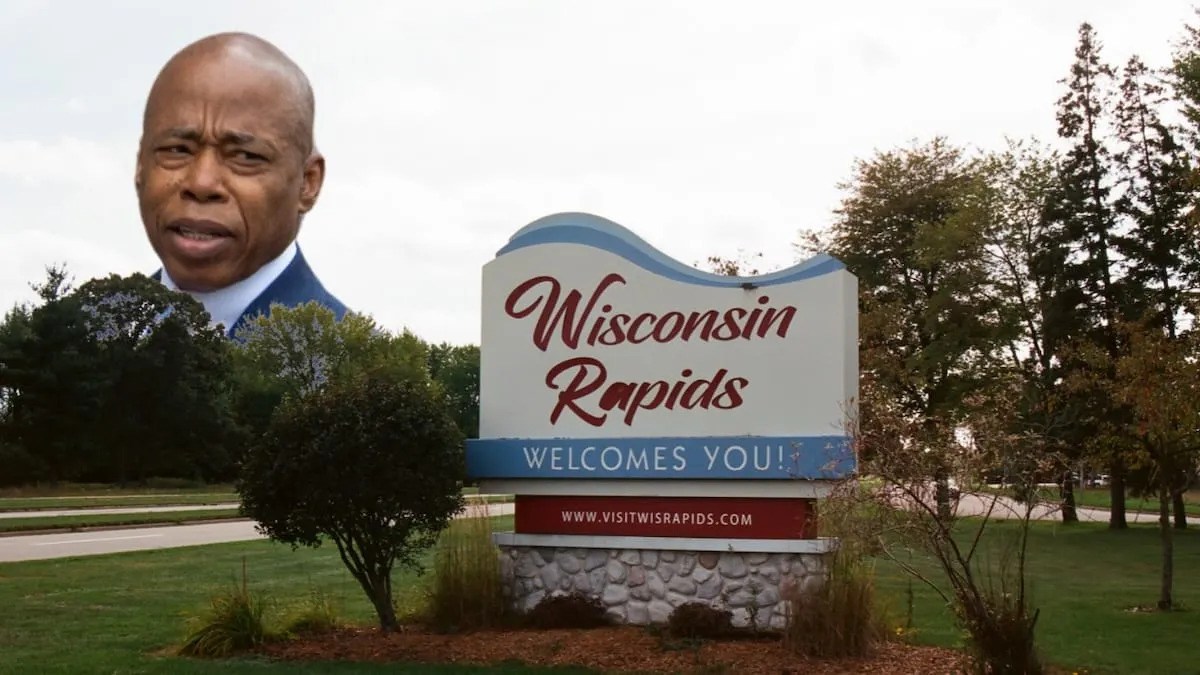
So when video surfaced of the former New York City mayor being mercilessly heckled by angry residents in a central Wisconsin library as he tried to convince them of the benefits of building a 150-megawatt data center at the site of an old paper mill, the record-scratch, freeze-frame questions asked themselves.
How did Adams spend his time in Wisconsin? What was his plan to make this work? And who, exactly, thought this was a good idea?
We traveled to Wisconsin Rapids to find out.
According to interviews with residents and opponents of the data center, and documents they obtained through public records requests, Adams did not handle the assignment well: He attempted to jam months of planning and outreach into a little more than six weeks, and he failed to show up to a fraction of the events he had promised to.
In fact, when Hell Gate visited Wisconsin Rapids last month, we spoke to dozens of people, none of whom had so much as shaken hands with the ex-mayor or bumped into him at a restaurant or barber shop as he pitched the project to the town.
By the time Adams was being booed at the library in the video, he may have given up on making any kind of lasting positive impression. According to flight records from FlightRadar24.com, a private jet left from Teterboro Airport in New Jersey at 7:15 a.m. the day of the meeting, landed in Wisconsin Rapids at 9:07 a.m. local time, and then left Wisconsin Rapids at 2:07 p.m., a little more than three hours after the meeting began.
"They came for an hour, and we actually flipped them off as they flew overhead," said Marissa Johnson, a local EMT and co-founder of the anti-data center group, South Wood County Neighbors for Responsible Development, who was at the meeting.
"I was offended that they thought we were so stupid as to be charmed by Eric Adams, the celebrity that he wants to play," said Kaitlyn Federwitz, the owner of a vintage store in Wisconsin Rapids, who also co-founded the group. "Because no matter what side of the political spectrum you fall on, Eric Adams is not a popular man."
Wisconsin Rapids, population 18,654, is almost smack-dab in the middle of the state, two and a half hours from Milwaukee, and just over three hours from Minneapolis. It has long been a paper mill town, like many other cities along the Wisconsin River. But the Wisconsin Rapids Paper Mill closed in 2020 and was torn down around 18 months ago, eliminating 900 local jobs.
The paper mill had cycled through several owners over the last few decades—yet another example of private equity swallowing up American industry—and for a time was owned by Apollo Global Management, the asset management company founded by Jeffrey Epstein associate Leon Black.
Mike Schmidt is a trial lawyer who practices family law and is in court almost every day. He was raised in Wisconsin, and is sympathetic to the argument that the city needs to replace the tax revenue lost from the demise of the paper mill.
"We have two choices: increase the property tax levy, by hook or by crook, or cut services, and we all know in most places that austerity measures are not good for the economy," Schmidt told me in his second-story office, which has a view of the Wisconsin River, and is directly across the river from the 209-acre proposed data center site.
"And that's what renders [cities like ours] vulnerable to people like the PNK Group," Schmidt said.
PNK Group, the company that tapped Adams on the data center project, was originally founded in Russia, according to its company website, then set up an office in Lower Manhattan in 2017 (the company claims it withdrew from Russia entirely in 2024).
In recent years, PNK Group had ridden the logistics boom, touting technology that could purportedly construct a warehouse quickly and with minimal human effort. Earlier in 2026, the company sold a warehouse it had built in Georgia to the federal government to be used for ICE detention. The sale spurred over a dozen senators and congressmembers to write a letter to the owner of PNK Group questioning whether its warehouses were suited to human habitation.
As the AI arms race ramped up, PNK Group began approaching cities across the country about building data centers, including Wisconsin Rapids.
PNK Group offered to make investments in Wisconsin Rapids in exchange for building the 150-megawatt data center, which is big enough to power around 100,000 homes. The company never specified exactly how much tax revenue the city would reap from the data center, but eventually, after prodding by city officials, PNK Group said it would invest $5.7 million toward emergency services, riverfront access, and conservation and workforce training. It also refused to divulge who the data center would eventually be used by, but did say it would not be for generating cryptocurrency.
Sometime this spring, PNK Group approached Adams to become their go-to for helping sell skeptical Wisconsin Rapids residents on the data center proposal.
According to documents filed with the city of Wisconsin Rapids, and obtained by Hell Gate through an open records request filed by local groups, Adams's job was to "build trust, hear concerns on the record, and earn support" from the community before a series of votes on the data center plan.
The files show a plan that a company controlled by Adams, EA Holdings, proposed for how to earn support from the community during July 2026, before a vote in September on the permit for the data center.
The timeline was ambitious: A series of six "stakeholder" sessions with community members, clergy and faith leaders, and local community groups, all within a single month, leading up to a big community meeting on August 1.
EA Holdings' proposal acknowledged this timeline was fairly compressed. "Done properly, an effort like this usually runs six months to a year. The plan condenses that work into a single month without losing the rigor," his proposal says.
But apparently, even if his company might have been present, Adams himself did lose the rigor. He completely skipped several stops on the proposal, like a Chamber of Commerce golf tournament, according to community members in Wisconsin Rapids. Some groups on Adams's list told Hell Gate that they never made contact with the former mayor. It was unclear whether a planned "supporter dinner" a few nights before the August 1 hearing ever took place, given that Adams was apparently not in Wisconsin Rapids until just before the public meeting, and supporters of the data center plan were mostly absent from the public hearing.
Ultimately, the goal of Adams's proposal was to create a "sizable, credible turnout at the August public meetings," and a hammered out community benefits package that residents could get on board with.
But by the time Adams walked into the library at the beginning of August, clearly residents had turned on him.
One of the people heckling Adams at the library was Federwitz, the vintage store owner. By the time she co-founded South Wood County Neighbors for Responsible Development, she had been following the rise of data centers across the country, and the complaints of worsening air quality, noise pollution, the depletion of local water resources, and rising energy prices, in areas where they had been built.
Like people in other parts of the country, residents in Wisconsin Rapids were kept in the dark about the plan for the data center until a couple of weeks before the city council was set to vote on a conditional permit for the proposed data this past May.
"It was sneaky and done without a chance for the community to be informed," Federwitz said.
Johnson, the EMT, said she was desperate to try to get other residents to pay attention as the data center neared a vote this spring.
"We're sending letters, being respectful and it got us nowhere. We were being laughed out of the room repeatedly, and so we changed our strategy and we were more aggressive and we wanted to be on top of this 100 percent of the time, 24/7," Johnson said.
The group hounded the city council members, flooded the town with lawn signs, and helped convince the planning committee to postpone the vote that had been scheduled for May until later in the year.
The activists only learned of Adams's involvement with the project in late July, when Schmidt, the family attorney, and other local activists got an open records request that contained some surprising emails.
"We thought that was a joke, when we got the open records request and saw they emailed someone named Mayor Eric Adams at Gmail.com," Schmidt said. "We're like, 'Somebody's hilarious. Someone's joking around.' I mean, my name's Mike Schmidt, greatest third baseman of all time. Some people have the same names, but it wasn't a joke, it was the real Eric Adams. Like, what the fuck? Seriously?"
The emails are how the residents learned that Adams had already met with the town's mayor and director of community development. Adams's email address was CC'd on several emails regarding planning for the data center with city officials.
"We found references to him having been here, multiple times. He had already met with the mayor, and that's when I got wind from someone in the library, not only has Eric Adams been to the library before, he’ll be here this Saturday at 11 a.m.," Federwitz said about the run-up to the August information session at the library.
Schmidt said he was dumbfounded by the whole chain of events, and noted that the appearance of Adams, who was federally indicted on corruption charges before the Trump administration intervened and the charges were dismissed, only added to the sense of distrust and suspicion around the project. (Adams has denied the allegations.)
"Eric Adams is famous for one thing. Corruption. Eric Adams is not famous for his honesty, for his salesmanship, for his fashion sense. He's not famous for anything on this earth except for bribery," Schmidt said.
When giving comment to Hell Gate back in August, PNK Group defended hiring Adams for the job.
"Eric Adams is enthusiastic about the opportunities these technologies can create for communities and the economy," the PNK Group spokesperson wrote. "Having led one of the world's most complex cities as Mayor of New York, he brings extensive experience in community engagement, stakeholder communication, and navigating large-scale projects with diverse constituencies."
When Hell Gate reached back out for comment for this article, it directed all questions about Adams to Adams himself. It also did not respond to questions about whether Adams was still under contract with PNK Group.
A spokesperson for Adams did not return multiple requests for comment.
At the August 1 meeting, after an eight-minute speech, Adams relinquished the microphone to PNK Chief Development Officer Anton Voronkin, who touted the data center's use of new, untested technology to cut down on both its energy usage and noise pollution. The crowd was even less receptive. (Voronkin himself has a notable track record: Before coming to PNK in 2026, claimed on LinkedIn he had worked on Neom, a megacity in Saudi Arabia that has been marked by Human Rights Watch as abusing workers.)
Perhaps Adams and his PNK Group associates just had bad timing. By the time of the August meeting, the momentum against the AI buildout, and data centers specifically, was gaining traction across Wisconsin, and the country at large.
On September 16, the city's planning commission voted against the data center permit, 9-0.
After the permit vote, South Wood County Neighbors for Responsible Development has kept organizing. The very next week, they recalled a local city councilmember who had sent what many viewed as a threatening email to a local bar where anti-data center signs were being sold.
In late September, at a meeting in the same room of the McMillian Library where they heckled Adams, the group continued to discuss ways they could steer Wisconsin Rapids towards development of the paper mill site that would provide support to the local economy, not just enrich a group of out-of-state developers.
The group, which livestreams its meetings on Facebook, saw that Voronkin had tuned into the meeting.
"Hi Anton!" They shouted into the camera.
During our time in Wisconsin Rapids, Hell Gate didn't meet a single person in favor of the data center. We went to local bars, the farmers market, computer shops, and beyond. (The mayor's office and the local Chamber of Commerce declined to be interviewed by Hell Gate. The city planner who was instrumental in bringing PNK Group to Wisconsin Rapids has since resigned his position.) Just last week, the city approved a 12-month data center moratorium.
From what we could find, Adams never came back to Wisconsin Rapids after he got booed out of the McMillan Library.
The site of the paper mill is currently covered in rocks and large green puddles, but until a better idea comes along, residents are content to have it stay that way.
"We know we're sitting on an industrial site, we know it's a brownfield, and we know this was a mill for 100 years. It is not going to be a park. It can't be a park and it can't be housing, but this area could be an employer again," Federwitz said. "This is an industrial city. The Wisconsin River is a very industrial area. That's not going to change and we don't want it to change. That's what makes this area what it is. This mill did so much for us over the past 100 years, we'd love to see something come here, just not a predatory data center."
Rumours abound in Wisconsin Rapids that PNK Group has turned its sights on another former paper mill, further down the Wisconsin River (the company did not return a request for comment about this).
"You know what a lot of people would say turned the attitudes away from the PNK Group, was Eric Adams," Federwitz said. "I have it on really good authority that a lot of the people in government were very put off by the Eric Adams showing."
Johnson was even more blunt.
"Eric Adams was a gift for us. It was a gift to Wisconsin Rapids, and I want to personally thank PNK right now for Eric Adams. Thank you PNK, you really did us a solid with that."