

Bob and Cathy Kohlmeier don’t want their rural property to hum like a running dishwasher.
The Kohlmeiers have lived for 50 years in a quiet slice of Hermantown, a woodsy northern Minnesota community of 10,221 just outside of Duluth. In their 900-square-foot house, sitting on 45 acres, they raised “three beautiful daughters” and planted 10,000 pine trees. In the winter, the retired couple cross-country ski with their three grandchildren; in the summer, they pick raspberries back beyond the barn.
Those skis are stacked near the door as Bob, lanky and bearded like David Letterman, sips his coffee. He’s angry in a Minnesotan sorta way, which translates as a handful of polite-yet-emphatic curses. (Cathy gently reprimands her husband for his language.)
Bob’s mad because 300 feet from his property line a proposed 1.8 million-square-foot hyperscale Google data center might begin a 24/7 whine that, if proponents are to be trusted, won’t exceed the 50-decibel moan of a dishwasher or refrigerator. The Kohlmeiers are convinced the actual noise will buzz at a much greater volume.
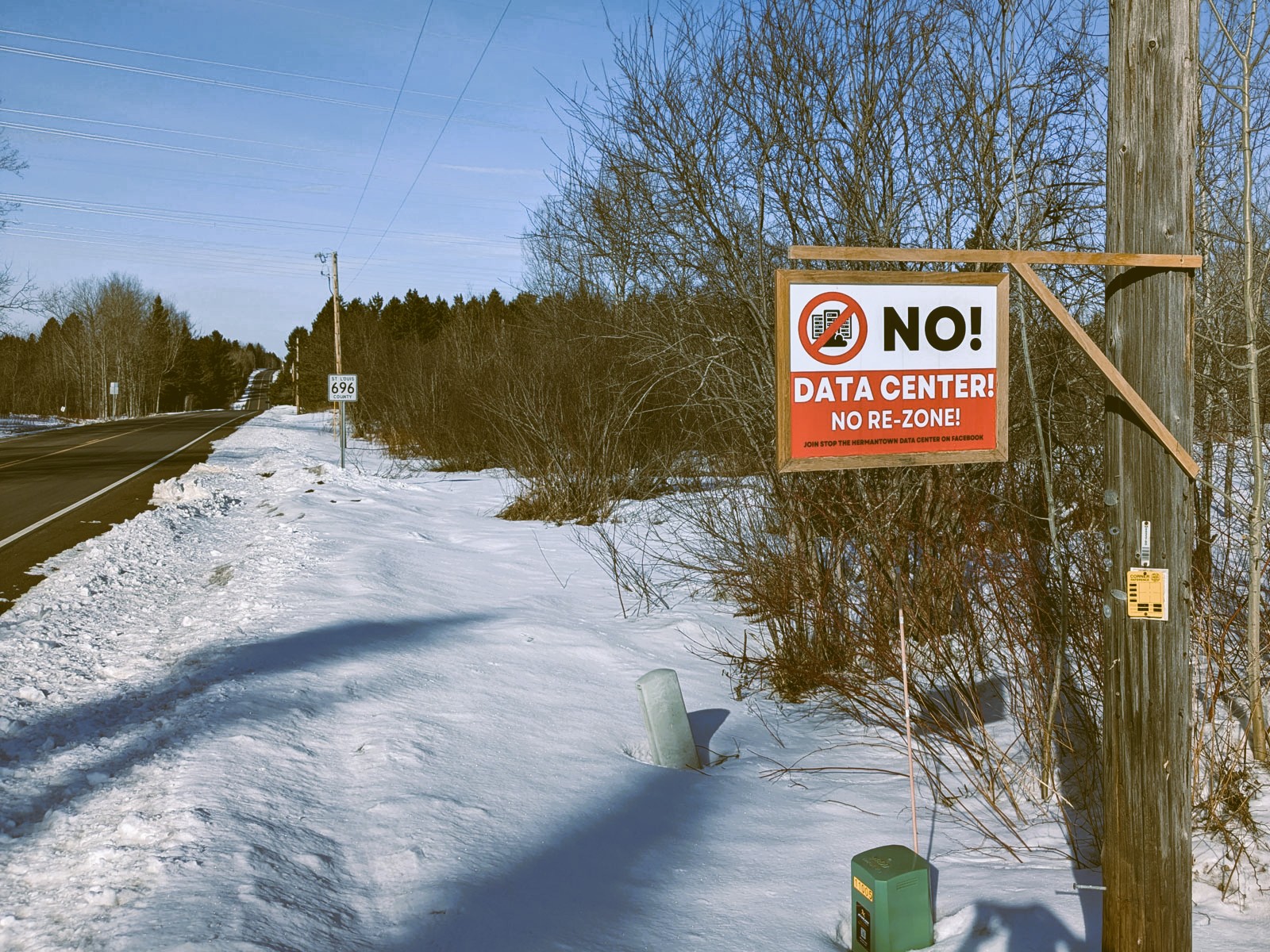
Their distrust is rooted in the layers of secrecy surrounding the project, and it’s shared by many in Hermantown. A grassroots group, Stop the Hermantown Data Center, launched last year amid whispers of city- and county-level politicians signing non-disclosure agreements with a mystery Fortune 50 company that had begun buying up acreage near Midway Road and Highway 2. Now 5,000+ strong on Facebook, the group is “very organized and really sticks together,” observes reporter Jana Hollingsworth, who covers the Twin Ports for the Star Tribune.
Their concerns? Pollution, power and water usage, the aesthetic character of their hometown, and a lack of political transparency. Their foe? The second-richest company on Earth, whose early corporate slogan—”Don’t Be Evil”—now reads like a glaring red flag.
"We don't want to live in the shadow of something we don't know anything about, and we don't trust this government anymore because of their NDAs,” Bob says. “It's like the fox guarding the henhouse … It’s a bunch of bullshit."
Decoding “Project Loon”
Bob Kohlmeier remembers the exact date he became aware of the data center plan: January 10, 2025. He still has the letter he received that day from Minneapolis-based Mortenson Development, which wrote to folks living along St. Louis River Road with news of the adjoining “Hermantown Project.” The company was curious about whether the Kohlmeiers were interested in selling their property to an undisclosed “buyer.”
A few days later, Bob wrote to the city’s Planning & Zoning director to inquire about the vague “industrial project.” No response. So he texted Mayor Wayne Boucher. Ditto. "I had an inkling this might be a data center," Bob says. The Kohlmeiers then called Mortenson and asked, specifically, whether the Hermantown Project involved data centers. “The man on the phone said, ‘Well, I can’t tell you,’” Bob remembers. “So right away, mistrust.”
Eleven years ago, Emma Richtman moved from the Twin Cities to Hermantown with her husband for “a closer connection with nature.” Now they’re raising two young children there as they restore their fixer-upper forever home. By the time Richtman encountered the Hermantown Project, the data center cat was out of the bag and a Change.org petition had been launched to stop it; she was “gobsmacked” by the 1.8 million square footage figure. (For comparison’s sake, Mortenson-built U.S. Bank Stadium clocks in at 1.75 million square feet.)
Last October Richtman joined a Stop the Hermantown Data Center march, and her activism hasn’t stopped since. “We’re running up against the clock, because they’re trying to get this in before any regulation or moratorium—everything feels so immediate,” she says. Richtman describes recent public meetings—City Council, Planning & Zoning Commission—as increasingly packed and contentious. She came home and wept following Monday’s four-hour council meeting, which featured “powerful” comments from her neighbors. "People want answers, and we're not being given them,” she says. “We're the first to be impacted, and the last to know."
Hermantown residents spent most of 2025 in the dark about “Project Loon,” an ominous code name that accompanied early planning documents. Last September the Minnesota Center for Environmental Advocacy (MCEA) supplied news outlets with public records it had obtained through data requests. Turns out city officials had been discussing data center plans with Mortenson since 2024.
“Data center next to MN Power substation,” Hermantown City Administrator John Mulder wrote to colleagues in September ‘24. “1 billion investment 50+ full time jobs. [The mayor’s] response was ‘wow.’"
The reason Mulder hadn't been more forthcoming with his “wow”-eliciting news of the $650 million development, the largest ever in Hermantown? He’d signed a non-disclosure agreement with Mortenson, as had his assistant, 22 St. Louis County employees, and three county commissioners.
On October 20, weeks after the details leaked but months before Google would be identified, the Hermantown City Council voted unanimously to rezone residential land as commercial to accommodate Project Loon. The 4-0 vote came after five hours of overwhelmingly oppositional public testimony, notes Kohlmeier, who’s suing the city. On November 5, MCEA and Stop the Hermantown Data Center also sued Hermantown, alleging that the city’s environmental review is insufficient and that city officials lack transparency. MCEA has sued five Minnesota cities that are advancing data center proposals.
By mid-November, Mortenson hit pause on its pursuit of special permits; the company acknowledged the need for an open house “to foster meaningful dialogue.”
Stop the Hermantown Data Center’s big ask? A comprehensive Environmental Impact Statement (EIS), not the ongoing Alternative Urban Areawide Review (AUAR) approach, which its members view as a watered-down half-measure. Hermantown City Council adopted a AUAR report last fall, but just this month the city and Mortenson announced plans to conduct a new one. The process will sideline development for around seven months.
"The environmental review process in Hermantown is entirely on its head," says MCEA Northeastern Minnesota Director JT Haines, adding that AI infrastructure presents a still-new regulatory frontier. "It was all done in secret, this general AUAR thing, and they approved it before the public even knew what this thing was—that is a shocking fact. We’ve never seen AUARs used this way before.”
NDA Backlash: “The Damage is Already Done to Public Trust”
Three of Ashley Grimm's colleagues had been muzzled by Project Loon NDAs, a fact she only learned about after overhearing comments from a staffer. Making matters more troubling: Grimm and those three colleagues are publicly elected St. Louis County commissioners.
"I was really taken aback," she says. "I'd never heard of local elected officials signing non-disclosure agreements with companies. We're beholden to the public, they're our bosses. And this, essentially, was about secrecy."
At a county board meeting last year, Grimm announced a proposed ban on NDAs. Her fellow commissioners didn't like the idea; the ban couldn't get a second motion. That hasn’t stopped Grimm from sounding the alarm, even if it causes discomfort for her personally and professionally. She posed for a headline photo shoot with the Minnesota Reformer; she debated NDA-signing ex-Board Chair Annie Harala on TV; and she’s talking to Racket.
“It can be scary to call out your colleagues, but it’s really important,” Grimm says. “The community doesn’t buy the argument that we should sign our rights away to talk to them to the billionaire class. In a bipartisan fashion, this issue is really bringing people together.”
Pugnacious Twin Ports publication the Duluth Monitor has been all over the local government churn surrounding the data center, and its lone reporter, John Ramos, hasn’t exactly been well-received by pro-data center politicians. At a public meeting last September, Ramos watched as Hermantown Mayor Wayne Boucher threw his voice recorder in a trash can. At a St. Louis County Board meeting the following month, as NDA tensions boiled over and Ramos accused the board of shutting down public input, NDA-signing Commissioner Keith Nelson told him, “I don’t give a shit what you think.” Racket requested interviews with Boucher and Nelson but didn’t hear back.
Around a dozen data center sites have been identified throughout Minnesota, including the $800 million Meta facility in Rosemount that’s expected to open this year. At the state level, DFLers remain philosophically divided on the issue. They’ve heard plenty about it, at least from one side: Google “ramped up a lobbying offensive” last year at the Capitol, the Star Tribune reports. Former Fresh Energy executive Michael Noble, an ally of Gov. Tim Walz, helped lead the persuasion blitz.
"If I wanna build a big data center, I don't pick one site,” Hudson Kingston, legal director with environmental advocacy nonprofit CURE, says when asked to get inside the head of a tech oligarch. "I pick five sites and see what kind of deals I can get from the local governments.”
State Sen. Grant Hauschild (DFL-Hermantown) co-authored a 2025 bill that woos tech firms with 35 years of tax breaks if they build data centers in Minnesota. When he met with constituents about a potential Hermantown data center last July, Hauschild told Nikki Davidson of The Watch he was “speaking in hypotheticals.” He denies signing any NDAs. Rep. Natalie Zeleznikar (R-Hermantown) won't commit to a data center position, Hermantown resident Emma Richtman says.
State Sen. Jen McEwen (DFL-Duluth) charted the opposite legislative path. Last month the DSA-aligned lawmaker unveiled a bill that would place a two-year moratorium on all new data center permitting throughout the state. She says she’s been blown away by the support for it.
“The legislature needs a chance to hit pause and get out ahead of what these fast-track AI developments mean for Minnesota; this technology is moving so fast and, I’d say, being used for profit-mongering,” says McEwen, adding that tech monopolies with “unfathomable” wealth shouldn’t be dictating Minnesota's future. “A baseline of transparency is at the top of that list.”
McEwen, whose job title suggests she knows things before you do, found out about the Hermantown data center at the same time as the public. She blames the NDA secrecy on “the enormous, outsized influence” powerful industries have over our politics, and sees lobbyists “romancing” elected officials while dangling “shiny new objects” every session at the Capitol. In Hermantown, “the damage is already done to public trust,” she says.
This month, inspired by the saga in Hermantown, Rep. Emma Greenman (DFL-Minneapolis) introduced a bill that would ban “counties, cities, and towns, and any person acting in their capacity as a representative of the municipality” from entering into NDAs that shield information from the public. Sen. Erin Maye Quade (DFL-Apple Valley) authored a companion bill in the Senate. “[It’s] a problem. A problem we're trying to fix," Greenman told Fox 9. Her bill advanced last week with unanimous bipartisan support.
"The city keeps telling us NDAs are standard practice, but this is not a standard development, this is unprecedented,” Richtman says. “We’re being gaslit to think this is how it’s always done."
University of Minnesota media law/ethics professor Jane Kirtley seems to agree. She tells the Reformer that elected officials signing NDAs is “extremely problematic … Many of them are willing to sign their lives away in order to lure the businesses to their area.” In smaller communities with less oversight, she adds, “an awful lot of secrecy” can fester without much scrutiny.
The Data Center Pitch
Google appears undeterred by the drama surrounding its Hermantown aspirations.
In late January a Google shell corp., Harmony Group LLC, shelled out $6 million to acquire land from three Hermantowners. It paid a premium, too: St. Louis County records show a combined $1.9 million value for those parcels.
And, earlier this month, news finally broke about who’s behind the project. Google and Minnesota Power issued press releases brimming with cheery, AI-evoking language about “the beginning of a partnership rooted in sustainable innovation and long-term investment.” A Google PR rep didn’t respond to Racket’s interview request. A Minnesota Power spokesperson did respond, though she declined to arrange any interviews. Instead, we were provide a PDF of a recent press release. The Minnesota Public Utilities Commission is expected to review the Google-Minnesota Power partnership later this month.
“Google and Minnesota Power are just saying things in press releases, because there hasn’t been an adequate environmental review; nobody fucking knows the specifics, and that is on purpose,” MCEA’s JT Haines says. “Maybe they’re telling the truth, I don’t know, but this process is entirely backwards.”
Minnesota Power touts gifts arriving from Silicon Valley, including Google’s pledged investment of 300 megawatts of wind energy and 400 megawatts of battery storage. Additionally, Google plans to give the utility $5 million to assist low-income customers and aid efficiency. That dollar figure is “a slap in the face” coming from a tech giant that’s investing $1 trillion into AI, one Stop the Hermantown Data Center member tells the Strib. Minnesota Power promises that, due to state law, residential electric rates won’t budge if/when the megawatt-thirsty data center joins the grid.
There’s also the promise of jobs, about 40-50 permanent data center ones, plus the hundreds of construction gigs required to build out the complex. Stop the Hermantown Data Center points to the obvious contradiction at play: The product being produced, artificial intelligence, is projected to eliminate vast swaths of the American workforce via automation. Per an application to the city, the Hermantown development would include four 50-foot-tall, 300,000-square-foot structures housing tech, two office buildings, a warehouse, and enough parking for 600 vehicles. (Finding primo spaces should be a breeze for those 40-50 workers.)
"They're trying to polish a turd," Hermantown resident Emma Richtman says. "Google shows up, says all these great things, and acts like we should be grateful for it? The truth is they've willed this through with the enormous amount of financial resources they have. We are the collateral damage to this technological revolution these monopolies are pushing on us—this garbage, this slop."
The specter of Minnesota Power’s soon-to-be parent company, private-equity behemoth BlackRock, looms large in all of this.
Ready the It’s Always Sunny push-pin conspiracy board meme, because you should know that BlackRock is one of the largest institutional investors in Google’s parent company, Alphabet Inc., with about a 7% ownership stake; BlackRock also controls almost 8% of Nvidia Corp., whose chips power data centers, and around 7% of Apple, whose generative AI tech is baked into its devices. In other words: BlackRock’s utility would sell juice to BlackRock’s data center functioning on BlackRock chips so that your BlackRock iPhone can display the AI slop du jour. Duluth City Council Member Arik Forsman, a vocal cheerleader of data centers in Minnesota? He’s a longtime executive at Minnesota Power. (Forsman downplayed any accusations of conflicts, which have come up at council meetings.)
"We've been looking at why these private-equity investors are getting into this space," Hudson Kingston of CURE says. "BlackRock has made public statements about wanting to make a shit-ton of money off of building hyperscale data centers, and, now, they coincidentally own Minnesota Power."
What We Know About Data Centers
How much power, specifically, would the Hermantown facility draw? And from what sources? Those details aren’t available because Google and Minnesota Power refuse to share them. “I’m worried that number will never become public, because it’ll be treated as a trade secret,” Kingston says.
But if Hermantown’s hyperscale data center is anything like other hyperscale data centers, the amount of electricity required to power its chips would be staggering. JT Haines of MCEA says typical hyperscale data centers suck down between 400 and 500 megawatts of electricity. That’s more power, he says, than the draw from every residential home within Minnesota Power's 1,630-megawatt service area.
“[Data centers] are the largest single points of consumption of electricity in history,” Princeton University climate modeler Jesse Jenkins recently told The Atlantic. Within the next five years, that could mean the equivalent demand of 60 Seattles added to America's power grid. By 2030, according to Siddharth Singh of the International Energy Agency, U.S. data centers will guzzle more electricity than all of the country's heavy industries—combined. Generative AI will be responsible for about half of that consumption.
“Short-term: natural gas,” will (fossil) fuel the data center boom, according to OpenAI CEO Sam Altman. More and more pipelines are popping up around the country. Of note: Minnesota law dictates that all utilities must operate 100% carbon-free by 2040; Minnesota Power has met 60% of that renewables goal.
The Hermantown data center would be air cooled, which sounds promising in a region that’s tucked between the Boundary Waters Canoe Area and Lake Superior. Still, a Google-flattering FAQ page on the Hermantown website says the project would draw on 50,000 gallons of municipal water per day from Lake Superior—the equivalent demand of 160 homes. A single large data center can chug 5 million gallons of water per day—the equivalent of 50,000 homes. Yet last month Altman dismissed AI water-usage concerns as “fake.” Air cooling uses less water, “but the trade off is you’re using more energy,” Haines says, referencing the backup diesel generators that Bob Kohlmeier suspects run louder than a dishwasher.
And then there’s the noise. Initially, that’ll mean the volume required to turn 200 acres of woods and wetlands into a sprawling industrial campus. Construction is expected to last between eight to 10 years. Living in proximity to a data center presents its own audio annoyances. Emma Richtman cites the chilling headline from a recent Politico piece: “A data center opened next door. Then came the high-pitched whine.” In it, residents of Sterling, Virginia, describe “unbearable” noise emitted from nearby data centers. “We don’t want to be outside anymore,” Lindsay Shaw says.
Sounds a lot noisier than a Bosch.
Or maybe the AI arms race is leading to an AI bubble, as many are predicting. If that’s the case, this delirious data center construction spree— McKinsey projects that $6.7 trillion invested by 2030 would keep pace with demand—could result in thousands of ghost sites around the country. Sooner or later, that’d be the fate of Hermantown’s complex. Hyperscale data centers only last about 15 years before obsolescence sets in, Haines says.
The Arrowhead Pushback
In politics, the 80-20 rule defines issues with overwhelming public consensus—80% of folks on one side, just 20% on the other. Opposition to the Hermantown data center is almost that strong. A new survey from Northern News Now found that 74% of Twin Ports residents don’t want the thing in their backyard. Construction-related trade unions, the Hermantown Area Chamber of Commerce, and local politicians are among those advancing the unpopular position.
Around the country, people standing up to data centers are winning. Energy news publication Heatmap found that, after significant public outcry, 25 data centers were scrapped last year—quadruple the number from 2024. A recent Daily episode from the New York Times told how one Indiana community snuffed out an encroaching data center. Big Tech hyperscalers “need some P.R. help,” admits President Trump, whose White House and Department of War are cozy with most of the major AI power players.
Back in Hermantown, Project Loon is in a sort of limbo. No major construction can advance while the second AUAR is compiled, which could take seven months. If Hermantown doesn’t bow to Google’s liking, Hudson Kingston of CURE believes the data center could be scrapped without much thought. “Hermantown is not particularly special to Google,” he says, predicting the company will build wherever it can secure the sweetest sweetheart deal.
Stop the Hermantown Data Center isn’t resting. The group will march around the Capitol for a second time next month, Bob and Cathy Kohlmeier say.
“The marathon continues,” an exhausted Richtman says after Monday’s council meeting. “My endurance is tiring, but tomorrow the sun shall rise and with renewed purpose, so again I shall too. The fight continues—hold the line.”
That resolve is shared among her neighbors. You’ve heard this story before: Don’t bet against the tiny guy wielding low-tech weaponry.
“Google is a $3.6 trillion dollar company… I mean, I have a degree in mathematics and that number is hard to fathom,” Bob says from his kitchen counter, glancing out the window at his quiet, snow-capped wooded acreage. “We’re just a little ol’ David vs. Goliath, but we’re gonna fight. This is our home and we will fight. And I think we’re gonna win.”
Correction: A previous version of this article misidentified Michael Noble as Tim Noble. Racket regrets the error.