



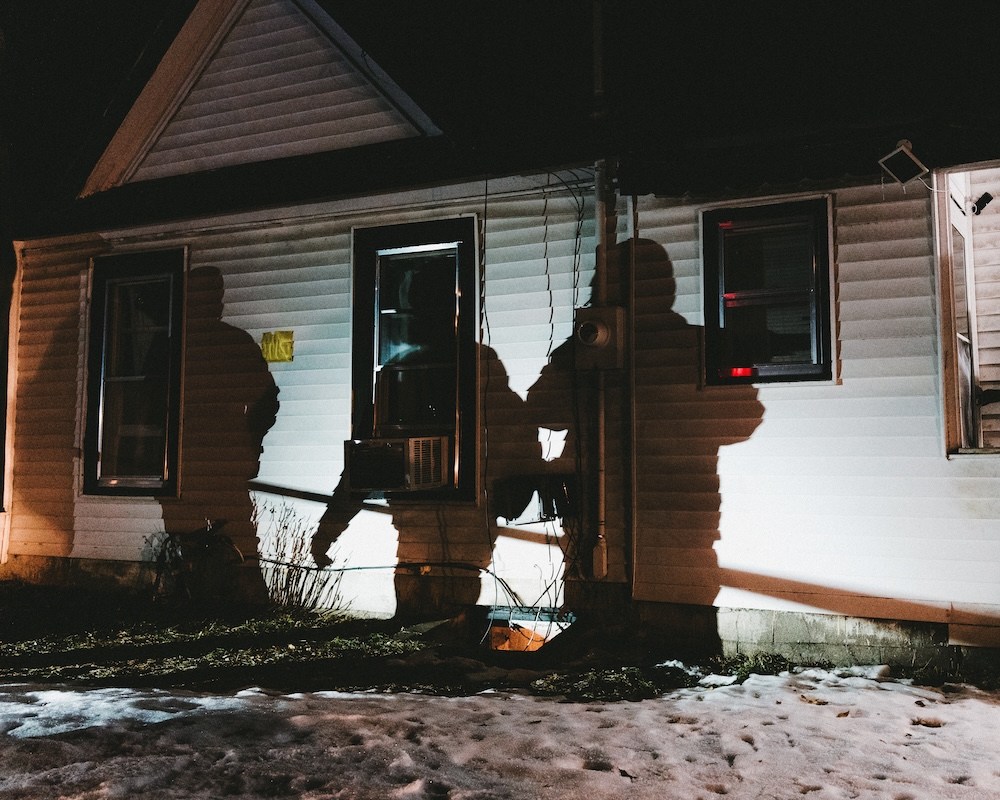
In the opening scene of They’re Here, the viewer travels alongside an unseen observer who identifies herself as “Liz Lemon" while she tails an ICE vehicle through northeast Minneapolis. The sequence culminates in a heart-stopping moment when an agent pulls up outside of the resident’s own home and silently, ominously points at her. Displaying the steely calm so many ordinary Twin Citians showed in standoffs with ICE this winter, she tells a volunteer dispatcher, “I'm not afraid of them.”
Nine months after federal agents shot and killed Renee Good and Alex Pretti on the streets of Minneapolis, a new documentary about the terror wrought by Operation Metro Surge is making the rounds of the fall festival circuit. Directed by Oscar nominee Laura Poitras and journalist Rachel Lauren Mueller, the 25-minute filmThey’re Here collates on-the-ground footage from the rhizomatic, non-hierarchical networks of citizens counter-surveilling ICE.
Minneapolis resident Adam Mellion (who would become a researcher and co-producer on the film) had been working with Poitras for several years. During the ICE occupation, she asked him if he knew anyone shooting footage in Minneapolis, and he introduced her to Mueller.
“I was out filming every day,” Mueller says. “I would send Laura footage and she would edit. And over time, I developed what became the cinematic language for [the film].”
The filmmakers agreed to employ a distinct visual signature to immerse their audience in a harrowing, sometimes uncanny space. Features like Children of Men and Nickel Boys served as signposts for sequences like the film’s opening.
“Cinema has the potential to communicate a situation like this uniquely,” Poitras says. “We were interested in how cinema could denormalize the violence that was unfolding in Minneapolis… not to add aesthetics to reality, but to actually get us closer to reality.”
Anchoring They're Here is the testimony of an immigrant laborer using the pseudonym Éden Villa. Villa’s account of traveling to and from work in the trunk of his car is dramatized by Mueller's footage, yet this aesthetic flourish is rooted in a practical concern: the safety of their source.
“We knew that an immigrant story was going to be central to the story that we were telling and that that person was going to be anonymous. There wasn't a question about that,” Mueller says.
Poitras demurs when called a “humanist” filmmaker (“It’s not language I ever use because we all are human”). Yet They’re Here builds on her prior portraiture of dissidents like Nan Goldin (All the Beauty and the Bloodshed) and Edward Snowden (Citizenfour) who contest the brutality of global capitalism as abetted by panoptic surveillance methods.
“Surveillance has always been a tool of the state to monitor dissent and then to target people,” Poitras says. “And so what we saw in Minneapolis was really scary. We know that they were using facial recognition to document the people who were protesting.”
The film descends into a wintry hellscape marshaled by former Border Patrol commander-at-large Gregory Bovino lobbing tear gas at community members with Napoleonic pageantry. One shot Mueller captures of a tank rolling through a miasma of green smoke is indelibly frightening, and no less chilling is the footage from Nick Benson at the Minneapolis-Saint Paul International Airport of detainees being shuttled onto an Eastern Air Express plane to destinations unknown. Yet digital maps of flights monitored by organizations like MN50501, Human Rights First, and Flight Aware help contrast fascist overreach and grassroots resistance, encapsulating the film's fragile hope.
“There's a through line in my films around… the importance of resistance, how resistance can be effective, how organizing matters in moments like this,” Poitras says. It’s a philosophy that aligns closely with Minneapolis’ storied history of local activism, from the American Indian Movement of the '60s to the neighborhood watch groups that formed during the 2020 George Floyd uprising.
“This is not the first time that we've seen a very intense military force on our streets,” Mueller says. "So when ICE arrived, some of these things were already organically in place… I think that really is part of what seeded the success of the resistance of the occupation.”
They’re Here received a warm reception at the Venice and New York Film Festivals, and the film will have its first local screening at the Riverview Theater in Minneapolis this Wednesday. (That screening is sold out, but another is scheduled for November 4 at the Cedar Cultural Center.)
Asked how the global community can support Minneapolis, Mueller singles out the Minnesota 15, who are under investigation for charges of domestic terrorism. She hopes the film will serve as a call to action for viewers in communities across the U.S.
“ICE is very active across the nation right now,” she says. “Despite the huge economic impact that has happened to the Twin Cities, we'll figure it out. I think that the greater risk is to ignore the ways in which ICE is stealing people from other communities.”
Poitras also urges the journalism community to continue investigating the alleged human rights abuses committed within ICE detention centers, and asks local organizers to boycott companies that profit from the patronage of ICE officers. “We can demand more transparency and accountability so that we know what's happening,” she says.
They’re Here
Where: Cedar Cultural Center, 416 Cedar Ave., Minneapolis
When: 7 p.m., November 4
Tickets: $12.75; more info here