

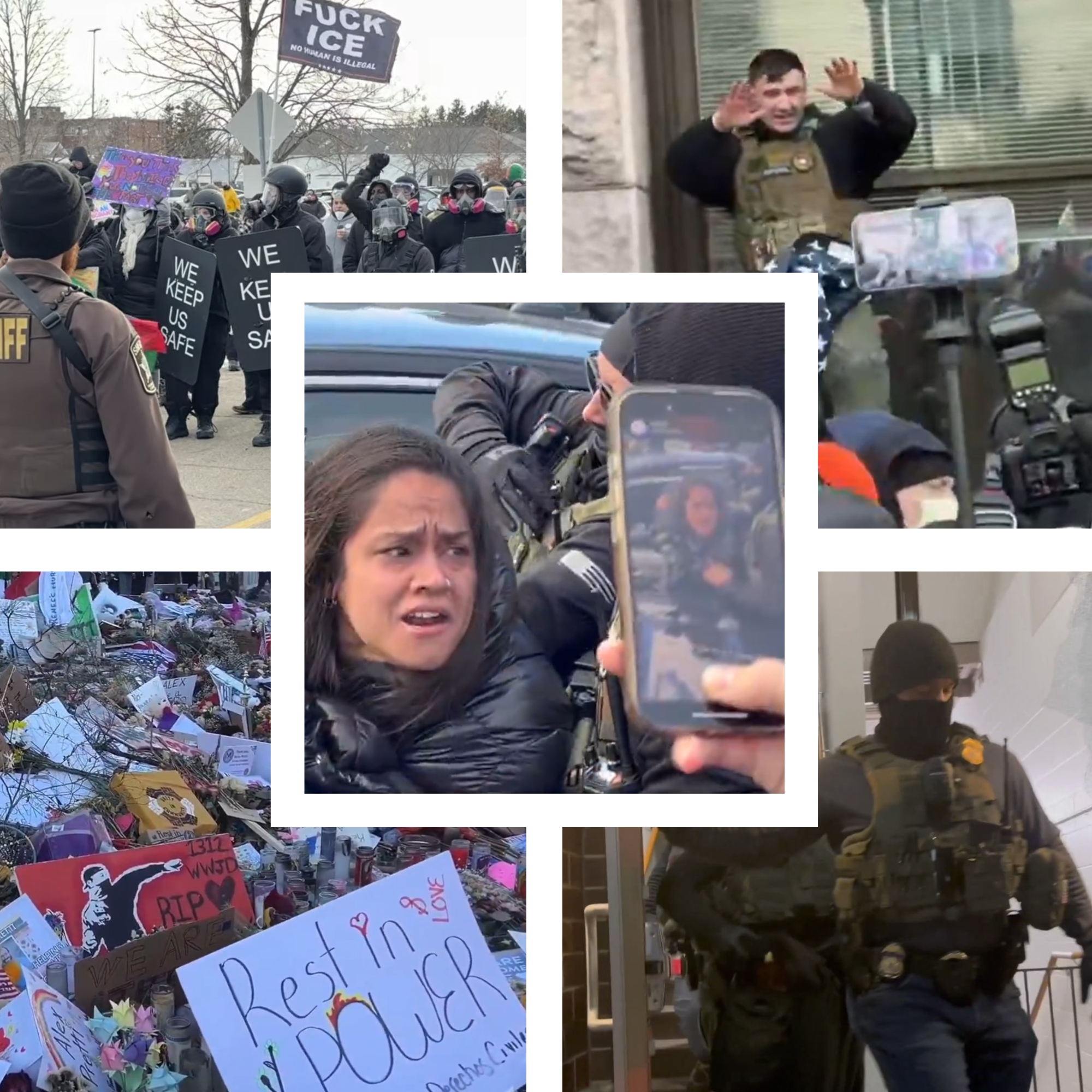
Like a fleet of glowing periscopes, they followed the months-long chaos of Operation Metro Surge throughout Minnesota: smartphones and cameras, hoisted high and aimed at federal agents, the people they detain, and local protesters.
Some are attached to journalists of various ideological leanings. Some belong to activists. Some are wielded by clout-chasing influencers, while others are weaponized by political provocateurs. They’re all competing alongside establishment reporters to capture some twist on the same story: a state under siege by 3,000 federal agents carrying out President Trump’s anti-immigrant agenda, and a citizenry pushing back with all its collective might.
"It's quite frustrating when you have 100 selfie sticks, you know, blocking someone from Getty or AP who literally have the reach of the entire world, taking a livestream that two people are watching,” says independent reporter Amanda Moore. “On the flipside of that, it's really nice to have all these videos collected.”
That’s where we find ourselves in this era of livestreaming: journalists and citizens surveilling the surveillance state, with good-faith operators hoping undoctored footage can reveal truth amid moments of gunfire, abductions, and violence. Yet it’s also the era of AI deepfakes, increasingly brazen government lies, and a diminishing shared consensus about what “truth” even means. It all feels a million years removed from the Arab Spring of 2010, back when Big Tech championed social media as a benevolent force for sociopolitical change.
“Now livestreaming has transformed the media landscape,” Unicorn Riot co-founder Niko Georgiades observes. “There's right-wing cats that've infiltrated all these places—all the Nicks, Nick Shirley and Nick Sortor. They're at the White House’s ‘Antifa Roundtable’; they're getting big money. You see 16-year-old kids with selfie sticks on TikTok. It's the content-creation game; it's the new game of media."
Meet the Streaming Journalists
Formed in 2015 out of the Occupy movement, decentralized nonprofit newsroom Unicorn Riot became a local pioneer of livestreaming civic tumult after Jamar Clark’s killing (2015), Philando Castile’s (2016), and George Floyd’s (2020).
The uprising that followed the police murder of Floyd put Unicorn Riot on the map, Georgiades says, though he’s quick to credit other early Twin Cities streamers. UR watched their bank account nearly drain entering ‘20, he adds, but their dogged work that May and June on the streets of Minneapolis brought in waves of donations. Georgiades livestreamed the storming of MPD’s 3rd Precinct and filmed cops firing rubber bullets and teargas into crowds all over town; he says his outlet was targeted “really hard” by police. Unicorn Riot has been busy documenting social justice movements around the globe ever since.
When discussing livestreaming, roving and prolific video journalist Ford Fischer pushes back against the term “new media.” He points out that back in 2014, as a college student at Washington D.C.’s American University, he was already uploading raw protest and rally footage with his News2Share co-founder Trey Yingst. Fischer has since become a video-licensing powerhouse, while Yingst now works as the chief foreign correspondent at Fox News.
Like Fisher, independent reporter Amanda Moore left her D.C.-area home late last year to—more or less—track now-disgraced DHS Commander Greg Bovino on his immigration warpath around the U.S. Her reporting career began during pandemic when she went undercover to report on far-right extremism; Mother Jones contracted her to film and write about Operation Metro Surge, among other surge hotspots. Last week (a possibly schnockered) Bovino tweeted out fantasies about her making him “heirloom apple” pie.
Locally, outside of Unicorn Riot, we’ve got St. Paul-based Andrew Mercado, whose Mercado Media channel has racked up 100K+ followers on Facebook and YouTube. He has been seemingly everywhere during Operation Metro Surge, dodging DHS flashbangs and riling up right-wing provocateurs (more on that later). Mercado’s media operation began when he put down the PlayStation 4 controller in 2020. (Though his channels still feature hours of video-game livestreaming.)
"I was tired of sitting at home and watching the Covid briefings every day,” he says. “I was playing Call of Duty: Warzone, and my friends were like, 'Well, let's go down to George Floyd Square and see what's going on.' I went viral over at the 3rd Precinct, which had obviously turned into riots."
And there’s Twin Cities-based Rebecca Brannon, a former Alpha News and Turning Point USA contributor whose coverage helped bring down two very messy Minnesotans—drunk driving Hennepin County Sheriff Dave Hutchinson and scandal magnet Jennifer Carnahan. Following a years-long hiatus, Brannon recently dusted off her Twitter account to begin streaming anti-ICE protesters. She says frustration over the post-2020 influx of influencers “farming for engagement” inspired her to get back in the game.
"Nowadays compared to then, it's such a different world,” Georgiades says, reflecting on 2020. “The content creators, the monetization… There's such a vast landscape of monetization in these social platforms that has created a grifty nature.”
Different Streams, Different Angles
“We bring the voice of the community to the public,” Unicorn Riot’s Niko Georgiades says. “How do you do that? You bring a microphone to the people who are struggling on the front lines. We were a part of helping that push—bringing consent-based, community-centered media rather than the corporate standpoint of, 'Oh, the police said this...'”
The UR crew has deployed that bottom-up, left-wing approach around the world—from the Dakota Access Pipeline protests to environmental advocacy in Germany. Early on, the 30ish-member collective shunned YouTube and Facebook for principled anti-corporate reasons, but ultimately they relented. The reach of 500,000+ Facebook followers, and its ability to spread their missions, mattered too much. “We had to adapt,” Georgiades says. UR still rejects ads, sponsors, and platform monetization.
Amanda Moore assumes a more traditional journalistic posture, though through an unabashed progressive lens. “I mean, I work for Mother Jones,” she says with a chuckle. She has also written for lefty outlets like The Intercept and The Nation, and her work during Operation Metro Surge took an unflinching look at ICE’s campaign of terror:
"I see what's happening with ICE and Border Patrol as kind of an extension of what I was already doing with the far right,” Moore says. “Now instead of Proud Boys beating people up in the street, it's just state violence. I think this is fun for them, this brutal display of force that's essentially terrorizing people and neighborhoods."
Andrew Mercado has plenty of opinions, and he's leveraging lots of ways to share ‘em: Twitch, YouTube, Discord, Twitter, Facebook, etc. "I'm terminally online. It sucks. My whole job is online... I'm with the times, I guess," the 33-year-old military vet says. You can buy him a coffee online, you can support his Patreon, or you can purchase a YouTube Super Chat. At night, you can flip over to Mercado Gaming to watch him stream hours of Metal Gear Solid. He’s hoping his political livestreaming cross-pollinates with his gaming feed.
"I kinda wanna be like Reuters or AP, but with an interactive chat. I'm one of the few that bring streamer culture into it,” Mercado says. “With my livestreaming, I'm filming, doing journalism, and when I'm at a scene and things slow down, I'll pull up my YouTube or Twitch chat. I'm trying to build a community.”
Rebecca Brannon bristles at being characterized as a right-wing photojournalist. It’s true that her recent footage, mostly of activists near Minneapolis’s Whipple Federal Building, along Nicollet Avenue by the Alex Pretti Memorial, and outside of the University of Minnesota’s Graduate Hotel, gets lapped up by MAGA tweeters looking for evidence of looney leftists. But she insists her commentary-free coverage is objective, and that past experiences with right-wing media left a bad taste in her mouth. "They want the outrage clickbait," she says of working with Turning Point USA and some extremely online Minnesota-based conservatives.
-7 degrees #Minneapolis
— Becca Brannon (@RebsBrannon) January 25, 2026
Anti-ICE protesters bang on dumpsters and trash cans from their makeshift barricades as they chant ‘Fuck Ice!’
They continue to hold several intersections completely blocked off along Nicollet. pic.twitter.com/gwRcVFFjvF
"It's tense out there, the mix of journalists and influencers,” Brannon says. “Authorities don't know who's really press and who's not. It makes it harder for everybody. You know, what's real and what's not? It's this battle of information."
Fischer conducts himself with an eye toward history. He defines himself as a primary-source documentarian, meaning he intends for the raw images he captures to become the building blocks of news stories and documentaries. He doesn't claim neutrality, which he considers a trap of mutual equivalence, but prefers to let his material speak for itself. Fischer’s archival footage has appeared everywhere from Frontline to South Park.
Like his friend Moore, Fischer never stops zigzagging across the country for work. "I think you need people who can provide a comparative analysis by timelining Trump's movements from one community to the next,” he says.
“It Was Dark”: Reporting Memories of Operation Metro Surge
Amanda Moore can’t shake the ICE/CBP violence—and the public indifference to it—she witnessed while reporting on Chicago’s Operation Midway Blitz last fall. She doesn’t understand how or why Minnesota was so different.
"Where the fuck was everybody in Chicago? No one gave a shit. No one. It's crazy. It's baffling,” she says. “All these reporters and people flocked to Minnesota in a way they didn't flock to anywhere else."
Moore describes the networks of Signal-chatting ICE watchers she met during her time in the Twin Cities as “truly remarkable,” and theorizes that the under-reporting of Operation Midway Blitz may have emboldened immigration officers when Minnesota entered their crosshairs. “There was a rapid escalation,” she says.
Border Patrol federal agents in St Paul break the window of a man in a gas station, pull him out of the car and arrest him while firing pepper balls at activists crowding around the scene. pic.twitter.com/erwtvMfqOF
— Ford Fischer (@FordFischer) January 11, 2026
Of all the scenes Fischer recorded during his two weeks in Minnesota, one of Greg Bovino & Co. dragging a man out of his car at a St. Paul gas station is burned into his memory. “When I published that video, for a few days I got messages of people asking if I was able to confirm that person was alive. My honest answer was, 'I don't know,’” he says, adding that he later learned the man is awaiting deportation inside a Texas detention facility.
The following month Fischer posted clips of ICE agents driving like idiots. The official ICE account later accused him of "stalking" those officers. "It isn't journalism—it's activism," the agency's social media team scolded. To which Fischer responded: "Following and filming federal agents or any type of police from a safe distance is our journalistic and American duty under the First Amendment."
"More cameras out there is good, more influencers being out there is bad," Fischer says, adding that he'd rather not name names.
Moore doesn’t share those reservations. She’s happy to call out Nick Shirley, whose shoddy viral video on alleged Minnesota daycare fraud created the spark for Operation Metro Surge, and January 6 rioter turned far-right activist Jake Lang, whose recent MAGA stunts backfired multiple times in Minnesota.
"I don't interact with them. Nick Shirley is a propagandist for the state, not a journalist; Jake Lang is an insane neo-Nazi and insane narcissist,” she says, noting with a laugh that Shirley’s mother tends to accompany him on his recording trips. “You can't be blowing a whistle and calling yourself a journalist. Just like you can't be snatching a whistle out of someone's hands and calling yourself a journalist, right?"
JAKE LANG GETS PELTED WITH WATER BALLOONS
— Mercado Media (@MercadoMedia1) January 17, 2026
Lang stood in a window only to be hit with water balloons and at one point a super soaker.
📸: @Guru_Merc pic.twitter.com/2FiL5kfm3V
Last month Andrew Mercado imposed Sabrina Carpenter music over a “cringe” video by a Lang acolyte, Jayden Scott. It didn’t sit well with Scott, who menacingly posted footage of himself lurking outside of Mercado’s apartment. Mercado remains unfazed. “There are scary people on the internet, but him? No. He's a little guy,” he smirks.
Unicorn Riot covered the vigils for Renee Good and Alex Pretti, protests at the MSP International Airport and the Whipple Federal Building, and Jake Lang’s ass getting shame-marched outta town. Nothing Niko Georgiades witnessed from federal agents caught him by surprise. "They're violent, untrained, racist... but isn't this normal in America? This is what America is," he says.
Mercado’s core memories of Operation Metro Surge revolve around a standoff between workers, marooned on a rooftop in Chanhassen, and the ICE thugs waiting to abduct them below. And the clouds of teargas and thunder of flashbangs that filled north Minneapolis the night ICE officers shot Julio C. Sosa-Celis in the leg; the agency’s lie-loaded account of that shooting has since disintegrated under scrutiny.
"That was a sample of authoritarian fascism. The federal government came here and treated it like a war zone—them vs. us. It was dark, especially when Greg Bovino was here," he says. "To not really have the support of any government at all... I mean, our government was cucked. Truly, we were on our own. The journalists looked out for each other, the activists looked out for each other, the community looked out for each other."
Surveiling the Surveillance State
A throughline of all our conversations with streamers? Hypervigilance when it comes to recording the actions of the state.
There’s a baked-in irony to that, considering the recent rash of DHS immigration surges have seen the government triple-down on its own surveillance programs.
The Department of Homeland Security’s Inspector General is investigating whether ICE's facial recognition AI, face-scanning apps, social media snooping, license plate combing, biometric databases, and contracts with sinister tech firms like Palantir have broken the law. With a freshly ballooned budget that's on par with the world's 14th best-funded military, ICE "is going on a surveillance shopping spree," according to the Electronic Frontier Foundation. DHS is "circumventing the Constitution" as it hoovers up data without warrants, the ACLU notes, and its AI-powered person tracking "crosses [a] dangerous line,” per the American Immigration Council. As Operation Metro Surges reportedly winds down, there's a push to preserve footage captured by 950 cameras owned by the city of Minneapolis, highlighting yet another layer of government surveillance.
Andrew Mercado is cognizant of the “moral limits” livestreaming can run into. “When you're streaming, you're live and you know the government is watching too,” he says, adding that considerations about blurring faces can’t be addressed in real-time.
Fischer admits to finding it "a little frustrating" when influencers enter the media throng and make it about themselves. But, he adds, "I actually think it's good for people to be filming police of every kind—that's something I've been advocating for a decade."
He cites the brave bystander video shot by teenager Darnella Frazier as MPD officer Derek Chauvin kneeled on George Floyd’s neck, noting that police initially described the resulting death as a “medical incident”; he cites the multiple videos that defy Homeland Security Secretary Kristi Noem’s assertion that Renee Good and Alex Pretti were committing acts of domestic terrorism before their deaths. "For moments when the details really matter, I would like for the public to be prepared to film,” he says.
Unicorn Riot’s Niko Georgiades agrees that, in this historically dark political moment, sunlight is the best disinfectant. It doesn’t matter whether that’s achieved from a selfie stick or a 4K rig with optical zoom lens.
"They lie. They consistently lie. It's so important for people to be the watchers,” he says. “Thank you, thank you, thank you to all the media makers for putting your lives on the line. The media and citizen observers."