


On an overcast, mid-70s morning in August, one monarch butterfly flits through an incongruous floral fusion of crimson roses and sunny black-eyed Susans on the boulevard in front of The Brothers Cafe on Lyndale Avenue. I’m waiting for Minneapolis writer Kawai Strong Washburn to arrive by bicycle.
KSW (I’m making this a thing) is an award-winning author and social justice activist with a new novel, the follow-up to his first big-deal book, 2007’s Obama-bumped Sharks In the Time of Saviors. The plot of The Names of the New World (Farrar, Straus and Giroux, 448 pages) is drenched in climate disaster. In anticipation of our conversation, I’ve paid extra attention to headlines I’d rather skip: Lala pounding Hawaii, drought evaporating Lake Mead, the Bear Trap fire scorching the Superior National Forest.
The butterfly triggers my solastalgia, a contemporary psychological phenomenon KSW describes in Names as, “The feeling that things you loved were already on a path of undeniable loss that you had no way to prevent, so the good-bye was already happening, the goodbye was every day alive.” In the not-so-distant past, migrating monarchs coated the tree branches in the backyard of my childhood home in southwest Minnesota. Orange-and-black wings covered every leaf. Flutters filled the air under the maples and ash. Now, no matter how much milkweed and blazing star I seed in my Minneapolis backyard, only scant handfuls of the pretty insects show up. Habitat loss, oversalted roads, and neonicotinoid insecticide are responsible for their drastic diminishment, all things I can’t control.
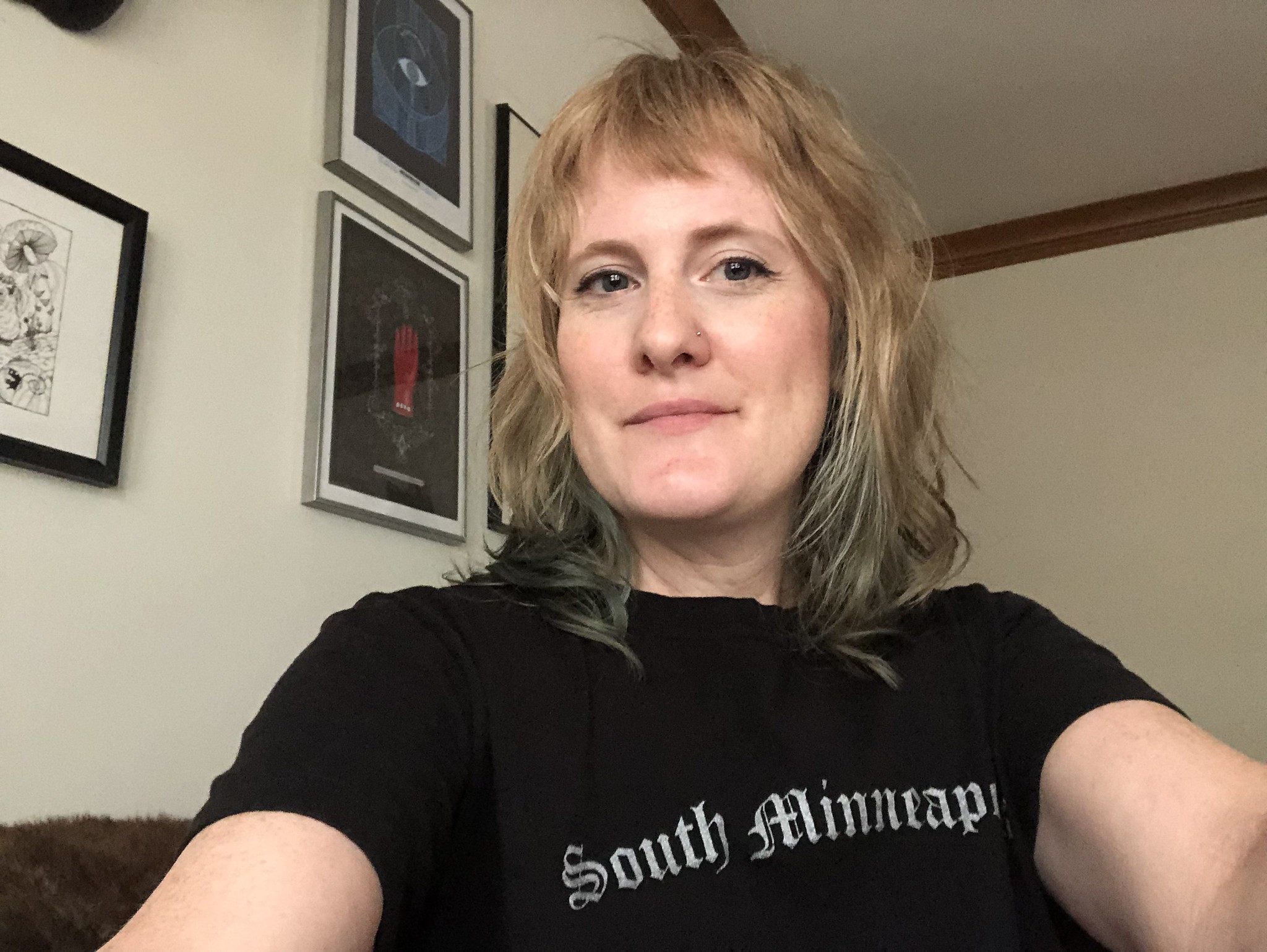
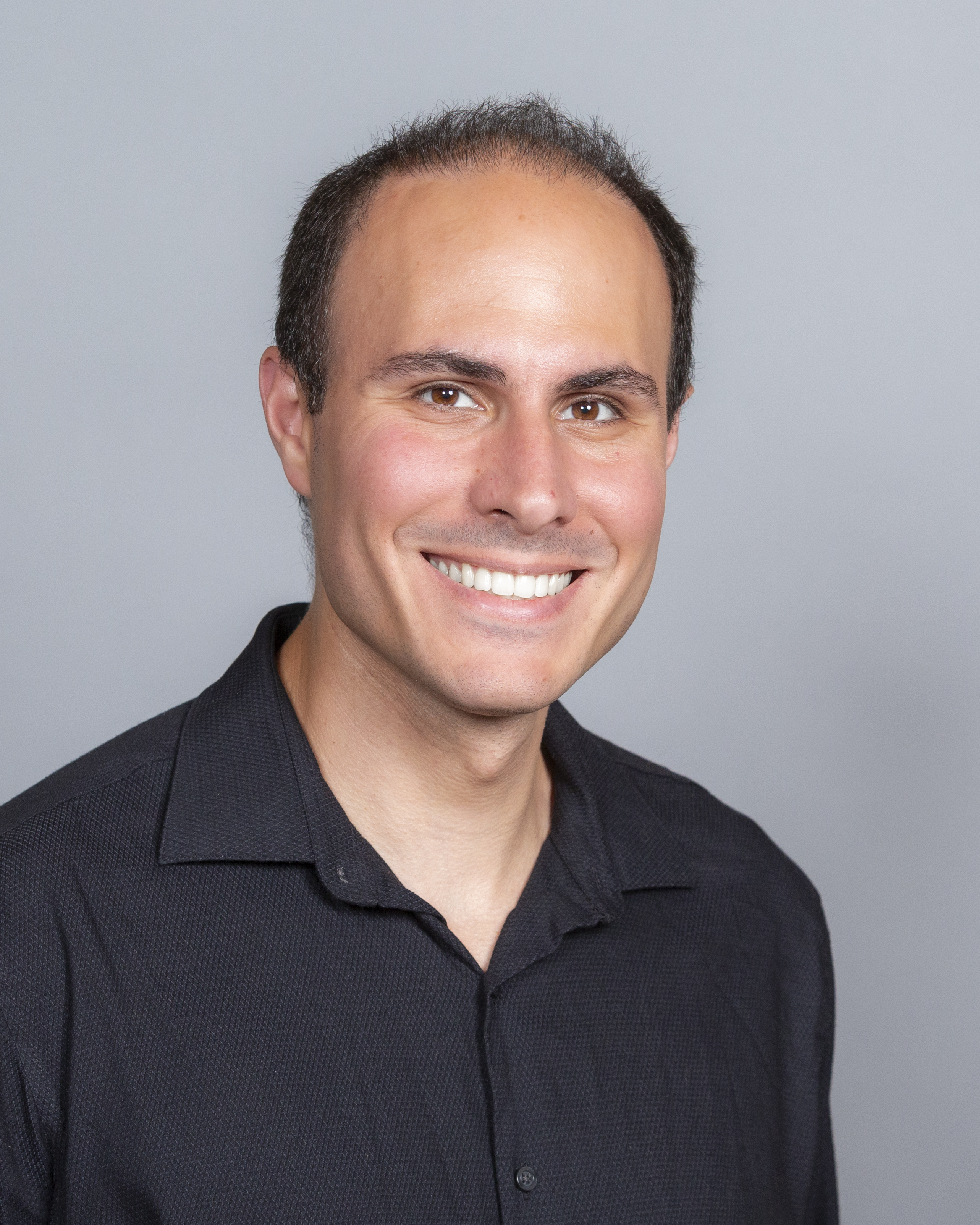
Just in time to interrupt my monarch sorrow, KSW rolls up on a sleek road bike in Ray-Bans, black skateboard sneakers without socks, grey nylon shorts with keys dangling from a belt loop, and an employer-swag laptop backpack. He’s 6-feet-tall and 20th-century skinny, his body free from ultraprocessed snacks, red meat, and car commute abuse, kept slim by rock climbing and cycling. He wears an Apple Watch, diamond stud earrings, an etched silver wedding band, and a tattoo on his inner right upper arm.
Inside a sheltered booth that’s ideal for conversation recording, KSW scans the eggs-and-bacon heavy diner menu. Nothing appeals. He used to be vegan, now he’s vegetarian. He politely says he’s not hungry. We order a matcha latte and coffee.
KSW has high cheekbones and short dark hair with a bleached streak in the front. We’re the same age—46—and my hairline’s going silver in the same place. Is the blonde hiding grey? “No,” he says, “It’s just a fun way to stay creative.” A highlight is cheaper hair flair than the cornrows he used to maintain and less boring than the Caesar cut he had before his last grow-out. His short-sleeved, slate-blue collared shirt with palm-tree print looks tailored. KSW bought the aloha shirt on his last trip to his home state from a custom made-to-order apparel company called Olomana.
KSW grew up in Honoka’a, a former sugar plantation town on Hawaii’s Big Island, in a blended family with mainlander parents. His mother, who is Black and grew up in Kansas City, Missouri, moved to the island seeking relief from continental U.S. racism. His father, who is white and from Oklahoma, went for a graduate program in music composition and ended up spending his career at Honoka’a High School. As a music educator, Gary Washburn earned a “Living Treasure of Hawaii” distinction from the Hawaii State Senate and a Grammy Signature Schools Award.
KSW has an older half brother, an older brother, and a step-brother and step-sister, twins his same age. His grandparents moved from Oklahoma to the Big Island when he was a kid, and KSW’s grandmother would drive him to the nearest bookstore, 40 miles away in Hilo, to buy him Michael Crichton novels and Anne McCaffrey’s Dragonriders of Pern series.
After high school KSW went to college at University of Portland, where he studied computer science, learned to snowboard, and socialized with other Hawaii transplants. He also graduated from Columbia’s School of International and Public Affairs with a master’s degree. “I’m interested in the deep intellectual rigor of [applying research] to hard problems in the real world that are making a difference in people’s lives,” he says. He contemplated a Ph.D. but wasn’t interested in participating in the churn of academic research.
KSW has traveled the world and lived on multiple continents. Between college and graduate school, he taught English at a middle school in Namibia. A quarter-turn of the globe away, he lived in Nicaragua and Guatemala, studying Spanish and working for a social service agency to build their website. His drive to problem-solve took him to Nigeria, where he worked with the United Nations Development Program on the Millennium Villages project. Later, a job with an international nonprofit led to weeks-long stints in Liberia, Ghana, and Palestine’s occupied West Bank.
While working for a microfinance organization in Washington D.C., KSW met Christine Strong, a former Stillwater High Pony who captained her high school’s Nordic Ski Team. The two married after dating for just 11 months. They moved to the Bay Area in 2015; KSW’s stepmother was dying of cancer and California provided an easier time zone for phone calls and flights home. By 2019, the Strong Washburns were raising two kids in a place where they couldn’t play outside.
“The wildfires got really bad, like apocalyptic. You saw people walking around with masks. The skies were orange,” KSW says. Between the smoke, the water issues, and housing costs, California felt unlivable for the long term. KSW wasn’t eager to leave the ocean, redwoods, and nearby mountains. He had imagined teaching his kids to surf, but had to abandon that parenting dream. When the Strong Washburns decided to move, KSW’s family was scattered over two Hawaii islands, Texas, Missouri, and Oregon. His in-laws were all in Minnesota, so a climate migration to Minneapolis made sense.
All the while KSW was pursuing his graduate degree, building his career, and creating his young family, he wrote. A literary light first switched on during his Namibia job, right out of college in 2003, before e-books. A fellow traveler had left a Hemingway short story collection behind. When KSW read “A Clean Well-Lighted Place,” he says, “I was like, I don’t understand what just happened but I’m a different person now than I was 10 minutes ago.”
Denis Johnson’s Jesus’ Son, a gateway short story collection for many sad young literary men with publishing aspirations, sparked a similar feeling to the landlocked-with-Hemingway scenario. So KSW wrote short stories that remain unpublished and a first novel that “is just going to digitally decay somewhere.” He read craft books, took classes, and attended a couple of prestigious writing workshops.
At a Bread Loaf Writers’ Conference, he made friends with Kathryn Savage, who is now an associate professor and coordinator of the BFA in creative writing program at Minneapolis College of Art and Design (the acknowledgements section of KSW’s debut novel says he would take a bullet for her). Savage describes KSW as “easily one of the most motivated, hardworking people I’ve ever met.” His first fiction publication, the short story “What the Ocean Eats” about a young surfer’s strained relationship with her divorced parents, was published in McSweeney’s (the literary magazine, not its satire website), and anthologized in The Best American Nonrequired Reading 2015.
How about critique partners or beta readers? KSW doesn’t need ‘em. “I’ve almost always written on my own,” he says. “Multiple drafts until I think it’s in a really strong place and then I take it to my agent [Duvall Osteen]. I trust her with what she thinks and then I just work with my editor.” Osteen, now at United Talent Agency, sold KSW’s debut to Farrar, Straus and Giroux. Sharks In the Time of Saviors is a masterpiece set in Hawaii, what J. David Gonzales writing for Los Angeles Review of Books called “one of the most richly imagined and evocative debuts in recent memory.”
The pandemic curtailed the book’s publicity plan and nearly kept it from readers. Then Barack Obama named it a 2020 favorite. After that, a long tail of accolades kept the book in cultural conversation. Sharks won the 2021 PEN/Hemingway Award for Debut Novel and the 2021 Minnesota Book Award for Novel and Short Story. Regional library leaders selected Sharks for the Friends of the St. Paul Public Library’s One Book program in 2024. The Friends’ Senior Director of Programs and Services Alayne Hopkins says KSW was “terrific and lovely” to work with, and the book reached readers across 40 Minnesota counties.
Since the publication of Sharks, KSW has achieved markers of literary success. He taught a workshop through McCormack Writing Center (formerly Tin House) and Chatham University’s creative writing MFA capstone summer residency seminar. But, like most contemporary writers—even award-winning Obama list makers—KSW has a day job. He used to work for a cobalt mineral exploration company that built ethical supply chains for electric battery materials. From November 2025 to July 2026 he intended to write full-time and finish revisions on his next novel, Wavebrother, but the federal occupation ate up his time and creative energy. The wobbly economy drove him back onto the job market and his job search gobbled the rest of his writing time. This July, he started work at Cape, a privacy- and security-focused mobile phone carrier start-up.
He wakes in the fives to get at least an hour of writing in before his children get up, although he finds the pre-dawn routine is harder in his mid-40s than it used to be. He squeezes edits into his lunch break and weekends. During an author visit to one of Savage’s MCAD classes, KSW advised undergraduates to “Write every day, even when you don’t want to.”
KSW gives verbose answers to even my yes-or-no inquiries. When we get to his climate activism, he explains the intricacies of the five U.S. regional electrical grid operators, and I get the sense he’s operating in a different dimension than average climate activists. “[Lobbying] is much more effective when you can speak authoritatively about specifics of the legislation you’re proposing,” he says. He’s been an environmental advocate for the last decade, volunteering in a significant capacity for Citizens Climate Lobby, MN 350, and now Unidos.
KSW drew upon his climate advocacy when writing Names of the New World, a work of climate fiction that begins with an ultra derecho destroying parts of Minneapolis. Amid the mangled rebar and broken glass, three strangers meet. Each is vexed by an intense intellectual riddle: how to be a good person in the midst of Earth death that cannot be solved through micro personal action or macro professional action.
Naomi, a solastalgia-suffering Midwest transplant from Hawaii with Marshall Island ancestors is a bleeding heart with a violent streak kept compartmentalized by a mixed martial arts hobby. She wins a Congressional District 5 seat and disrupts D.C., in the mold of U.S. Rep. Ilhan Omar. Raheem, a burly tradesman with a gentle side shown through his facility for braiding his wife’s and daughter’s hair, stands to lose his economic agency if the grid gets electrified. Amaré, a private equity bro from south Minneapolis who has gone to Chicago to seek his own fortune, gets pulled back home to Minneapolis by his carnal attraction to Naomi. When Amaré reluctantly acquiesces to Naomi’s save-the-planet mission, he turns into a devoted stay-at-home dad with post-partum depression.
The book’s chapters alternate between a close third-person perspective on each character, their interior landscapes so distinctively drawn I began to think of them as a climate horror version of red-soled Sex and the City archetypes. I’m a Naomi when I bike to buy organic beets at the Kingfield Farmer’s Market, a Raheem when my minivan burns dino skellies on a grocery budget-stretching trip to Costco, and an Amaré when I browse the Patagonia website for chic and sustainable winter outerwear. The three represent the struggle of how to behave in the Anthropocene end times, with an occasionally heavy-handed dichotomy: You can either enjoy late-stage capitalism spoils like an asshole or fight the machine and have no friends.
KSW’s writing is playful and a treat to read. He improvises neologisms like “eye-funk-morning-throwing-it-together-out-of-bed”; he describes vivid fights, steamy sex, and dapper fashion. Names includes the most accurate summation of what it feels to be third-trimester pregnant that I’ve ever read by a male writer: “Long gone the Deep Nausea Days and the Exhaustion Days and the Glowing Fun Hair Like a Drybar Days and then there were the Dear God Get This Monster Out of Me Days.” He excels at the awful body feel of breathing wildfire smoke: “unfiltered, tasted like toxic industrial rot, as if old steak were barbecuing on treated wood and decaying tires and circuit boards.”
The way in which the South Pacific shines in the book isn’t surprising, given the dazzling Hawaiian depictions in Sharks. KSW gives Minnesota the same I-see-you treatment: “They sent those trucks out into the flatlands, early in the morning, with the river of headlights on the black interstate and the jam of gas stations and fast-food joints and little ski hills that went brown and waterslide in the summer.”
KSW captures the culture of a place just as well as he describes settings. In 2020, he turned down an opportunity to write about the racial uprising because he didn’t feel qualified, having lived in Minneapolis for less than a year. But six years into being a Minnesotan, he writes delicate and cutting scenes about the state’s peculiar racial dynamics. Naomi gets irritable from all the dogged whatareyouwheredidyoucomefrom inquiries.
I particularly enjoyed a scene that takes place in a Greater Minnesota bait shop, when a group of Black men notice the self-conscious awkwardness with which the white staffers prove they’re not racist. I recognize those performative smiles. As a white person, I’ve made that cloying welcome face. Outstate, while camping with my family members of color, we’ve been on the receiving end of that look. No matter how well intentioned the white face is, the look still makes an Other of its target.
I started Names during a lovely, mild June that segued into a stupidly humid 300+ air-quality index July. In this super El Niño fall, the weather might be even worse during KSW’s appearances on his publisher-sponsored book tour at the Wisconsin Book Festival, Calgary’s Word Fest, Vancouver’s Writers Festival, Third Place Books in Seattle, and Powell’s in Portland, Oregon. A warmer, wetter Earth where society devolves into dystopia is a familiar climate fiction plot. A trope, at this point. Expected. Take macho examples, like the films Waterworld and Snowpiercer, and the novel The Deluge by Stephen Markley, or softer but equally sinister literary ruminations like A Children’s Bible by Lydia Millett or The Department of Speculation by Jenny Offill.
When the term “climate fiction” was coined in 2013, the works it described served to warn of a far-off future filled with civilization-destroying weather. Now that the horrors have arrived and become so commonplace that we drive our bloated vehicles unphased by NPR voices reading deluge descriptions and death tolls, the crises in Names of the New World are barely speculative. The weather KSW imagines could tick under a 2026 cable news talking head: heat waves that make Europe as hot as Baghdad; rain bombs that erase islands; king tides and storm surges from an “ocean angry with melted glaciers.” The disasters are prescient and predictive and sometimes uncanny, like the fictional fire that mirrors this summer’s Boundary Waters Canoe Area Wilderness conflagration.
So what can climate fiction do in 2026, now that the horrors are here? Matthew Salesses writes of the too-lateness problem in a Literary Hub essay: “If cli-fi acts as warning, and it is too late for warnings, what is the point? There must be another way.” KSW meets this challenge with Names. He’s not just warning or lamenting. He’s also exploring possibility and hope, which is a refreshing perspective to read, living as we are in a failing empire with a ruling class so greedy that it refuses to limit carbon pollution; so deranged that it would, if it could, ban rainbows.
Writing about climate can be “a very tricky hope seesaw,” says University of Minnesota English professor V.V. Ganeshananthan, who specializes in creative writing and contemporary fiction. I experienced a color clash of emotions when I finished the novel. More hopeful than I expected. But should I feel good? That’s the crux of cli-fi, Ganeshananthan says.
“If you tell someone to hope, are you lying to them or are you not? And how do you convey the nature of that?” she asks. “Fiction is uniquely well made, in that it can convey a lot of nuance about hope. It can convey scale and sweep of a problem. And it can convey the importance of hope as a moral stance.”
Fiction can’t reduce atmospheric carbon parts per million but it can save us from despondence as we face the challenges of a climate wrecked by fossil fuel pollution. Even if humans can’t stop themselves from skewering the atmosphere with an immolating churn of greenhouse gas and tire particulates, it’s fun to pretend that someday, enough people might get their shit together, put aside their selfish grievances, and create a different destiny for the planet.
All kinds of climate solutions show up in Names. Technology like hydrogen flights, solar panel microgrids, and bullet trains. “It was just fun trying to build things that I wanted to be part of the conversation,” KSW says. To feed his positive mindset, he finds inspiration in Canary Media and books like Not the End of the World by Hannah Richie and the anthology All We Can Save: Truth, Courage, and Solutions for the Climate Crisis, edited by Katharine K. Wilkinson and Ayana Elizabeth Johnson. With Names, KSW sees his authorial role as happy contrarian, to argue that things can get better. For humanity to continue in the face of something as big and intractable as climate change, he thinks that we need to be able to imagine a future.
“These insane tech psychopaths like Elon Musk or whatever, they talk about colonizing Mars. It’s because that was in all the stories they read when they were kids,” KSW says. When he wrote the futuristic parts of Names, he was writing with themes in mind toward seeding imaginations with positive possibilities. His spiritual life as a practicing Buddhist helped him develop the themes in Names. “Buddhism encourages a clear-eyed willingness to face things as they are right now,” he says. In writing Names, “I wanted to evoke what it might feel like to have moments of wonder and beauty and hopefulness, even in a place that is going through really challenging transitions.”
When our liquid lunch is over, KSW pedals back to work via the Bryant Avenue bike lane. I linger and write down my impressions of our conversation. When I leave, around the corner from the cafe, I see a monarch dipping in and out of a tidy allium row planted in a front yard pollinator patch. Then I see two.