


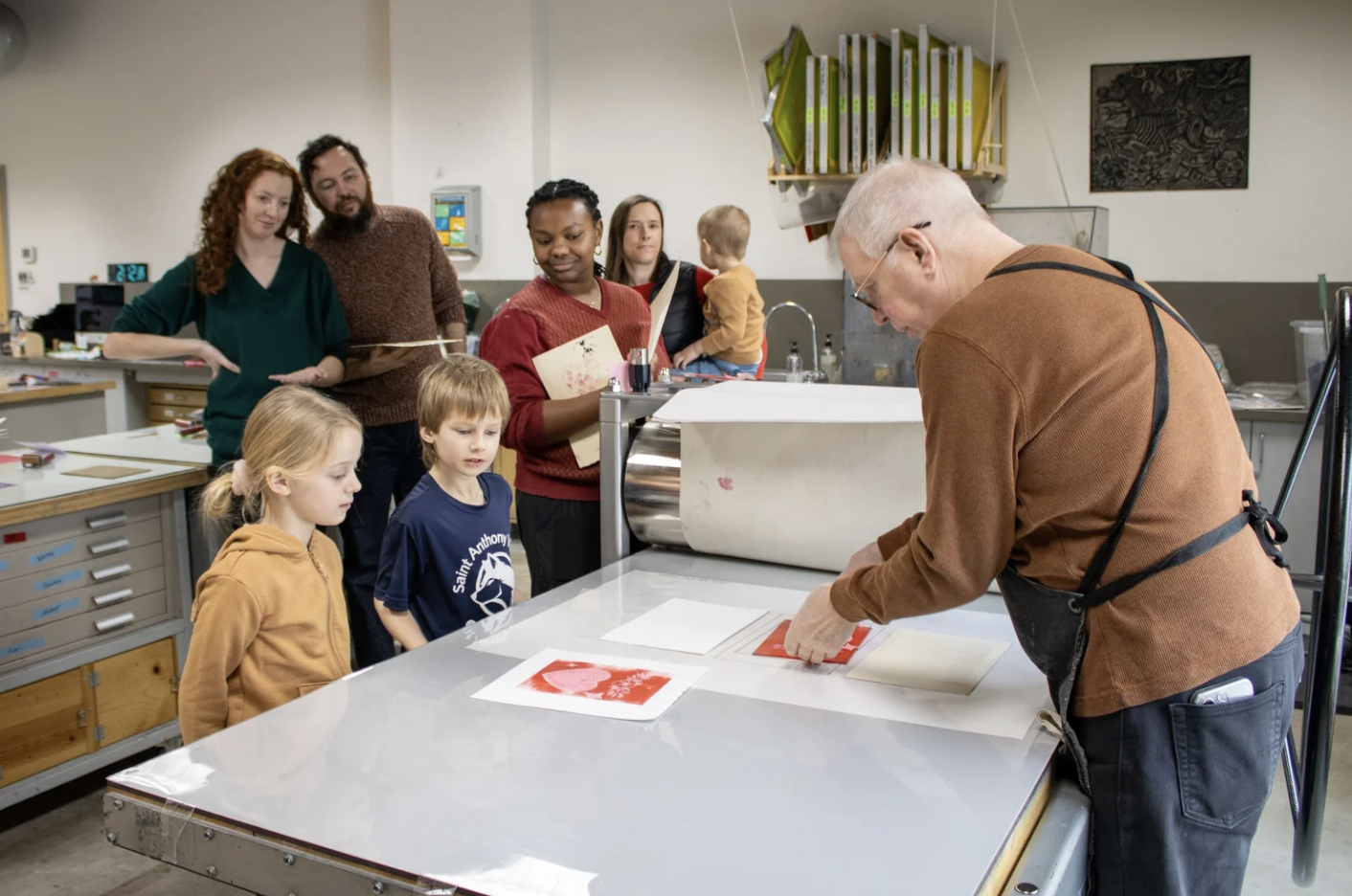
Highpoint Center for Printmaking isn't just a gallery. It’s not just a publisher and it’s not just an education center either. It’s a rare type of institution with ancient roots: a craft guild.
The Minneapolis-based nonprofit’s mission is rooted in accessibility and the need for printmaking equipment outside of an academic setting. Printmaking is a cost-prohibitive craft, but since Highpoint is a co-op artists can get around that barrier by paying a fee to use its equipment and space. “It's kind of like a gym membership. You pay a monthly fee and our members have access from 8 a.m. until midnight,” says Josh Bindewald, director of artist programming.
Since its founding in 2001, Highpoint has become an international institution, supporting nearly 500 members. It has served over 95 different K-12 schools via its youth programming. Over its 25 years, it has collaborated with 40 artists through Highpoint Editions, including three MacArthur Genius Grant recipients, Indigenous bead artist Dyani Whitehawk (recently featured at the Walker Art Center), and Jim Hodges, whose boulder monoliths Untitled you might recognize from the Minneapolis Sculpture Garden.
It all began in 1996. Carla McGrath was coordinator of the Walker Art Center’s youth program at the time.
“My boss wanted me to do printmaking classes and wanted me to buy a press, which is a big endeavor,” says McGrath. “I had done some printmaking, but didn’t feel qualified.”
So she met up with fellow educator Cole Rogers, who ran the printmaking department at the Minneapolis College of Art and Design. The two began talking about gaps they noticed in the Twin Cities arts landscape, from getting kids interested in printmaking to making resources available for post-grads.
“There were a lot of people in academia doing printmaking,” says Rogers. “Here I am teaching these students to learn lithography, to work on these big stones. When they graduate, they're going to have, let's face it, student debt, usually.”
And yet, if they wanted to continue working on their lithography or intaglio techniques after college, there was nowhere to go.
“It felt like I was at the top end of this pyramid scheme where all these people were taking out loans, and I was benefiting, but what was the next step for them?” he says.
Rogers imagined a studio that connected printmakers to equipment and to fellow artists, while McGrath realized a space like that could be the perfect vessel for youth education. They arrived at a conclusion of why not both?
So they got to work bringing their vision to life. The first order of business was to find a location. Luckily, Soo Visual Arts Center’s founder, the late, great Suzy Greenberg, had just purchased a building at 27th and Lyndale, and was searching for a tenant for the suite next door. With Greenberg as their landlord, Rogers and McGrath cofounded Highpoint Center for Printmaking in the spring of 2001, and hosted the grand opening that October.
McGrath and Rogers’s vision for Highpoint also involved a publication arm, where established artists from all over the world could visit and make prints. But Highpoint wouldn’t just reproduce work; the center would facilitate printmaking by artists who had ideas that needed stewarding.
While the artists who publish via Highpoint Editions are sometimes printmakers themselves, often their practice is grounded in other media. “That’s the best part,” Rogers says. “They’re used to painting or drawing or using watercolor or whatever and all of a sudden, we’re giving them these new materials and a whole new area to explore.”
Staff and guest curators decide which artists are invited to work with Highpoint Editions, with each member on the committee preparing a pitch for who they think would be a good fit.
“We're looking to build a program that has a range of artists,” says Jehra Patrick, Highpoint’s current executive director. “We're both launching artists’ careers and we're working with artists who have very established careers. We're also looking for a range of geography as we build the program, and a range of core disciplines that the artists are working in. This person's a ceramist, this person's a painter, this person's a sculptor. They're going to make really different prints—and that's exciting.”
The gallery area of the workshop was opened alongside the co-op in 2001 as a way to show off work from both visiting artists and members. Eventually, Highpoint began hosting schools for educational programming, closing the co-op to members until noon for K-12 classes in the printmaking workshop.
By 2005, it was clear that Highpoint had outgrown its original location. “We knew we were out of space,” says McGrath. “The professional shop was packed. We had one office and three staff people trying to use it. The roof leaked the whole time.”
McGrath and Rogers made a plan for a big move in 2008, launching a capital campaign with a $3.5 million goal.
“The Great Recession hit, and here we are in the middle of trying to raise $3.5 million,” remembers Rogers. “It's like, ‘Oh, shit.’ But they say that sometimes the best time to start stuff is when things are in the gutter.”
Another challenge came when choosing the new location. “Everybody said, ‘Why don't you go over to the Warehouse District or find some obscure or cheaper area?’” says McGrath.
But they knew that wasn't what they wanted. They wanted people to be able to come to exhibition openings and then go out to nearby bars or restaurants. They wanted co-op members to be close to coffee shops for breaks.
“We wanted the average person walking by to go, ‘Oh, what is this place?’” says McGrath. “That doesn’t happen if you're too secluded or you're two or three floors up in some warehouse.”
They eventually found the perfect fit: a purple, boxy 1952 building located at 912 W. Lake Street near Uptown. While it had originally been a bakery, the space had just been vacated by DreamHaven Books, which had moved to its current Standish location.
As news of the move was announced James Dayton, the architect behind the MacPhail Center for the Arts and an apprentice of Frank Gehry, got in touch with hopes of helming Highpoint’s building redesign.
“I said, ‘We can’t afford a real architect,’” says Rogers. But Dayton was determined. In the 1970s Gehry had renovated Los Angeles printshop Gemini Graphic Editions Limited, and Dayton intended to follow in his mentor’s footsteps. He had a generous plan, offering to renovate the building for half his typical fee, and half of what he was charging he would accept in artwork. “We kind of had to say yes,” says Rogers.
“That building is fairly nondescript,” James Dayton told Finance & Commerce in 2008. “It’s a one-story, 10,000-square-foot stucco box on Lake Street. This isn’t about a building. It’s very much about bringing the work of Highpoint out onto the street. It’s got great street frontage. They’ll have nice, big open windows. They’re ready for a bigger space, a little more visibility.”
It was decided that the gallery would be in the front of the building to welcome people off Lake Street. The publishing studio would be its own workshop, attached to the artists’ co-op to foster connections and knowledge-sharing between visiting artists and co-op members.
“The space is designed to show any visitor everything that’s going on,” says McGrath.
“When kids came in to take classes, they’d see the adults working,” says Rogers of their vision. “It wasn’t like they’re making a little craft; they could see a progression or a future.”
The bakery’s loading dock out back would be removed and replaced with a rain garden to mirror the Midtown Greenway nearby. To design it, Rogers hired a former mentor, sculptor/printmaker Kinji Akagawa. Under Akagawa’s watch, the soil was amended and the foundation of the building was waterproofed. “Much to the chagrin of the construction company,” Rogers laughs. “Their idea was to get rainwater as far away from buildings as fast as possible.”
By 2010, Highpoint Center had really hit its stride. An exhibition, titled “Highpoint Editions: Decade One,” opened at the Minneapolis Institute of Art. That same year, the center hit its $3.5 million goal.
In 2019, Highpoint paid off its mortgage, and the following year Highpoint Editions’ entire 20-year catalogue was acquired by the Minneapolis Institute of Art. In 2021, the Institute showcased the catalogue in an exhibition titled “The Contemporary Print: 20 Years at Highpoint Editions.”
Weeks after the exhibition opened, McGrath announced she would be stepping down from her executive director role. “We wanted to be a nonprofit because we wanted Highpoint to continue beyond us,” she says. “A lot of people think we would own Highpoint. We don’t—Highpoint belongs to the community.”
Jehra Patrick took on the executive director role, which she occupies today. “I feel like I’ve intersected with Highpoint so many times throughout my career,” Patrick says, “I think that’s a testament to how connected Highpoint is to the Twin Cities arts ecosystem.”
Like all of Highpoint’s transitions, Patrick’s onboarding in 2022 was subject to a unique cultural crisis. Her first order of business was to get the printmaking center fully operational again after pausing during the pandemic. There was also a shift to prioritizing community protection following the uprising after George Floyd’s murder.
“The arts are most prepared to come out ahead of that because the arts are a vehicle for resilience, right?” says Patrick. “They are the balm. We saw that with Operation Metro Surge.”
This past spring, Highpoint hosted “Resilience,” an emergency group show curated by local printmaker Maria Cristina Tavera. The exhibition documented and showcased work that had been made to protect and protest during the federal occupation.
“Print is so democratic, right? It's not like I'm holding up one painting that I made. I'm able to make multiples and get my message out far,” says Patrick. “I think using art and especially printmaking as this survival tool is unique to us. Those big heavy moments are felt by all Minnesotans. The work of artists and cultural organizations… we’re all first responders when it comes to stuff like this.”
In celebration of its 25th year, Highpoint is hosting its first-ever archival exhibition, showcasing the work of 149 artists and printmakers. In order to make this possible, Josh Bindewald reviewed 25 years of Highpoint’s membership records, dating all the way back to 2001, and emailed every member, past or present, he had record of. Of 430 total co-op members 149 responded—that’s 34% of members from Highpoint’s lifetime—submitting work for the collaborative exhibit.
By displaying just how many artists have been able to produce work via Highpoint’s membership program, the group exhibition reflects the center’s focus on community and access. Every aspect of Highpoint Center for Printmaking, from its architectural design to its ongoing programming, honors the people it welcomes into its guild: the unassuming Lake Street passersby, the 60,000+ schoolchildren since opening, the 82 paying co-op members, the blue-chip artists wanting to stretch their creative legs, and anyone else willing to come in and explore.
“We're not just a gallery,” says Patrick. “You can go all the way to the back. You can peek at someone cranking a press. That openness, not just architecturally, is also a part of the way we approach community.”
Highpoint Print Fest
Where: Highpoint Center for Printmaking, 912 W. Lake St., Minneapolis
When: 11 a.m. to 4 p.m. Sat.-Sun.
Tickets: Free!