


My SUV exits a tangle of Minneapolis freeways as my phone flashes.
“I’ll meet you down there,” reads a text from my dealer. The product is waiting in his trunk, he says. Four other customers are expected at the parking lot that windy afternoon; street supply is reportedly low and getting lower. I’m first up. I pace around his Prius and spot the stuff, all 44 pounds of it, through the window. It's just sitting out in the open—glassy, smooth, a little dusty.
Alex Garnett appears from his high-rise apartment complex and heads toward me across the asphalt. He’s literally pushing the goods. The friendly 33-year-old is ferrying a luggage cart, same kind you’d find in a hotel lobby, but instead of suitcases it supports three old-school TVs.
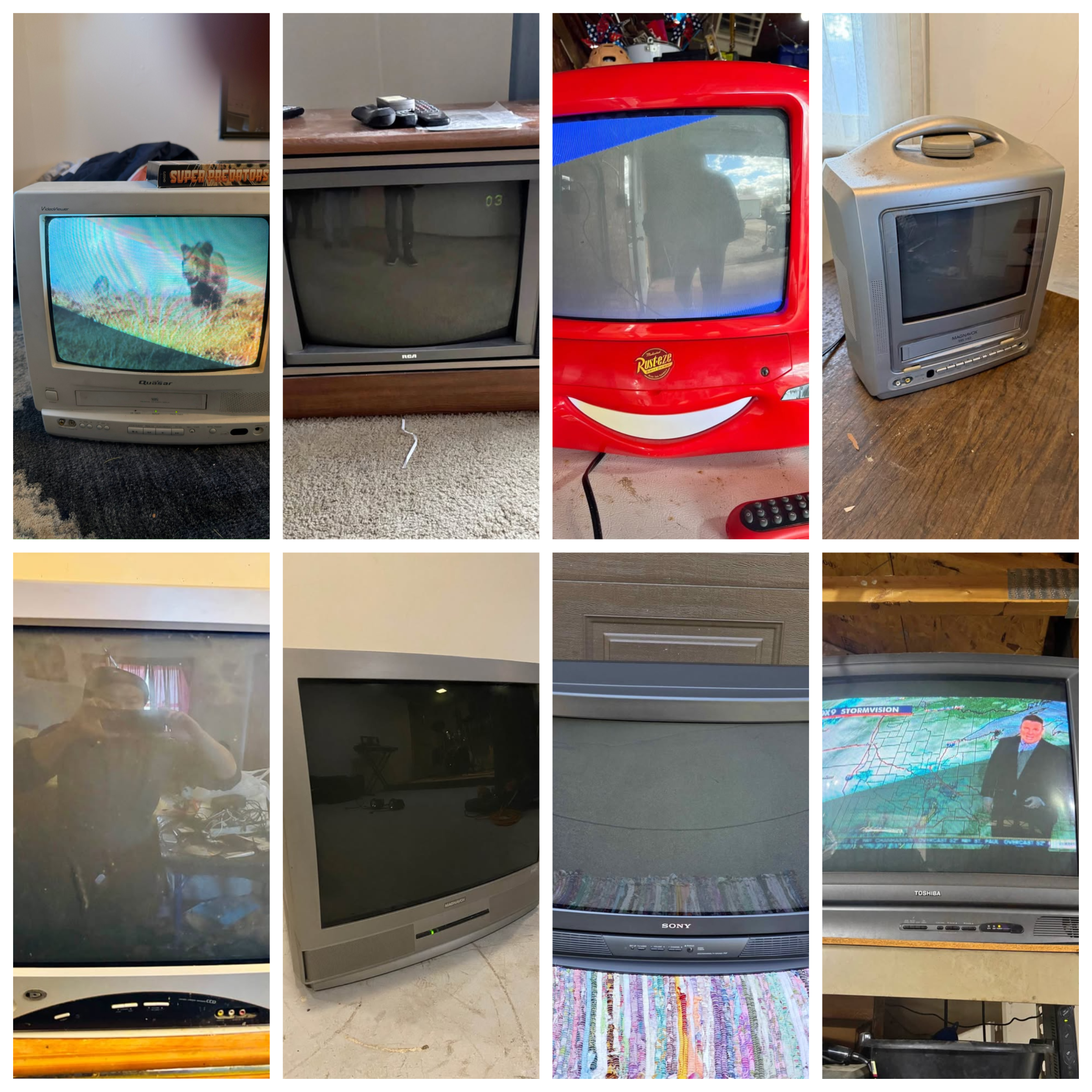
They’re CRT units, the type of boxy sets that flatscreens made obsolete by the 2010s. But cathode ray tube technology is far from dead, something Garnett learned by chance a couple months ago. When his roommate lost his job, the buddies scrambled to make rent by reselling various “free or cheap” items on Facebook Marketplace. One day, Garnett spotted an old TV—a 27-inch Sony Trinitron, the Cadillac of throwback sets—going for $200.
“I was like… why?" he remembers thinking. He also noticed some folks giving the 100-pound beasts away. An entrepreneurial lightbulb clicked, and the dealer, er, seller has since hustled almost 20 CRTs, including the 20-inch Panasonic he sold to me that day for $50.
Garnett unknowingly stumbled into a CRT market that began booming around the pandemic. Retro video gamers are the driving force, lured to the dated tech because, well, old systems look like shit on 4K LCDs. VHS and DVD enthusiasts have stoked the boom, as has a less tangible reaction to the algorithmic, AI-supercharged feeds streaming across modern TVs. The thrum, the glow, the physical media rituals—there’s analog comfort to CRTs in an increasingly ugly digital world. There’s also the thrill of the hunt. Commercial CRT manufacturing ceased in 2015, and boomers and Gen Xers had banished their ’80s, ’90s, and ’00s tubes to landfills years before that.
And when spiking demand meets diminishing supply, you meet guys like Alex Garnett in a parking lot to buy a hulking TV from 1999.
"People are really looking for these things, and inventory has been pretty bone dry lately," says mega-collector/archivist Shane Torvik. "These things will never be commercially available again—what we have is what we've got."
The Tech
Cathode ray tube technology dates back to 1897, when German physicist Ferdinand Braun invented a crude tube that would become the template for 20th century televisions and computer monitors. The process still seems incredible today: electron guns firing through a vacuum tube and into a phosphor screen, which then renders bursts of light into moving images.
Germany’s Telefunken company began producing the first commercially available TV sets in 1934, and two decades later color sets hit the market. Hundreds of millions of CRTs were sold through the 20th century; those electron cannons showed us the moon landing, the Challenger explosion, and the music video for Aerosmith’s Armageddon-soundtracking "I Don't Want to Miss a Thing,” the video for which was filmed inside of Minneapolis’s Armory. As LCD and plasma screens started dominating the market in the ’00s, the recycling of CRTs became a “major problem” around the globe due to the presence of lead, cadmium, barium, and yttrium inside of them.
"We have to be careful with how we process them,” says Jean Marie Durant, the executive director of Minneapolis e-waste recycler/tech thrift shop Free Geek. “If there's a spill, if they're dropped, it's a whole hazardous waste process that includes clearing the area."
There are added high-voltage dangers for home tinkerers. Two years ago the tech website Aftermath wrote about the joys and perils of restoring CRTs. A process called RGB modding, which greatly improves the picture quality, has become particularly popular among enthusiasts. That mod makes up the bulk of business for Prior Lake-based RetroActive Solutions, a CRT restoration company founded by Mark Gaeta.
"These CRTs can be incredibly dangerous if you don't know where to and where not to touch,” Gaeta warns. “It's something like 30,000 volts they retain even after you unplug them. I can't tell you how many times I've gotten bit working on these."
And there’s the unwieldy heft. My new-to-me Panasonic CT-20G13W proved liftable enough at 44 pounds, but weight increases dramatically as screens get larger. A 2004 Sony 34-incher, for instance, tips the scale at 196 pounds. A new 55-inch UHD smart TV, meanwhile? Twenty-two pounds. "We call 'em the hernia makers,” Scott Bade, owner of North St. Paul retro shop 1Up Video Games, says of CRTs.
So who’s in the market for these massive, chemical-dense, highly charged artifacts? A growing number of people, it turns out.
The Buyers
By age 25, I’d owned three TVs: the 5-inch black-and-white one for watching Letterman when my parents thought I was sleeping; the 19-inch Toshiba for playing Madden 2005 with my high-school buddies; and the much larger HD DLP set I purchased as a status symbol once I became a high-earning college journalist at the Minnesota Daily.
Torvik, 25, has bought, sold, and historically documented almost 600 CRT TVs. While sourcing out this story, no fewer (and, let’s be honest, no more) than three people said you’ve gotta talk with Torvik. As administrator of the CRT Listings of Minnesota group on Facebook, he has more or less become the godfather of the local CRT movement. (A national group, CRT Collective, has over 283,000 members.)
"During Covid I was isolated, my dad passed away,” Torvik says. “And I actually got a CRT because he wasn't there to tell me I couldn't get a big TV."
Somebody delivered the 36-inch Sony Trinitron WEGA to his house for $30, a deal that'd be unthinkable these days (more on that later.) A gamer since age 7, Torvik wanted to play the light-gun game Time Crisis to kill some, well, time, and modern TVs are incompatible with light-gun tech. Additionally, retro gamers prefer CRTs because they provide zero input lag, superior dark colors, native 4:3 aspect ratios, and a pixelated sheen that better represents the golden era of video games.
"It's Covid,” collector Ben Cencer says, pinpointing the start of the CRT boom. “People had extra money, and started getting into hobbies because they're just sitting at home. Not just games or TVs, everything."
Born in 1992, Cencer has owned around 150 CRTs as an adult. He and Torvik point to old-school gamers as the No. 1 driver of CRT revivalism, though other use cases exist. Everyone interviewed for this story used the word “nostalgia” at least once (with varying degrees of cynicism), and several pointed to rejecting a tech landscape that feels increasingly dystopian.
"People are getting fed up with scrolling TikTok and being constantly online,” Cencer says. “Retro stuff in general is a good way to escape it. I can listen to anything I want literally whenever I want at the highest possible quality on Spotify, but there's something about putting a disc into my CD player and listening the whole way through."
My dealer, Garnett, says he has sold to multiple dads who want to expose physical media to their children (guilty), and when asked to boil down why the tech appeals to him, Cencer has a one-word answer: "Autism," he says with a laugh. Gaeta likens it to the vinyl resurgence: "Vinyl is audio, CRT is video—it makes perfect sense.”
Garnett cites another demographic that echoed throughout my conversations.
“I don't know any better way to put this…” he says. “But I've never had more beautiful women show up at my door than the first week I started selling small CRTs."
Sure enough, a semi-recent wave TikToks featuring smaller, VHS-equipped CRTs stirred the imaginations of Gen Z.
@angelinerichard My physical media TV set up with all the details #physicalmedia @ebay #ebay @Libib #physicalmediaforever
♬ Soft Shadows and Smooth Jazz - JUNDY
(FYI for potential buyers: Everyone interviewed for this story warned that CRTs with built-in VCRs are notorious for breaking and almost impossible to repair.)
It’s not a gendered phenomenon, though. I checked with two of Racket’s male Gen Z freelancers, both of whom exhibit infinite patience whenever their gnarled 38-year-old editor reflexively asks them about youthly trends. One owns a CRT he reportedly stole from his landlord, and the other has a 19-year-old brother who yearns for one. (Find yourself an absent-minded landlord, kid.)
As for me, a non-beautiful non-woman? I was motivated to score a CRT after my wife picked up a collection of Disney VHS tapes off Marketplace, the idea being that our 7-month-old daughter, when she’s old enough for movies, could pop those in rather than navigating the mind-polluting universe of streaming. In the meantime, I’ve sunk upwards of $20 into acquiring around a dozen titles for daddy—The Rock, The Fugitive, The Mummy, etc. Oh, and there’s the $10 DVD player I picked up from Free Geek to watch The Simpsons seasons one through 10. The physical media collecting process, I gotta say, feels pretty addictive so far.
To hear everyone tell it, I entered the market at a dicey time.
The Market
"The secret's out: People are paying hand over fist for these TVs,” Mark Gaeta of RetroActive Solutions observes.
Over at Free Geek, incoming CRT TVs used to be processed mostly for recycling. That’s still true of non-operational units (donation costs run $10-$30, depending on size), but Executive Director Durant reports that nowadays functional sets are among the hottest sellers.
“We can not keep them in the facility,” she says. “They're flying out within a day or two of being placed in the thrift store."
Bade, the owner of 1Up Video Games, says business is booming, largely driven by a consumer scramble to hoover up physical media. He recently purchased a trove of 4,000 DVDs to sell alongside the shop’s retro video and card games.
"Seven years ago, when I first opened the shop, nobody wanted CRTs,” Bade says, noting with a chuckle that millennial nostalgia is sometimes hard to separate from millennial immaturity. “They were hated with all the heart. Nobody attempted to sell us any, they were like, 'Hey do you guys do electronics recycling?' We don't, they didn't care, so they'd drop off the TV anyway. It's insane, the boom we've had.”
The hot market for CRTs created a busy side hustle for Gaeta. He has modded, calibrated, and repaired CRT sets out of his home workshop for almost three years. Gaeta works on TVs as a part-time gig, but he says business has picked up to the point where, in the next year or so, he might be able to transition to full-time. While consumer electronics of the ’80s and ’90s tend to last longer than today’s products, CRTs were built with components (capacitors, neck boards, power supplies) that age out and, over time, screen geometry falls out of alignment. Gaeta is happy with each unit he can spare from the dump.
“It’s really important to carry the torch,” he says. “The people who worked on these back in the day, they’re passing on and their knowledge is dying with them. They’re never going to make these again, what’s out there is all we have.”
In collectors like Torvik and Cencer, you can hear pangs of disillusionment over the state of soaring CRT prices.
"It's kind of sad to see what they've devolved into, as far as people hoarding them and reselling them,” says Cencer, adding that he’s down to just three trusty CRTs. “The way it's been lately has kinda made me depressed, with how much people are spending on these TVs."
Torvik seems genuinely interested in the preservation of this tech. When he started down the CRT-hoarding rabbit hole five years ago, he’d give units away after restoring them. He’s still actively cataloging model-specific details, specs, and attributes on the website CRT Database.
"I'd find seven or eight models per week," Torvik says of those early days. "Now everyone wants 'em; I'm finding one or two per month and I’m searching high and low."
Although, he adds, recent life developments—in concert with marketplace scarcity—have curtailed that searching.
"When you move your fiancée in, and she says 'Why do you have so many CRTs?' You reflect on yourself,” Torvik says with a chuckle. “It's good to get them into the hands of people that use them."
Throughout my sprawling, localized exploration of the CRT revival, one crucial question remained unanswered: Did I get ripped off on my Panasonic? Knowing what I know now, I sure seem like a potential rube.
So I connected again by phone with my dealer, who, as of press time, was still wheeling/dealing several CRTs over Marketplace. (“I need FB Marketplace to help with bills, but I do it for the love of the game,” reads his delightful profile.)
"I don't think I price-gouged you too bad,” he reassures me.
A 4.9 outta 5 star-rated seller for good reason.