

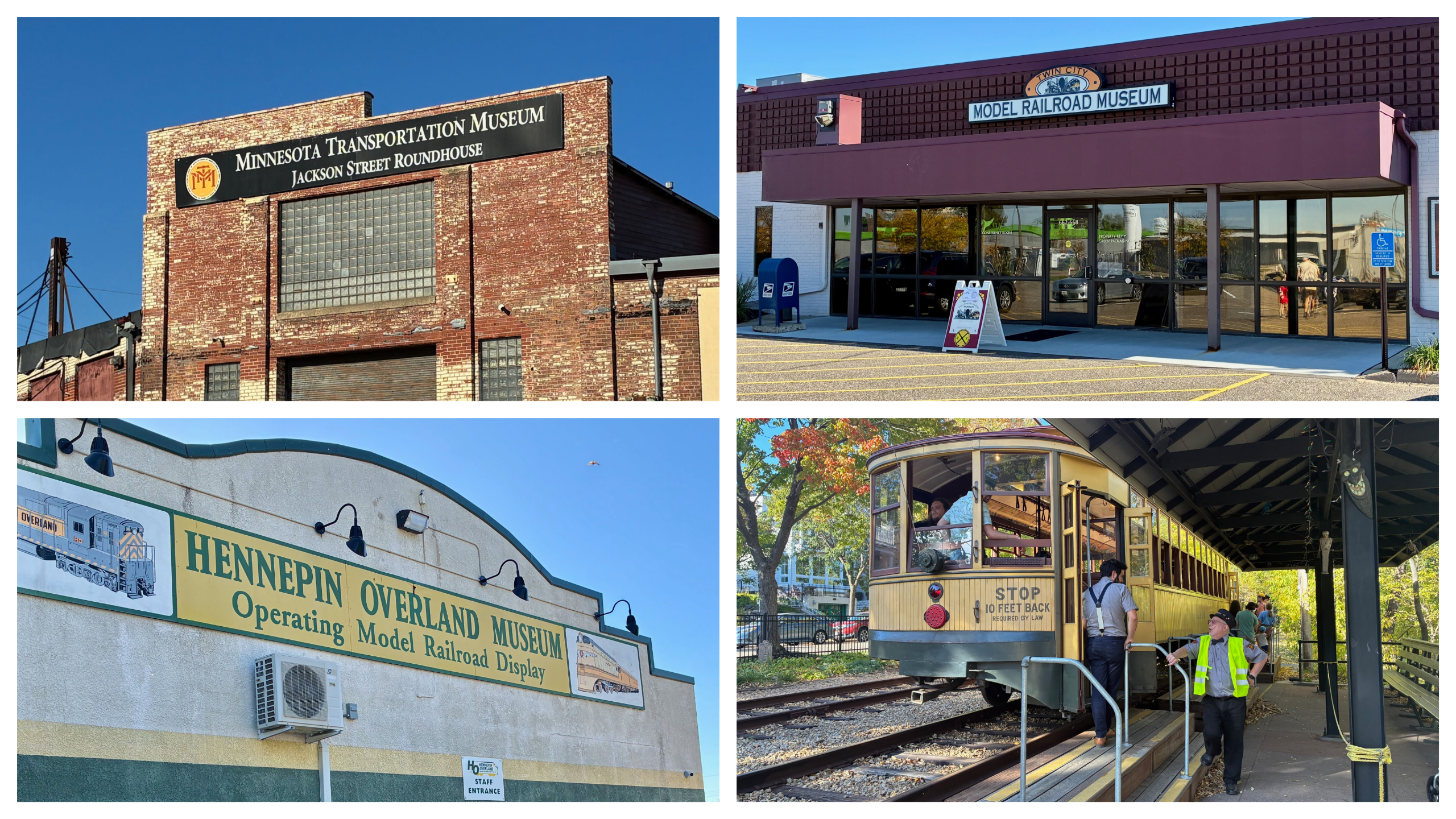
To anyone who doesn’t know—and from asking around, that’s virtually everyone—the Twin Cities has four, count them, FOUR, separate train-centric museums.
In St. Paul, there's the Minnesota Transportation Museum's Jackson Street Roundhouse for big trains and the Twin City Model Railroad Museum for little ones. Minneapolis has the Hennepin Overland Railway Historical Society for trains on a mission and the Minnesota Streetcar Museum, which you can ride.
That’s more train museums than in all of New York City, a metro area with roughly a million times more actual trains.
Why do we have so many train museums? Who’s behind them? And what is their loco-motive for dedicating their lives to preserving historical transit models?
The best way to find out was obviously to visit all four in a single day, a feat possible on a mere handful of autumnal Saturdays each year due to the museums’ arcane schedules. Given the theme, it only felt right to complete this quest entirely by Metro Transit.
At 9:25 a.m. on October 10, the schedules finally converge, and I leave my house bound for adventure. The 67 bus scoops me up and we rumble east across the washboard of St. Paul side streets towards the Minnesota Transportation Museum’s Jackson Street Roundhouse. Sadly, the museum is far from the bus stop and after only two blocks of walking the sidewalks disappear. I arrive two minutes after opening, slightly shaken from hostile driver encounters but excited about choo-choos.
Open: Wednesdays and Saturdays year-round
Adult admission: $15 in person
Tickets and more info: trainride.org
Transit time: 37 minutes
The Jackson Street Roundhouse is a historic repair depot from the age of steam. Its main attractions are a fleet of antique train cars, a kiddie play area, and display cases of artifacts. Visitors skew heavily towards Thomas the Tank Engine-obsessed toddlers on the birthday party circuit, but I enjoy seeing how the robber barons used to ride.
Standard admission also gets you a trip in the caboose, chugging out to the boundary of the property and back. For me, the ride is calming. The 4 year old next to me, however, is vibrating with excitement, and I could not be more thrilled for them. A transit-positive but not specifically steam-train-fixated adult will enjoy the exhibits here, but the real pleasure is watching the under-7s and over-70s for whom this is Graceland.
Also incredible are the workshops where an all-volunteer force maintains the fleet. While my schedule is too tight for the guided tour, a guy named Ken gives me the speedrun through this tinkerer’s wonderland: woodshop, cranes, an actual blacksmith’s forge. Here wizards of dying arts take cars that may have spent decades as chicken coops and make them shiny again. The work is painstaking, yet it’s clear everyone is having the best time with their buddies.
My allotted hour gone, I dash back along the worrying edge of the pseudohighway to catch another 67 bus west to museum No. 2: the Twin City Model Railroad Museum.
Museum 2: Twin City Model Railroad Museum
Open: Friday through Monday year-round
Adult admission: $10 for regular, $15 for night trains (lit only by the tiny street lights)
Tickets and more info: tcmrm.org
Transit time: 40 minutes exactly
The Twin City Model Railroad Museum showcases train displays at all different scales, from chunky 1950s Lionels to tracks so itty-bitty an entire model city could allegedly fit in a suitcase. The largest exhibits feature Twin Cities landmarks like the Stone Arch Bridge and the Grain Belt sign, but there’s also an amusement park, a hidden dinosaur cavern, and an exuberant Lego universe, as well as two different models of the Jackson Street Roundhouse.
The best part: You get to push the buttons! There are signs everywhere explaining how to power up individual miniature elements so you can watch the trains race about. Sounds, lights, and hidden features—it’s an overstimulated child’s dream.
There’s also a miniaturized repair shop, where the “Train Doctor” (why didn’t anyone tell me about this job on career day?) revives tiny engines that visitors bring in. A camera allows you to watch as he turns miniscule screws and strips wires so fine I can barely see them. I am mesmerized. All too soon, it’s time to leave for the only working trains I’ll ride all day—to the Green Line!
Of course I miss the train. I use the interval to munch a few purse-stable tube foods to keep my energy up, huddling in the one sliver of shade on my side of the tracks. It is an unnerving 85 degrees this beautiful mid-October day.
Cool and collected, I glide over the border into Minneapolis, switching to the Blue Line at a station swarmed by teenagers costumed for a color guard competition (not a metaphor). Somehow I lose my focus, overshoot, and have to double back, costing me eight precious minutes, though gaining a sexual proposition from a man old enough to be my father.
Museum 3: Hennepin Overland Railway Historical Society
Open: Saturdays and Sundays September through April
Adult admission: $10
Tickets and more info: hennepinoverland.org
Transit time: 68 minutes, but with better luck, closer to 46
If the Twin City Model Railroad Museum caters to action-oriented kids running amok, the Hennepin Overland Railway Historical Society is more a clubhouse for adults who graciously allow us to peek in—as long as we definitely do not touch anything. The production value is outstanding, though. Everything is the same minute scale and hyperdetailed. You can see the weeks poured into each miniature shop, full scenes playing out inside if you peer in at the right angle.
While the massive train layout is probably only half complete, there’s a ton to gape at, including in-progress schematics for a future steel-refining plant. Fans of folksy midwesternism should also note the fully realized Lake Wobegon tucked in here at 1:87 scale.
Impressive as the models are, to the club members there that day these are just the backdrop for conducting “operations.” There are complex timetables, switch maps, and radio chatter. I watch a 16-car train carefully back into the depot to link up with another car, its conductor guiding it over a frustrating deadspot with a wooden skewer.
Wholesome hours beckon, but with the transit delays, I need to dash if I want to complete my own very serious quest. It is now 2:46 p.m., and my final stop, the Como-Harriet Streetcar Line, closes at 4. Happily, the 38 bus to the E Line transfer goes smoothly, dropping me off a short walk from the historic streetcar’s northern station.
Museum 4: Minnesota Streetcar Museum, Como-Harriet Streetcar Line
Open: Saturdays and Sundays May through October, plus Wednesday through Friday in summer
Adult admission: $3
Tickets and more info: trolleyride.org/como-harriet-streetcar
Transit time: 40 minutes
I’ve just missed the trolley, but it’s beautiful out and only a 10-minute wait. Once aboard, I see the car is lined with old-timey advertisements above open windows, letting in the breeze coming off Bde Maka Ska. The trolley glides along cheerfully, exactly as watching Mister Rogers’ Neighborhood led me to expect.
At the end of the one-mile ride, I disembark and purchase my fare in the little station (most people start at the south end, but the reverse is easier from public transit). I am handed an actual antique token to carefully deposit in the fare/box for the equally charming return trip.
Back at the north station, I watch the final train of the day retreat along the track before I turn towards home, my zany mission complete. At the E Line, I run into one of the trolley conductors, Serge Zenisek, still in uniform. The New York transplant, who did a shift a week until the birth of his kid, describes becoming a volunteer streetcar operator as the “most fun thing ever.”
After four museums, three hours on Metro Transit, and an entire day marveling at choo-choos big and small, it is this joy that leaves the greatest impression on me. While the cringe of being an adult train enthusiast is obvious, everyone I encountered in these spaces seemed to be having the time of their lives, aside from the exhausted parents.
The volunteers that make these museums possible have found something they love both intensely and openheartedly, channeling that passion into making art, fixing machines, preserving knowledge, building community, and making countless small children incandescent with delight. What does cringe matter compared to fulfillment?
I can now absolutely understand why the Twin Cities has four museums entirely dedicated to trains. I wonder if four is even enough.