



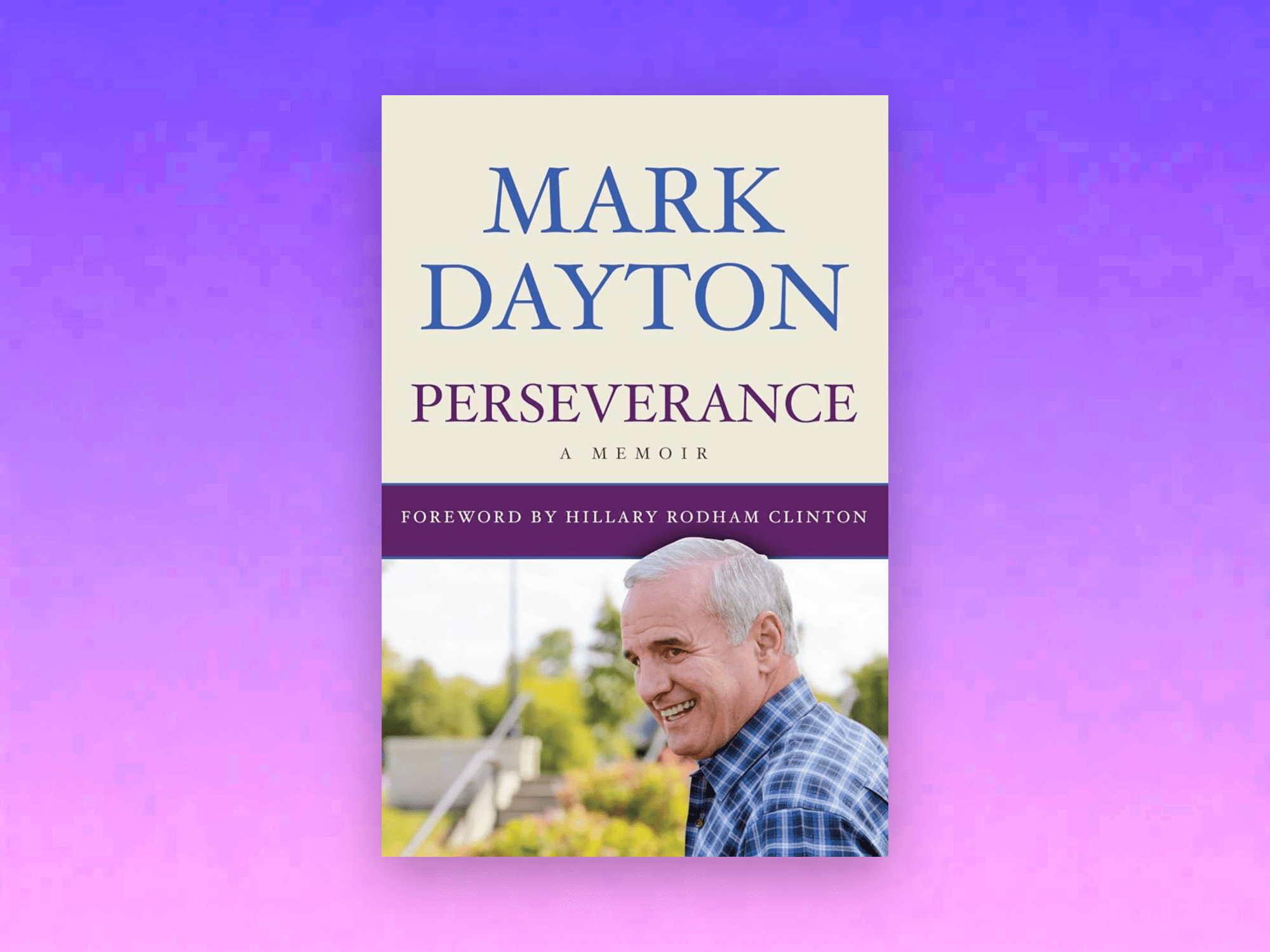
Life’s hard for the rich! That’s according to Mark Dayton’s new memoir Perseverance (Minnesota Historical Society Press, 320 pages), which he wrote as he approached his 80th birthday “to tell my story my way.” Had any other old-money heir written a “poor, rich me” statement, I’d have quit reading. But I can take it from Dayton, who has always been a teller of unvarnished truths with candor seeping through the seams of his bleeding heart.
Being born silver-spooned is hard, especially with a verbally abusive and alcoholic mother and an inattentive father in a mansion in Long Lake, Minnesota. Dayton’s fortunate-son origins began when his father, Bruce Dayton, and uncles turned the family’s dry goods store into The Dayton Company, a retail behemoth that begat Target Corporation. Dayton attended The Blake School, then an all-white private academy, where he became a decent hockey goalie. He credits his interest in being a good person with a stint as a 15-year-old orderly at Abbott Hospital’s Emergency Room, where he watched a kid die. Also, the progressive Episcopal sermons he heard at Yale University in the 1960s. A hockey skate to the throat made him contemplate his mortality. Then, Robert F. Kennedy’s political platform and 1968 assassination made Dayton spurn the gilded comforts of his upbringing.
Committing to one profession is hard when you don’t have to worry about making rent. Dayton tried on different occupations, like teacher in New York City and counselor to at-risk youth in Boston. He washed dishes and dug ditches at Esalen Institute, a rich hippie retreat in Big Sur, where a Gestalt therapist helped Dayton overcome his traumatic childhood. Young man Dayton went on fun social-justice side quests. He donated $100,000 to Black Panther Joan Bird’s defense fund and protested Vietnam War defense contracts with his childhood pal Charlie Pillsbury at Minnesota-based Honeywell, where Bruce Dayton held a directorship.
Forging a political career is hard when your dad hosts Saturday morning salons so Senator Fritz Mondale can chat with the Twin Cities’ executive class. When Dayton got a nepo-appointment as Commissioner of the Minnesota Department of Economic Development in 1978, he had to convince Governor Rudy Perpich he wasn’t a “rich prima donna who would try to work banker’s hours.” Maintaining a happy home life is hard when you marry a Rockefeller and get parenting advice from Jacqueline Kennedy Onassis. Running for office is hard when you campaign with $7 million of your own money and lose a Senate seat. Having a faulty frame inside your meatsuit is hard when your sick spine flares and the world-class surgeons at Mayo Clinic have to weld you back together.
I rib Dayton’s born-on-third plight with love. This is a review of the book, not his career, but I like both. Even Hillary Rodham Clinton’s foreword to Perseverance, written in her signature bureaucrat drone, made me feel my feelings, reminding me that “government can be a force for good” when folks like Dayton are in charge.
Dayton’s writing style is precise, concise, and conversational. The prose took me back to Dayton’s gubernatorial years and his underenunciated press conferences. And I’m a fan of the fun punctuation! Dayton uses 142 exclamation points to pepper pedantically bland political details. He sums up Taiwan: “What a vibrant country it was!” The India-Pakistan border near Islamabad: “A tough neighborhood!” And a misdialed call from the Oval Office in 2017: “The president said, ‘I was trying to reach Matt Damon.’ (!)”
Readers might pick up Perseverance because the speech-filled appendix could help with school project research, or because they’re a Democratic-Farmer-Labor Party stan, or because of their Bravo TV-level obsession with Minnesota’s one percent, or because they’re curious about the formula for getting wealthy individuals to Robin Hood themselves and spend their personal fortunes pursuing progressive legislation. I’m B, C, and D. (And I skipped the speeches.)
Dayton’s political losses and achievements humanize him. He’s the kind of friend who’ll bring winter vests and hot coffee to chilly May morning campaign stops. He’s oddly brave, staying in haunted room 407 at Pipestone’s Calumet Inn, and kinda dopey, like when he had to stash a pheasant hunting shotgun before meeting President Obama’s Air Force One at MSP. Name drops make all the hustings and legislating more interesting. Back in the era when pedophile behavior ruined careers, Dayton witnessed “the most bizarre political upheaval in my lifetime”: the gross Jon Grunseth pool party scandal where the gubernatorial candidate tried to rip the swimsuits off his daughter’s 12- and 13-year-old friends, then dropped out of the race.
There’s a pre-brainworm RFK Jr. encounter where Dayton drove him to speechify at the Minnesota State DFL Convention. He watched RFK Jr. chug a snootful of beer in 20 minutes before he took the stage. Through Dayton’s Rockefeller connections, the actor Paul Newman stumped for him at the Brainerd Speedway. Billionaire Carl Pohlad had a penchant for bargain flights. As state auditor, a job Dayton didn’t really care for, he called out Rudy Perpich for profiting from a Minnesota Public Employees Retirement Association technicality intended to benefit stay-at-home parents returning to the workforce, not executive-level elected officials. The pension squabble destroyed their friendship and Perpich never spoke to Dayton again.
There’s a lot for lefties to love about Dayton’s tenure in his two biggest jobs: rejecting the Iraq War, getting gay marriage in Minnesota’s constitution, and appointing Tina Smith to the U.S. Senate. (When’s her memoir coming out? Tina: if you need a ghostwriter, DM me! We could have fuuuuun!)
I was surprised by a few of Dayton’s missteps. Small quibble: The book misidentifies Minnesota prairie town Worthington’s main industrial ag-meat export as turkey, when it’s actually pork. Bigger quibbles: PolyMet copper-nickel mines, even outside the BWCAW watershed, are bad ideas! Dayton boasts about some ethically questionable senatorial special favors, like overriding a pause in international adoptions from Cambodia amid accusations of baby trafficking. Dayton’s son Eric lobbied to get his friend’s dad appointed to the U.S. African Development Foundation. The friend? Current Minnesota Star Tribune columnist and Iran War enthusiast Andy Brehm. Dayton editorializes a little about RFK Jr.’s desertion of the Kennedy family’s Democratic Party values, but when he could have criticized Benjamin Netanyahu’s slide into genocide, all Dayton writes is, “Presently he is the prime minister [of Israel].”
Were there any Kevin Kwan-esque Crazy Rich Minnesotan antics? Nope, not unless you count the photographs of pearl-adorned Dayton matriarchs and the Bachelor Farmer boys with their Bergdorf blonde wives. Dayton spends only a couple of sentences on his first divorce at 40 in 1997. He drank too much, then checked into the Betty Ford Center in California. Boom, bam, clean.
He’s candid about money, up to a point. “My victory and my defeats cost me my inherited financial fortune,” he writes. “Inherited” is a tidy qualifier. I don’t think the money’s all gone. Dayton founded Vermilion Investment Company, a private financial firm, which yielded “a darn good nest egg.” He spills very few details about his pandemic-era May-December romance with his 41-years-younger third wife, whom he met when she was a high school intern. I knew he wasn’t going to Kitty Kelley himself, but I was disappointed that all the juice got sucked up by the editorial version of shoebox silicone bead packets.
He’s such a good, humble person, with an empathy superpower and an amazing public service record; I kept thinking, “How can we use this book to get the next generation of American hard knock rich kids to use their noblesse oblige to work toward fully funding public schools, a more equitable system of taxation, and restoring clean water in the country’s precious lakes and tributaries?” If the formula really is hospital tragedy + hockey accident + New Age self-actualization program, maybe the Ivies can implement a required class with a syllabus that assigns bingeing The Pitt, a neck-guardless hockey scrimmage, and some one-on-one humanistic therapy for all their legacy admissions and nouveau riche Silicon scions.
We don’t get a rubric from Dayton for how to give the next generation of über-privileged people a social justice-focused worldview. Dayton is great at telling what happened and good at explaining why, but falls short when it comes to what it meant. I wanted a more fiery ending that directly addressed his one-percent brethren, but didn’t get it because that’s not what Dayton set out to write. Perseverance simply lets us know about his tough, extraordinary life!