


“You know, usually riding my bike puts me in a better mood than this.”
The woman on the muddy trail in front of me grinned, or possibly grimaced, as our tires sank and slid through thick, slippery mud. It had rained heavily in Duluth the night before, and the path in front of us was pure pudding, with each pedal stroke kicking globules of mud onto our bikes, our legs, our faces. We came to an abrupt stop when someone went down on one of the wooden bridges in front of us; their tires, caked in mud, simply slid out from under them, and they and their bicycle went crashing into the brush.
Are you familiar with that old saw about how you should do one thing every day that scares you? Over the years, I’ve come to base much of my worldview on a variation on that maxim: Do one athletic endeavor every year that makes your friends and family think, there must be something going on with her.
If you’re a competitive person, a sports-loving person, a person who has trouble sitting still—perhaps you, too, are an Aries?—I cannot recommend this strategy enough. Prioritizing the stupid and ambitious is how I got into bikepacking, taking longer and increasingly challenging rides through Minnesota and Wisconsin with my clothing and gear lashed to my bicycle. In 2025, this was the guiding principle that led me to register for the Afton Trail Run, a 25K foot race with more than 2,000 feet of elevation gain, despite having almost no trail running experience.
There are many benefits to the cause-stress-to-your-loved-ones system: getting in shape, staving off boredom, avoiding your feelings (they literally can’t catch you if you don’t stop moving!). The problem is that you always need to be upping the ante. No one I know batted an eye when I told them I was doing the Afton Trail Run again this year. The system requires greater distances, increased sacrifice, higher stakes. You are Tom Cruise; life is your Mission: Impossible stunt addiction.
So in April, when I saw a friend posting about registering for the Race Across Duluth, my eyes did not so much light up in ecstasy as they did widen, sickos-like, at the potential for self-inflicted suffering. A 43-mile, point-to-point mountain biking race along the Duluth Traverse, which literally spans from one end of Duluth to the other? My sit bones were sore just thinking about it. Yes… yes!
Had I been mountain biking more than five times in my life? No. Did I own a mountain bike? I did not. I smiled. I navigated to the registration page. All of this pleases The System. Tom didn’t climb the Burj Khalifa in a day.
The Log Lady Rises
First, to address the biggest and most expensive obstacle: obtaining a mountain bike.
These days, you can find a really nice, modern, full-suspension mountain bike—something with hydraulic disc brakes and a dropper post—for like $1,000 on Facebook Marketplace. Someone out there is always realizing they don’t ride that thing as much as they thought they would.
Now, let’s say you have a psychotically specific self-image and a commitment to aesthetics that draws you to the old, rare, and outdated. You might find yourself more interested in, say, a steel-frame, single-speed mountain bike, one designed by a now-defunct, Twin Cities-based bike company and manufactured for just a year over a decade ago.
Unfortunately, you can find those on Facebook Marketplace too.
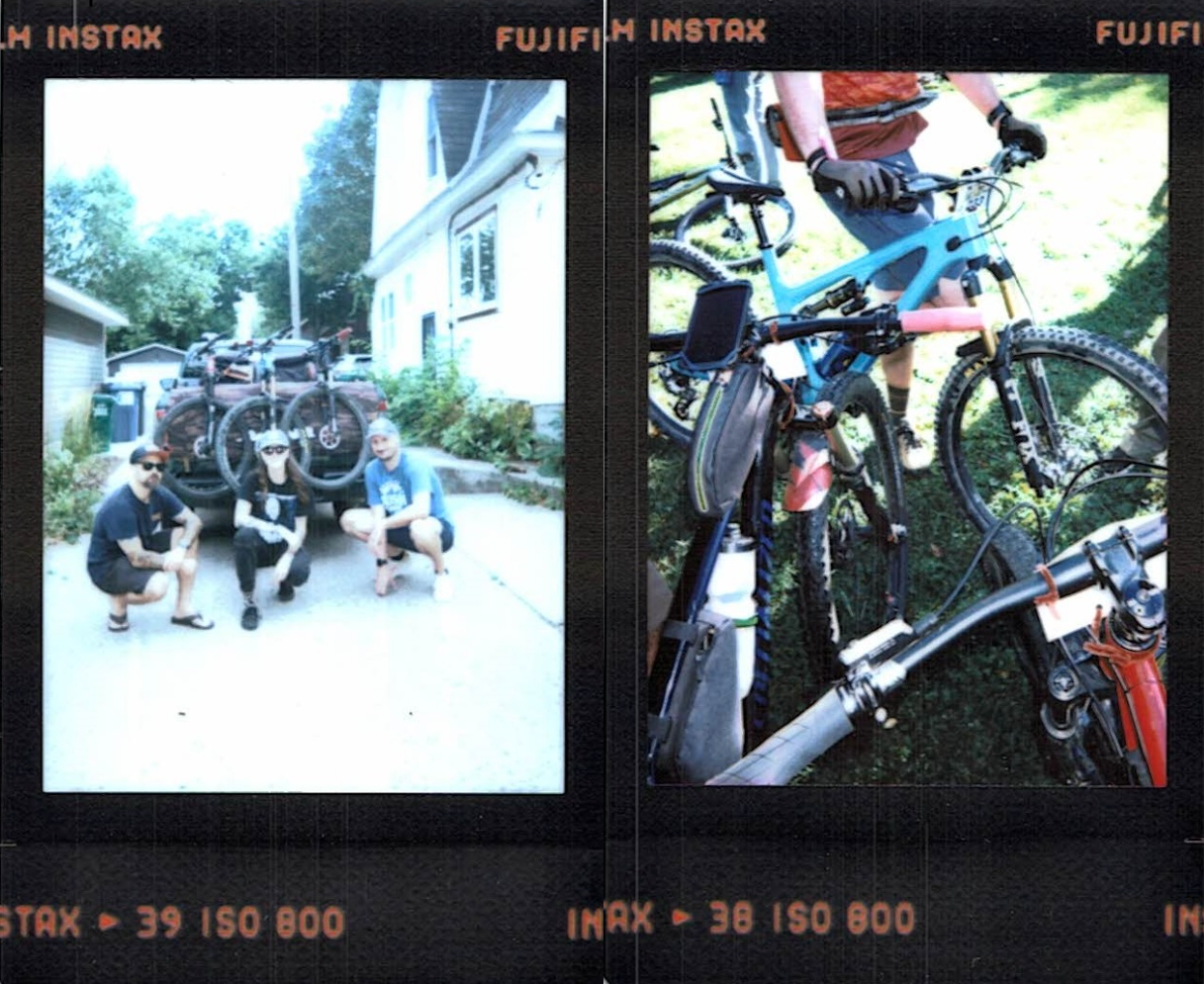
I did not intend to purchase an All-City Log Lady for my trail bike, but only because I didn’t know they existed until six months ago, when my partner Marcus—who, along with my brother, Addison, foolishly agreed to race the RAD with me—sent me the Marketplace listing. Released in 2016, the Log Lady is what you could call a novelty bike, built for the kind of person who would think it was funny to rip up technical singletrack on a single-speed bicycle named for an oddball Twin Peaks character.
And it was gorgeous. I mean, hello:
Now, the seller had priced this particular Log Lady, a bike that initially retailed for $1,499, at $900, which meant a little more research would be required before I schlepped to St. Paul to meet him.
“What do you know about the All-City Log Lady?” I texted the listing to my friend Jeff, the All-City knower in the friend group, who responded with a rundown on the specs. Pros: low production run, could be built up single-speed or geared (as this one thankfully was), very cool looking. Cons: hydraulic disc brakes can be kind of a pain, the old suspension fork probably needed work, the chainstay had been wrapped in electrical tape, probably a sign that there was rust or other damage hiding under there.
“I’ll also say, 900 bucks in this economy for a 10-year-old bike is a lot, regardless of rarity,” he gently added.
“This is SUPER helpful,” I responded, already mentally earmarking $900 for the impractical mountain bike of my idiot dreams. It’s a collector’s item!!! I reasoned, actively not thinking about the lumbar effects of riding a collector’s item on 40+ miles of trail. To quote the Log Lady herself: “Behind all things are reasons. Reasons can even explain the absurd. Do we have the time to learn the reasons behind the human being’s varied behavior? I think not.” Tell ‘em, sister!
Something to know about these impulsive athletic challenges is that buying things is at least 20% of the fun. How much do you think Tom’s Burj Khalifa stunt cost? I bet more than a bike race!
As I readied for the RAD over the course of five months, my training… sure, we’ll say it necessitated the purchase of a pair of Ripton riding pants ($135), douchy photochromic sunglasses ($81.74), a Revelate frame bag ($135) and bleach-dyed trail jersey from Angry Catfish ($79.95), among other bike-related bits and bobs. Are you roughly $1,500 poorer? Congratulations, you’re ready for race day.
As for the Log Lady, I knew I’d be taking her home from the first pedal stroke. She needed new tires. The front fork was doing something weird. I did not look beneath the black electrical tape because I already knew what awful secrets it obscured and because you can cover up chain strike gouges and prevent future damage with a Lizard Skins chainstay protector ($9.35). Marcus asked the seller if he was willing to go any lower, and he said he could do $850.
The art of the deal! We threw the old gal in the bed of my 2003 Subaru Baja (old, rare, outdated) and headed back to Minneapolis.
Oh, Right, I Have to Ride My Bike
“How quickly, I reflected, peril could be followed by beauty in the wilderness, each forming a part of the other,” Anne LaBastille writes in her 1976 book Woodswoman.
I found myself thinking about that quote on a Saturday afternoon on Elm Creek’s singletrack as, after I looked away from the trail ever so briefly, my handlebar glanced off a tree that sent me careening off course, skidding to a stop. Fine, fine, maybe I didn’t think of it in the moment, exactly; in the moment I was thinking, “shit shit shit shit.” But a few days later, when I read those words in the epigraph to Liz Moore's 2024 bestseller The God of the Woods (hell of a book), I thought to myself, That is totally about mountain biking.
If you love spending time in nature, this dichotomy will be familiar to you. The world’s most beautiful places are also some of its most dangerous, and any outdoor adventure involves some amount of risk. Add in elements of speed or distance, and those dangers compound due to carelessness or exhaustion (or both). I’m fairly certain that LaBastille never rode a mountain bike, but if she ever did, the way the beauty and the peril are all mashed up back there on those twisty trails would have been quite familiar to her.
The woods really are beautiful when you explore them by bike: the trees that wall you in and make you feel totally secluded, even if you’re only minutes away from the city, the sun that dapples the trails and dances on the ground as the wind shifts the canopy above. But it’s that same shimmering sunlight that will obscure a rock or a root until one second too late, when it catches your tire and sends you shooting off course, with your heart exploding in your chest from the sudden stress.
The thing about mountain biking is: It’s really hard. No one talks about this!
On a “normal” bike ride, through the city, let’s say, you can let your mind wander, even if you have to vigilantly watch for drivers with a loose interpretation of what bike lanes are for or what a red light means. Bike rides are where I do some of my best thinking and writing; your brain is active, but not occupied, and the thoughts just kind of whirr along.
Not so on a mountain bike, where my brain is almost entirely occupied by thoughts of, “Oh no.”
The RAD takes place on the Duluth Traverse, a 43-mile long-distance singletrack trail running from Lester Park on the northeast side of Duluth to Chambers Grove in the southwest. Its construction is an incredible feat; the DT is made up almost entirely of purpose-built urban trails, and these days, no matter where you are in Duluth, you’re no more than a mile from some of the state’s premiere singletrack riding (or running) trails.
There’s no other trail like it in the state that I’m aware of, and the singularity and improbability of the DT, which exists thanks to a collaboration between Cyclists of Gitchee Gumee Shores (COGGS) and the city of Duluth, is part of what drew me to the Race Across Duluth in the first place. As outdoor advocate Hansi Johnson told mountain-biking publication Pinkbike in 2018, “Duluth has resurrected itself through a number of means, and yes, mountain biking has been a part of that equation.”
According to COGGS, the Duluth Traverse is mostly made up of beginner and intermediate trails, but I’ve done enough outdoor recreation to know that those descriptors are largely vibes-based or at least subjective. One person’s “intermediate” is another person’s “are you fucking kidding me,” and my biggest concern, as I practiced throughout the summer, was that I’d fall into the latter camp.
There’s also the fact that my partner is very fast and very competitive, whereas I am very slow and very competitive. (As you can imagine, this dynamic has never once led to conflict in our relationship.) During each ride at Elm Creek or along the River Bottoms, he’d speed ahead, whipping around corners and hurling himself off jumps as I plodded behind, wishing I had the lack of regard for my own wellbeing (or maybe the quality health insurance) that would let me stop holding the brakes on long descents or take the jumps rather than the carve outs to avoid them.
Was I enjoying myself? Um, tough to say. The concept of “enjoyment” is just… so complicated. I know I was getting faster because I am addicted to Strava data and I have the little PR medals to prove it, so that felt rewarding. I could feel myself getting “better” with each ride, or at least braver, and with mountain biking confidence is really important. You have to believe your bike can make it over that root or that rock—and it can—or else you won’t. Sounds made up, I know, but it’s true.
Did it matter? Not really. Enjoyment is secondary to The System. The point is that you’re challenging yourself to do something difficult, that the deficient part of your heart that’s only satisfied when you’re tired, sweaty, and a little scared gets what it wants. Fun is less of a requirement than it is an occasional welcome byproduct.
Race Day: Baby’s First DNF
“You chose to do this.”
On Saturday morning, I repeated the words like a mantra as I pedaled through those first few muddy miles of the RAD, my tires slipping and sucking through the slop. When a man in front of me dismounted suddenly on a slick ascent, causing everyone behind him to do the same, I barely had the traction to push my bike up the hill on foot.
Finally, the trail opened up, revealing a segment that was slightly drier, with a beautiful view of Duluth—and which was almost entirely made up of huge, tall slabs of rock. Which we had to climb. “Oh, good, slippery rocks!” a rider near me laughed.
None of the mountain biking near the Twin Cities, nor the riding I’d done on the Iron Range over in Cuyuna had prepared me for it: Where there weren’t hulking rocks stacked upon each other, there were large, sharp, crushed ones, jutting out several inches and covering the entirety of the trail. There was no easy line that I could find.
I hopped off and hiked a bike for a while with another rider from Minneapolis—he too was in over his head on this section. We commiserated a bit, and I knew, after about seven and a half miles and close to 900 feet of climbing, that my day in the saddle was done. My legs could have gone longer, but my brain couldn’t. I’d psyched myself out.
Never before had I DNF’d a race; it was not a possibility I’d considered. As I sat on a gravel road and waited for my parents and sister-in-law to pick me and my mud-caked bicycle up, I considered that I was being punished for my hubris. Served me right for bragging about winning Babes in Bikeland in the virtual pages of this very publication mere months ago, then pitching a story on the Race Across Duluth.
After my brother crossed the finish line later in the day, he’d tell me he was pretty sure that I’d already made it through the hardest part—a few more grueling switchbacks, and I’d have hit the aid station at mile nine, with the rockiest, most difficult section of trail behind me. (I don’t know if that’s for sure; Marcus shot him a look that I believe was intended to say “please don’t go on about that or she’s going to start crying.” He wasn’t wrong!)
But I’ve thought about that a lot over the last few days, regret and disappointment and a little bit of shame swirling around inside of me. How do you know if you’ve already made it through the hardest part? How can you tell the difference between difficult and unsafe? Is it even wise to convince yourself to keep going, knowing that you might get hurt?
There are metaphors in there that are probably worth exploring, and I’m choosing not to think about them. Who am I, Anne LaBastille? I have a half-marathon trail race at Theo Wirth to get ready for this weekend—no time to feel a feeling. The System, as always, works.