


The Minnesota Lynx did not persist.
They did not, in a favorite phrase of their coach, Cheryl Reeve, “meet the moment” of living up to their hard-earned status as the most likely team to capture the 2026 WNBA championship. On the contrary, they were brusquely swept out of the first round of the playoffs in two reputation-staining games by the New York Liberty. This abrupt exit exposed the inexperience of their rookie maestro point guard, Olivia Miles, the still-mending ankles and questionable fervor of their holdover star, Napheesa Collier, and the lack of capable brawn and reliable depth on the rest of their roster.
For better and for worse, this year’s Lynx were always performing ahead of the narrative. With four of their top seven players from their previous season gone to other teams, and a fifth, the cornerstone Phee, sidelined from surgery on both ankles, early prognostications had them in the mushy middle of the pack among the 15 franchises in the W.
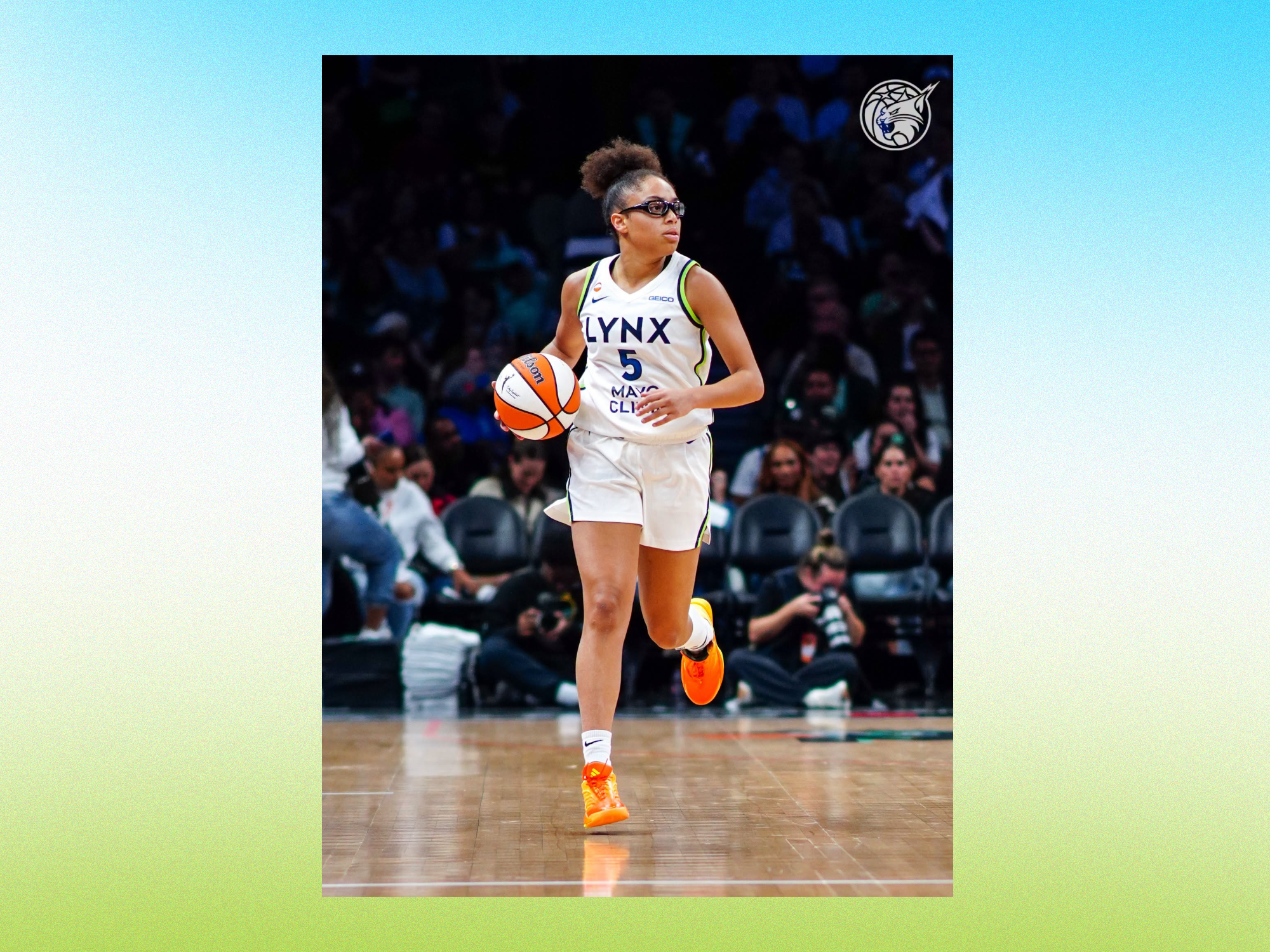
But Reeve the general manager stocked the roster with just enough high-value complementary personnel to enable Reeve the coach to ambush the league with a tenacious defense and her stupendous rookie Miles. The Lynx grabbed a share of first place on May 27, their seventh game of the season, and held it for nearly four months, straight through to the finish line. At first their success was a shiny bauble, a curio whose staying power was still TBD. Pundits played it safe by gushing over Miles and the genius of Reeve while elevating the Lynx into the cluster of contenders.
But by then the Lynx had already hit another gear, going on a six-week tear from July 7 to August 21 in which they lost just once in 17 games, with a high-powered offense led by career-best sharpshooting from 13-year veteran Kayla McBride and more eye-widening finesse and flair for Miles. When Phee returned two weeks into the burst, the stratosphere seemed like the limit instead of the sky. Precious few people seriously doubted the ongoing domination of the Lynx as the playoffs approached.
But the signs of decline had begun creeping in. Amid the cavalcade of victories, Reeve roared about her team’s declining defense like a home inspector citing random spots of mold. And while the Lynx held a commanding five-game lead on the rest of the league with just six games to play on August 22, merely four games separated second and eighth place, providing every other contender with palpable motivation to shift into the high-intensity, more physical brand of hoops that occurs in the playoffs.
In the two games before the 18-day layoff for the FIBA Basketball World Cup, the fearsome defenses of Golden State and Atlanta (ranked first and third, respectively, while the Lynx had fallen to fourth) physically took the body and thus sapped enough soul of the Lynx to coast to victories. After the break, the New York Liberty provided a harbinger of the postseason: They pasted the Lynx for the second time in three matchups, marking Minnesota’s first three-game losing streak of the season. Reeve & Co. managed to beat the pathetic Connecticut Sun, a nearly pyrrhic win given that the woeful Sun offense had open looks for most of the contest.
Then, in the penultimate game of the regular season, the Indiana Fever ran the Lynx off the court so thoroughly that Reeve benched all her starters midway through the second quarter. Having finally clinched the top seed due to a Golden State loss, the Lynx reversed the embarrassment upon the Fever in the season finale with a sterling performance that convinced too many people, myself included, that they were somehow appropriately locked and loaded for the playoffs.
As I wrote in a column for Racket last week, the Liberty were the worst possible first-round matchup for the Lynx. Put simply, they were the only opponent who could blend enormous size with marquee talent and then add both regular-season success against Minnesota and ample playoff experience.
More specifically, they were the team with the personnel and the schemes that had already proven they could significantly diminish the playmaking of Miles—arguably the most valuable single component of the Lynx success in the regular season. With the Liberty’s rookie counterpart Pauline Astier hounding her in the backcourt, two sizable wings filling the gaps of passing lanes, and two All-Star bigs—6-foot-6 Jonquel Jones and 6-foot-4 Breanna Stewart—protecting the rim, New York held Miles to 32% shooting in three regular season games, and just 28.6% from three-point range.
That’s why the first point-of-emphasis in last week’s column about how the Lynx could topple the Liberty was: Take some of the offensive load off Olivia Miles. That didn’t happen, and Miles suffered through an abysmal playoff series, making just four of 20 shots and notching a mere two assists while committing five turnovers in the two losses.
In the exit interviews that were the team’s final public utterances of the 2026 season Thursday morning, Miles was typically brave in being searingly honest about her travails as a rookie entering her first playoffs against a foe with a history of stopping her.
“Thinking too much. Really not playing as free as I did. Maybe playing not to lose and not being motivated by a dire hunger to win,” she recounted. “I just didn’t know what to expect. I’m not going to sit here and beat myself up about that but it was more of a scarcity mindset going to the playoffs and ‘gosh what if this doesn’t happen?’”
The unkind but accurate term for what she is describing is “choking.”
In her typically adroit fashion, Reeve was quick to defend Miles without denying the magnitude of the failure.
“We had conversations [about what was happening on the court]. It was obvious. We kind of knew, going into it [that it would be rough],” Reeve said. “I honestly think if the basketball schemes were similar to what she was finding success with [during the regular season], you would have seen her grow through the series, [with] less nerves and less pressure.
“Maybe she felt a little more uncertainty because of what she was feeling around her. I think that’s true,” Reeve continued, pointedly. “I don’t know that we had a group that was possessing a collective will [to win] at that time. I think if that was different maybe Liv [would have been] less unsettled.”
Reeve didn’t exclude herself from blame. When I asked Miles on Thursday her approach in balancing the passing of a “pure” point guard with the shooting of a “scoring” point guard, she answered that she had grown up emphasizing the pass, but learned she could be more effective if, “I developed a more attacking mindset and scoring first. That’s what allowed me to open up my passing lanes.”
Reeve knew all this, of course, and knew the Liberty were uniquely equipped to recognize it and smother it. When I asked her what aspect of her own postseason she was kicking herself about the most, the chess-match checkmate the Liberty put on Miles was foremost in mind.
“I think sometimes when you know they are going to take something away, you plan for other ways to accomplish it. Instead of maybe going, ‘Let’s go down with who we are,’” Reeve began. “Ultimately, was Liv thinking too much? Did I cause her to—I don’t think it is a good idea to keep challenging 6-6 [the height of Jonquel Jones meeting her at the rim]. Could I have got her in those spaces [differently]? We thought about this and we did try. But it is really, really hard to change your identity, right?
“You can’t change who you are—I say that all the time. But finding ways to get Liv where she maybe wasn’t at the top of the offense, and there was movement [by her teammates] first and [thus] getting their bigs out of position a little more. That’s my biggest ‘uuggghhh!’" Reeve concluded, making a sound of aggravated frustration as she balled up her fists.
The lassitude of Collier was a close second on the Lynx list of disappointing performances. It was an unpleasant surprise to watch her, a player who finished second in the MVP voting the previous two seasons, passively get schooled by Stewart in both games of the series at both ends of the court. At the end-of-season presser, she leaned on being proud to make it back from those ankle surgeries in time to contribute anything at all. Reeve backed that notion by remarking, “Everybody could see Napheesa Collier wasn’t Napheesa Collier,” and then by adding, in a likely oblique reference to the lack of playoff synergy between Miles and Collier, that the team “tried within games to figure out chemistry” during the regular season.
You can grant both points—Phee worked hard to surmount formidable physical damage and then had to adjust on the fly to teammates and opponents all playing in full midseason rhythm—and still note that she looked better in those regular-season wade-ins then she did versus the Liberty after 16 games (which were sandwiched around her participation in the FIBA tournament to boot).
It is no small matter that Phee purposefully signed just a one-year contract before the season, making her by far the most attractive free agent on the WNBA market this offseason. It so happens that almost all of the good teams are hard up against the salary cap, but a player of Phee’s pedigree will stimulate creative diligence if she indicates she is receptive to relocation. On Thursday, Phee said she hadn’t given her next career move much thought. That might sound ridiculous on its face, but it makes more sense when you consider she expected the Lynx to last much longer in the playoffs and wisely decided not to distract herself in the meantime.
Reeve’s exit interview comments about Phee’s free agency brilliantly walked the line between stating that of course the Lynx would love to have her back in the fold, finishing her career here, and understanding there are many personal reasons why players seek to stay or go, beyond the immediate basketball situation. As Reeve pointed out, it was a choice to sign only a one-year deal. Phee wanted the freedom to choose. And Reeve wisely understands that Phee’s choice is beyond her control and has told her there are no hard feelings if she elects to go.
Whether Phee stays or goes, the Lynx still need to change if they genuinely want that elusive fifth WNBA championship. The Liberty are not the only opponent who could effectively bully them with talented size, and aside from former Hopkins prep star Nia Brodie (née Coffey), who had the best playoffs of anyone on the team, the Lynx don’t have a single reliable player coming off the bench. (Maya Caldwell, a hound on defense but with plenty of room yet to grow on offense, is the most promising candidate to improve next season.)
The Lynx lost 6-foot-4 center Emma Cechova to injury three games into the season and meted out 307 occasionally promising minutes to 6-foot-1 forward/center Anastasiia Kosu this year. But Reeve’s top priority should be finding a more talented big to either spell Natasha Howard or occasionally bump Tashi to power forward. This is especially true if Phee leaves—and easier to accomplish as well, because there would be more money to spend.
Bottom line: The Lynx turned exceedingly modest expectations into fantasies of a juggernaut to the championship through the magic of Miles, the command of Reeve, and the selfless grit of core personnel such as McBride, Howard, Courtney Williams, and Brodie. (And a soupçon of Phee.) It was a memorably hedonistic regular season.
But here’s the rub: Reeve excels at motivating her players to work hard and become greater than the sum of their parts; an extraordinary achievement amid the numbing regimen of the regular season, though something that is easier to enact when the games that matter the most are on the horizon, or right in front of you. The Lynx have compiled the best record in the WNBA for two years running—and have just one playoff series triumph to show for it.
Some sports fans are ring-or-bust types. They don’t believe in slow rebuilds or consolation prizes. They’d prefer a single championship over a half-dozen deep runs in the playoffs. They are, by definition, perpetually aggrieved.
On the other hand, when you sustain excellence for as long as the Lynx have been in the hunt, you naturally get thirsty for the big prize. Reeve would have gladly traded in her fifth Coach of the Year honor this season in exchange for the fifth championship in franchise history. Instead, we all get another round of “Thanks for the memories” with a “Wait until next year” chaser. Some smooth intoxication with a bittersweet aftertaste.