

Four shootings, all on weekends, over the course of a month, in the areas located on the perimeters of Minneapolis’s Uptown neighborhood. Two in the same area, one week between them; the other two a mere eight hours apart. All sent people to the hospital.
And notably, three of the four shootings occurred close to nightclubs hosting DJ parties, even if the shootings did not take place on those nightclubs’ grounds.
The uptick in gun violence is rattling even those who tend to be blasé about the occasional rough-and-tumble nature of the neighborhood. And among those affected are the dancers.
Uptown nightlife is usually given scant consideration when assessing the area’s viability, which seems odd, given the historical importance of late-night options to the neighborhood, from midnight showings of The Rocky Horror Picture Show at the Uptown Theater to ‘90s rave boutiques like Cynesthesia. But the timing of the shootings, and their proximity to dancing bodies, has exposed long-simmering tensions.
That proximity shook the two DJ nights at Mortimer’s—The Assortment, a cavalcade of iPod-era throwbacks on June 20; and Gothess, which self-promotes as “MPLS nightlife for the Goths, gays, and theys,” on June 26—during which the first two shootings, in and near the close-by Wedge co-op parking lot, took place. Both The Assortment and Gothess would soon afterward announce their departure from Mort’s.
Three weeks later, on July 19 at 12:30 a.m.—Saturday night—an alleged drive-by shooting injured nine people outside of Reign, an EDM-focused bi-level nightspot near the Uptown Transit Station on Hennepin Avenue. Later that morning, another shooting took place on 19th & Nicollet.
“Uptown has definitely changed,” says Mar Luz Navarro, a.k.a. DJ Q, the founder of Gothess. “They’re having a lot of issues with gun violence outside. It’s an external problem that is bleeding into the internal world of the venue.”
“It’s bigger than Mortimer’s,” says Michael Todd Grey, who pilots The Assortment. “Like other parts of Uptown, [the bar is] dealing with what they have to deal with.”
And what they’re dealing with is testing many of them.
“I Don’t Feel Safe”
Uptown has died a lot over the years.
A cursory search of the Racket archive yielded “Uptown Death Watch,” or words approximating them, in no fewer than 10 Flyovers since 2022, half from the first six months of this year. The funniest-slash-saddest is one of the latter, from May 15, with the neighborhood as victim of AI slop.
When Racket kicked off five years ago, the first feature was “24 Hours in Uptown,” which diagnosed the culprit of "what killed Uptown this time” as a “real, imagined, or . . . mix [of] gentrification. The pandemic. Crime. And, of course, ‘unrest.’”
But dismissing overblown suburbanite fears of a little grit shouldn’t allow us to overlook the real dangers posed to people in Uptown at night now. Or the effects this current gun violence is having on the area’s nightlife. (As for the much-disputed borders of Uptown, we’ll set that argument aside for another day.)
The Assortment and Gothess “were the two most regular things” on the Mortimer’s calendar, says Jasha Johnston, who owns and operates both Mort’s and the nearby restaurant Nightingale. Losing both of those regular events hurts.
And it’s not just the dance nights. “A lot of bands have canceled. A lot of all kinds of things have been canceled,” he says, adding that it’s been “very difficult” to fill those slots.
“People were really rattled about that, writing me messages: ‘I don’t feel safe right now,’” Grey says. He made an official announcement on July 16: The Assortment will continue, beginning August 28, at the Uptown VFW. Grey wanted to stay in the neighborhood, because Uptown is home for him.
“We’ll be able to capitalize on his many years of hard work, and also maybe build on it, since we have more capacity,” says Joe Holland, the VFW’s long-time booker. “We want to gather together to take a moment off. Put your phone away, don’t scroll. Come to the bar and get some real face-to-face action with friends here.”
The recent spate of gun violence has not slowed business at the VFW, Holland says, “because if it’s a good event, people aren’t thinking about the danger. They just want to go to the event. I think most people are going out unaware, and there’s just a small group of people out there randomly looking for crowds of people to fuck with, for some reason.”
That reaction is really no surprise. Party people tend to adapt. Raves used to take place wherever the hell they could go off without incident—not just here, but worldwide. And Minneapolitans need to get out and boogie, even, maybe especially, in a relatively small crowd.
Dance parties at small venues like Mortimer’s and the Uptown VFW are largely scene-focused. Nights like The Assortment and Gothess serve a highly local and often devoted clientele, the kind that generates more involvement.
“It’s a big, fun, immersive experience,” Holland says of a night out at the Uptown VFW. “But when you leave the club, you’ve got to be careful, because what happens in the city around our bars and businesses is really unpredictable. You can feel safe having a good time at the club, but you’ve got to really be careful when you’re coming and going around Uptown. Usually, everything’s cool till about after 1 a.m.”
“The unfortunate reality,” Grey says, “is that Franklin and Lyndale, and parts of Uptown, are going through a crime wave right now.”
Creating a Small-Scale Music Scene
A tricky factor in diagnosing the relative health of Uptown is the disparity between its housing and its retail markets. A recent Star Tribune report suggests that the housing market has long outstripped the demand for area retail. It’s not surprising—rent is $1,500 a month on average, compared to $2,000 a month downtown or in the North Loop.
This coexists with a “retail backslide” in the area that goes back a decade: As Mike Norton wrote in Racket two years ago, more than 20 Uptown shops had closed in the previous seven years. That’s not even accounting for Seven Points, the husk once known as Calhoun Square, due to reopen as apartments in the fall of 2027, or the Uptown Art Fair, coming this August to Lake of the Isles. The result of this odd confluence has been an area in the throes of a paradoxical cultural stagflation.
That’s one reason the area’s nightlife has remained relatively cheap. The door charge for a dance party at Mort’s or the VFW tends to stay under $20, which is the minimum charge for parties in other parts of town. “With all our pricing, food and drinks, we try to keep it accessible,” Holland says.
Accessibility was the point of the stage room at Mortimer’s, which was added in 2017, after Johnston, a bartender there since 1997, took over the business. (He still works one bar shift per week.) “It was just a neighborhood bar,” he says. “We turned it into a musical venue.”
Mortimer’s had been a music-scene gathering spot long before then. “A lot of local musicians hung out there. They’d come in and we’d play their CDs,” Johnston says, describing it as “kind of a punk and rock ‘n’ roll scene.”
For the stage room, he says, “We essentially wanted a smaller room for those smaller-drawing artists, like 50 [people]. More of an intimate setting, and local musicians that maybe aren’t big enough to play at First Ave, but need a venue.”
In 2017, that was The Assortment. Grey’s 2000s-era throwback night had gotten its start in a pair of now defunct venues, the Nomad Pub and before that the notorious Clubhouse Jager. “We know some of the stories around those bars already. We don’t need to relitigate those,” says Grey with a bright laugh (though if you’d like to do just that, follow the links).
Good promoters mingle. But Grey managed to do it at Mortimer’s without leaving the decks. Even stuck in place, the DJ took requests and said hello to regulars, intently involved with the crowd.
Grey notes that he’d likely have had to find a new venue eventually anyway; he was starting to draw above Mortimer’s capacity of 200. “Last year, I started to feel like I was growing out of the space,” he says. “I sold out quite a few events last year.”
“There wasn’t a dance floor anymore,” Holland says. “It became a mosh pit.”
The Assortment’s regulars began to bring their complaints to the promoter. “There’s no space to dance. There’s not enough airflow,” Grey says. “It got very hot, steamy, and sweaty. I want to make sure that people are safe and comfortable. I’m starting to lose people because they get too hot.”
Then there’s parking. Or no parking, as the case may be. Once, Mortimer’s customers could park in the Wedge’s adjacent lot; now, thanks to contractual issues, they can’t. “That created problems for people,” says Grey. “Once they start parking two blocks away to walk to your event, and they’re leaving at two in the morning, we have to think about safety there, too.”
“We Can’t Really Control What’s Happening Outside”
Mar Luz Navarro, aka DJ Q, is a busy promoter, doing Gothess events at numerous other venues besides Mortimer’s, and has also mentored a number of the city’s rising queer DJs, several of whom would become Gothess residents. This has helped give Gothess consistent musical turnover, even as its basic gothy tinge remains intact.
The night of June 26 at 12:30 a.m., Navarro says, “I was up on stage getting ready for my set.” Then: “People ran into the venue screaming: ‘There’s guns! They’re shooting!’”
Jasha Johnston is at pains to clarify that neither shooting took place in or directly near Mortimer’s. The first, during The Assortment, was at “an apartment party adjacent to us. The party had spilled out into the co-op parking lot. Our name got mentioned because it was so close,” he says. And the second, during Gothess, happened in “the alley, super-close to us. They weren’t shooting at us or at our customers.”
But they caught one nonetheless. “A regular of the goth night got shot by this person, as they’re coming back from their car, just to get cigarettes,” Johnston says. The victim survived thanks to a staffer’s intervention.
“I tried my best to calm everybody down—but this is a marginalized community,” Navarro says. “We just had the shooting [the week before], and the punk house at Nudieland—people that were from those shows were having traumatic experiences. [It was] triggering things for them. And it was Pride Weekend, so a lot of us were thinking about Pulse. There was a lot of emotions going through that whole room.” Navarro credits the swift and ready response of the club’s staff, saying security gave them as much information as they could.
“It was really close and really loud and really scary,” Johnston says.
Well after the police had cleared the area, Navarro and the club’s manager got a quick look out the back deck. “As soon as we opened the door, it just painted the picture: tables thrown all over the place, broken glass,” says Navarro, who could vividly imagine what happened. “You could see all of the bodies trying to get low, to not get shot before running into the venue.”
Almost immediately after the second incident, the bar began making plans to build a wall around the back deck. “We’re just going to close off our patio—a permanent structure,” says Johnston. It will have an emergency exit, but not allow re-entry, he says. “You re-enter through the front door after a certain time of night: I think we’ll do 9 o’clock.”
In addition to enclosing the patio, Johnston says the bar plans to “put a big floodlight” over the parking lot. “We’re working on a couple other things,” he says. “We’re trying hard over here.”
But there’s only so much Mort’s can do. “We have been doing a lot to mitigate anything happening inside the bar, previous to all this happening,” Johnston says “But it’s true: We can’t really control what’s happening outside on city property or someone else’s property.”
The club’s calendar is still up in the air, though Minneapolis has no shortage of DJs looking for places to play. “I’ve kind of been in talks with some people that know DJs, and I think we’re going to try to go more of a DJ route in the near future,” Johnston says.
“You’re Feeling Risky”
Five long years ago, Reign seemed like the epitome of an Uptown-specific type of upscale nightclub. It was divided into a top floor and basement, the latter dubbed the Vault. From Racket’s “24 Hours in Uptown”:
The crowd that spills on to the Hennepin sidewalk outside Reign, situated in what was once the Beaux-Arts-y Walker Library, is a sartorial cross-section of Uptown clubgoers, some as elegant as the woman in matching pink puff-shouldered jacket and tight slacks, some as casual as the fellow in Hawaiian shirt and shorts. Two cops lean against their car nearby.
According to a Star Tribune report, 911 calls to the building, which is owned by Minneapolis developer Ned Abdul, jumped from 30 in 2024 to 100 in 2025. In the aftermath of the July 19 shooting, a City Council committee flagged Reign’s liquor license, with those 911 calls being reviewed before taking the matter up again in August. One shooting victim remains in the ICU. (Reign’s management did not respond to multiple requests for comment from Racket.)
Nonetheless, JT (John Tasch), who runs SIMshows and has promoted numerous events in the Uptown area, including in the Vault, says he will continue doing shows there. “Someone else had an EDM event down there, and my production team was staffing it, so they were on the site when it happened,” JT says.
No one inside was harmed, he adds, thanks to swift work by the club’s security staff. “They locked everything down right away and kept everyone inside. Everyone was super safe inside,” he says.
Uptown has typically been a safe zone for nightlife, though not always a busy one. “Downtown, there’s ebbs and flows, because downtown’s larger and there’s different clubs and events that pop up in different areas,” JT says. “Uptown hasn’t, in my decades of this, had the same experiences.”
But suspicions in the area are on the rise. JT recalls that when he recently parked on Lyndale Avenue, near the VFW, where he had an event, “Somebody made a comment to me, like: ‘I noticed you parked there. You’re feeling risky.’ Because I had some gear in my car, worth money,” JT says. His car stayed parked without incident.
“Get Small Businesses Back in Place and Create Culture"
Everyone has their theories as to why the spike in gun violence.
Holland says, “My opinion is, most of the people causing problems are not 21. They’re not old enough to get in the bar, so they’re finding other forms of . . . I don’t know what.” His read is that in many cases, “They’re trying to one-up each other and do it for the ’Gram, do it for the plot. They want to make some content of themselves being badass and impress their friends.” He pauses. “Or maybe there’s legit organized-crime shit going on.”
“Some of the buildings that are next to [Mortimer’s] are having parties that seem to be underground, with underage kids, that are doing a lot of things incognito and operating in a way where they’re coming out with 3D-printed guns,” Navarro says.
Holland is critical of nearby “condo and luxury apartments,” which he faults for lax standards. “Around here, you can’t do Airbnbs in short-term leasing with limited background checks—that’s insane,” he says.“These absentee landlords: Their bad behavior and their greediness is contributing to this.”
“Why aren’t there laws to hold building owners accountable for giving out month-to-month leases with no background checks in an area that needs revitalization?” Grey asks. “I don’t mean tearing-down-the-Uptown-Bar revitalization. I mean getting small businesses back in place and creating more culture.”
Instead, he adds, “You’ve got people inside of an apartment building that shouldn’t be there, and building owners aren’t being held accountable, and politicians aren’t doing enough to help change any of that.”
When asked about the neighborhood, Johnston is unsparing. “It’s terrible right now,” he says. “It’s scary over here. I wish the city had given us more help. I wish there was more public police presence. I wish everything was lit up more around here. I don’t know if there’s some sort of safety force out here. I don’t like my wife walking around the neighborhood at night.”
“There are times in and around Uptown in general, especially spotty stretches of Franklin Avenue specifically, where it seems like our city is utterly failing to meet the fentanyl crisis head-on,” says Sam Woodman, who runs the Mortimer’s residency Pop-Up, which spotlights outré global electronic styles.
Grey wishes the city would “clean up some of the obvious eyesores: Rudolph’s has been sitting there vacant for how long? Can we just turn it into a parking lot? Because there’s no parking.”
“I really believe that a lot of people still steal based on need,” JT says. “People are trying to survive. We live in a country right now where the disparity in income is unbelievable. If somebody breaks into my car and steals something? Of course, someone’s gonna say they’re gonna use it for drugs. There’s also a strong possibility they’re gonna use it for food.”
Nonetheless, he adds, “I’m happy to see that the city is planning on higher police presence. The issues are bigger than where people congregate. These are societal issues.” He points to Minneapolis’s recent skate-park initiative as a model for “giving kids places to hang out and do positive things.”
“I show up and vote,” JT says. “I believe that policies dictate pathways. I don’t want to let fear dictate things.”
When Navarro got out after Gothess’s long last night at Mortimer’s, “I went home pretty sad about the whole situation,” they say. “I had a lot of people at the event saying how traumatizing it was, that they wouldn’t be coming back. I absolutely understand that. It’s not something that anybody wants to go through again, or normalize in any way.”
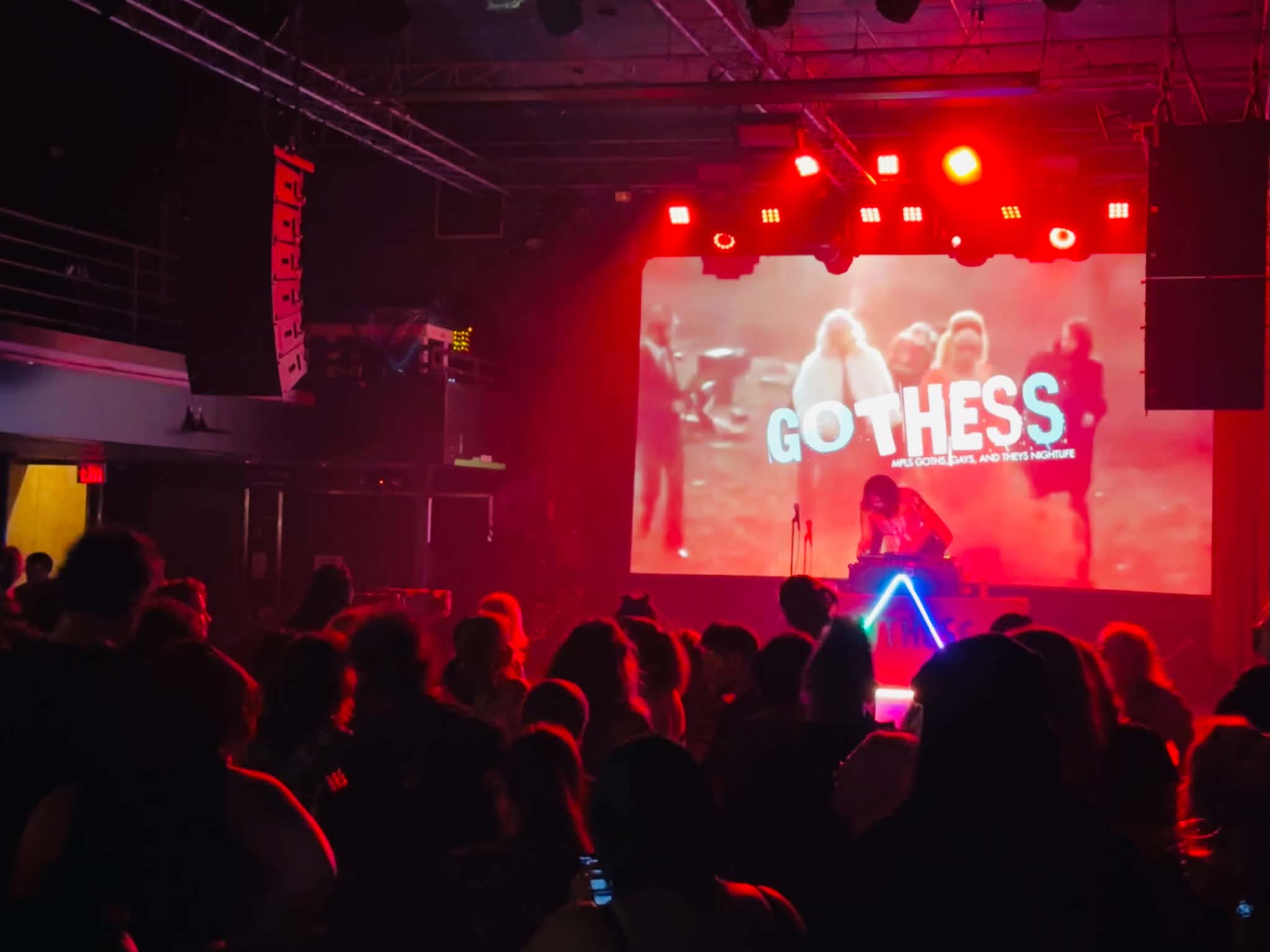
There was some closure for Gothess, which hosted a Pride event at the Fine Line the night after the shooting (see photo). “Stress was high,” Navarro says, “but thankfully it was a night that brought some solace to the community.”
Grey still hopes to someday get on the Mortimer’s stage again, maybe even before the year is up. “I will definitely consider playing there if I feel like it’s safe enough,” he says.
“All I can do is keep my whole property and building as safe as possible for our customers,” Holland says. “It’s a huge priority. It’s about all we talk about, just to be in a defensive mode. It’s pretty crazy.”