


Earlier this year, I became unemployed for the second time since I turned 50. The first time, I was in the company of everyone else who found themselves jobless when the pandemic struck. I can't take that one personally.
Still, it was a new low. I spent the first eight months of lockdown unemployed and cowering from death germs in my Condo of Solitude. Then, in a moment of boredom-induced delirium, I accepted an offer to do my former weekly Welcome Services volunteer gig at Hennepin County Medical Center, but for pay and health insurance.
It didn’t occur to me until a few hours into my first shift that agreeing to a part-time, entry-level, frontline worker position at a famously chaotic county hospital during the peak of a global pandemic was perhaps a mistake. It was the most stressful job I’ve ever had. In the absence of any other opportunities or offers, I kept it for nearly two of the shittiest years of my career. The only perk was that I got the vaccine months before everyone else.
I escaped that relentless hell after a friend referred me for a remote legal writing job. Even before AI exploded, writer job interviews were hard to come by, but they were compelled to grant me an interview due to the internal referral. I happen to be the Olivia Miles of job interviewees, so I cranked the charm up to 11 and got the job. The company was a subsidiary of a stable, century-old global brand. I thought I’d retire there.
Two years later, my company was sold off to a conglomerate in California, which immediately started downsizing. I survived the first round of layoffs, but this past March my manager sent an invite for a video call, 20 minutes before it was set to start, with the subject line “Touch base.” I knew I was fucked even before I logged on and saw the grim face of my HR rep.
I’d fallen victim to the contemporary cliche of many laid off workers; I trained my replacement, a nice person in the Philippines, whose salary was a fraction of mine.
After my company’s sale was announced, it only took a few minutes of cyber-stalking our new owners to understand that my job security was suddenly as flimsy as an ICE agent’s alibi. I started job hunting immediately.
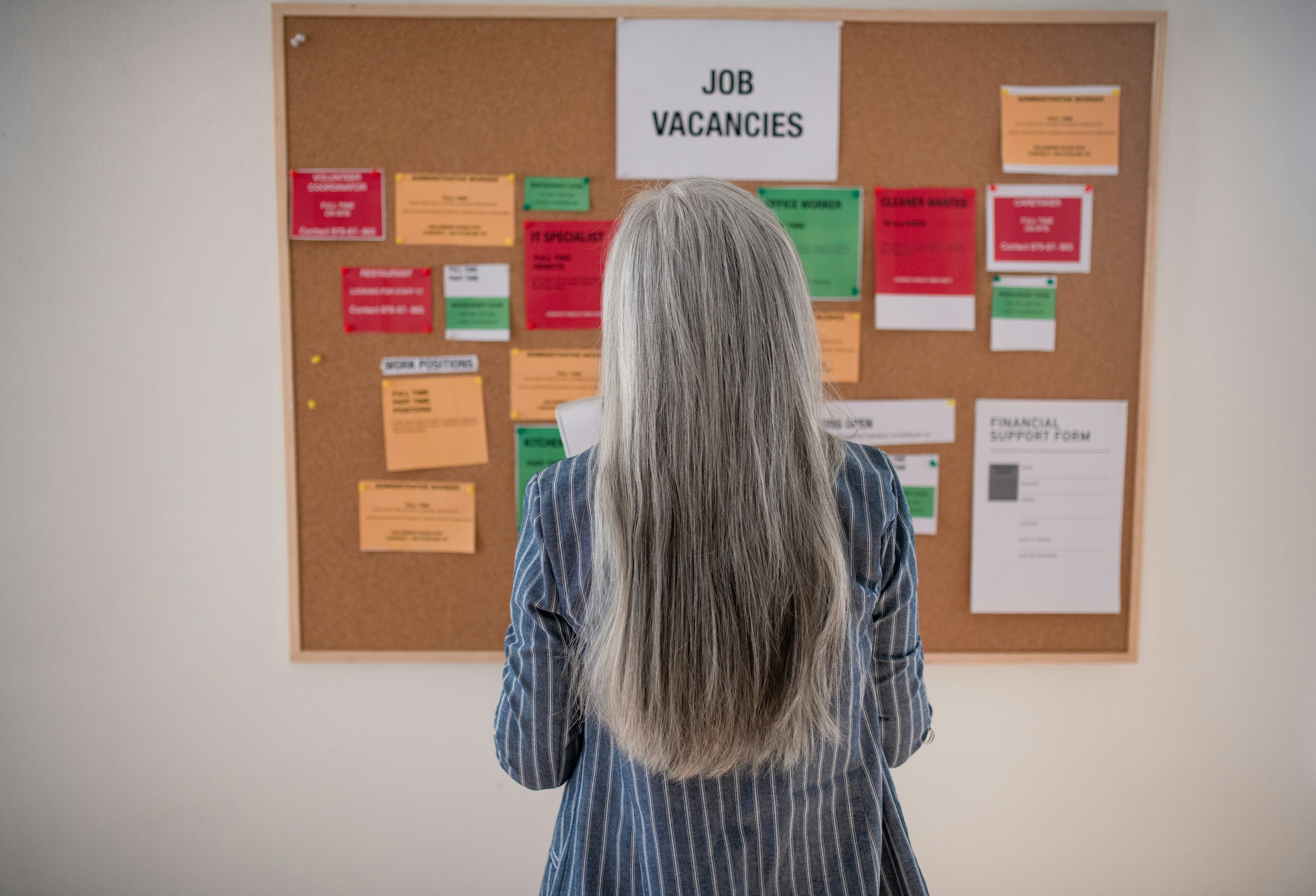
As of this writing, I have engaged in a weekly job hunting ritual for 18 months. In that time, I have received zero offers and zero interviews. Companies have so little interest in me, they won’t even waste 15 minutes on a screening call to check that I can speak in complete sentences and dress myself.
As I see it, being a replaceable, crusty writer is only my second most pressing problem. The first is that I just turned 56 and, spoiler alert, ageism is rampant. At least that’s what everyone believes.
Age Discrimination for Older Applicants is Real (We Think)
The odds are stacked against older job seekers for a number of reasons:
- Older professionals are less likely to relocate. (Guilty.)
- They’re looking for a unicorn job that perfectly aligns with their strengths. (Very guilty.)
- They may be lacking new skills required for emerging jobs and sectors. (Debatable.)
- They have higher salary expectations. (Isn’t that how experience works?)
- Older professionals may not be up to speed on the best job search practices. (No, you may not be up to speed on the best job search practices, butthead.)
Reliable ageism-in-hiring data is thin, because collecting accurate data would require employers to admit to breaking federal law. In the U.S., federal ageism protections start at age 40. That bar was set in 1975, when life expectancy was 77 for women and 69 for men. Now, in an era when the average age in Congress is something like 92, why is ageism still a thing?
I feel compelled to point out that current ageism victims are largely from the famously durable Generation X. How many Gen Xers do you know that are too feeble or tech-deficient to hold their own in the workplace? On the contrary, the Gen Xers that survived halfhearted safety concerns in the 1970s and ‘80s, like no seatbelts and 8-foot tall jungle gyms built over concrete, are basically indestructible. We stared death in the face once or twice a week for the first two decades of our lives, so yeah, we can handle your quaint, non-lethal job.
Age discrimination lawsuits filed with the Equal Employment Opportunity Commission (EEOC) are on the rise, but that number is still infinitesimal, considering America’s population. Out of tens of thousands of age discrimination complaints filed with the EEOC, just six lawsuits were pursued in 2022, 12 in 2023, and seven in 2024. These cases are rare, because hiring and firing age discrimination is notoriously difficult to prove.
We have job seeker data, and a million aggrieved essays like this one, decrying ageism, but this data is based on job seekers’ perceived discrimination. A 2024 survey by CWI Labs of more than 1,600 U.S. adults aged 50+ revealed that 59% of job seekers felt their age was a negative factor in their job search.
That said, a 2023 meta-analysis of studies conducted between 2010 and 2019 found “a sizable effect of age discrimination against older applicants in the selection process.”
OK, You’re a Generalist Writer, Dude. Certainly People With In-Demand Skills Are Doing Better?
Let’s check in with a few of them!
Pam Mandel is a senior-level technical copywriter with 20+ years of experience, based in Seattle. A technical writer in a city that’s home to mega-brands like Microsoft and Amazon should have a firehose of job offers, right?
“I'm walking dogs. I have a part-time, minimum-wage job for a small culinary business that'll end in a few weeks,” Mandel reports between dog whispering sessions. Her last job ended when the client didn’t renew their contract, and the whole team got canned. In fact, Mandel got canned so hard that she started a podcast called Canned, where she interviews people who got fired, laid off, or otherwise benched. She‘s not hurting for mature guests.
Despite what the internet claims, technical writing isn’t the slam dunk it once was. Mandel’s obstacles sound familiar. “Managers are being told AI can do my job. A lot of jobs aren't real. AI bots are gatekeeping jobs for all but the most perfect matches. A lot of people are unemployed so there's a zillion applicants,” she explains.
Mandel has thoughts about ageism.
“Younger workers are cheaper and—I think this is important—more compliant,” she says. “The tech market I started working in 20+ years ago felt like it prized creativity and curiosity. The current market seems to prize productivity and conformity.”
“I am 56, female, brown, and will soon be laid off for the second time in five years,” adds YS, VP of marketing operations at a Midwestern bank, whose full name is being withheld to protect her job prospects. “This time there are far fewer jobs posted overall, many of them are clearly ghost jobs posted to maintain ‘growth’ PR and therefore valuation manipulation.”
As for me, I’m at least partially responsible for making the bed that I’m currently tossing and turning in. I was well aware that working as a subsistence travel writer for 13 years would delay my retirement significantly. Given another chance, I’d change nothing. However, I did not factor lengthy intervals of under-employment and unemployment into that equation. These days, the concept of retirement feels like a chapter in Alice in Wonderland.
As we were prodded into college in the ‘80s, we were assured that if we worked our asses off, we’d be rewarded with a comfortable retirement at 62, a big house, two cars, a cabin Up North and, according to breathless news reports at the time, maybe some jetpacks.
Instead, we got a world where a semi-literate, preposterously corrupt sex offender is our two-term president and a ketamine-addicted racist is the world’s first trillionaire. Moreover, we’re grappling with the possibility that Social Security will run dry when we need it most. And if things don’t turn around, Gen Z is going to have it even worse. (Yeah, I ignored you, millennials. How does it feel?)
Overqualified is the New Underqualified
Why are there so many “overqualified” job seekers? Choose your explanation:
- There were 3.5% fewer corporate jobs in 2025 than there were in 2021.
- Fewer people are quitting among fears of an impending recession.
- Layoffs are on the rise including employers cutting middle management positions.
- DOGE cuts resulted in more than 260,000 workers leaving federal service in 2025 alone.
What are older workers supposed to do? Apply to a lower-level position and spend five years working back up to the salary they had a minute ago? That’s an unappealing prospect for someone in their mid-50s, never mind the ego blow of reporting to a manager that was in preschool on 9/11.
Would Mandel or YS take a pay cut for the right job?
“Yes, but I don't think the HR bots will even consider me,” Mandel vents. “I got a lot of ‘you're overqualified’ rejections and I was like, ‘OK, but could you ASK if I'd take the job at this rate? Coz I might!’”
“I am absolutely looking at roles with serious pay cuts,” YS admits. “It hurts more since my 2024 transition included a $30K cut already! I'm more comfortable with a cut if I can stay remote, which opens me to a wider range of companies, although it also increases my competition.”
Adversarial Intelligence
Increasingly, AI bots are judging your résumé before a human ever views it. And new research suggests those bots prefer younger candidates.
“I think AI HR is both unimaginative and adversarial,” Mandel confides. “It encourages hiring managers to zero in on the perfect match for the skills list rather than other less quantifiable skills.”
I’m in that boat. How do I work something like “I’ve never missed a deadline” into a resume that AI will acknowledge? How do I communicate that the years upon years I put into learning to juggle nine balls demonstrate that I will work tirelessly with little to no encouragement? Does AI understand the heroic discipline it takes to self-publish three books (and an e-book edited by none other than Racket’s Em Cassel)?
Where’s the job application dropdown answer that indicates I’m remarkably adaptable? Will AI appreciate that I got hired at 52 for my legal writing job and, despite being a bit fuzzy on the concept of “probate,” in barely a month I was cranking out 1,000-word articles on ERISA? (Google it.)
Should I debase myself by prompting AI into crafting my resume so it’ll satisfy HR AI for a job that involves training AI? And does that sentence alarm anyone else?
Or do I go the job-application-via-TikTok route by setting up a table on Nicollet Mall and challenging the youngs to simultaneous arm wrestling and Ms. Pac-Man matches? I doubt that will get me a job, but think of the views.