

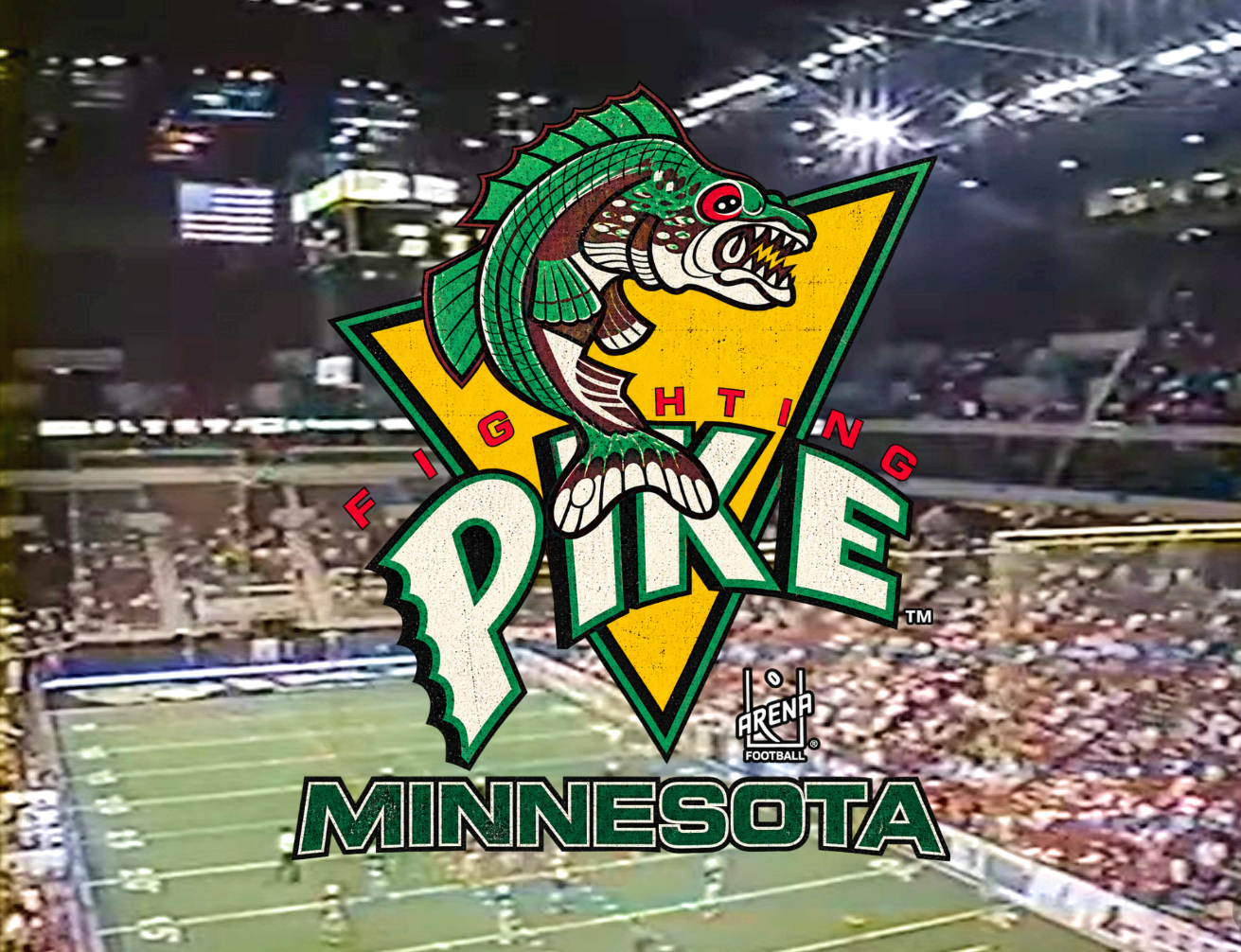
The coaches didn’t quite understand the game. The players, desperately seeking another shot at football livelihoods, arrived from obscure colleges and the Canadian Football League. The owner made his fortune running the Ice Follies, and the logo he chose didn’t depict his team’s namesake fish species.
Yet for one hard-luck season the Minnesota Fighting Pike managed to play pro football in downtown Minneapolis. In foreboding fashion, that 1996 campaign was delayed when an aerial performer entangled himself in Target Center’s rafters ahead of the home opener. It would end a few months later with checks bouncing like balls off of arena football netting.
“It was special, I just wish the financial part would have lasted longer than a year,” says Alvin Ashley, a two-way player who would compete for 11 years in the Arena Football League. “We were excited to come back, then bam: no longer a franchise.”
Here, 30 years later, is the story of Minnesota’s fleeting AFL franchise, as told by the Pike players and coaches who fought the good fight.
Spawning the Pike
In his 2015 Star Tribune obituary, the Minnesota Fighting Pike owner was billed as "the unsinkable Thomas Scallen." Over the years the colorful local businessman had ownership stakes in the Harlem Globetrotters, the Vancouver Canucks, Ice Follies and Ice Capades, Chanhassen Dinner Theatres, and the Lexington Restaurant. He piloted his own media firm, International Broadcasting Co., but also enjoyed a senior VP run at 20th Century Fox. Scallen went to prison in Canada (he’d later received a full pardon), and he battled through bankruptcy. He was remembered as "an old-school impresario" whose career resembled a "wild and wonderful roller coaster," and the Fighting Pike represented his first foray into the Arena Football League, which had launched nine years earlier. Scallen’s pro-football venture kicked off with a head-scratching introductory statement…
Tom Scallen, owner1: This isn't just about high-speed, in-your-face football action—it's about saving an entire generation of Minnesota's game fish from becoming shore lunch.
Adrian Lunsford, defensive specialist: I think we maybe met the owner once. Didn't know him.
Kevin Guy, defensive back: I don't think I ever remember seeing or meeting the ownership group. If I did, I probably didn't even know who the hell they were.
Scallen2: Our [broadcasting] company is not trying to win Academy Awards. You can find most of our movies on HBO late at night. We're [as] commercial as you can get. We're always looking for opportunities in the entertainment business. We're not trying to kid anybody with Arena Football. It's 50 percent football and 50 percent entertainment. The going price for an Arena League team was $1.25 million... we were able to get this team for below market value—well below.
Frank Haege, defensive coordinator: They actually named my dad [Art] as the original head coach. He was with the Iowa Barnstormers in '95, but he had a stroke afterwards. When he came to Minneapolis to start working, it was just too much for him, honestly.
Dan Barreiro, Star Tribune columnist3: In the next millennium, how will Minnesota Fighting Pike historians refer to the Art Haege Era? Chances are they'll call it short. Haege, the Arena Football League team's first coach, concludes his storied tenure with a record of 0-0. He came, he saw, he left in a huff... On Sunday, the Pike conducted tryouts at Macalester College. On Sunday night, Haege left.
Art Haege, coach4: I'm more of a hell-bent, raise-hell kind of guy who is going to go after people. I'm not an intramural junior college guy... I didn't want a bunch of weaklings... They weren't my kind of folks.
Frank Haege: They ended up hiring Ray Jauch probably a month before the season.
Ray Jauch, coach5: You've got the fireworks and the cheerleaders and the guy getting shot out of the cannon. And you've got a game being played right in your lap. In arena football, fans are part of the game, and they really seem to like it. It's an exciting game.
Rickey Foggie, quarterback: I was married at the time and my ex-wife, who's from north Minneapolis, wanted to get back to the Twin Cities when I was up in Canada. It was a good deal because now I'm making my wife happy—for a change.
Guy: I was probably the greenest on the team. I had a Southern accent that was strong in those days. I remember calling to set up my phone and the lady I was on the phone with couldn't understand what I was saying. I thought everybody up there talked different!
Frank Haege: We practiced inside the indoor bubble at Augsburg, and they gave us a couple offices for coaches inside the dorms. Our guys stayed across I-94 at one of those apartment buildings.
Lunsford: You had everything you needed right there. You could walk to practice.
Guy: I'm 23 from rural Alabama, and it was the first time in my life I ever got on a plane. At Augsburg, that was the first time I learned about walking on ice—I busted my head open the first day.
Foggie: It was a shock to the system at first. Playing with teams in the CFL, I was used to more structure, practice, meetings, being on time... and a lot of Pike players were not [on time]. And unfortunately I was one of 'em. [Laughs.]
Lunsford: The coaches did not know the game, they were learning on the go. There were maybe one or two who had played arena football before getting into coaching.
Frank Haege: The young guys, especially, were trying to use it as a stepping stone to the NFL. But then you had guys who had been at it awhile, and they just did it because they loved it. Beats working for a living, I suppose.
Guy: People forget: Only 1% of football athletes make it to the NFL.
Mike Vanderjagt, kicker: At that point, even when I was in Canada, the NFL was not my end goal. I was just trying to figure out where you can get a paycheck and be successful.
Alvin Ashley: wide receiver and defensive back: Because of my [5-foot-9, 140-pound] size, I never got any looks for the NFL. When I got drafted by the arena team out of Milwaukee, I didn't know anything about indoor football. That was my starting point. I made the most of it, and ended up playing 11 years.
Jeff Loots, backup quarterback: I was in the top five quarterbacks coming out for the '93 Draft—Rick Mirer, [Elvis] Grbac, Trent Green. Then I blew my shoulder out with two games left to go my senior year.
Guy: So I was the fastest guy on the team, and I don't remember who gave me the nickname, but somebody started calling me "Mighty Whitey." And it has stuck with me for 30 years!
Foggie: I'm used to throwing on a 110-yard Canadian Football League field. You put me into this little ice rink sort of a deal, and I keep breaking people's fingers in training camp. We had some athletes on our football team, and Alvin Ashley was one of 'em. He was our iron man on offense and defense.
Ashley: I was just motivated to prove to the world: Hey, you don't have to be the biggest guy to be successful.
Bill Shea, journalist, author, and ex-Continental Indoor Football League player: There's more than enough guys who want to keep chasing the dream or just play. Every year it seems like there's a new indoor or outdoor football league.
Beginnings of the Arena Football League Heyday
The Arena Football League began rising to prominence in the late ’90s, eventually peaking at 19 teams in 2007. There were TV deals with ESPN, a developmental spinoff league called AF2, and a 2006 EA Sports video game. Much of the country’s interest was attributed to ex-Iowa Barnstormer Kurt Warner, who championed the sport as he ascended to Super Bowl XXXIV MVP with the St. Louis Rams. Following a 2009 AFL bankruptcy, celebrity owners like Jon Bon Jovi (Philadelphia Soul), Mötley Crüe's Vince Neil (Las Vegas Outlaws), and Gene Simmons (Los Angeles KISS) participated in the league’s second iteration from 2010 to 2019, though bankruptcy would strike again. In 2024 a third crack at the AFL birthed the Rickey Foggie-coached Minnesota Myth, who would play just two games. (Foggie, who was joined on staff by Pike buddy Jeff Loots, shares his unsavory Myth memories below.) Launched two years ago, Arena Football One would become the AFL's spiritual successor, and earlier this month one of its eight teams—the Minnesota Monsters—announced their relocation from Duluth to Minneapolis.
Ray Jauch, coach: The fella that invented the game, Jim Foster, was the son of a friend of mine in Iowa City, a plumbing contractor. Jim got me started in arena football. It was kinda interesting.
Randy Snow, arena football reporter, podcaster, and historian: Jim Foster was working in the marketing department of the NFL in New York City. He left work one day, and he went to Madison Square Garden to see some soccer all-star game. He's sitting there in the stands, and he's looking at these guys playing soccer in a hockey arena, and he thought to himself: "Hm, I wonder if they could play football here." And he pulls out this manilla envelope and sketches out what a field would look like, the rebound nets, and some of the rules. That's how arena football got started.
Alvin Ashley: wide receiver and defensive back: There were a lot of people that didn't know about arena football, but we always said: Once you go to one game, and experience it, you'll fall in love with it. And a lot of people did.
Snow: People loved the fact it was quirky, and that it wasn't trying to compete with the NFL. If you ever go to an arena football game, in-person, you will love it and you'll get hooked. Not on TV, not highlights: in-person.
Bill Shea, journalist, author, and ex-Continental Indoor Football League player: I fell in love with this kooky, weird, substrata of everything below, basically, the NFL—it's a wild, wild world. The Arena Football League spawned this entire galaxy of competing major and minor leagues.
Rickey Foggie, quarterback: We had ESPN, we had ABC, if you went to a Tampa or Orlando game, you had 16,000 people at those games. We had the good fortune of playing against this guy named Kurt Warner. We had no idea he was gonna turn out the way he did. You had guys in that league that could easily be playing in the NFL, but it's a numbers game.
Ashley: It was basically a summer job. [I got], maybe $1,500 a game? If you were a quarterback, like a Rickey Foggie or a Kurt Warner, your contract was much larger.
Foggie: It was a nice check.
Adrian Lunsford, defensive specialist: I believe I was getting paid, with the win bonus and everything, like $2,000 a game. I was making $500 per interception.
Kevin Guy, defensive back: In those days, I was making $700 a game plus incentives. You were really using this as an opportunity to get yourself into the NFL, that's why everybody was doing it. I didn't have a problem with the pay coming right out of college, getting free housing and free utilities.
Jeff Loots, backup quarterback: It was probably around $1,000 per game base. But you'd get a couple hundred dollars for touchdown passes, everybody would get a $500 win bonus. Toward the end we got in with the NFLPA so we had year-round benefits, 401K.
Randy Snow, arena football reporter, podcaster, and historian: The Arena Football League got even bigger in the 2000s. Some of the top quarterbacks were making $100,000 per season. That was really the heyday.
Foggie: You're bringing up a sore subject. The Minnesota Myth... they got the name right, because it was a myth.
Snow: The guy running that [third iteration of the AFL] made so many promises and didn't fulfill hardly any of them.
Loots: I feel bad for these [indoor and arena] players nowadays, because they're playing for a couple hundred dollars a game.
Swimming Against the Current
The Fighting Pike surged out of the gate with a 36–24 road victory in late April over another AFL expansion team, Houston’s Texas Terror. A week later 14,840 fans greeted the Pike for their downtown Minneapolis home opener inside Target Center, where Iowa Barnstormer QB and future NFL MVP Kurt Warner notched a comfortable 59-43 victory. An eight-game losing streak followed; home attendance never again cracked 9,000. The Pike did catch fire in July, however, winning three of their final five games en route to a 4-10 record. Rickey Foggie tossed 40 touchdowns, Alvin Ashley approached 1,000 yards receiving, Kevin Guy led the team in tackles, and Adrian Lunsford tied for second in the league with seven interceptions.
Frank Haege, defensive coordinator: We didn't start off very well. The first game, the crowd is all hyped, and someone is going to rappel out of the ceiling of the Target Center and bring the first ball to center field for the coin toss. This guy rappels out of the rafters, and he gets stuck. So dude is stuck, and they had to delay the game for like 20 minutes. I heard they sold a lot of beers. I think they might have actually run out of beer at the first game—they underestimated how much partying was going on.
Kevin Guy, defensive back: We didn't know anything about arena football. But one of the coaches said, "Hey, if you want to be a fan favorite, it's kinda like hockey, get in some fights." I remember Iowa scored a touchdown, and I went up and punched the receiver right in the chin. Got a personal foul! [Laughs.] There was a lot of experimenting going on.
Frank Haege: There was a decent buzz around town. All the news outlets were doing stories about it; our games were actually decently attended. Having Rickey Foggie as our quarterback was a big story. Any Gopher fan worth their salt remembers Rickey Foggie.
Rickey Foggie, quarterback: My name, being the Gophers quarterback, was exciting for people coming to the games as we tried to get it rolling. I'm not really sure what they did to advertise other than promotions, but if you saw our first home game, you were coming back. We had a hot tub next to the field, and we had some very, very attractive ladies in that hot tub. We weren't sure if people were coming to see football or if they were coming to view the ladies.
Art Haege, coach6: I think it's because we do a lot of gimmicky stuff, like set off fireworks and things like that. I know people think it's rinky-dink but I just hope they give it a chance because it's a lot better than people think. It's good football. I'll tell you something else. We're not just a bunch of fat-heads who can't take a joke.
Marty Essen, Star Tribune reader7: Last week's Minnesota Fighting Pike halftime show featured a "bullfight," consisting of taping concert tickets to the bellies of two frightened calves. Contestants then chased the animals around the arena while yanking on their tails in an attempt to grab the tickets. I would have thought we had advanced beyond terrifying animals under the guise of entertainment, but apparently not. I, for one, have attended my first and last Fighting Pike game.
Adrian Lunsford, defensive specialist: Off the field, it was guys being guys. You're the hot topic of the town... until the Timberwolves start playing.
Guy: We were living the life, man. We worked hard during the day, but at night... Now, we got our work in, don't get me wrong. But we were young and when we were out hitting the city, we were chasing. When we'd be out trying to date the girls, I didn't have any problems because I think everybody loved my accent. [Laughs.] There was definitely a lot of partying going on in those days. One thing I will say about Minnesota people: Man, everybody up there loves to drink beer.
Worker, Target Center8: This crowd isn't great, but it's a lot better than what the Arctic Blast had in here last night. They announced 3,000-something. I don't think they had more than a thousand.
Jeff Loots, backup quarterback: They didn't do a great job of marketing it, getting the name out there. It was kind of just word of mouth.
Frank Haege: Once you hit the summer, and people are up at their cabins, we struggled a lot more. And obviously we weren't winning. In pro sports you gotta win right away. Everyone at that level knows the teams can come and go at any time.
Guy: Some of the older guys, I don't know how serious they were taking it at the beginning of the season. Coach Jauch was a high-character guy, and he ran off a couple knuckleheads during the season. At some point, everybody got on the same page and we caught fire.
Adrian Lunsford, defensive specialist: The whole year we were close, you could send something magical would start to happen. And at the end of the season, we found our groove.
Guy: Probably a month after the season, coach Ray Jauch sent a handwritten, personal letter to every player on the team, thanking them for their effort. I've never seen that done anywhere, and I've not seen it done since. He wrote a full page, and I remember being so impressed by that, I told myself, "Hey, if I ever become a head coach one day, I'm gonna do that." And I'm gonna tell ya right now... I never did it. [Laughs.] That's a lot of letters to write!
Going Belly Up
The AFL officially disbanded the Minnesota Fighting Pike in late November. Owner Tom Scallen stiffed creditors with over $200,000 in unpaid bills; Scallen—who co-owned the team with a collection of Mexican businessmen and Major League Soccer commissioner Doug Logan—reportedly lost $400,000 on his 13-game arena football adventure.
Ron Kurpiers, AFL president9: It was strictly a financial decision. If we don't commit marketing power, it's really difficult to succeed. We need ownership with the marketing power to do that.
Kevin Guy, defensive back: If there's nobody in seats, then it's gonna be hard to run the business. And I'm sure it cost a pretty nickel to play at the brand-new Target Center.
Bill Shea, journalist, author, and ex-Continental Indoor Football League player: There was just no stability in the Arena Football League. The early NFL was like that, too. Instability kills things. When you get to these lower levels of pro and semi-pro football, it's really easy to lose money. The Pike are part of the long, very patchwork history of indoor football history.
Jeff Loots, backup quarterback: The owner was probably kicking himself because I think he sold the team for a couple hundred thousand, and like three or four years later teams are going for $5, $6, $7 million.
Frank Haege, defensive coordinator: We played our first game over the weekend, and then we got our checks on Wednesday. Well I didn't get my check to the bank until the following Monday, and my check bounced. They were like "The account had closed." I figured, oh, OK, that's not good.
Rickey Foggie, quarterback: Sure enough, I went to the bank to try and cash our last game check... we didn't get our last check, that's for sure.
Alvin Ashley: wide receiver and defensive back: Yeah, game checks weren't clearing the bank. That was a headache.
Adrian Lunsford, defensive specialist: I got my last check. No issues.
Guy: We wound up winning a lawsuit several years later, and they had to go back and backpay us for four years, and Minnesota was one of those years.
Shea: I think most people from the highest to the lowest levels of arena football will have some really great memories, and then a ton of stories and memories of getting ripped off.
Mike Vanderjagt, kicker: I was surprised when they folded. They pulled the plug on it a little too soon.
Cutting Bait on a Future NFL Star
One member of the Minnesota Fighting Pike would reach NFL stardom: kicker Mike Vanderjagt, owner of the league’s 10th-highest career field goal percentage. Naturally, the Pike cut the eventual Pro Bowler after two games.
Mike Vanderjagt, kicker: I was really good at making field goals and extra points. The problem was I kept kicking off into the stands on the side, and not into the net. So every time I'd kick off the other would get the ball at the 25 instead of the 5. I became a kickoff liability.
Frank Haege, defensive coordinator: This is one of my claims to not fame: We ended up cutting Mike Vanderjagt. He was very accurate, obviously one of the most accurate kickers in the history of the NFL, but he didn't have a really strong leg, so he had a tough time hitting the net on kickoffs. We ended up letting him go—one of the infamous stories of the Pike.
Vanderjagt: I think coach Jauch just said, "We gotta go in another direction. You're killing us.”
Ray Jauch, coach: Yeah, that happened I guess. He was a good guy.
Adrian Lunsford, defensive specialist: True story, Adrian Lunsford’s version. There's two sides to every story, and then there's the truth. Mike Vanderjagt, obviously a very talented kicker. I always equate it to the same problem Peyton Manning had with him, just his bubbly personality of "I don't care," kind of. He didn't understand that, hey man, it's very important that you kick the ball through the net. He just didn't take the arena game seriously. In all fairness, he might have felt it was beneath him. I don't know that. He missed a field goal, and I remember him laughing. Guys like myself? This is my livelihood. I was a captain, and I was just like, man, cut him! I guess I helped spark his career because he got cut, went on to the NFL, and never looked back.
Rickey Foggie, quarterback: He was cool. Kickers hung out by themselves.
Jeff Loots, backup quarterback: I had a good relationship with him because I held for his field goals and extra points. He had the talent he's always had, just to let him go is crazy. To get cut from that league and go on to be one of the best kickers in NFL history... crazy.
Kevin Guy, defensive back: I always tell him he got into the NFL because of my holding.
Vanderjagt: I don't dodge the fact that I got cut a lot, but I convinced myself that I was good enough and proved everybody wrong. I do some motivational speaking, and part of my talk includes the Fighting Pike. I got cut by the Saskatchewan Roughriders, cut by the Toronto Argonauts, cut by the Hamilton Tiger-Cats, cut by the Minnesota Fighting Pike, and then retired as the most accurate kicker in NFL history. So the Fighting Pike come out of my mouth more often than you would think.
That Logo, Those Unis
If most football fans have forgotten the Minnesota Fighting Pike, collectors of throwback sports memorabilia have not. At press time, all three vintage Pike T-shirts available on eBay are listed north of $84. Retro sports accounts rack up likes whenever they post about Minnesota’s defunct AFL squad. It makes sense—look at those sick fish unis!
Alvin Ashley: wide receiver and defensive back: When we first saw 'em, it was like, oh man... there's a fish, we got a fish on our helmet. The colors were great, green and gold. The uniform was nice. I just didn't know about that logo.
Bill Shea, journalist, author, and ex-Continental Indoor Football League player: In the '90s, uniforms started getting insane. Even at the pro level.
Rickey Foggie, quarterback: Our uniforms were legit, I'm telling you! They were cold as ice.
Ray Jauch, coach: The Fighting Pike... one of my friends said, "What is it, the Wicked Minnows?" I had a lot of fellas joke with me about it.
Frank Haege, defensive coordinator: I kinda like the name, very appropriate for the state. I actually have a poster of one of the original logos in my garage to this day.
Mike Vanderjagt, kicker: My son, who's a fishing fanatic, wears my Minnesota Fighting Pike hat often, and somebody told me it's a walleye on the side of the helmet and not a pike—is that true?
@Q_T_22, Twitter user: Super sick… but why is the logo a walleye haha.
Cory Goldsworthy, Lake Superior fisheries supervisor with the Minnesota Department of Natural Resources: The plot thickens, however, when we go back in time and walleye were referred to as “walleyed-pike”… but the logo definitely looks more like a walleye than a pike!
Randy Snow, arena football reporter, podcaster, and historian: The name has stuck. With anybody, when you're talking about arena football history, the Fighting Pike name and logo come up. I actually have a mini helmet of the Fighting Pike because I thought it was so cool.
Minnesota Memories
Every former Minnesota Fighting Pike player and coach interviewed for this oral history remembers the blink-and-you-missed-it franchise with fondness. Several of them joined forces the following season with the more successful New Jersey Red Dogs, and all of them forged nice careers in the AFL. Kevin Guy, who’s now head coach and president of the Indoor Football League’s Arizona Rattlers, became the winningest arena/indoor football coach ever two years ago. They’re forever bound by history because of that one summer, back in 1996, when they went to battle together inside Target Center as Fighting Pike.
Patrick Reusse, Star Tribune columnist: I think I might have written two pieces total on ‘em and my memories are close to nonexistent.
Randy Snow, arena football reporter, podcaster, and historian: The Pike were the epitome of the Arena Football League quirkiness that worked. They didn't try to be NFL-like—they were their own animal.
Rickey Foggie, quarterback: It's hard to break into the Twin Cities when, you know, it's really not needed—you have the four pro teams, you have all the college teams. It was gonna be tough. It was a great experience, though. I wouldn't change a thing for the world.
Adrian Lunsford, defensive specialist: The big takeaway for me was living in the moment. I relished that year, because I had a great year with seven interceptions, near the top of the league. The Vikings were talking to me about coming to training camp, and I broke my shoulder and didn't get to go to camp. We had an understanding that it could be gone tomorrow, and with the Pike, it was.
Kevin Guy, defensive back: There was no 50-year history of the league. It was 1996, and the league had only been around for a little while: The coaches were learning the game just like the players. I wish Minnesota would have kept the team. When [Racket] hit me up, I thought, "Fighting Pike?!" I've been waiting on this call 30 years.
Archival Sources:
Footnotes
- Press release, November 1996Return to content at reference 1↩
- Star Tribune, June 1, 1996Return to content at reference 2↩
- Star Tribune, January 17, 1996Return to content at reference 3↩
- Star Tribune, January 17, 1996Return to content at reference 4↩
- Star Tribune, January 31, 1996Return to content at reference 5↩
- Star Tribune, November 10, 1995Return to content at reference 6↩
- Star Tribune, May 19, 1996Return to content at reference 7↩
- Star Tribune, June 1, 1996Return to content at reference 8↩
- Star Tribune, November 22, 1996Return to content at reference 9↩