

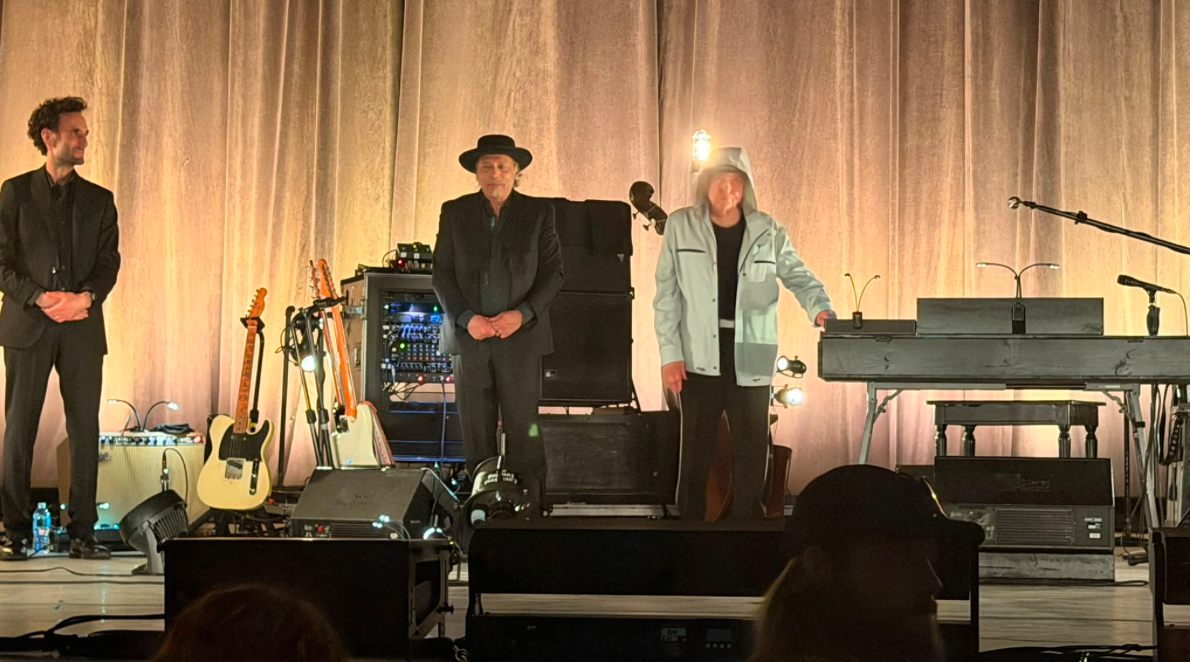
I sat just about as far away from Bob Dylan as a paying customer could at the Mystic Lake Amphitheater on Monday night. I could see a stage but not much of what happened on it. Was I missing anything? Up there on the screen, an elderly fellow in a hooded white coat was crouched behind an electric piano, his band silhouetted on the dimly lit stage. It’s not like Dylan was gonna do a backflip.
Way back in GA at the new Shakopee amphitheater, where a surprising number of teens (Chalamet Effect?) lounged on blankets spread across the fake grass, the sound was excellent and a breeze stirred as the sun set around Dylan’s 9 p.m. start time. It was the perfect summer night to sit back in a rented lawn chair (at $10, way cheaper than the cheese curds) and listen to a rock legend stir up treasured old memories with all your favorite tunes.
That’s not what Dylan did, of course. That’s not what he does. As ever, he roughed up some catalog numbers, both familiar and less so. He dipped into his most but no longer especially recent album, 2020’s excellent Rough and Rowdy Ways (his best at least since Modern Times two decades ago). He covered a few oldies you’re not likely to hear anyone else singing these days. He ran through 16 songs in an hour and a half, all of which have been on his setlist for months now.
I get that this is hardly everyone’s idea of a good time, though it’s been Bob’s M.O. for so long that any prospective emptor should long since have been caveated. Admittedly, my own attention lagged around three quarters of the way through, when “Soon After Midnight” segued into the title track from Under the Red Sky. If you don’t precisely share Dylan’s particular interests at the moment—in other words, if you’re not Dylan himself—he’s not going to make the effort to convince you.
Which doesn’t mean he’s trolling his fans or indulging in any other sort of provocation. My thoughts on the alleged “weirdness” of Dylan’s performances remain the same as when I caught his short Farm Aid set last summer. Forgive my gaucherie (or laziness) as I quote myself:
[W]hat’s so weird about a guy who just likes working up new arrangements of old songs and lets you listen in? Figure it’s Dylan’s version of jazz—tinkering with the oldies to figure out what makes them tick, yanking ’em this way and that to expand their parameters without obliterating their identity.
In its ragged, gnomic way, this was in fact a perfect summer concert—bluesy, tuneful, unrushed, relaxing even. You could bear down on the nuance of the performances or let them waft past you. I’ve never been partial to weed, and I distrust everyone who insists THC makes music sound better (whatever, hippie), but yes, this would’ve been a great night to get high.
A clatter of cymbals, clamor of guitar, and roll of piano revealed itself “To Be Alone With You,” from Planet Waves—a gregarious enough opener, with funk akin to early Ray Charles, if more subdued. Then came a moody turn toward “The Man in the Long Black Coat,” festooned with chilly, trebly guitar lines.
Though casual attendees might be unaware, Dylan’s touring band is currently in a bit of flux. Bassist Tony Garnier (on board since 1989) and drummer Anton Fig remain, and Dylan’s own keyboard work provides more melodic adornment than rhythmic foundation, though he shed two guitarists with some unascertainable level of acrimony earlier this spring. Versatile Chicagoan Joel Paterson appears to have signed on as a regular sideman, and Monday night he was joined by buzzy jazz guitarist Julian Lage, who also sat in with the band for about a week last month.
It wasn’t always easy to tell who was playing what from my vantage point (from most everyone’s, honestly), and my ear’s not attuned to either guy’s style well enough to call a play-by-play—the best I can do is observe that one seemed to pick his lines more sharply, while the other had a more fluid if not airy tone. Regardless, the setlist gave both guitarists plenty of room to show their stuff, particularly on the late-set Rough and Rowdy Ways boogie “Goodbye Jimmy Reed,” where they squared off without being corny about it. You could hear that someone or sometwo up there felt a need to impress the boss, who occasionally granted discernible nods of approval.
The covers provided the guitarists another chance to shine: Bo Diddley’s “I Can Tell” (love the hapless way Bob emphasizes the “no” on “you don’t love me no more”) offered killer slide work from Paterson. And when Dylan tackled Bobby “Blue” Bland’s “Share Your Love With Me” and Jerry Lee Lewis’s “I’ll Make It All Up to You,” we could be grateful that he’s never cowed by more mellifluous singers or dexterous pianists. There’s nothing more desperate than the romantic yearning of an aging man, and Dylan is never more willing to reveal that than on other people’s material.
The old guy was in fine voice—keeping in mind that his larynx is a battered old piano that he plays with full awareness of which keys are dead, which creak, and which are off-pitch. Overall, he sang with a fair amount of spry playfulness, and he has only honed his adept, even actorly phrasing, with time. As Dylan sang on “False Prophet,” its guitars lighter and more decorative than on the recording, “I'm nothing like my ghostly appearance would suggest.”
When Dylan recorded “Tryin’ to Get to Heaven,” for Time out of Mind nearly 30 years ago, after a dire health scare, he sounded ancient. He was, in fact, 56, an age at which, I can report firsthand, one may happily feel both feet firmly on this side of the grave. Tonight it was more like a freewheelin’ ramble. If they’d closed the doors to paradise tonight before he reached his destination, you sensed, he could maybe just swing back tomorrow afternoon.
The verses of “It Ain’t Me Babe” had a slick ’70s country-pop feel, rendering it as the Bellamy Brothers song it kind of always has been. But the chorus was instantly recognizable; if you were there to sing along, for some reason, you’d better have got it out of your system here. And yet even here, the way Dylan traipsed across the lines “Someone to close his eyes/Someone to close, to close his heart” slightly adapted the original.
This was Dylan’s first return to the Twin Cities metro area, aside from his Farm Aid appearance, since he played the Xcel in St. Paul in 2017, a fact he acknowledged exactly zero times. There were probably more on site than the 7,000 attendees than the Strib's Jon Bream estimated, though unsold assigned seats were plentiful enough that some GA attendees (not me!) were given 100 level tickets by the venue and security was lax enough that someone (possibly me) could sneak down into the 200 section without being accosted.
I hope you weren’t expecting “Masters of War” or some other broadside about the a-changin’ times. Openers John Doe and Lucinda Williams had already made the requisite political points for the evening, with the X singer hauling out his old band’s “The New World” (“It was better before/Before they voted for whatshisname”) and Williams dedicating the Memphis Minnie number “You Can’t Rule Me” to whatshisname himself. But though I admire Lu’s spirit, I don’t need to hear anyone but Neil sing “Rockin’ in the Free World” ever again. Maybe not even Neil.
As for Dylan, he has always been a mind out of time. In his songs historical events and forgotten legends sit alongside the exploits of today’s villains, and prophecy is indistinguishable from memory. A venerable artisan, he’s fallen back on craft. Fitting then that the evening’s most engaging number was a tangofied “When I Paint My Masterpiece” that sounded like “Istanbul (Not Constantinople)” (a song Bob must know, even if he’s never heard of They Might Be Giants), with both (I think?) Lage and Paterson really cutting loose.
Yet the most eager applause of the night came not for any particular song, but when Dylan blasted a few notes on harmonica, which happened twice—on “Under the Red Sky,” which (despite a lyrical guitar solo) needed a little blast of something, and the closer, “I Shall Be Released,” which, aside from an occasional rush of syllables, sounded very much like “I Shall Be Released.” Dylan apparently enjoyed himself: Before disappearing backstage, he stepped forward and gave us a little wave, the night’s only confirmation that he knew we existed.
Setlist
To Be Alone With You
Man in the Long Black Coat
It Ain't Me, Babe
Tryin' to Get to Heaven
False Prophet
I Can Tell (Bo Diddley cover)
Black Rider
Share Your Love With Me (Bobby “Blue” Bland cover)
When I Paint My Masterpiece
I'll Make It All Up to You (Jerry Lee Lewis cover)
Crossing the Rubicon
Soon After Midnight
Under the Red Sky
I've Made Up My Mind to Give Myself to You
Goodbye Jimmy Reed
I Shall Be Released