

When we look back on this past winter in Minnesota, many of the scenes we’ll remember will be ones of cruelty.
A 56-year-old Hmong man, barely clothed, cuffed and yanked into the freezing cold from his St. Paul home. A disabled woman on her way to a doctor’s appointment, pulled screaming from her car and dragged face-down along the street. A small child in a blue bunny hat and Spider-Man backpack, eyes wide as he waited to be loaded into a black SUV. A distended drivers-side airbag covered in blood, with children’s toys spilling out of the glove box next to it.
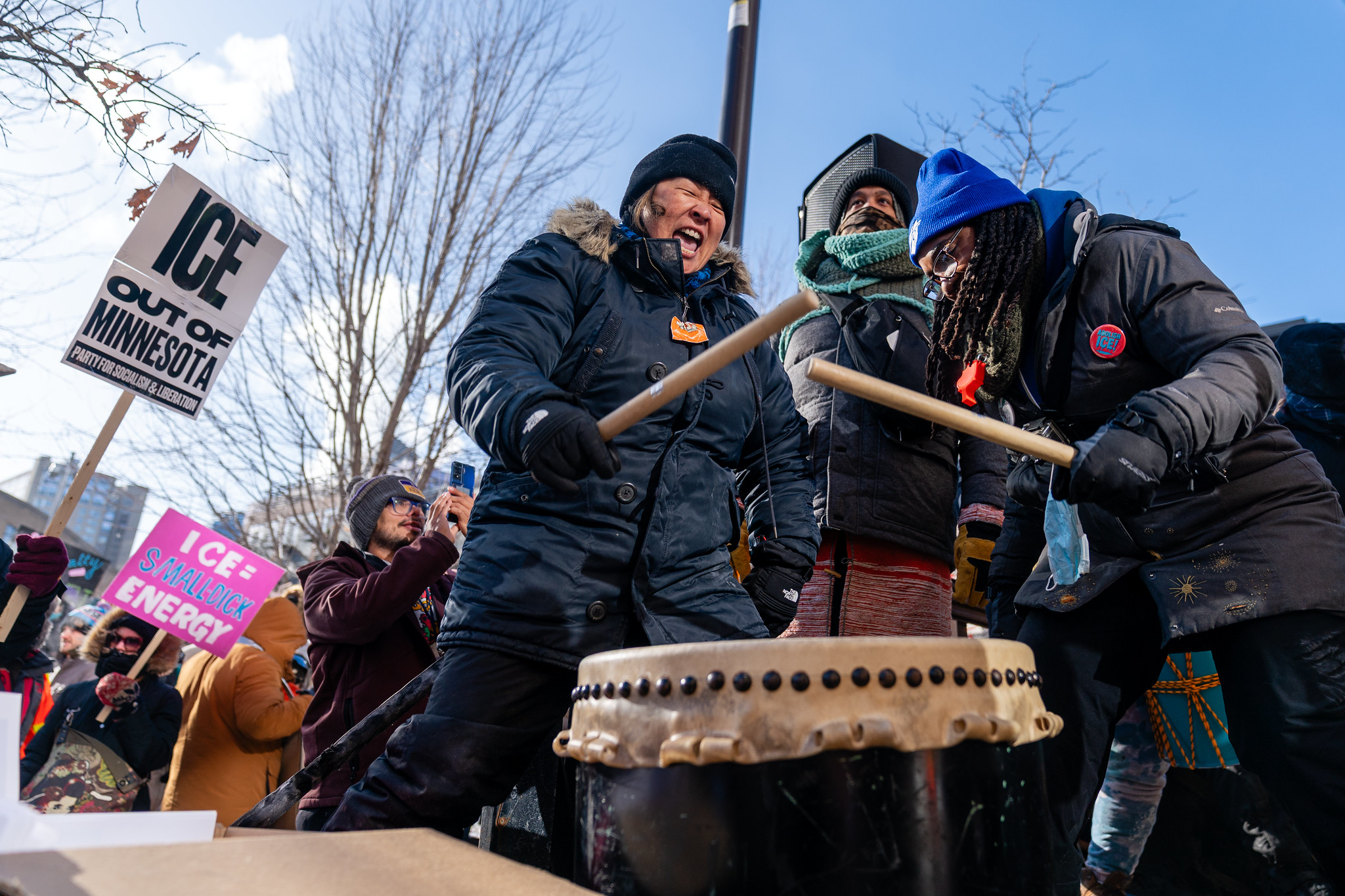
But there have been other, more uplifting scenes too. Fifty-thousand people thronging the streets of downtown Minneapolis in subzero temperatures to protest ICE’s presence in the Twin Cities. Thousands more pedaling their bikes through south Minneapolis, many in “peaceful observer, don’t shoot” vests, to honor a cyclist killed by state violence. Massive papier-mâché puppets presiding over rallies and memorials as brass bands play songs of liberation, and luminaries on frozen lakes spelling out messages like “ABOLISH ICE” and “ICE OUT 4 GOOD.”
The Trump administration underestimated how deeply unpopular and politically toxic Operation Metro Surge would be, and the world took notice as Minnesotans combated the largest immigration crackdown in U.S. history with perhaps the greatest outpouring of nonviolent protest in recent memory.
For every act of barbarism committed by 3,000+ federal agents in the name of immigration enforcement, there have been corresponding acts of protest that shows the unrelenting spirit of the people of Minnesota. Protesters have made clear their disgust with the Trump administration and their willingness to fight side-by-side with their neighbors. And they’ve done so, often, in distinctly Minnesotan ways: with ice fishing, art sleds, and winter bike rides.
“So many people who were, like myself, activated during the murder of George Floyd, stayed and did work and built community,” says Miguel Hernandez, an organizer with the Minnesota Immigrant Rights Action Committee (MIRAC). “We saw that we have great power, and now we know how to wield it, and we know what we’re capable of.”
This situation is different, but “I think people took a lot of lessons from George Floyd,” he continues. “As a community, we said, ‘We know how to heal, but let’s take action this time.’”
Jarrod Alder was working at Angry Catfish Bicycle Shop on the morning federal agents killed Alex Pretti. As videos of the killing circulated online, Alder and his coworkers couldn’t shake the feeling that the bearded man, seen bravely filming the agents before he was shot, seemed eerily familiar. And as information about Pretti became available throughout the morning, they realized he was a regular Catfish customer.
Alder remembers how heavy the mood was in the shop that day; everyone had interacted with Pretti at one point or another. He also remembers that while he didn’t really know what to do, he knew he had to do something.
“When cyclists are murdered by cars, we tend to ride bicycles as a memorial,” Alder says. Pretti may have been killed by federal agents, but he felt that a memorial ride was the right way to honor him.
“Bicycles to me, growing up, have always been protest. You’re riding a bike to combat traffic; you’re showing people that you can exist in a world that’s car-dependent … bicycles have been in protest movements and revolution in so many ways,” he says.
So Alder started working, and quickly, connecting with Genosack, Melanin in Motion, and other local cycling groups to organize a memorial ride one week from the date of Pretti’s January 24 killing. A friend, Casey Robertson, designed the poster, with a grinning, helmeted Pretti and the words “we ride in unity.” Alder sent the details and the art to a few bicycling publications, and the ride took on a life of its own; before long, he was fielding inquiries from cycling groups in Atlanta, San Francisco, and Berlin.
On January 31, more than 300 participating cities across the world held Alex Pretti memorial rides, with an estimated 5,000+ people riding in Minneapolis alone. “People were riding at the same time across time zones, globally … That is unreal, to reflect on that, and just know that everyone’s heart was feeling the same thing, and heavy with it, at the same time,” Alder says.
In Minneapolis, riders met at Washburn Fair Oaks Park and rode over eight miles together, passing Pretti’s memorial site on Nicollet Avenue and the nearby memorial for Renee Good on Portland Avenue. The mass of cyclists stretched for several blocks wherever they went.
“The state chose to murder someone that was a standout, good human being,” Alder says. “At the very least, Alex deserved to go on one last fucking bike ride, and we were able to come together and take Alex on a ride around the world.”
That same Saturday, on Lake Harriet in Minneapolis, Nate Pischke and Erik Sudheimer were setting up an anti-ICE ice fishing protest. The host and videographer, respectively, of the YouTube fishing and cooking program Shorelunch With Nate P. had been looking for a way to use their platform to speak out against the government’s invasion of Minnesota. And they were struggling.
“You always want—what’s the perfect act of defiance? What’s the perfect act of protest?” Sudheimer says. “But that’s a limiting idea. I feel like, let’s get people together on the ice, and we’ll ice fish. The optics of that are amazing. It’s super Minnesotan; this is what people are like.”
Many Americans have never been on a frozen lake before, which the Shorelunch duo thought would bring some eyes to the cause. Plus, people could see that the folks standing up to ICE on literal ice weren’t paid agitators, but guys in gaiters—everyday folks who saw something terrible happening to their immigrant neighbors and reacted to it.
The sentiment resonated with viewers far beyond the Twin Cities. To quote the top YouTube comment on the episode of Shorelunch that recaps the protest: “Saw this dude on a Mother Jones clip. Now I’m watching a fishing and cooking channel apparently. I’ve never been more charmed by Minnesota and its Minnesotans.”
“It’s almost like, in an area where it’s so cold sometimes it hurts to breathe, where everybody’s neighbor at some point has come out to help get their car un-stuck, you almost need community for survival—emotionally or physically,” Sudheimer says. “I think there’s something unique to the way people have built community and rallied around the environment they live in in Minnesota that kind of makes it unique to that area.”
“So many people were like, ‘We’ve gotta do this again next year!’” Pischke adds. “And I said, ‘No fuckin’ way, let’s not do this again next year. I don’t want these people here anymore!’”
A protest 50,000 people strong, like the statewide economic shutdown and march that took place in downtown Minneapolis on January 23, doesn’t just happen. It’s the result of diligent organizing and years of community building from local political and faith leaders, labor organizers, and activist groups.
You also need participants who are willing to disrupt order—to leave work, to avoid shopping, and to flood the streets—so that people can’t go about their day without paying attention.
“And Minnesota did that, hands down, the best I’ve ever seen it in my lifetime,” says MIRAC’s Miguel Hernandez.
For more than 20 years now, Hernandez says, MIRAC has been fighting for an end to immigration raids and deportations, and protest is one tool the grassroots organization uses in that fight. “Many of the people at MIRAC have been trained to do protests, civil disobedience, rallies, at every varying capacity—everything from 20,000 people at the height of the Palestine movement and Black Lives Matter movement to 50,000 or 100,000,” he explains.
MIRAC was just one group that threw its weight behind the “ICE Out of Minnesota: Day of Truth & Freedom” strike and rally, which was also supported by the faith community, the small business community, and Minnesota unions.
Maybe it seems like an unlikely grouping—faith, labor, community activism—but Chelsie Glaubitz Gabiou, president of the Minneapolis Regional Labor Federation, says these connections have grown stronger over the years. Many of these groups worked together, for example, to support the “avalanche” of progressive legislation that supported Minnesota workers and families during the 2023 legislative session.
“We have been working this mobilization muscle for a long time,” the AFL-CIO leader says. But when it comes to this current moment in Minnesota, “I’ve never seen us work this closely in tandem before.”
“When you’re a group of 50, 60 people, all of the sudden you call up your partners and you’re a group of 300 … you can pull off things like a group of 50,000 marching in the middle of winter and have people be safe,” Hernandez adds.
The breadth of that coalition also lets its leaders be in multiple places at once, explains Martha Schwehn Bardwell, lead pastor at Our Saviour's Lutheran Church. On the morning of the Day of Truth & Freedom rally, a group of about 100 clergy members were arrested at MSP International Airport, where they were protesting ICE detainments and deportations. That same afternoon, she was part of an action demanding accountability from leaders at U.S. Bank headquarters in downtown Minneapolis.
“There’s just been so much solidarity and cooperation among different groups,” says Schwehn Bardwell, whose congregation gathers blocks from where Renee Good was killed. “The most beautiful part of the resistance is that there’s been so much collaboration.”
Those efforts have ramped up considerably since Trump re-took office last year, even before the federal occupation of Minnesota. MIRAC, Unidos, and other immigrant-rights orgs have been hosting “know your rights” training sessions since last winter, while the AFL-CIO trained people on nonviolent direct action and how to be protest marshals.
The success of rallies like the one on January 23—in which one in four Minnesota voters took part or had a loved one who did, according to Workday Magazine—is due to many factors. Among them, Glaubitz Gabiou says, are the “thousands of hours” organizers spent doing worksite visits and having one-to-one conversations with community members ahead of time.
“The mobilization of people has been the only proven structure and strategy to actually make gains, economically or in civil rights, for people,” she says. “Without protest, without mobilization in our communities, without organizing, there would be no progress—for workers or for many of these social justice issues.”
Art Shanty Projects is a quintessentially south Minneapolis tradition, a pop-up display of public art that takes over Lake Harriet during some of the coldest weekends each winter. The shanties are the kind of local oddity that have, in the past, caught the attention of the New York Times—look at those wacky Minnesotans, thousands of of them, clambering out on a frozen lake to dance the hora or participate in “fro-gahhh” (that’s “frozen yoga”).
A lot of work goes into prepping the program for the four weekends it takes place. Artists apply in the summer and are accepted by August; by the end of each December, they’re more or less ready to go for a mid-January debut.
“In January, we always have an all-artist meeting the Wednesday before we install all the shanties,” says Art Shanty Projects Artistic Director Erin Lavelle. This year, “that was the day that Renee Good was murdered.”
Lavelle and the other Art Shanty Projects directors were working together when they heard about Good’s killing, and they quickly huddled together to discuss what to do about the event in the wake of such tragedy.
“We need to carry on. We have to do this,” she remembers thinking. “We actually have an obligation to the public to do this—it felt like a responsibility."
This is a city where public art installations are common, and where giant puppets are a regular fixture at festivals and protests. (Take the confusion regarding the giant T-rex atop a car in videos from the aftermath of Good’s killing: “Lotta people thought it was AI at first until locals started chiming in to say that the city is just like that,” one Redditor helpfully explained.)
The Twin Cities has a larger than average puppetry community, which is why you’ll see a giant yellow bird flying over marchers on Lake Street, or a lumbering, life-sized bear—a creation of Christopher Lutter-Gardella at Big Animal Productions—leading protestors through Powderhorn Park. The stars that often fly overhead during vigils? Those are crafted at Semilla Center for Healing and the Arts.
“Similar to other neighborhood chats, we have this puppet rapid response chat,” says Steve Ackerman, a puppet artist who oversees community partnerships for In the Heart of the Beast Puppet and Mask Theatre. “So many artists are on it, where it’s just like, ‘We need puppets at this event—who’s ready? Who’s willing to go?’”
Ackerman says that the role of puppets at protests is both practical and emotional.
“Puppets, in general, they’re just able to hold the grief, the anger, and the frustration of the community,” Ackerman says. “And some of those larger-than-life ones, they’re kind of these otherworldly beings … They’re able to stand with the thousands that are protesting, and they’re eight, or 10, or 12 feet tall, so they’re able to kind of rise above the thousands of people and be seen from way further down the street.”
In other words? ICE made a major tactical mistake when it fucked with a puppet town.
The resulting scenes feel iconically Twin Cities, as do those from annual events like the Art Shanty Projects and the Powderhorn Art Sled Rally, which served essentially as protests-in-waiting. At the latter, which took place on January 17, cardboard sleds included giant bottles of de-icer on skis, a cup of warm horchata (“cuz fuck ICE”), and a giant bowling ball that careened down the hill and smashed into waiting pins that were named for dictators including Donald Trump.
Several Art Shanty participants adapted their projects at the last minute to respond to and address ICE’s cruelty. At the Wicked Winter Shanty, where a group of witches cast spells, it was all about anti-ICE spells this year: “They just let people smash ice cubes all day long and guided people through that moment of catharsis,” Lavelle says. The Weather or Not Station, which is designed by two dancers who connect people somatically to their “internal weather,” ended up being one of the year’s more powerful stops, as people shared their thoughts and feelings to determine the “weather” of the day.
And ASP organizers worked with a neighbor in Linden Hills who, after seeing luminary messages of “ICE OUT” and “SOS” spelled out Lake Nokomis and Bde Maka Ska, approached them to ask about doing a luminary message on Lake Harriet. Their response was yes, with one caveat: The message had to be as stark and as straightforward as “ABOLISH ICE.”
The Art Shanty Projects always emphasize participatory art, and people show up to the lake expecting to engage with artists. That’s now more crucial to their mission than ever, says Lavelle.
“We believe in that always, but especially in this moment where we’re all trying to figure out, ‘How do we show up? How do we connect with strangers?’” she says. “A lot of the mutual aid work and a lot of the direct action work is showing up to places where you don’t know the people, and you have to figure out, ‘How do we make change?’”