


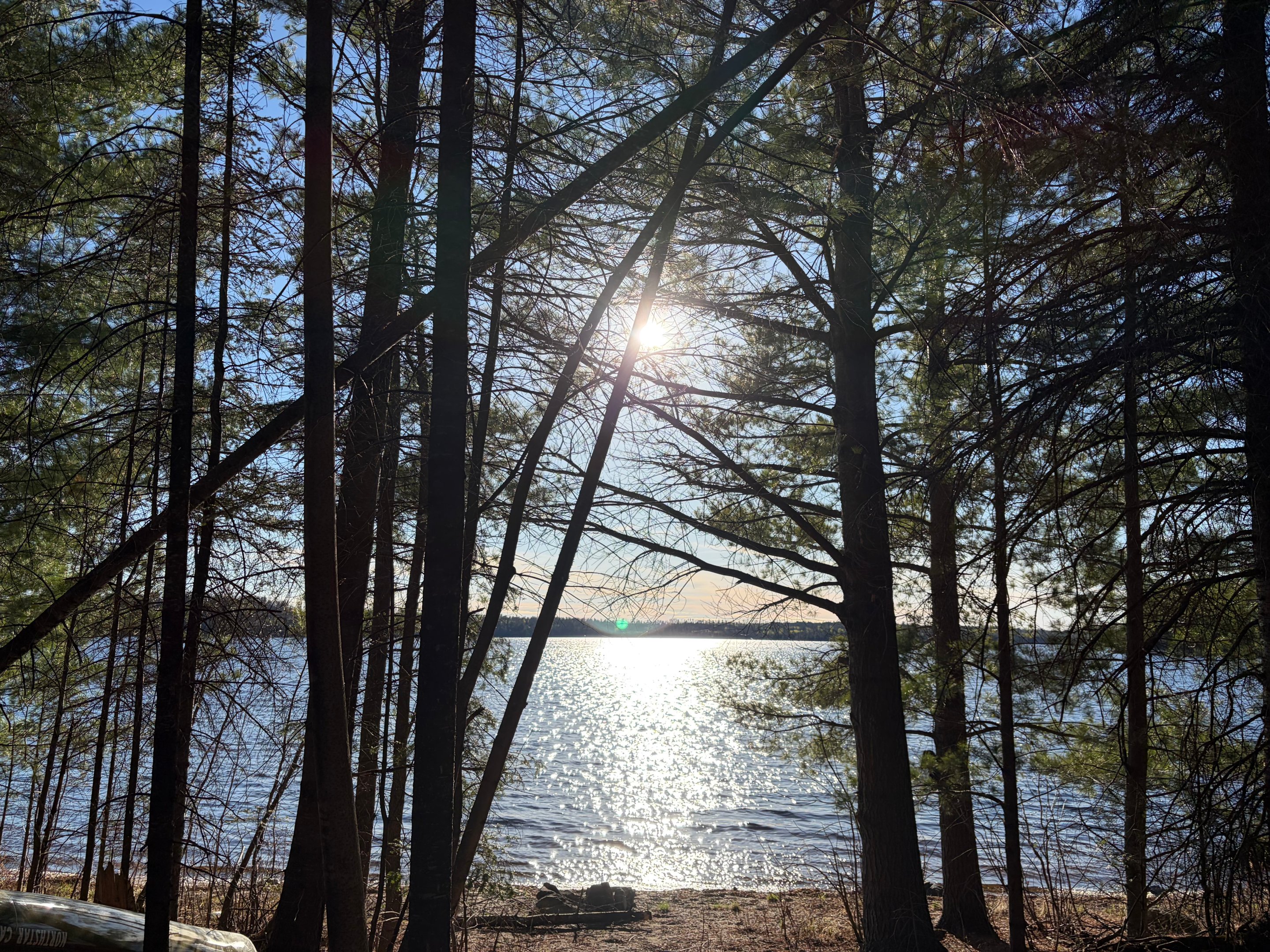
When seeking to escape the monotony of day-to-day life through wilderness living, you'll find no shortage of literary dude fellow travelers. It’s a simple solution to the complex issue of existing in modern civilization: Fuck this standing desk and these Slack notifications, I’ll just go chill with the woodland critters.
If you want to talk about escaping to the natural world, there’s always Thoreau (classic transcendentalism) or John Muir (conservationism) or Christopher McCandless (new-age nomadism). And if you really wanna be edgy and weird people out, you could reference Teddy Kaczynski (tech-paranoid bombings).
When I daydream of ditching the rat race for serene nature life, at least these days, I think of Minnesota author Paul Gruchow and the Boundary Waters Canoe Area Wilderness (BWCA). As the cynical and money-hungry hack away at wilderness protections throughout our country, including recent rollbacks that imperil the BWCA, Gruchow’s writing offers a repose. Through his work, the late conservationist provides a better understanding of the importance of the wilderness and, with that, ourselves. To Gruchow, wild places like the Boundary Waters offered perspective and clarity: Where the dominance of humanity is undetectable, our assumed superiority is lost.
Civilization? I’ll Stay Right Here.
This story really begins aboard an Amtrak train in early 2025. I met Gary Deason only because the seat next to him was the closest, and he didn’t mind me sitting there.
We chatted idly for a while. He was headed to Milwaukee, and I was bound for Chicago. Deason is a writer, conservationist, professor, and world-class conversationalist. I was hoping to enjoy a pleasant talk and, then, retreat into reading whatever book I’d brought along—probably Nausea or some similar existential downer. But first, I had to throw a newsletter together.
As I putzed around on my laptop, Deason inquired about what I was clacking away at (I’m a loud, distracting typist). I told him, with the humble pride any 21-year-old has for what they do, that I was the editor of the Minnesota Daily.
Thus, I met Paul Gruchow, Deason’s neighbor and canoeing pal from about 30 years back.
Gruchow had been dead for 20 years by the time Deason introduced me to his work on that eastbound train. Gruchow was the editor of the Daily while enrolled at the University of Minnesota in the ‘60s, and headed a newspaper in Worthington after he graduated from college. (As a Gopher, he studied under famed poet John Berryman.) Gruchow became a successful nature writer after selling the paper, fathered four children with his wife Nancy, and died by suicide in 2004 at the age of 56 after a lifelong battle with bipolar disorder.
Deason wrote about a moment with Gruchow in The Grace of Grass and Water: Writing in Honor of Paul Gruchow that best illustrates who he was. While on a canoe trip together after Deason’s divorce, they set up camp on shore for the night. Gruchow was sketching in his notebook, and Deason wandered off. When Deason returned to Gruchow, he found him as he had left him—sketching a molting dragonfly. Deason also saw, as he described, two beautiful women paddling away from their camp. Gruchow said they’d stopped by to ask for directions; he spoke to them briefly before sending them on their way and returning to his sketches. Deason was pissed.
“This was my first time being single in years, and you don’t often run into people in the Boundary Waters like that,” Deason told me recently when we met up for a couple drinks (coffee for him, rum and Diet Coke for me) at Birch’s on the Lake in Long Lake. Unfortunately for the bachelor, Gruchow was busy with his bugs. Deason says Gruchow had a tendency to tip his canoe while he leaned over the side, and he’d wax about the flora and fauna below the water surface. He was obsessed with the natural world, submerging himself into it in every way he could, sometimes more literally (and unintentionally) than others.
It took me over a year after I met Deason to finally read Boundary Waters: The Grace of the Wild. In that time, however, I hadn’t gone long without Deason or Gruchow crossing my mind. As a myopic writer in my early twenties, it was and is difficult not to see myself in Gruchow. Obviously, we had the same job at the Minnesota Daily (shoutout to my beloved), but even the nature of his struggles with bipolar disorder struck a personal note for me. But I refuse to define Gruchow by his illness, and I refuse to bore you with the family trauma and self-diagnoses of a self-obsessed 20-something.
But I will bore you with some of the many coincidences that have followed me on my quest to understand Gruchow and make sense of our current situation in the Boundary Waters. Published in 1999, Boundary Waters was his follow-up to 1992’s Travels in Canoe Country, a collaboration with photographer Gerald Brimacomb. Brimacomb died this past Valentine’s Day, so I could not reach him directly to confirm the following. I will assert with 90% positivity that my roommate Tim had one of his photos hanging from the wall of his room as I wrote this very essay. It’s a photograph of a canoe resting on an island shore in the BWCA, and it’s nearly identical to the photo on the cover of Travels, just taken at a slightly different angle. I’d walked past it hundreds of times without paying it much mind, but one night as I chased a ping-pong ball into his room (no follow-up Qs, please), I couldn’t shake the déjà vu feeling that I’d seen it somewhere before.
This isn’t some divine message that I was destined to write about Gruchow, and it wasn’t an act of god that sat me next to Deason on that Amtrak. I won’t even credit Fortuna in its work uniting Deason and Gruchow. (Long story short: In the mid ’90s, Deason was booking a speaker for St. Olaf and, after contacting Gruchow, he discovered they’d soon be neighbors; later, he helped him land a job at the school.) While the brainless maxim “everything happens for a reason” feels ill-suited for our era of villainy and grift, I will say the spiritually adjacent adage about Minnesota being one big small town seems to hold some weight here.
Speaking of: Gruchow grew up on a farm in Montevideo, Minnesota. His mechanical gifts were limited, his farming instincts far from second nature. (He’d train himself into a skilled gardener later in life, sketching insects and studying whether they’d benefit the garden or become destined for extermination.) Gruchow’s dad sent him off the farm briefly to work at a nearby turkey inseminator—where he’d, you know, inseminate turkeys—and, following that gig, it was clear to Gruchow that his future included a college degree of some kind. So, off he went.
What Are People For?
In April, the U.S. Senate passed a bill that stripped the Boundary Waters of protections from nearby mining; Trump signed it into law as fast as possible. As the Department of Homeland Security pushed nationalist imagery about the Great American Wilderness on the site formerly known as Twitter, right-wingers like Rep. Pete Stauber (R-Minnesota) celebrated the end of what he called “Biden’s illegal mining ban.”
Without the ban, an offshoot of Chilean mining conglomerate Antofagasta, Twin Metals Minnesota, can move forward with its plan to build a copper-nickel mine near Birch Lake in Ely. The waste and pollution from this site will likely drain into the Boundary Waters, a pristine slice of over one million wild acres that has been federally protected since 1978.
Stauber, a Duluth native and noted hockey cheater, was the main sponsor of the bill. He told KARE 11 that, because you are required to get permits to mine, and there have been mining operations in northern Minnesota and near the Boundary Waters in the past, pollution isn’t a big concern. This is stupid. Antofagasta has a proven track record of not following instructions like, “Don’t pollute the water, dickheads.” The billionaire-owned mining giant was recently fined by Chile for failing to follow proper water management protocols, and has also destroyed archaeological sites, polluted and blocked water sources in Chilean communities, and even privatized water, making it more difficult for people to access the foundational resource that keeps us alive. But I’m sure the permits will stop ‘em this time, Pete!
Here’s a quote from Gruchow that has nothing to do with mining. Nothing at all, really. He wrote it in reference to somebody whizzing past him on a motorboat, but I think it has some value in this conversation: “No engine yet devised can speed the workings of the spirit. If you have hurried to get into the wilderness physically, you still will not be there mentally or emotionally.”
Later, referencing Wendell Berry, an intellectual hero of his, Gruchow asks, in reference to the human tendency to strive for speed and efficiency above all else, “What are people for?”
Are we for enriching Chilean mineral kingpins? Are we for destroying the last vestiges of the wild so Stauber keeps getting his pro-mining donations? Are we for pushing the net off of its moorings in the 1988 NCAA national championship, robbing St. Lawrence of a chance to take a 4-3 lead in regulation? Stauber is.
In Boundary Waters, Gruchow describes signs around canoe country that warn against eating the fish; even then, they were contaminated with mercury and other toxic metals from industrial run-off. He lamented of the wilderness, “Freedoms and purifications of the soul are still to be found there, but the body cannot now escape the transgressions of our industrial labor.” Maybe it’s already too far gone. Maybe it was too far gone 30 years ago when he wrote that.
“When you’re surrounded by skyscrapers and enormous machines that can far outpace you, it becomes easy to fall into the delusion, in the worlds we normally live in, that we’re all powerful, that we’re little gods, in a way,” Gruchow said as a guest on MPR News in 1997. “And going away to a wilderness without aid of those marvelous inventions of the human mind, just entering wildness again for a while, offers the lesson that, despite the things we have invented, we are still, after all, in the scheme of things in the universe, very small.”
Maybe Stauber has forgotten how small he really is.
One World at a Time
Gruchow never forgot that sort of thing. His accounts of struggling in the wilderness, always laced with self-deprecation, were triumphs of his work. At one point, he refers to himself as a lousy swimmer and an inept canoeist who “has been unable to master even the basic J stroke.” He could also be hilarious, like the time he wrote about squirrels torpedoing pine cones to drive him from their rightful territory.
One of the only times Deason can remember Gruchow getting upset over critics? The time Prairie Home Companion host Garrison Keillor was asked about his personal vision of hell; he said it was to be marooned inside a cabin with nothing but one of Gruchow’s novels to occupy him. But Keillor, an alleged creep, was also a hopelessly boring radio personality, so bad literary takes are among his lesser sins.
By Deason’s account, Gruchow was a humble man who took great pride in his work, and most other reviews of that work proved overwhelmingly positive. One blurb of Boundary Waters from Mary Pipher called it, “our twentieth-century Walden.” Fitting, considering Gruchow writes extensively about Walden in Boundary Waters. It’s an easy comparison to make given the book’s focus on the natural world, but it isn’t entirely accurate. Gruchow notes in his book that, for as much as Thoreau wrote extensively about his personal experiences—around two million words—in Walden and in his journals, there isn’t much introspection. This isn’t true in Gruchow’s case, though I would by no means call him a navel-gazer. Much of his writing interweaves nature with his own (often tumultuous) internal workings.
Before he took his own life, Gruchow’s final work was Letters to a Young Madman: A Memoir. Published posthumously, the collection of poems and essays is a dissection of his lifelong struggle with mental illness and the systems intended to assist those who are struggling. The book was released in 2004, and Deason says he has never read it. It is too painful.
In his Boundary Waters essay “By Light of the Winter Moon,” Gruchow details his time at Wilderness Base Camp on Sea Gull Lake when he met with three of his students to discuss Walden.
Gruchow wrote of Thoreau’s last moments, in which he told a friend who had asked him about the afterlife, simply, “One world at a time.”
Gruchow wrote of the American obsession with the West and the powerful pull of the North. The great appeal of elsewhere. But, in a moment of introspection, the man who made a living writing about his travels offered this:
“I would hate to see a calculation of the number of years of my own life that I have spent wishing I were somewhere else. I would like to discover, as it were, how to live one world at a time.”
Near the end of his life, as detailed in the essay “Happiness 5” from Letters to a Young Madman, Gruchow, who had been gripped by a depressive episode that left him bed-ridden for four days, got himself out of bed to see a creek trail near his home in Duluth. Awed by the smell of the pines and the harsh wind on his face, he returned home calling out the names of plants—his “friends,” jewelweeds, bluebeard lilies, spikenards, white and purple asters, etc.—on the trail. Even as his mental health deteriorated, nature waited for him.
“When I got back to my apartment, my left knee throbbed, but I was alive," he wrote. "The feeling of vitality lingered for two days. The darkness, as it does, closed in again, but I had the conviction this time that, if I could just get there, I knew where to go to find the light.”
As the fight to save the BWCA grows darker, there are glimmers of light. The Minnesota Department of Natural Resources has the ability to cancel Twin Metals Minnesota’s lease as it enters its 36th year; entangled by lawsuits and bans, the company has yet to mine in or pay royalties to the state. Better than nothing, I suppose. As we struggle to find some peace in this world, I pray Gruchow has found some peace in his, even if I don’t really believe in that sort of thing.