

The Minnesota Lynx have been bestowing a steady bevy of feel-good moments and milestones upon their fanbase throughout this magical 2026 WNBA season. Some are simple unveilings, like the first flashes of wizardry and preternatural poise that announced the instant stardom of rookie point guard Olivia Miles. Some are statistical achievements, such as Cheryl Reeve becoming the coach with the most wins in WNBA history. Some are official designations, like Reeve being inducted into the league’s Hall of Fame and Miles, forward Natasha Howard, and guard Courtney Williams being named to play in this weekend’s All-Star game.
And some involve the return of iconic champions from prior Lynx teams, highlighted by an extensive postgame ceremony for Sylvia Fowles last week. Ostensibly to update her banner in the Target Center rafters to connote her own Hall of Fame status, the moment allowed the franchise to revel in how wonderful it has been to have germinated such an extended family of gritty and gracious human beings.
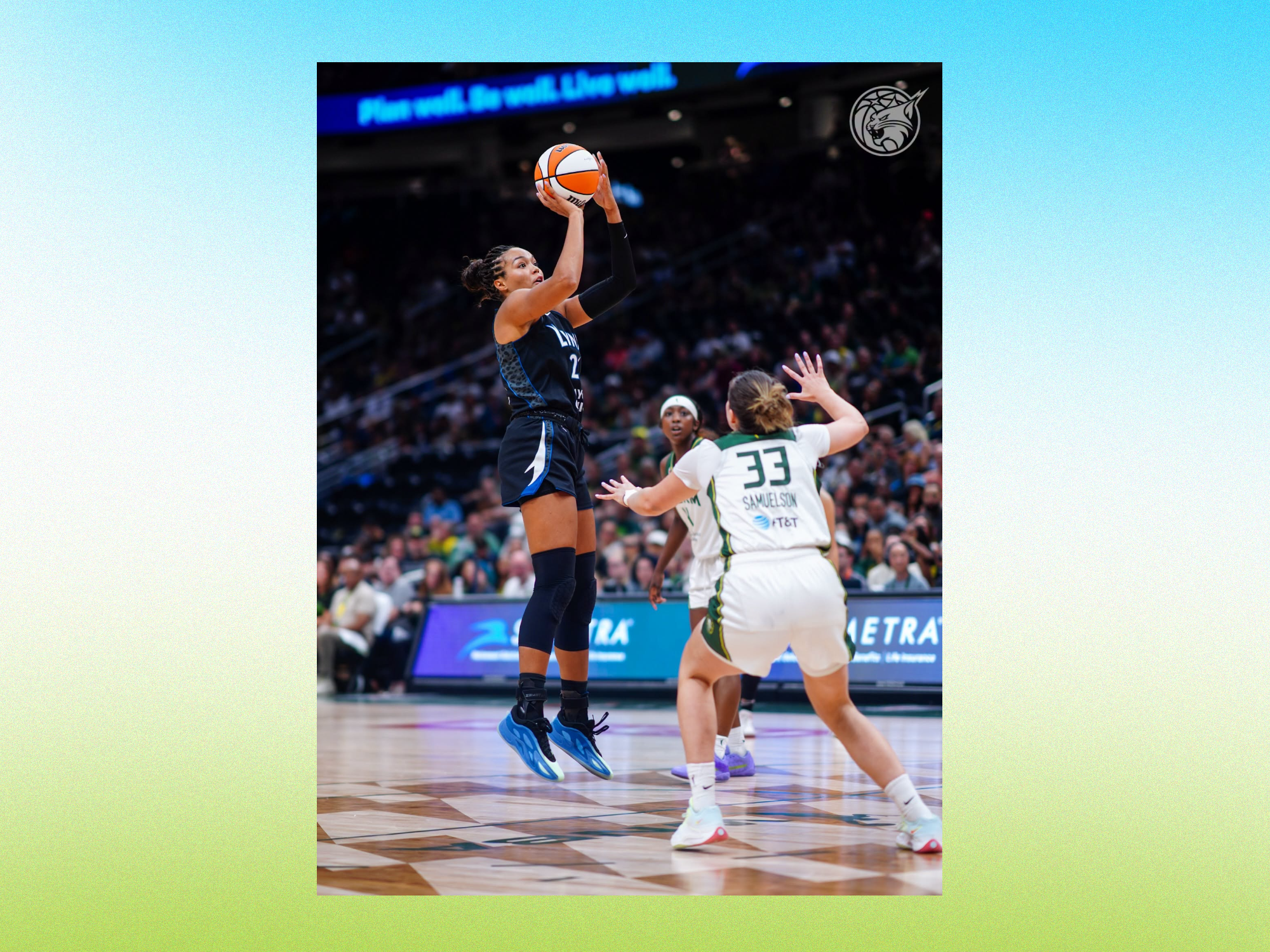
But the most anticipated event of the Lynx season thus far occurred Wednesday afternoon in Seattle, as Napheesa Collier played her first game in more than nine months. Phee, the runner-up for the league’s MVP Award the past two seasons, painstakingly rehabbed from surgery to repair a severe sprain in her right ankle and another surgery to address a trio of torn ligaments in her left ankle.
That the Lynx compiled the best record in the “W” with her hobbled on the sidelines was a scenario almost too good to be true. But that didn’t prevent everyone associated with the team from imagining an even better reality with Phee back in the fray.
And that’s exactly what happened on Wednesday.
Minnesota’s first offensive possession of the game was predictably chaotic, as the two alpha playmakers, Miles and Phee, nearly collided at the foul line, with Miles curling into a drive in the same space that Phee was either cutting or coming over to set a screen. No matter: Miles kept her dribble and bounced back out to the perimeter for a successful pick-and-roll with Howard.
The long layoff initially made Phee impatient, which is totally out of character. She was right to go for a layup dribbling free on a pick-and-roll, and to soon after try a lightly-contested 3-pointer. But the drive was blocked and the trey was wide right. Reeve sat her after three minutes, then brought her back for the final three minutes of the 10-minute quarter. Phee jacked up four more shots, making just a pullup midrange jumper after an upfake from behind the 3-point arc. She missed her sixth shot in seven attempts 15 seconds after Reeve brought her back in nearly halfway through the second quarter.
Then her majesty returned. Phee stopped forcing the action, slaked her thirst via opportunism and deliberation. When Maya Caldwell wrestled the Seattle Storm’s inbound pass away from the opponent but then flubbed the layup, Phee raced down to clean up with an offensive rebound and a putback. And on the Lynx next offensive possession, when she got the ball closely guarded on the low right block, she jab-stepped left, knocking the defender back with her shoulder, then swung-pivoted the other way with ballroom-dancing dispatch and banked the layup over her opponent’s outstretched arm.
Those two morsels of classic Phee regained her recipe for subtle game dominance. Like the NBA’s Kawhi Leonard, she has honed her game with a relentless resolve that has left precious few weaknesses to exploit—exploitation is her purview. Among all active WNBA players who meet minimum volume thresholds, Phee ranks 5th in career points per game, 7th in rebounds per game, 2nd in steals per game, and 8th in blocks per game.
But again, like Kawhi, what really rounds out Phee’s superstardom is defense. She was named the W’s Defensive Player of the Year in 2024 and has appeared on four All Defensive teams, including the last three seasons in a row. Via instincts and intellect, she always seems to know where she’s going and how to put the clamps on when she gets there.
A quintessential defensive stop by Phee occurred near the midpoint of the third quarter against the Storm. Six-foot-six-inch center Dominique Malonga had sealed Howard off from the space between her and the basket while getting the entry pass in just the right place to spin and score. Phee saw it unfold and briskly rotated over, surprising Malonga with her presence as the much taller center went to shoot, then keeping her body vertical as Malonga collided into her for an offensive foul.
Despite the Lynx coming into Wednesday’s contest riding a six-game winning streak, Reeve made no secret of her unhappiness with the team’s defense, specifically citing an inattention to detail and lack of follow-through on the entire defensive possession. Those are exactly the sort of flaws Phee’s action and example can help remedy. It was no coincidence that the Lynx posted their best defensive performance in July upon her return, especially after she knocked the rust off in the second half.
The most basic analytic measure for defense is how many points you allow per 100 possessions. On Wednesday the Lynx allowed the Storm just 92.7 points per 100 possessions; their next-best performance in eight prior July games was 102.6 points allowed. And while individual metrics on a single game’s performance is usually a ridiculously small sample upon which to draw conclusions, Phee’s defensive reputation and the eye test of watching her performance lend credence to impact the numbers suggest that she had.
Specifically, in the first half (comprising two 10-minute quarters), the Lynx allowed the Storm to score 109.8 points per 100 possessions. But in the 11:30 that Phee played in that 20-minute half, the Storm scored just 96 points per 100 possessions. In the second half, Minnesota throttled the Storm, limiting them to 75.6 points per 100 possessions (they had 31 total points in the entire half). But again, in the 10:43 Phee was on the floor, that scoring efficiency plummeted to 52.2 points per 100 possessions.
Getting that kind of offensive synergy going between Phee and the rest of the team is likely to require longer-term adjustments. Phee was the primary Lynx playmaker the previous three seasons, leading the team in usage (the percentage of plays where the player is directly involved in the outcome) by a fairly wide margin, with usage rates of 28.9 in 2023, 26.7 in 2024, and 28.6 in 2025.
Thus far this season the usage queen in the most frequently utilized starting lineup is Miles, at 27.0, followed by Courtney Willians at 23.5, Howard at 23, and Kayla McBride at 21.9. It’s telling that the fifth player among the starters, the one Phee replaced on Wednesday, is Nia Coffey, whose usage rate this season is 12.5.
Adding Phee to the mix is going to keep the beads on the abacus charting the Lynx offense in perpetual motion—and bolster the aesthetics of this budding juggernaut along the way. It’s a smart, unselfish, well-coached roster with phenomenal talent. There are weapons everywhere, from Miles’s spontaneous decision-making, to McBride’s deadeye shooting, to Williams’ almost automatic midrange jumper, to Howard’s pick-and-roll finishing prowess. Now add the versatile skills of a perpetual MVP candidate.
On Wednesday the best example of their collective prowess occurred in crunch time. The Storm had cut a six-point Lynx lead down to one with just 1:19 left to play; they were on the verge of getting a shot-clock violation to give them the ball back with a chance to take the lead. But after receiving a desperate pass from Miles, Phee deliberately went up into the arms of the onrushing defender while shooting from behind the arc, earning three free throws. She made them all.
On the next offensive possession, Miles was trapped in double-team on the perimeter and got the ball to Howard behind the arc. Howard’s ostensible defender left Phee, who had earned her own double-team in the post, and rushed out to guard Howard, who zipped a pass to Phee, who delivered her signature fadeaway midrange out of the post for what was essentially the dagger, creating a six point lead with less than a minute to play.
In the glow of the victory and Phee’s sparkling numbers—24 points, 10 rebounds, and that remarkable defensive rating—it was easy to overlook that adjustments will be required to sustain success against foes that, unlike the Storm, do not have the worst record in the WNBA.
Phee’s usage rate for the game was 47.1, which will be an outlier due to its small sample size, but remains a testament to her overbearing impact on the offense. It’s not that hard to conclude that the splash of Phee’s presence at that end of the court is one reason why McBride, Miles, and Williams were a combined 2-for-16 shooting in the second half, including 0-5 on three-point attempts.
On the other hand, better integrating Phee with the rest of the team on offense is a first-world problem for a team with the best record in the W; a team that promises to keep those feel-good moments coming as they finally operate at full strength after the All-Star game.