


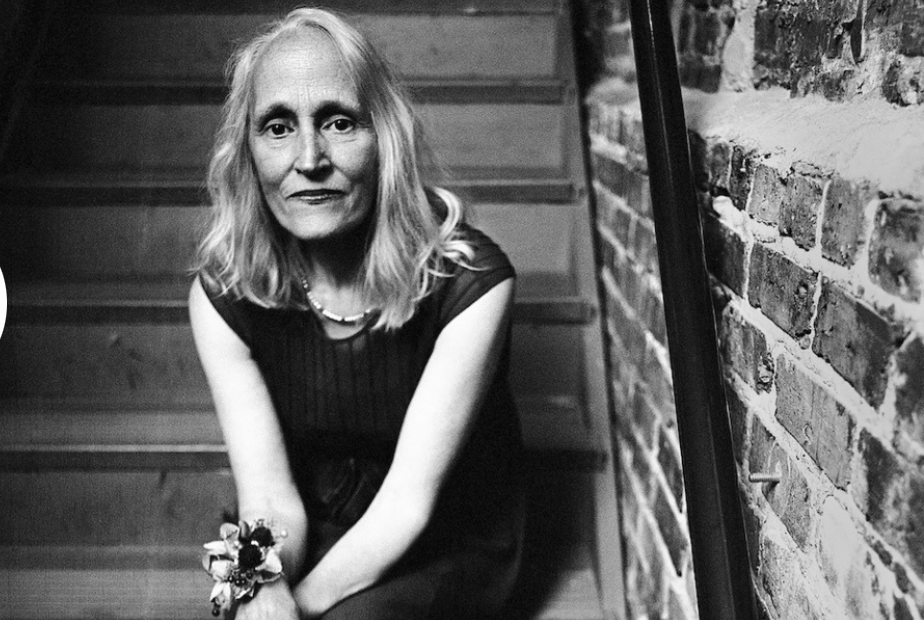
If you ever need a human skull, or maybe a few ribs, Cecelia Condit can probably get them for you.
“I walk into the Cleveland Museum of Natural History,” the storied video artist recounts about making her early pieces, “and I say, ‘I need a thigh bone. I’d like it to be a woman.’ And they say, ‘Here! Give it back when you’re done!’”
That bone, used for Condit’s 1987 short Not a Jealous Bone, did in fact return to its previous owner, as did the skull she borrowed for her first video Beneath the Skin in 1981. (Per Condit: “Somebody said, ‘I have a human skull. Would you like it?’ And I said, ‘On loan.’ I don’t want [to own] a human skull.”)
Other bones she obtained were not quite so lucky.
“I have rib bones,” Condit says. “I have lots of them.” She’s referring to props from her enduring 1983 piece Possibly in Michigan. At the video’s climax, two women kill and (fittingly) eat the same cannibal who has stalked them from a shopping mall to their homes, tossing his bones into the trash just before putting it to the curb. “I don’t think I ever gave them back. I wonder where they are,” she says.
Before I can ask why Condit wanted the bones to come from a woman, she fills in the blanks for me: “Even though it was a man [being eaten], I didn’t want to give him that respect.”
Beneath the Skin celebrates its 45th anniversary this year, and Condit’s work is more compelling than ever. Her engagement with the world is multivalent, tonally dextrous, at once frighteningly real and morbidly funny. She cuts right to the, well, bone of our anxieties surrounding patriarchy, violence, capitalism, and environmental collapse in a way that's both poignant and sanguine.
And new audiences are still latching onto her work. Possibly in Michigan resurfaced online in 2015 and now makes the rounds as a viral video every few years.
In that same time period, Condit has been immersed in a new era of creative reinvigoration. “We both resurfaced,” she says of herself and that video, “and I did work I felt free enough to do, that matters to me.”
Condit’s emboldened current era of artistic practice, and the shift in her approach to video over the years, will be on full display at the Walker Cinema at a screening Thursday night, where Condit herself will also appear in conversation. Split evenly between three of her defining shorts from before the new millennium and three of her more recent works, the evening, titled Monster in Me after her most recent piece, is the first substantial theatrical showcase of her videos in what is now her home state.
If you’re wondering why I keep referring to Condit’s work as “videos” rather than “films,” the distinction is one that she herself emphatically makes.
“I felt the package, the whole history of film, was a male medium,” she elaborates. “If I could get a hold of a camera, I could start doing something that was little. Not huge, not ambitious like a feature. But just a little thing where I could say something that mattered to me.”
In recent years, Condit has challenged herself to make a piece a year, each a document of her evolving preoccupations and shifting views. From 2019 to 2021 alone, the leaps between each video have been dramatic. Made amid the dismantling of Roe v. Wade, We Were Hardly More Than Children is a sober interrogation of how trauma blots memory, via a true story of Condit assisting her friend, artist Diane Messinger, in seeking an illegal abortion in 1969. Condit cites it as the moment where she knew “there was no way [she] couldn’t be political in this world.”
In 2020, she stuffed the short I’ve Been Afraid full of Instagram stickers and Bitmojis to render what she couldn’t capture about her fears and the fears of other women in the midst of the pandemic. And after a case of Covid in 2021, Condit grappled with her increased use of an Amazon Alexa in AI and I, a piece that has only become more resonant since.
“Most of this technology is produced by men,” she says, as we talk about the rise of generative AI and the proliferation of auto-generated sexualized images of women, without consent. “So here we are, having to again question, ‘Who did this? Is it part of the same system?’”
Previously a resident of Philadelphia, Cleveland, and Milwaukee, Condit came to live in Minnesota only in recent years. Monster in Me is the first piece of hers to be shot here, in Carleton College’s Cowling Arboretum. The artist found the site to be a place of tranquility and healing for her; she was drawn to one of its largest trees and the comfort she felt wandering its forests. In the midst of a particular bout of sadness, Condit mentions, the serenity was striking. “I just looked at the streams and the trees and I felt like everything was going to be fine,” she says.
Condit’s work has increasingly focused on the environment, driven in part by the writings of 20th century conservationist Aldo Leopold. Though none of her nature-themed shorts, from 2015’s Ireland-shot Pulling Up Roots to the Lake Michigan vistas of 2025’s Parable of Now, are explicitly about ecological crisis, that subtext has become just as significant to Condit as her portrayals of womanhood and violence. “A child isn’t born realizing that something’s wrong with the world,” she explains, “and in that moment when you realize, it gives you such pause that you don’t move for a while.”
That moment of realization was the powder keg for Condit’s pursuit of video art in the first place, via Beneath the Skin. The video is a discontinuous, free-associative barrage of hazy imagery and superimposition wedded to a stream-of-consciousness narration (“I would record lines on a crummy microphone; they never hit paper,” she recalls) and an a cappella track from collaborator Karen Skladany’s group the Guyettes. It recounts Condit’s experiences in a relationship with Ira Einhorn, who had murdered his ex-girlfriend Holly Maddux and concealed her corpse in his closet for 18 months. But making the piece didn’t fully purge what Condit carried. “It’s very hard to get over murder," she says. "One doesn’t realize [until] it comes close to you, how hard it is to recover from. It’s a kick in the gut.”
And so Condit followed that up with Possibly in Michigan, a piece conceived to “get [her] anger out.” Part avant-synth opera, part pitch-dark comedy, part bone-chilling slasher abstraction, the video is remarkable in its use of montage and surreality as a means to evoke the inherently fraught experience of living as a woman in a consumerist world predicated upon forceful male power.
Condit ties the story into a barrage of expressionist edits—a dog jumping for meat, the demolition of a building, startling superimpositions of mummified bodies taking on the movements of actress Jill Sands. (“People online actually think I killed them,” Condit says of these corpses. “I don’t know who they think I am! They’re very dead, centuries dead.”) The video’s increasingly erratic imagery and narrative never fails to shake me, unearthing new meaning and potency with every rewatch.
The act of putting the video together was deeply trying for Condit and her stars, Sands and Karen Skladany. “I didn’t know how to do any narrative matching action,” Condit admits, “so that was a learning curve that was terribly steep.”
Sands said that Condit was “terrible” in her inexperience; nine months into filming the director decided she had miscast the role that would eventually become Sands’s. “So I shot it again,” Condit says. “Jill moved up. She used to be second.”
Ohio’s Beachwood Place Mall would only let Condit film for 15 minutes at a time before it opened each day, which proved stressful for all parties involved. And once she changed the story to be about cannibalism (based on a true story of a woman Condit met who had dated someone who killed and ate women), that heavy tone took a toll on its leads as well.
Despite these behind-the-scenes difficulties, Possibly in Michigan is a still-miraculous achievement, a cornerstone of '80s experimental video art, far ahead of its time, an unexpected precursor to the tongue-in-cheek retro pastiches laced with grotesque gallows humor that would haunt the dead of night on Adult Swim.
And Condit emphasizes that the creation of the video brought all three collaborators closer. “There was this sisterhood,” she says, “this strange heart we put around us that protected us, by making this piece that defined a lot of our lives.”
Newcomers to Possibly in Michigan typically embrace its queer undertones. But in the 1980s, the video stirred up controversy. After being awarded a grant from the National Endowment for the Arts, Condit subsequently faced scrutiny from Senators Jesse Helms and John Glenn for Possibly’s supposed “anti-family, gay, and men-hating” values. Eventually, a clip made its way onto The 700 Club.
Condit admits feeling “rattled” that the Christian Broadcast Network painted such a target on her work, especially because she hadn’t intended for the piece to have a larger political agenda. In Condit’s mind, she was simply trying to express the very real things she had faced as a woman in the world. “I’m not an authority on being a feminist,” she tells me of how she saw herself in the 1980s. “I’m just a person who tries to make their way, in a world that feels really complicated, and in some ways has tried to kill me, numerous times.”
Rather than run away from that label, Condit found herself embracing the critical praise under that lens. “When people started writing on my work as though I was a feminist,” she reflects, “I went, ‘Well, there’s worse things to be. I think I should own it.’”
Condit’s work flipped through a number of different modes in the following decades. Not a Jealous Bone (1987) took a different direction entirely, shifting focus to Condit’s experiences working in neglectful nursing homes and her tenuous relationship with her mother. Suburbs of Eden (1992) pushed Possibly’s threads on the simmering hegemonic violence of suburbia into a surreal family melodrama. And much of her 2000s work, from All About a Girl to Little Spirits, enmeshed her perspectives on womanhood with other realms, from our relationships to the physical world to intergenerationally learned behaviors.
Condit has since eased up on the chaos and overt violence of the initial videos, growing more gentle, more meditative. “I felt like I had gotten all my anger out,” she says of where she was after Possibly in Michigan. “I didn’t know that I had just tidied up house.”
Beginning in the late 2000s, she also began putting herself in front of the camera more, feeling an instinct that “it mattered that I was the one who was going through all these experiences.” Comparing the eras of her career, Condit muses, “Back then, it was just shooting an arrow, and you almost didn’t care where it landed. It was brute force, or brute charm in Possibly. Now, I’m not as brute force as I was.”
My interview with Condit takes place at her home in Northfield on January 5. Two days later, Renee Good is shot and killed as ICE escalates its campaign of terror in the streets I call home. The words that exit her killer's mouth are pointedly gendered, his actions swiftly justified and exonerated.
The following weeks are filled with cycles of news about kidnappings, expedited deportations, separations of families, detainments in domestic concentration camps, and more shootings still. It becomes impossible to not hear reverberations of the conversation that Condit and I had just before—about violence, about ecological terror via chemical warfare, about those with power disappearing others.
I think back to an anecdote Condit relayed, which takes on a wholly different dimension while living through state-sanctioned citizen assault. “I was showing work in LA recently, and somebody asked me, ‘Is your next piece going to be about violence, in this violent world that you’ve created?’” she told me. “I felt so badly, because I would like it not to be. But I don’t know if it can be.”
As Condit says of the present day, "Time has brought women, and anyone who’s vulnerable, to a spot where there's a sort of reckoning taking place.”
This applies to the context of environmental collapse, which poses the greatest threat to those already most subjugated. But Condit points to a specific line in Monster in Me that illustrates her current perspective best: “Why is it that some people feel entitled to other people’s bodies?” “That’s [about] all these people disappearing,” she explains. “It wasn’t just me talking about women there. It was talking about this terror—people are doing terrible things to other people’s bodies.”
Condit considers Monster in Me, especially, a self-reckoning, an exercise in unconscious thought to allow her innermost feelings to emerge, and to look at herself more critically than before. Like Beneath the Skin, none of it was written in advance; Condit would wake up in the middle of the night and simply record voice memos of whatever words appeared in her half-asleep mind.
“In dreams, I play everybody,” she says. “There isn’t a person in one of my videos that I am not.” She offers the most literal example possible: the male cannibal Arthur in Possibly in Michigan, who she plays when masked, who the video’s narration describes as using “so many masks to disguise himself that he had forgotten who he was.” “That was totally about my life,” Condit admits. “I had worn so many masks to disguise myself that I didn’t know who I was. I was invisible.”
Condit sees Monster in Me as a turning point in her work, and how she wants to keep pushing forward in her video art. Screenings of her work like the Walker’s give her ample opportunity to reflect on how she reinterprets her past shorts, sometimes feeling “shocked” at what feelings emerge. “Sometimes,” she says, “I think I was very brave. And sometimes, I think that I was just not in control of it, that it just came out of my body. I know it wasn’t, because I know all the decisions and what they took out of me. But I think a piece takes on its own thing [after the fact].”
Though her debut piece is 45 years old, Condit doesn’t see herself slowing down with videos anytime soon—"I don’t know how to grow if I don’t,” she says. In doing so, she hopes to keep speaking above the systems that would otherwise render her and all those like her invisible, an act that she sees as political as anything else she has made, intentionally or otherwise. “I wasn’t trying to change the art world,” Condit says. “I wasn’t doing anything but trying to make who I was visible.”
Monster in Me: The Video Work of Cecelia Condit
Where: Walker Cinema at Walker Art Center, 725 Vineland Pl., Minneapolis
When: 7 p.m. Thursday, May 7
Tickets: $12/$15; more info here