

[Editor’s note: To protect their identities, the artists are referred to by their tags, which allowed Racket to hang out with them in the wild. And experience running from the police.]
Icandy sat in the brush, heart pounding.
He didn’t have time to think when he saw the Minneapolis Park Patrol officer fighting his way through bushes and trees down the steep hill to under the bridge on Burnham Road. He just grabbed his paint-stained, half-open backpack and ran. He barely had time to warn Ipsum, his right-hand man. He didn’t wait for him. He didn’t look back.
His black book fell out of his backpack. He almost left it there.
He listened for footsteps and snapping branches, but there was only his own breathing. Bits of leaf litter clung to his baggy jeans. His phone was still at 1%.
He texted Ipsum:
You good?
yeah
what happened?
Where you at?
There was a dude with a badge and uniform coming down
fr?
i’m by the car
They drove away as the officer locked a duffel bag of 12 cans and a bucket of paint, worth $100 if they’d paid for it all, in the trunk of his squad car. They were not going back to jail.
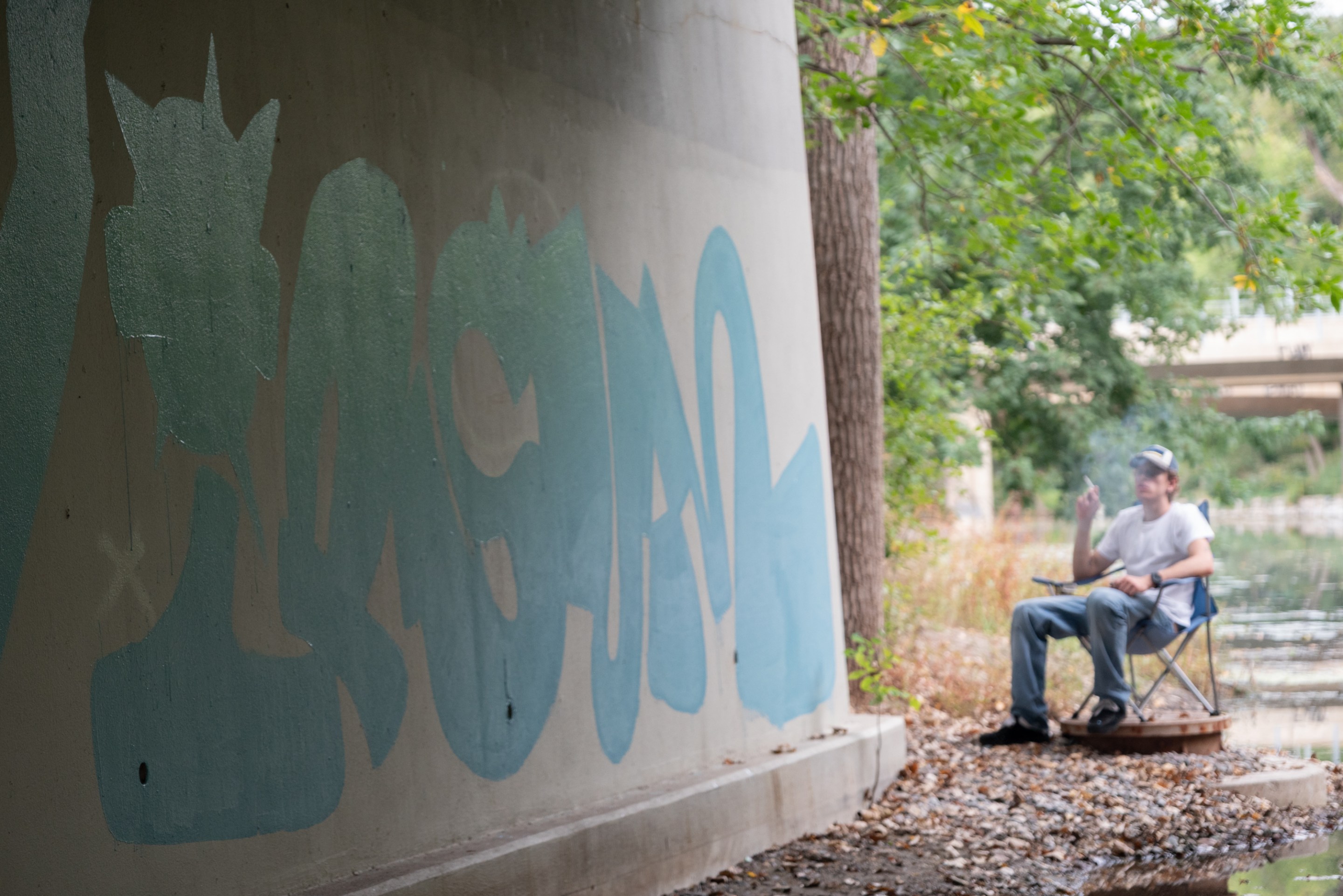
Ipsum grabs a can of white paint under a bridge in Cedar-Isles-Dean in Minneapolis and makes a mark dead center on the off-white wall under the bridge.
“This is not gonna show up at all,” he mutters.
Six cans of white paint—Legacy Glassworks was out of black—and it wasn’t going to show up.
“I think you’re right,” he calls out to Icandy. “We should use the tip of the roller.”
Icandy, who used to tag “Smack” before he, Ipsum, and their other friend Bier were arrested two Octobers ago, sits on the concrete next to the base of the bridge as he flips through the art in his black book. The smoke from his spliff wafts toward Ipsum’s blue foldable canvas chair across from him on a sewer grate next to the river, where the occasional kayak or paddleboard passes by.
“What do you think about this one?” Icandy offers up a page for Ipsum to see as he walks over, blocky gray letters weaving through and overlapping each other on the page. “The one in the top right.”
“Bro, that’s tight,” Ipsum says.
“Yeah?”
“Yeah, it looks good.”
Ipsum takes the spliff from Icandy, inhaling his medicine and exhaling the smoke. He sets it in the chair’s mesh cupholder, opposite the arm with “Casket” written along the fabric.
They don plastic gloves, brandish their rollers, and, using just the top edge, carefully outline large, sweeping letters with baby blue.
They begin to paint.
Icandy and Ipsum started their year of probation in July. If they get caught painting again, it’s back to jail. Back to packed cells with tiny windows. Back to picking up boxers full of other men’s shit.
Getting arrested again also means goodbye to Icandy’s plan to go to college for graphic design in January. It’s goodbye to Ipsum’s dream to leave the country with his girlfriend, to go back to Prague someday. It’s goodbye to their art, their street therapy.
Still, they paint.
Biafra, Inc., a tagger who works at a print shop in St. Paul, has been painting for 20 years. He’s painted in places across the country and hits about 50 trains per year.
“It’s exciting when you’re young because it’s the only art form that originated from kids and has continued as a thing that kids get into for each other,” he says. “It’s a fun thing to do outside of yourself where you’re building something without the credentials that you might need for other stuff.”
The total number of graffiti reports in Minneapolis has gone down roughly 40% since 2009, and hit its lowest point in that span in 2022. That decrease is likely due to fewer people reporting graffiti rather than less graffiti in the city, according to Biafra, Inc.
“I think people think it’s cool,” he says. “My parents are much more like, ‘Well, we need to get the graffiti off the wall.’ And I think the next generation after that was kind of like, ‘It’s not hurting anybody.’”
Icandy and Ipsum took a break from graffiti after they got out of jail. Bier quit completely and pivoted to music. Icandy and Ipsum stuck to their black books, too terrified to go out and paint but unable to leave the art behind. But the itch became too much.
“I was like, ‘All right, I'm just gonna use the rest of the paint up that I have left, and then I'll be fully done,’” Ipsum says. “And I should have known myself better with my addictive personality, that once I started I wasn't going to want to stop again, because I haven't stopped since.”
They’re taking a break after the almost run-in with the Park Patrol, giving each other drawing challenges and exploring anti-style graffiti, which uses crazier fonts or even pictures to sound out the tag. They know they can’t stay away forever, though.
“Me and my boy were traumatized,” Icandy says of their jail time. “But being in there did not make me want to do graffiti any less. It made me want to do it 10 times more.”
The sun drifts farther past its peak over the river, still plenty bright enough for Ipsum and Icandy to see their canvas under the bridge.
Ipsum wraps up his tag’s outline, embracing each lowercase letter’s curves in contrast with Icandy’s bulky angles. Before their arrest two years ago, Ipsum tagged “Yayo,” slang for cocaine. At the start of everything, he tagged “Casket,” after the caskets he and his friends would draw around the cigarette butts they left behind.
“Because smoking kills,” he says. “So every time you finish smoking, you killed a little bit of yourself.”
Since getting caught on the highway two years ago, he writes a different tag almost every time he paints.
“La Cheyene del Año” by Banda El Recodo blares from Ipsum’s phone, the same kind of music they listen to while working in the kitchen at the Keys Cafe at the Foshay Tower. In the car, it was hip-hop, but this is working music.
The sun is on the horizon by the time they start smoking on the river bank, waiting for the filled-in letters to dry. When it gets dark and the paint is still wet, they’ll go get Chipotle. They figure they’ll finish it the next day.
Graffiti somewhat originates from hip-hop culture, Biafra, Inc. says, but the art form has expanded. There’s no one kind of person who does graffiti.
“I’ve known some people that are super rich, or their parents are super rich, and then other people that are homeless and they’re poor,” he says. “It’s this thing that you get pulled into for one reason or another.”
Icandy was in Philadelphia for his grandpa’s funeral when he first paid attention to graffiti.
He remembers going over a bridge and seeing massive letters on an old navy base, styles unique to the city and its artists called “wickets.” He started drawing in his notebook, just toy stuff at first, trying to understand letter structure. He was about 15 when he bought his first can and painted the Target symbol on the sidewalk outside the store.
“My whole life has always given me something that needs to be let out, and graffiti was an amazing way to let that aggression out and a way that also gave me self-confidence,” Icandy says. “And it was lovely.”
His dad found out about the arrest in July, one and a half years after Icandy got caught on the highway. He works for a rehousing program for incarcerated people. Icandy was in the process of moving out of his mom’s house when his dad found the probation letter in the mail. His mom still doesn’t know about the arrest.
Ipsum’s brother, his main male role model growing up, introduced him to graffiti. He started painting at 13 while he was getting into trouble in other ways, including drug use, though he didn’t put much thought into his artistry.
“Obviously, it's still graffiti. It's about pissing off the world and putting your name in a place it doesn't belong,” Ipsum says. “But it wasn't really, like, true graffiti.”
Growing up with an alcoholic, abusive father stirred up a lot of turmoil within him, he says, which led him to jump from school to school, never having a constant set of friends.
Icandy and Ipsum met while skateboarding. Icandy was painting. Ipsum was painting.
“Bro,” Ipsum said. “Let’s go paint.”
The rest is history.
Maybe it’s a bad idea to paint in the daylight. Maybe it’s a bad idea to paint the same spot two days in a row.
But as Ipsum traipses down the trail on South Washburn Avenue to the Cedar Lake Canal, Icandy following with a duffle bag of cans, he spots construction on a house across the bridge. That noise should cover them.
They test colors next to the baby blue on the concrete below their tags, seeing what would work for the shadows and the highlights. Ipsum sprays a dot of dark magenta.
“Bro, come here,” he says. “What do you think about this for the background?”
“For the background?” Icandy looks at the dot next to the blue. “Sick.”
Ipsum swears they should have run that night. He doesn’t care that it’s an extra charge if you get caught. Next time—god forbid there’s a next time—he’s going to run.
They’d already hit a billboard, then painted on I-94 for 45 minutes, just chilling. Then they met up with Bier, who said they should hit one more spot on the highway.
Icandy wasn’t feeling it. It was 3 a.m. Bier had hit this spot before with his girlfriend as a lookout, and someone had pulled a gun on them as they were coming off the highway. Like, a huge gun. But the three of them were still on the highway, and it was just one more spot.
A car honked at them while they staked their claim in paint. Then a second car honked at them. Then a fifth car. Then a sixth.
Icandy’s never had six cars honk at him.
“All right, we gotta go. We gotta get moving.”
They crossed the bridge back to Bier’s car. Ipsum fell behind to get some last-minute tags along the way. He didn’t see the two police cars speeding up the exit ramp. Icandy and Bier did.
But the cars didn’t have their lights on. “No way that’s for us,” Icandy said.
FLASH.
A spotlight at their backs.
“Should we run?”
“Nah, just keep walking,” Icandy said. “Just keep walking. Don’t look back.”
Their shadows wavered in the light. Ipsum looked back.
Four squad cars in a row behind them. Two more in front of them. Three troopers and three officers to arrest three 19-year-olds for graffiti.
“Stop moving. Put your hands up.”
Ipsum’s heart dropped.
“I believe, and I still believe to this day, if we all would have ran…”
Icandy spent 36 hours in the Hennepin County Jail in a holding cell with Bier. Bored as hell.
Icandy flipped through some Calvin & Hobbes while Bier read a 400-page science fiction book from the stack of reading material sitting on top of the scratched-up television in a steel cage that only played cop shows. They found some playing cards made out of Monopoly cards and played Go Fish.
Icandy went around the cell and gathered everyone’s jail-provided hair combs, and he and Bier used the ends to etch their tags into the glass of the windows. It was the only thing that could fit in the circles through which they could see the real world.
Mostly, though, Icandy just slept.
Ipsum didn’t sleep at all.
He tried to keep to himself as he sat in a cell full of 10 to 20 guys he didn’t know. They were bigger than him. They could beat him to a pulp if they wanted.
Before he got breakfast, Ipsum got a broom and a mop. If he wanted to eat, he had to clean himself and his entire pod, including the vomit, the urine, and that pair of boxers full of shit. When he showered, there was no curtain, and the police watched him through a window the entire time.
All he had to keep himself sane, he said, was a pencil and his inmate guidebook. So he drew.
The huge, huge man who slept in the bunk below him tore up his own guidebook, pouring the milk from lunch on the pieces under his bed. He went around the cell asking for everyone else’s guidebook, tearing them up and putting them under his bed.
Ipsum shook when the man came to him.
“Dude, this is all I’ve got to do while I’m here,” Ipsum begged. “Can I give it to you when I leave?”
The man stared at him. Then he went to sleep in his bunk.
Ipsum gave him the guidebook before he left for freedom.
Ipsum calls his work street therapy. Not bombing or vying for cutty spots, but just painting.
“When you have the opportunity to stand in front of a wall for as long as you want and take your time,” Ipsum says, “it's truly therapeutic.”
Icandy doesn’t call it street therapy. It’s just a great way to pass the time, he says, or a way to mark time.
“Seeing your name around, going back and finding old tags is something I look forward to,” he says. “I don't know, it gave me a lot of love for life and the world around me.”
Ipsum sits on the sewer grate, scrolling through TikTok, as Icandy finishes his side of the background. He leaves his chair under the bridge for the early autumn sun.
“Dude, my phone’s about to die.” Icandy walks over, stuffing his phone in his pocket.
Ipsum looks up at the sun, the trees, the river, then down at the rocks around his feet. He finds one that’s smooth and flat and skips it once, twice on the water.
Ipsum skips another, and Icandy scours the river bank for more. He botches his first throw, but not the one after.
“There are so many good skipping rocks down here,” Ipsum says. He skips another.
“Bro, I got it to the other side of the river.”
“Dude, really?”
The rocks dance across the sunlit water as the paint dries under the bridge. Icandy walks away from the water to put his phone with his stuff at the other side of the bridge. Ipsum keeps skipping stones.
Then Icandy comes bolting toward him, half-open backpack in hand.
Without stopping he whispers, “Run.”