


If you don’t believe in psychics, that might be the best reason to see one.
I say this as a godless heathen with a science degree and a chronic case of skepticism. I do not “believe” in the afterlife, guardian angels, or that a deck of cards can predict my breakup cycle.
But I do believe in curiosity. I believe in the small and occasionally humiliating ways we try to understand ourselves. And after visiting three psychic mediums in the Twin Cities—Rachel, Nikki, and Lisa—I’ve come to believe that dismissing the whole practice says more about misogyny than about science.
I didn’t set out to test the practice for validity or expose frauds. I’m not a scientist or a hard-hitting journalist. I went in the way I approach any new experience: You get out what you put in. I wanted to keep my mind open enough not to miss the forest for the trees.
Whether you’re a believer or not, a psychic reading is incredibly fun. It’s a lot like having a heart-to-heart with one of your best friends about life, love, relationships, and careers—except your friend has a deck of cards and a sense of ceremony. A good medium is a polymath: part psychologist, part storyteller, part human mirror. They’re experts at reading energy, tone, and micro-expressions, and they spin your vague hints into something that feels like revelation.
Over the past couple weeks, I saw three readers/healers: Rachel Dominguez from 3rd Eye Psychic Salon in Minneapolis (they don’t do hair!), Lisa Rodriguez from Divine Messages 333 in Maplewood, and Nikki Bodine from Bloomington. I went in with two questions: What’s next for my comedy career and why are all of my romantic relationships just emotional escape rooms?
Rachel: The Empress and the Art of Vulnerability
Rachel’s shop looks like Stevie Nicks opened a Sephora, a black-and-pink bohemian salon smelling faintly of incense and conditioner. Magazines about shamans, portals, and oracles are scattered across a window ledge. She is dressed to match her décor—part rock star, part soothsayer.
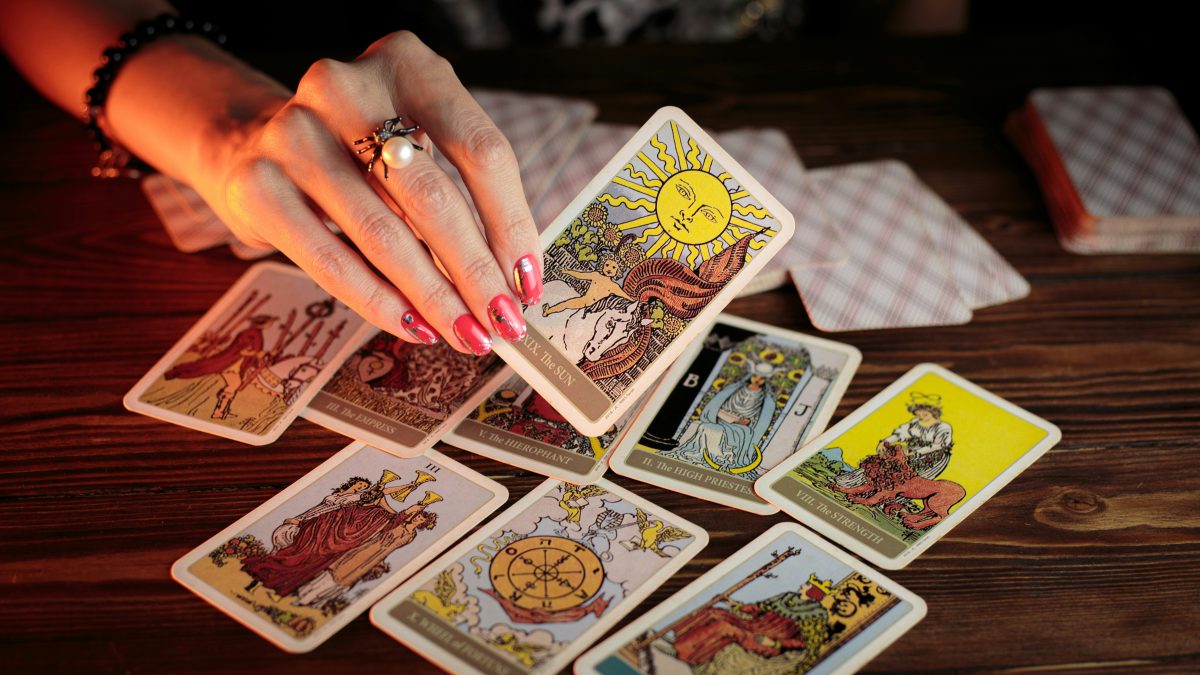
She shuffles her deck and asks me to cut it. The card I draw is Art. The cross card is The Empress—vulnerability.
“The more vulnerable you are onstage, the funnier you’ll be,” she says. “Delivery, presence, content. You can’t guard yourself. That’s the problem.”
She’s right. Comedy is a séance of sorts. You call something painful into the room, name it, and get people to laugh at it before it kills you. But that requires emotional honesty.
I tell her about getting a huge compliment from a comic with clout, how it froze me up instead of motivating me. Rachel laughs. “You have to be neurotically, compulsively insecure about your art or you won’t be funny. Isn’t that the whole game?”
She tells me I’m losing the love for it, that I’m approaching comedy like work instead of play. “Take a shot of whiskey before you go up there. Loosen up.” (Later, I’ll take a shot of Grey Goose at House of Comedy, and my set will go really well. I think I’m going to start drinking?)
Her reading becomes a mix of roast, pep talk, and creative intervention. “You’re subconsciously writing material you don’t have to deliver because you get to stay behind the veil,” she says. “You’re trying to be perfect instead of brave. Stop emulating dude comics. Tap into your femininity—that’s where the pain and absurdity live.”
Her final card is The Fool. “That’s good if you’re a comic,” she says. “You’re the jester. You’re supposed to leap before you look.”
Nikki: The Hermit and the Death Card
Nikki’s reading is over the phone. Her kindness and warmth bridges the geographical gap, making me feel comfortable by establishing a familiarity in a matter of minutes.
She keeps pulling cards about rebirth and solitude and eventually lands on The Hermit. “You’re not being honest about what you want,” she says. “You’re holding back.”
The phrase will follow me. All three psychics eventually say it, like a chorus of gentle ghosts: You’re holding back.
She lays out a full spread: The Tower (letting go of old ways), The Sun (joy, good fortune), and Death (not physical, but transformational). “You can’t speed up the outcome,” she says. “Be more relaxed. Let things unfold.”
“You’re going to be successful. The Spirit told me how funny you are. And I’m not just saying that to get a good review!” she laughs.
She tells me that humor, for me, is a form of armor, that I use jokes to cover vulnerability. “Instead of using humor or anger, let yourself feel the emotion underneath,” she says. “You’ve been strong your whole life. That strength has led you since you were a child. But you don’t have to keep fighting everyone and everything.”
Our talk is part therapy session, part sermon, and part improv set about my inner child having a tantrum. Her light critique of some of my character foibles strikes a chord without breaking any strings (no easy feat when dealing with me, as I can be a little stubborn and temperamental).
Lisa: Oracle Cards and Relationship Rehab
Lisa feels like a friend as she greets me at a coffee shop, a corner of which she turns into her own space before I arrive. The table is covered with random accoutrements: a chunk of amethyst, a pendulum, a Life Savers candy. She listens to music on low in her left ear as she does her reading. “Do you know Jack Harlow? That’s who’s playing right now,” she tells me.
She reads oracle cards instead of tarot. She says she already set an intention the day before, and paid attention to everything on her way to meet me: songs she heard on the bus, found objects, even strangers’ conversations.
She guesses I am from a small town. (“OK, yes.”) She asks if I am dating “exceptionally younger people.” (“Define exceptionally. OK, yes.”)
Her diagnosis: I am putting up walls. “That’s not good for comedy or relationships,” she says. “You’re aligning with the energy of scarcity—you’re attracting the same problems because you’re afraid to ask for more.”
Then she says something that sticks with me. “Stop entertaining people you don’t like. That includes your audience and your friends. You don’t owe anyone anything.”
Her last card, Justice, tells her that comedy can heal, that making people laugh is a way of restoring balance. “Your career brings fairness to others who need your help,” she says.
By the end of my three readings, I realize they were all saying the same thing—not just about my love life or career, but about how I think and how I hide.
The Skeptic’s Counterpoint
“If you go see one, you’re gullible,” my atheist roommate responds when I tell him what I’ve been up to.
“Do you go to magic shows?” I ask.
“That’s different,” he says. “Magic’s for entertainment.”
“Do you think people aren’t entertained by an hourlong psychic reading about themselves?” I respond.
People assume women go to psychics because they think ghosts are real. That’s like saying men go to magic shows because they believe objects can levitate on their own.
When men practice illusion, it becomes magic: top hats, rabbits, the power to make women disappear. When women practice intuition, it becomes witchcraft: hysteria, delusion, the power to make men uncomfortable, and, therefore, dangerous.
A magician’s trick is an illusion we agree to believe. A psychic’s reading is a truth we’re afraid might be real.
The history of mediums goes back further than organized religion. In early cultures, “seers” and “wise women” guided tribes through famine, storms, and childbirth. Then religion became institutionalized, and men decided they preferred to be the middlemen between humans and god.
It wasn’t until the 19th century that mysticism returned to the public sphere through the Spiritualist movement, led by three sisters from Rochester, New York: Leah, Margaretta, and Catherine Fox. They trademarked themselves as professional mediums who could communicate with the dead.
Eventually, the Fox sisters confessed it was all a hoax, but it was too late: by then, women across the country had found a new kind of agency. Mediumship gave them a way to earn money, speak publicly, and claim authority over unseen forces. They weren’t just con artists; they were early entrepreneurs in the business of belief.
Spiritualism also overlaps with abolitionism and the first-wave feminist movement. While men were writing laws, women were channeling ghosts and liberation. It was also one of the only professions where women could earn a living without a husband’s permission. And because of that it was immediately treated with suspicion.
Minnesota magician and comedian Derek Hughes agrees that the origins of magic, communal bonding, and fortune telling through tarot are intertwined.
“Thousands of years ago, magic wasn’t entertainment—it was survival,” he says. “Magicians guided the tribe to food and shelter.” When the leaders of the Spanish Inquisition burned magicians’ books and tortured and killed magicians, some of their secrets survived, hidden in paintings. “Some people think those symbols became the tarot,” he says.
When we dismiss tarot as “woo-woo nonsense,” often we’re really mocking a language of intuition that women kept alive while the church and state tried to burn it.
The Value of Believing, Even When You Don’t
“A lot of people think what I do is fortune-telling. It’s not,” says Lisa. “It’s about patterns—seeing what behaviors or beliefs aren’t working.”
The point of any psychic reading is not prophecy. The reading opens a portal. Someone sits across from you and translates your own intuition back to you in a language you can hear. Whether that’s tarot, comedy, or therapy, it’s the same job: helping people locate themselves in their own story. And in holding up a softened version of that mirror, you can finally see the truth you were avoiding without feeling judged.
That’s why a psychic reading works even if you don’t believe in psychics. The point isn’t supernatural accuracy. It’s reflection. It’s therapy in costume jewelry.
Rachel’s final card for me, The Fool, was, fittingly, the comic’s card. The leap of faith. The holy idiot who risks humiliation to find transcendence. In tarot, The Fool is not an insult. It’s the start of the journey. It’s the card of curiosity, risk, and beginner’s mindset.
And that’s the beauty of seeing a psychic. You don’t have to believe in spirits to believe in yourself. Sometimes, you just need a stranger with a deck of cards to remind you that falling on your face is the only way to keep moving forward. And if you’re having trouble falling on your face because you fear the pain, have a shot of vodka 10 minutes before you go onstage.