


During the streetcar era, the “Streetcar Series” or “Streetcar Doubleheaders” were an annual holiday tradition in the Twin Cities. Three times a year—on Decoration Day (Memorial Day), Independence Day, and Labor Day—the St. Paul Saints and the Minneapolis Millers would schedule games at their respective ballparks, and fans could watch both, riding the streetcars in between.
This is often mentioned as a footnote in articles about the streetcar era, but a few years ago I set out to understand what that experience would have been like in the heyday of baseball. Plus, as a transit enthusiast, I thought it would be fun to recreate the experience on the Green Line.
So, in 2024 and 2025, a group of my friends attended a series of “Light Rail Doubleheaders.” You can follow along with me on last year’s experience watching a Twins vs. Chicago Cubs/Saints vs. Iowa Cubs doubleheader, and read a little history along the way—and if you’re interested in attempting a Light Rail Doubleheader yourself, I’ve highlighted some dates during the current season when you can recreate the experience with your family and friends.
The Millers, the Saints, and the Streetcar Line That Connected Them
From 1905 to 1956, two minor league teams from the the American Association of Base Ball Clubs (AA) played in the Twin Cities: the Saints and the Millers. For many years, they were the kings of their league, and their close proximity made them natural rivals. During that same era, the Twin Cities Rapid Transit Company (TCRT) operated a series of streetcar lines that crisscrossed the Twin Cities. The teams and the streetcars both saw their popularity peak in the 1920s, so you can imagine that time as the heyday of the Streetcar Doubleheader.
I start my day at Lexington Station, located at University & Lexington in St. Paul. In 1920, at this same intersection, I would have been staring at Lexington Park. Earlier iterations of the Saints played in several ballparks in their early days, but when Charles Comiskey brought his Saints to St. Paul in 1895, he built a new park on this block. The ballpark changed hands, was damaged several times, and had to be rebuilt, but the longstanding park rebuilt in 1915 had its entrance near the present-day Aldi. Today you can visit a historical display next to the Huntington Bank branch, just south of the intersection.
I tap my GoTo card at the station and wait for a Green Line train to arrive. In 1920, the central corridor Interurban streetcar line ran approximately the same route as the Green Line, between both downtowns. The Midway of the time was a bustling industrial corridor, and this Interurban boasted the highest ridership line in the cities.
Today, light rail schedules deliver trains every 12–15 minutes, and even less frequently in the evenings. In 1920, the Interurban arrived every three minutes during rush hour, and every seven minutes outside of that. This is not to say it was speedy: The streetcars of the ’20s ambled through the system at an average rate of 10–12 miles per hour, no faster than today’s light rail or BRTs. But you wouldn’t be waiting long. Both the Saints’ and the Millers’ ballparks were just down the street from major TCRT garages, and as you left the ballpark, a long row of cars would likely be waiting for you.
The Interurban streetcars ran through both St. Paul and Minneapolis, and while they were operated by separate companies in each city, those companies were still owned by the same group of Thomas Lowry’s friends, later as the Twin Cities Rapid Transit Company. As you entered the car in St. Paul, you would have paid a token or a 5-cent fare (around $1 today), and as soon as your car crossed into Minneapolis you would have been expected to pay a second fare. In most places there weren’t assigned stops—you just stood in the street and hailed a streetcar driver. You entered the front of the car, where you paid your fare, then exited through the back. If you were looking for some conversation, you could hang out with the attendant in the rear of the car where the smokers congregated.
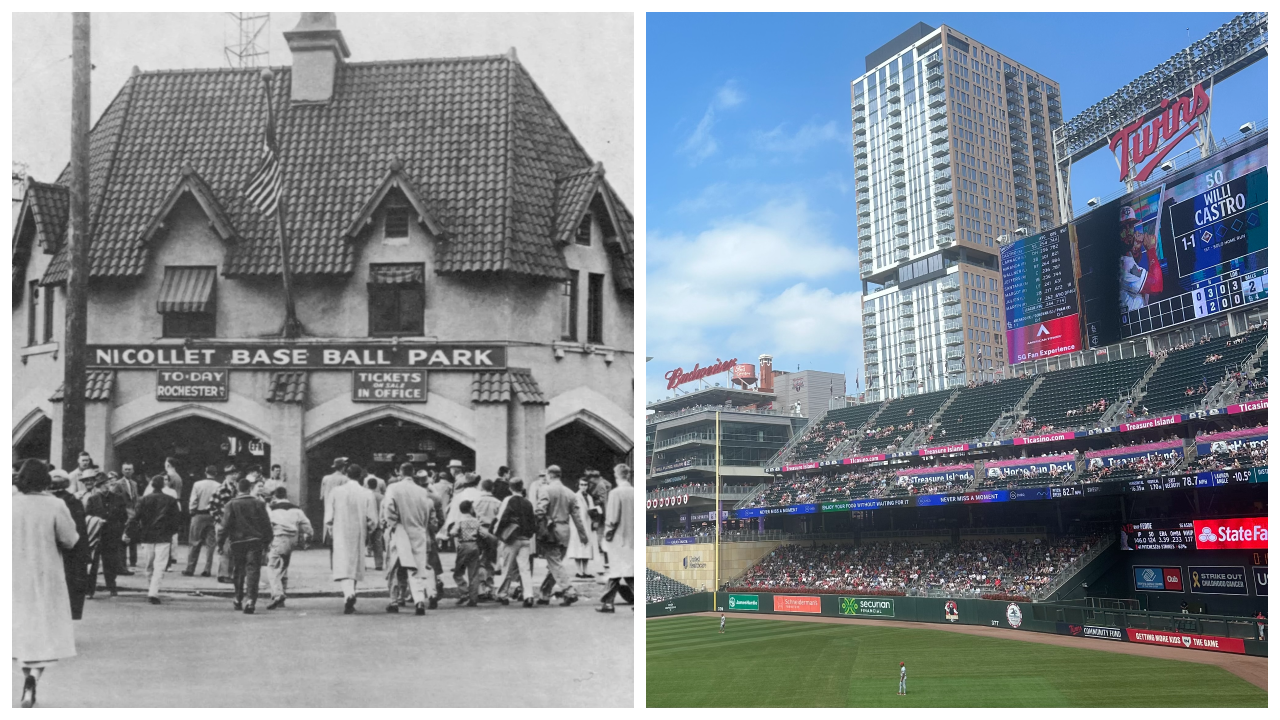
Today, I am thankful that there are no smokers in my car. I arrive at Target Field a few minutes before the game begins and find my friends. We tour the ballpark, buying sausages and mini donuts. We bought the cheapest tickets available (around $25 each), expecting to spend most of the game in the concourse, though later we may settle into our seats. Most of us do not know much about baseball, but I asked my friend and baseball knower Mara to give us a rundown of the Twins’ current season. The broad consensus is that the Twins are not doing well as a result of the teams’ ownership disinvesting in the team. But we see some good hits, we pick out a few players to cheer for, and we have a pretty good time.
In the 1920s, the Millers and Saints were exciting draws, and they would pack the ballparks. Good bleacher seats ran for $1, equivalent to around $15 now, but cheap seats along the outfield were often just a nickel or two.
Players of the era called hometown rivalry games, and streetcar series games in particular, “payday,” because they always sold so well. Newspapers of the time described overflow crowds where many people were seated on the field inside the fence. Rival games could be raucous. The July 4, 1929, game at Nicollet Park was interrupted several times by fist fights on the field. Players sometimes charged the stands and threatened hecklers whose jeers were a bit too cutting. Today, there are no fistfights, and the worst heckles are from my girlfriend, an inveterate Cubs fan.
From Minneapolis to St. Paul
The Cubs won handily, 8-1. As the game wraps up, we head to the exit to get on the train. We learned a lesson from a previous year: After games, there are two separate queuing locations for Green Line and Blue Line trains leaving Target Field. If you don’t get in the right line, you could be waiting for a while.
In 1920, there was not a regular daily route between the Millers’ and Saints’ fields. The Saints played at Lexington Park on the Midway Interurban. The Millers played at a ballpark at 31st and Nicollet, across the street from the recently demolished Kmart, just off of an Interurban that followed the present path of the B-Line BRT.
But for special events, like the State Fair or the streetcar series, TCRT would operate special destination-specific routes. So, much as today, you could step foot out of the ballpark directly onto your streetcar and be whisked directly to your destination.
Between games, we have a couple of hours to spare, so we stop off at my house in the Midway. Since we’re watching two games against the Cubs (their MLB team from Chicago and Triple-A one from Iowa), I have prepared a Chicago-dog buffet. We play some board games, eat some glizzies, and gear up for our second game. The weather is cooling, so we have procured blankets and jackets to wear out on the outfield berm at CHS Field.
As we spread out our blankets on the hill, we look through a program and each select a player to cheer for based mostly on their names (Kyle Bischoff! Connor Gillispie! Kody Funderburk!). Like the Twins, we don’t know much about the Saints’ standing, but we’re invested in the drama of these players specifically. We eat donuts. We drink beer. We take pictures with Mudonna, the team’s ballpig. I peruse the City of Baseball museum exhibit. In the end, our cheering pushes the team over the edge, and the Saints defeat the I-Cubs 2-1.
In the 1920s, Lexington Park had no lighting, so games had to be played in daylight. Tonight, the game ends after dark and we get to watch the fireworks.
After the fireworks die down, we amble down the street to Union Station. We wait a bit for the Green Line train, which runs less often at night, and as we head west one by one my friends say goodnight and get off the train.
Streetcars and baseball were an inseparable part of city life for nearly half a century. In the mid ’50s, streetcars died off as growing automobile and bus adoption, maintenance neglect, and biz-mobster collusion dismantled the system. Similar forces also ended the Saints and the Millers of the AA—both teams built new suburban-style ballparks in the 1950s, each hoping to get promoted as a MLB expansion team, and both folded before the Twins came over from Washington, D.C., in 1961. But decades later, in 1993, the Saints returned to St. Paul. In 2010, Target Field opened. And, in 2014, the Green Line and CHS Field both opened. So today, you can still attend a streetcar doubleheader as many would have a century ago.
I first planned a Light Rail Doubleheader excursion as an excuse to drag my friends along on an esoteric quest—to connect to history and to rediscover the rhythm of the city from days gone by. Recreating a Streetcar Doubleheader did feed our desire to connect to the history of cities around us. But it also gave us an excuse to spend a whole day together seeing places we already knew in a new way. I almost don’t remember who won these games, but I remember the time I spent with the friends who joined in on this quest.
Wanna Do a Light Rail Doubleheader?
If you’d like to attend your own historic day of baseball, you should start with a spreadsheet. Find all the dates that both the Twins and the Saints play home games, and cross off any games that do not start more than four hours apart. Check if you have any personal conflicts, then pick a date and go for it.
According to my spreadsheet, the Twins and Saints are playing Streetcar Double Headers on the following dates this season. As for me and my friends, we will be attending a double header on May 16—I hope I see you there!
Thursday, May 14: Twins-Marlins (WA) > Saints-Clippers (OH)
Saturday, May 16: Saints-Clippers (OH) > Twins-Brewers (WI)
Tuesday, May 19: Saints-StormChasers (NE) > Twins-Astros (TX)
Wednesday, May 20: Twins-Astros (TX) > Saints-StormChasers (NE)
Saturday, June 6: Twins-Royals (MO) > Saints-Indians (IN)
Saturday, August 29: Twins-WhiteSox (IL) > Saints-Mudhens (OH)