

There’s never been a more difficult time for the immigrant-owned restaurants along Lake Street in Minneapolis.
After the start of Operation Metro Surge, some businesses closed their doors indefinitely, as workers and customers alike stopped leaving their homes, fearing gangs of federal agents. Those that stayed open are still struggling for the same reasons; according to the Lake Street Council, the 1,000+ immigrant-owned businesses along the corridor lost $46 million in December and January, and the federal invasion is now in its third month.
“We have seen firsthand the effect on the businesses themselves, because we’re in direct contact,” says Muaz Osman, digital content specialist for the Lake Street Council and Visit Lake Street. But the nonprofit is also hearing from residents. “People want to help,” Osman says. “Community members are reaching out, constantly, over email and phone calls, [looking for] ways that they can support other than donating—maybe lending a hand or standing with a business as pedestrian security.”
That’s how Osman and his colleagues came up with an idea: What about cash mobs? The shop-local take on a flash mob became popular in the early 2010s as a way to bring lots of people out to local businesses, and they’d seen the idea implemented successfully in other Minnesota communities. Why not Lake Street?
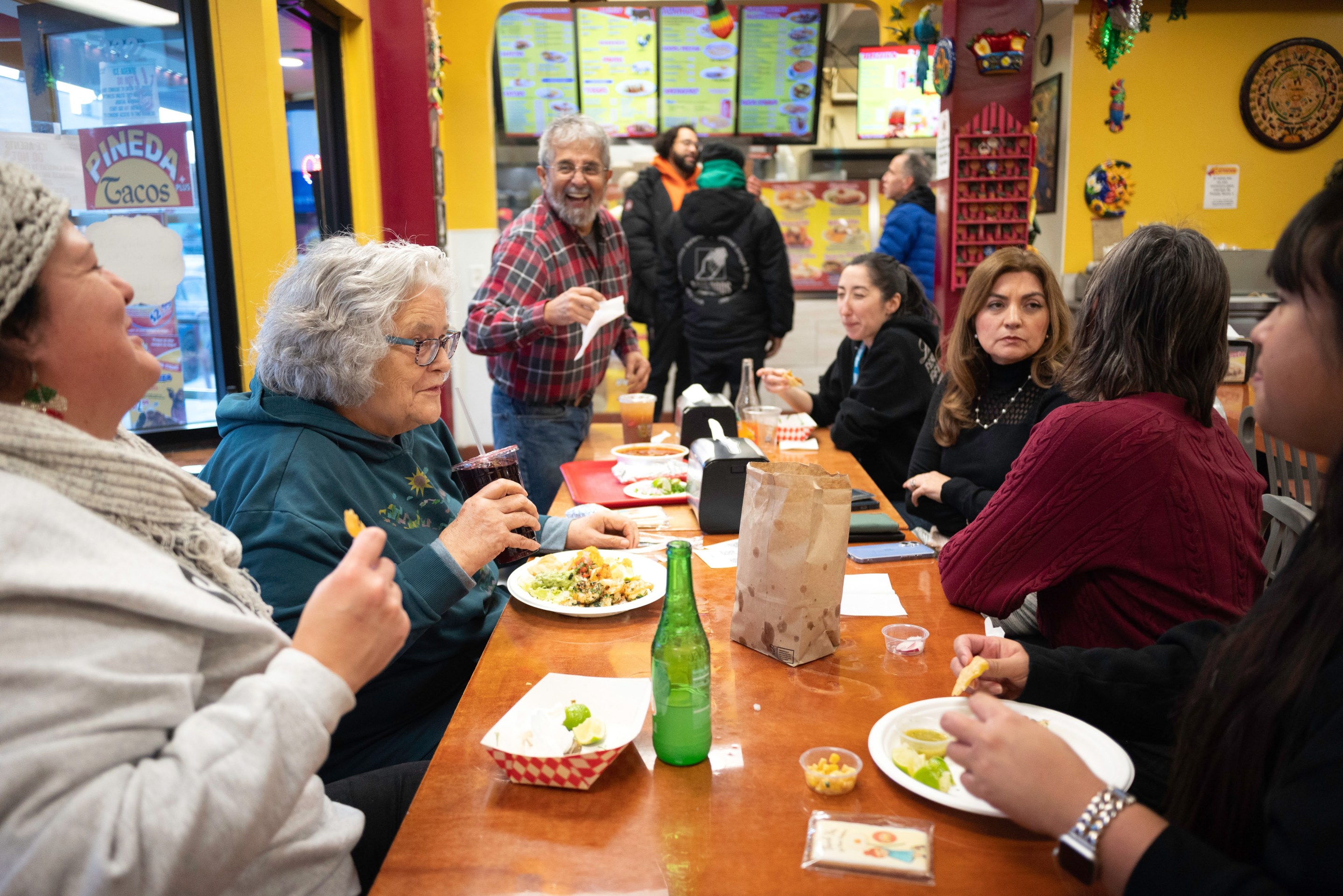
The council spoke with a few local restaurants to make sure they could handle that kind of crowd and held its first cash mob at Pineda Tacos Plus on January 21. Events at other Lake Street businesses have followed each Wednesday since, first at Lake & Bryant Cafe and Lito’s Burritos, then at Hamdi Restaurant, and then Sanag Restaurant, where there was also live screenprinting with local artists. The fifth installment will take place this Wednesday at Galapagos Bar and Grill from 4-7 p.m.
Cash mobs provide a tangible call to action; they’re a structured opportunity and a way for people to have a measurable impact, all while eating some really great immigrant-made food.
“It’s one thing to say, ‘Go shop local,’ because I think people are doing that,” says Alex Tsatsoulis, director of development for the Lake Street Council. “But I think people also really want to know where they can have the biggest impact.”
The response has been overwhelmingly positive, Osman reports, with the weekly cash mobs consistently bringing out more than 200 people. And those are just the ones they’re counting during the three-hour-ish windows during which the gatherings take place.
“We did not expect—like again, we’re asking these businesses, ‘Hey, can you handle 100 people coming at once?’ The response has been overwhelming for both us and the businesses,” Osman laughs. “A few of the businesses had to work extra hours just to cover up, because there were so many people that they couldn’t handle them by 7 o’clock.”
“The one we went to last week at Sanag Restaurant, I came with my son, and we were at the front door with a bunch of other people—the owner was trying to hand out menus but didn’t have enough for all the people,” Tsatsoulis adds. “I thought, ‘This is a good problem to have.’”
Better yet, the nonprofit has been in contact with businesses afterward, and they’re hearing that traffic has increased overall, with guests either returning after their initial cash mob-inspired visit or seeing the restaurants on the Visit Lake Street Instagram and going separately from the event. Some people have said that the cash mobs have become their weekly date night, or the day each week that the family goes out to eat.
And often, people are experiencing a restaurant they haven’t visited before.
“A lot of people, that was their first time even dining on Lake Street, or visiting Lake Street, which was a surprise,” Osman says. “The Minnesota community is standing up, and a lot of people from the suburbs and outside the Twin Cities have been showing up to these events, trying to support—that camaraderie of the North brings people together.”
After this week’s cash mob at Galapagos, this series is taking a brief break. (It’s the beginning of Ramadan, and several restaurants are changing their hours for the Muslim holy month.) But many businesses have expressed interest in hosting upcoming cash mobs, and the events will resume in early March on a biweekly or monthly basis.
Ultimately, Tsatsoulis says, the goal is making sure that these restaurants are still here six months from now—and six years from now: “That’s why we live here, that’s why we love Minneapolis, is because of the diversity and the vibrancy of places like Lake Street.” He acknowledges that there’s still a long road ahead, he feels cautiously optimistic—businesses are starting to reopen, and people are returning to the cultural corridor and the restaurants that line it.
“As someone who lives in Minneapolis and works on Lake Street, the last few months have been really, really hard for everyone in the community,” Tsatsoulis says. “But that community spirit—folks coming together—is what’s going to get us through all this.”