


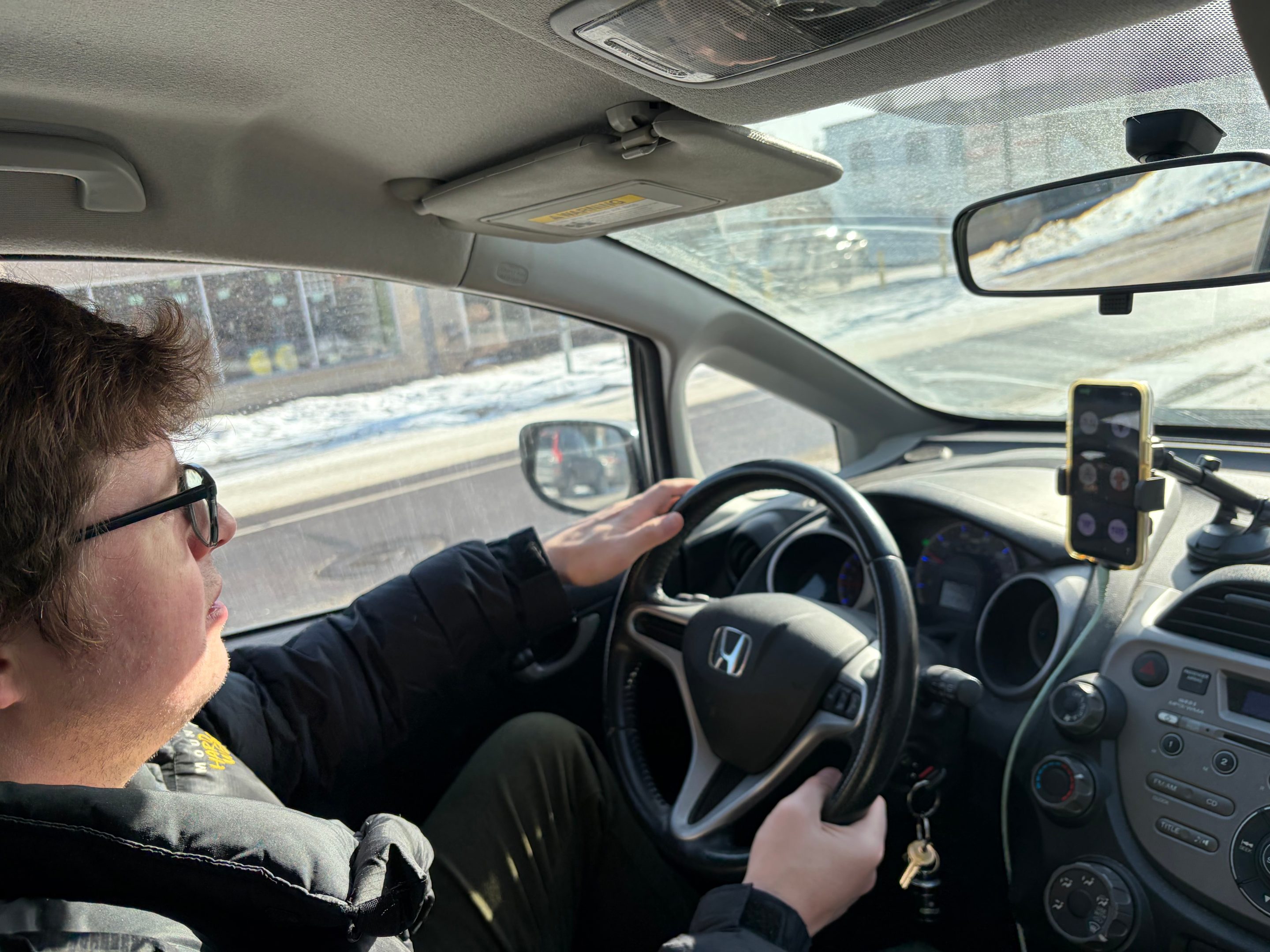
“The backseat has easier access to the gas mask,” Will Stancil says as he guides me into his black 2011 Honda Fit. On his patrols tracking ICE around Uptown and Whittier earlier this month, Stancil was tear-gassed for the first time in his life. The second time happened that same week.
Stancil was “radicalized into action” by ICE agents invading his Minneapolis neighborhood, and like many others, when Jonathan Ross shot and killed Renee Nicole Good on January 7 in Minneapolis. His resolve only fortified last Saturday when immigration officers beat, shot, and killed Alex Pretti two miles from the site of Good’s death.
Stancil describes himself, accurately, as a mild-mannered 40-year-old lawyer. While he always opposed ICE, he didn’t see himself chasing armed agents around Uptown, breathing in tear gas, or using Signal chats to check the license plates of suspicious-looking SUVs a month ago. But, in a city that continues to be under federal siege from Operation Metro Surge, he joins a growing network of outraged and organized residents determined to track, document, and confront roving gangs of 3,000 immigration officers.
The big difference with Stancil? He’s frantically updating his 100,000+ Bluesky followers in the process, and continuing to transform his very online persona from relentless (and at times exhausting) political pundit to aspiring lawmaker to, these days, tireless anti-ICE crusader.
ICE Spotting 101
The general strategy for ICE spotting looks something like this: Drive around your neighborhood, patrol a few streets (in Stancil’s case, Lake, Lyndale, and Hennepin), and listen to the Signal call for your neighborhood. On that call, you’ll hear other drivers reporting plates of suspicious vehicles to be checked by dispatch, or you can request that someone tail a suspicious vehicle. All of this comes with a bit of a learning curve; not everyone is familiar with the tricky NATO phonetic alphabet, which is used when identifying plates.
There aren’t any hard and fast rules to spotting ICE vehicles, but Stancil says he generally looks for middle-aged white guys wearing sunglasses in domestic SUVs with out-of-state plates. This isn’t an exact science. Early on in our ride-along, another driver calls in some plates to see if they had been previously confirmed as ICE. Without pause, Stancil hops on the call to say he remembers the plates: They belong to a local Door Dasher who’s often confused with ICE because of his big, clean ride. Later we come across that Door Dasher, blasting hip-hop from his shiny black SUV on Lake Street, presumably waiting for an order to come through.
While the web of rapid responders—drivers, foot observers, “man-in-the-chair” types—covers a lot of ground in our state, the decentralized structure means mistakes do happen. The people involved don’t have special training—they’re citizens armed with smartphones and whistles, doing their best to protect their communities. And the only way to really identify ICE is through license plate checks, which responders do through a makeshift database. Visual clues only offer so much, since the difference between an ICE logo and a Patagonia one can be hard to discern from behind the windshield of a Jeep Wagoneer.
“What if I let them go and they go get somebody?” Stancil asks. (The Department of Homeland Security claims, without evidence, that 3,000+ people have been detained during the current occupation of Minnesota.)
But Stancil says rapid responders are usually good at identifying actual feds. Generally, he says, ICE agents can tell when someone is following them, and that can lead to intimidation tactics like arrest threats.
“They act all scary, but when you follow them, they run away,” he says, noting that it’s not illegal to trail them. “Unless they get out and club you.”
Stancil says a couple ICE agents have tried to make one thing clear: They know where he lives.
“Some of These Guys Are Lunatics"
On Martin Luther King Jr. Day, the day before our ride-along, Stancil says the ICE driver he was following attempted some basic evasion maneuvers—pulling off onto a street to see if he was being tailed—before circling the same block 25 times. After a while, the agent started on a new route, one that led directly to Stancil’s home. The agent told Stancil over a loudspeaker to go home, which Stancil did not do. Eventually, he says the ICE agent sped through a red light to evade him.
“Some of these guys are lunatics,” he adds.
A few days before that, while Stancil was tracking a black Ford pickup, the ICE agent inside stopped in front of Stancil’s home and pointed at it. Stancil yelled out to him: Wanna come in for a beer? (He did not.)
If Stancil’s name doesn’t leap out to you, he is indeed a civil rights lawyer/researcher living in the Lowry Hill neighborhood. He also made an unsuccessful bid to represent District 61A in the Minnesota House of Representatives in 2024. And before that he became famous—or notorious, depending on who you ask—for his internet presence.
I wasn’t super familiar with that incarnation of Will Stancil. One of my first introductions to him was about a week ago, when I saw a tweet that read, “So if ICE kills Will Stancil do we laugh or make him a martyr?”
Stancil doesn’t think it would be all that funny to be killed by ICE, for the record. In the past his outspoken political commentary has stoked the ire of leftists and neo-Nazis alike, though it isn’t the leftist haters making cartoons about Stancil being sexually assaulted because of his “vibecession” takes. In fact, his recent ICE-hunting efforts appear to have won over those lefty factions, simultaneously creating a Stancil-is-good-actually cottage meme industry. “Most people don’t even know why they don’t like me at this point,” he observes.
But Stancil says all of that internet bullshit is secondary to what he is doing now. He’s too busy following feds, for as many as 30 hours per week, as they try to abduct his neighbors.
Keeping an Eye on Karmel Mall
About an hour and a half into our patrol, Stancil takes me to Karmel Mall in Whittier, a commerce center with a large number of Somali businesses. Many have shuttered, their owners worried that they’ll be targeted by ICE agents.
One Karmel vendor says he sometimes sees ICE roll through twice a day. With the invaders stomping around the mall and YouTubers trying to replicate Nick Shirley’s grift and “expose” Somali-owned businesses—harassing working people, shoving cameras in their face, and intentionally misrepresenting them—there has been no shortage of antagonists inside Karmel Mall over the past few weeks. “There’s no guarantee, even if you are a citizen, that you go home,” the vendor tells us.
Both Karmel Mall and nearby Marissa’s Supermarket have observers stationed outside throughout the day in case ICE comes by.
Tor, one of those observers at Karmel, stands by with a whistle to alert anyone within earshot about federal agents. Since people have become more vigilant in monitoring ICE’s activities, Tor says agents have gotten smarter—which is really saying something, since they’re reportedly quite dumb. While their rented SUVs have been easy to identify up to this point, Tor and Stancil say agents have started covering their vehicles with bumper stickers or placing stuffed animals on the dash to throw off would-be followers.
“They’re getting wise to what we’re looking for,” Tor says. But can those tricks stand against Stancil’s subcompact ICE interceptor, equipped with a standard-issue Turbo Tim’s bumper sticker?
One of the few positives to come from the last few weeks for Stancil, if there are any, has been the opportunity to propagandize for the Honda Fit. Stancil has lauded the small, zippy car he uses to keep tabs on the invading fascist troops as “unironically the best car ever made,” and credits it with a lot of his success in following ICE agents. He says the Fit drives like a go-kart, can park anywhere in the city, and can turn on a dime, making it the perfect ambush vehicle. “They try to lose me, and they literally cannot do it,” he grins.
“I’m not worried that they’ve become masters of disguise,” Stancil says. “We’re still pretty good at finding them. They just haven’t really been around the last few days.”
When federal agents aren’t visible, that usually just means they’re active somewhere else—they outnumber MPD five to one, after all. While I ride with Stancil, we don’t come across any ICE or Border Patrol agents, but there seems to be an elevated presence of feds in Roseville, according to Signal chats and the Ice Out tracker. It’s hard to know where your efforts would be most helpful.
Paranoid Haircuts, Constant Vigilance
Stancil says he has witnessed two people abducted by ICE, and each time was deeply traumatic for all involved. It’s scary, and you want to help, but once agents swarm, what can you even do? Tracking ICE can take a lot out of you. Stancil even compared it to being at war, noting that he hasn’t been in active combat himself.
“In the moment you are in it, you are on,” Stancil says. “When you go home, all the stress leaves your body.”
More than anything, though, he says this strains the community. While masked faux-soldiers teargassing and abducting people being the obvious, primary stressor, there is also the added stress of paranoia.
Stancil tells me a story about a vehicle that was spotted outside of a barber shop with confirmed ICE plates. The driver was inside, getting a haircut. When this info got to the Signal group, many responders went to the barbershop and watched the man as he sat in the barber’s chair. Because ICE often uses rented vehicles, it is impossible to know if this man was a real ICE agent or just unlucky enough to have rented a car that had been used by one previously.
“If he was just getting a haircut, it was probably the scariest of his life,” Stancil says. “You don’t want that much paranoia in your neighborhood.”
While masked mercenaries still survey our streets for easy targets, paranoia is all but unavoidable. Stancil was already a neurotic character before this, he says, and I watched him for three hours throw his head in circles, spotting Texas plates on cars I hadn’t even noticed yet. During that afternoon, we didn’t find a single ICE vehicle. Maybe they’ve gotten better at disguising themselves. Maybe they were busy terrorizing suburban school kids.
But the more they have to hide their brazen terror campaign from vigilant watchers like Stancil, the less they can carry it out.
“If I can’t tell they’re ICE, then they can’t really do ICE stuff,” he says.