

The term "folk school" conjures a certain vibe: a rural setting in the woods or along the shores of a lake. Scandinavian-inspired classes about knitting mittens, or baking rye bread, or whittling wood. Classrooms full of people toiling away at looms or weaving baskets.
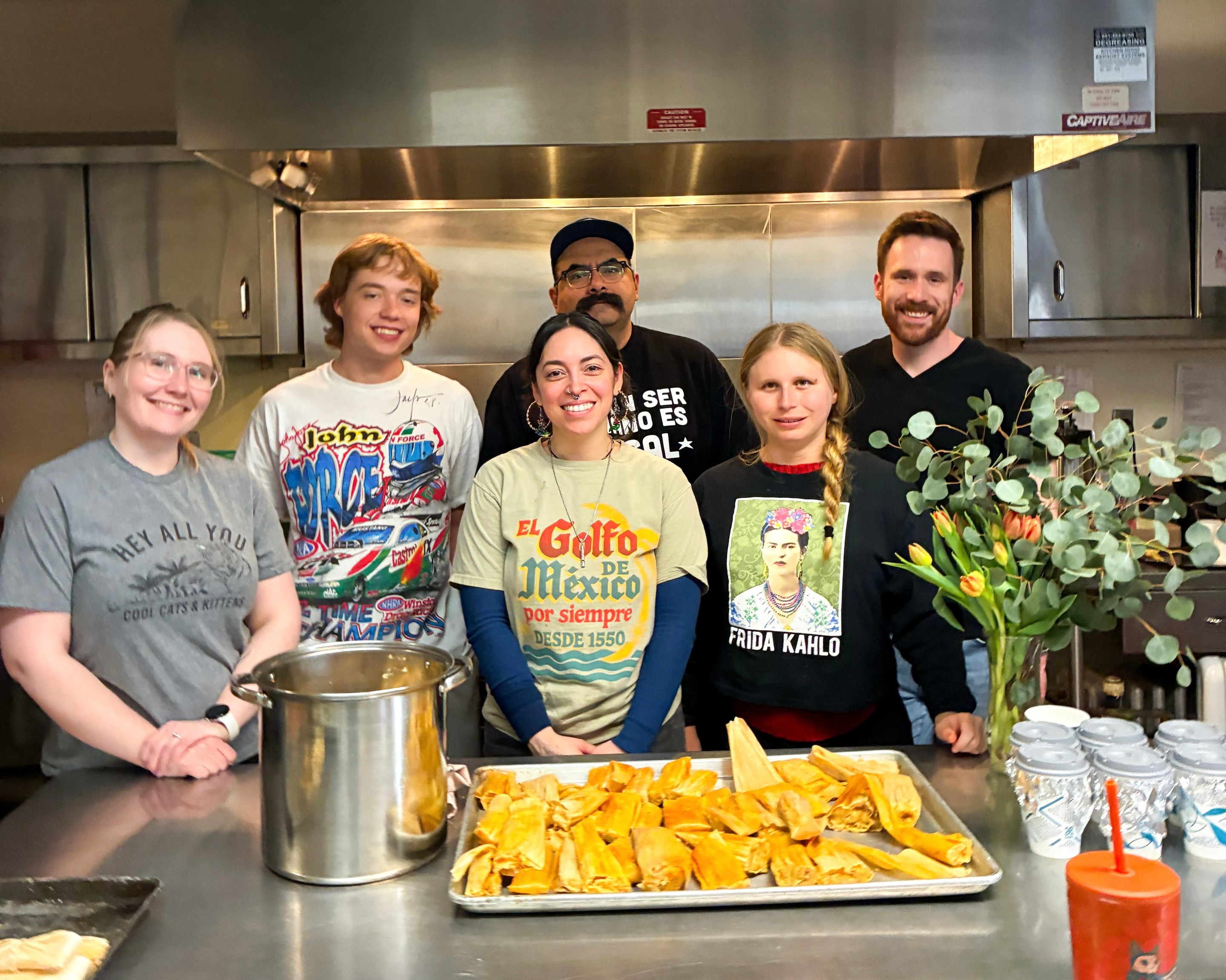
That focus on traditional craft is great, but the Euro-centric lens doesn't necessarily resonate with Minnesota's increasingly diverse population. Launched last fall, the Center for People and Craft seeks to address that disconnect by revamping the 19th century Danish folk school concept for 21st century Minneapolis. The urban folk school opened last fall, and offers a lineup of classes that reflect the city's wide-ranging cultures, from a day-long tamale making workshop to an Ojibwe-style beadwork class to a course in crafting Mexican milagros.
(And yes—there are also workshops in basket-making and woodcarving.)
“We are seeking to create a place where people from all parts of the world who find themselves here in Minneapolis are sharing the practices and traditions that help them feel at home wherever they are,” says Cal Stalvig, the center’s co-director. “[The center] is a place where regular people are sharing craft knowledge, food knowledge, and traditional movement and music knowledge as a way to support the lives of others and their communities.”
Although the Center for People and Craft taught its first classes in December, “I've been getting ready for this for years,” founder and co-director Anna Lindall says with a chuckle.
Lindall has worked in a variety of educational roles and is also the founder of the Free Forest School, a community-led nature play group she founded while living in Brooklyn that now has a presence in over 30 states. She finds inspiration in the mid-19th century Danish folk school model, which offers a non-hierarchical approach to sharing cultural knowledge, and she’s also influenced by the Highlander Folk School, which applied the folk-school methodology to the needs of working class people in 1930s Tennessee. (Highlander has since evolved to become a social justice leadership training school.) In recent years, Lindall has traveled to Sweden to study a methodology for teaching handcraft to children and has attended classes and taught at North House Folk School in Grand Marais.
“As much as I absolutely love North House and being part of that community, I know that it's not accessible—it's expensive, it's far away,” Lindall says. “It just always seemed like, why don't we have more of this in the city?”
That idea became a reality thanks to the Arts & Culture Vibrant Storefronts Program, a city of Minneapolis-funded program that matches artists, arts organizations, and cultural focused-businesses with vacant properties. Grant recipients are awarded $100,000 over two years to be put toward rent, which is negotiated with their landlord. As a 2025 awardee, The Center for People and Craft has used the funds to lease a former preschool space at St. Mark’s Episcopal Cathedral, across from the Walker Art Center.
Over the past several months, the Center for People and Craft has already offered classes representing a wide range of handcraft traditions, including willow basketry, knitting, sashiko (traditional Japanese embroidery), green woodcarving for kids and grownups, traditional Appalachian clogging, and hand broom making. Upcoming offerings include an introduction to kolrosing (an ancient Scandinavian technique for decorating wood), a beginner-friendly Indigenous beading class, and a two-day candle making workshop that utilizes invasive buckthorn to make candle molds.
In order to make programming more accessible, each class has at least one spot set aside for a half-tuition scholarship, which anyone with financial need can apply for online. And some workshops are offered at three tiers: pay-it-forward (which helps cover costs for other students), standard (the actual cost), and community (a low-cost option for those who need it). Nearly all classes and workshops are under $200, including materials.
There’s also a free-of-charge service learning program supported by a grant from the American-Scandinavian Foundation. Over the course of a single-day class or multi-day workshop, participants work with master artisans to construct furniture and equipment for the Center for People and Craft’s workshop. Several classes have sold out, and the intro to traditional Appalachian clogging was so popular that there’s now an intermediate-level class for people to continue to build their skills.
“I think that what we're really offering people is that the artifacts are not in the cloud,” Stalvig says. “There is a satisfaction in being able to create objects that can be shared, that can be passed down, that have a tactile quality that a lot of folks just aren't getting when we're working on computers.”
Community-building is also a key aspect of the center’s mission.
“My favorite part about being here is when it's a Monday night, and there are three things happening at the same time: Appalachian clogging in one room, and then a Black choir in another room, and then a knitting group in another room,” Stalvig continues. “This is exactly what I dream of—many people all coming together for very different reasons, but also just seeking to be in community with other people who are seeking to be in community.”
Lindall sees the center’s diverse teachers and learners as inherently anti-fascist. She notes that a distrust of immigrants and other marginalized groups is a central tool of fascism, and folk schools provide a powerful counterpoint to that ideology.
“When you get into a room with 10 or 12 other people from a variety of different backgrounds, and you sink your hands into someone's cultural tradition that they are genuinely sharing from their background, you can't help but realize that people have way more in common than we have different,” she explains.
Handcraft also pushes back against the current AI-fueled, hyper-capitalistic focus on productivity.
“It's not the most efficient way to do things,” Lindall says. “But the connection between people, and taking the time to know one another in this way, it's just incredibly valuable.”
Lindall and Stalvig both emphasize how integral volunteers have been to the center, from providing guidance with the financial aspects of running an organization to cleaning the space to serving as hosts who welcome class attendees. Fundraising efforts are also ongoing, with a Super Spoon Carving Saturday fundraiser scheduled for this Saturday.
“If this is an idea that in some way speaks to you or appeals to you, we are really inviting community members to come join,” Lindall says. “There are many ways to get involved, from joining the board, to giving five bucks a month, to taking a class, to telling your friends about it.”
“As much as I want it to push back on the powers of capitalism in our lives, there's a very real need to have the revenue work, to be able to pay our instructors well,” she continues. “We have this runway [thanks to the Vibrant Storefronts grant]. We need to build it now, and if it's something you value, come help out.”
Center for People and Craft
Address: 519 Oak Grove St., Minneapolis
Super Spoon Carving Saturday Fundraiser
When: Saturday, May 2, 10 a.m. to 3 p.m.
Tickets: Registration starts at $20, with proceeds going directly to purchasing carving tools for the Center for People and Craft’s workshop