

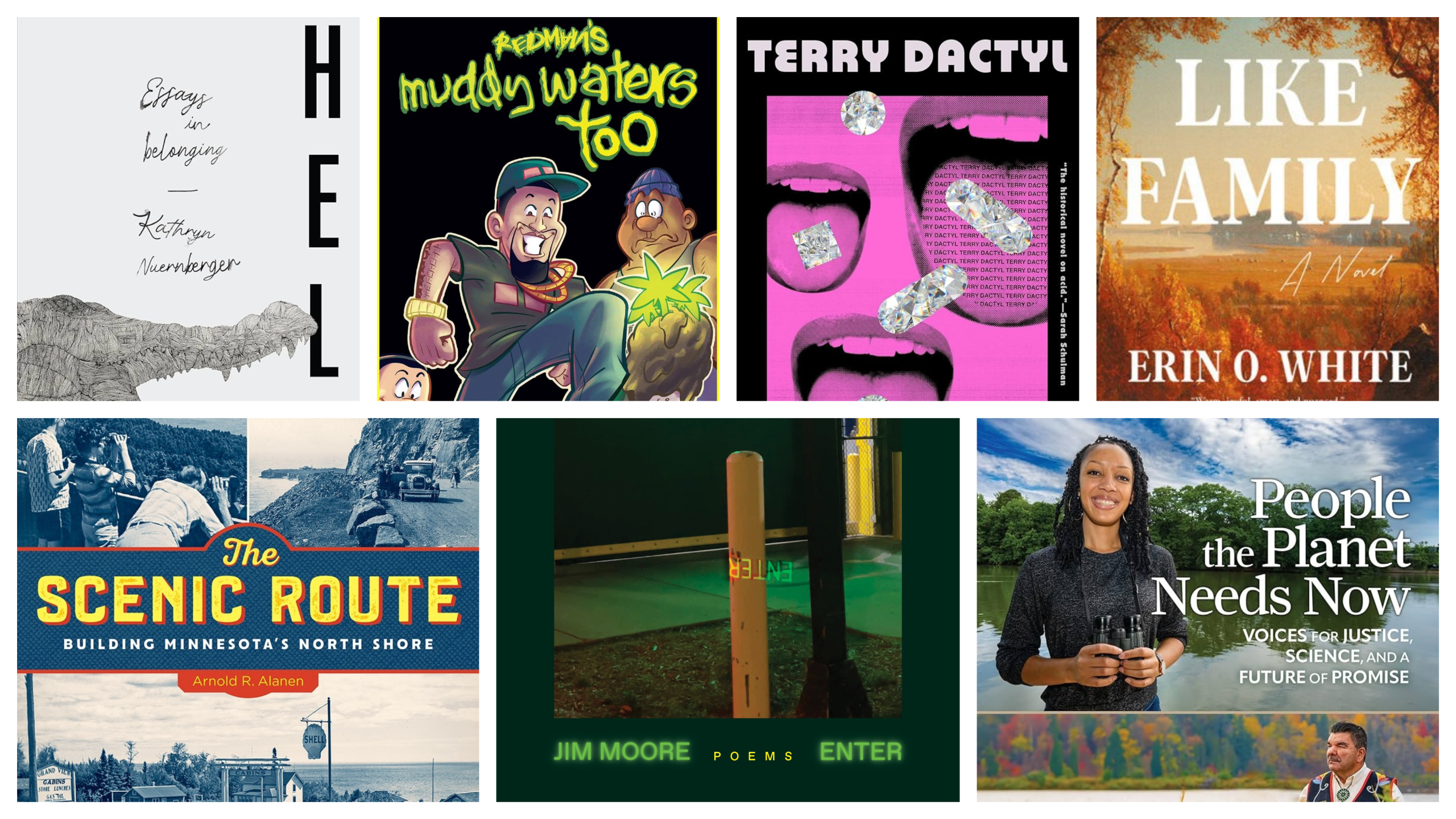
Let’s read more books to counteract online AI slop! Better yet, let’s read more books about niche topics written by local authors and published by small presses. Here’s a selection of the top slop-fighting Minnesota books published in 2025.
The Scenic Route: Building Minnesota’s North Shore by Arnold R. Alanen
For the Up North explorer who has toured Split Rock, hiked to Bean and Bear Lake, and spit into Devil’s Kettle. Who knows how many breath-holding seconds it takes to drive through the Silver Creek Cliff and Lafayette Fluff tunnels. Who has memorized menus, from the beer list at Castle Danger to the baskets at The Angry Trout. Who thinks they’ve seen and done everything the North Shore has to offer, The Scenic Route (University of Minnesota Press) will enhance their next trip up Highway 61.
Instead of focusing on the predictable splendor of Lake Superior and the Sawtooth Mountains, author Arnold R. Alanen, professor emeritus of landscape architecture at the University of Wisconsin-Madison, covers the built environment—how Highway 61 between Duluth and Grand Portage went from a mail service route to a treacherous road to today’s scenic byway. The book is delightfully granular, with maps, photographs, and descriptions of landmarks both iconic and long gone.
People the Planet Needs Now: Voices for Justice, Science, and A Future of Promise by Dudley Edmondson
“This book is not supposed to make people feel great,” writes Dudley Edmonson on the opening page of People the Planet Needs Now (Adventure Publications). The book includes compiles first-person accounts from BIPOC scientists and activists about problems in their communities, like an ornithologist who advocates for conservation in urban areas and calls out the inequity of unpaid internships in her profession. Another chapter focuses on Roxxanne O’Brien, a North Minneapolis hero who held Northern Metals accountable for lead contamination (“They were sloppy culprits, and they were bullies”). O’Brien’s tale explains why she advocated for settlement money to go directly to the affected community.
Edmonson’s right. The strife doesn’t feel good, but the stories of people who push back against the environmental ravages of capitalism are inspirational. Alongside the activists’ stories, the book’s glossy pages feature portraits of the activists, wildlife scenes, and even pretty pictures of plastic pollution.
Held: Essays in Belonging by Kathryn Nuernberger
Held: Essays in Belonging (Sarabande Books) is full of stunning instances of symbiosis in the natural world. Author Kathryn Nuernberger, a professor of creative writing at the University of Minnesota, writes with awe about relationships between owl droppings and redwood tree roots, frogs and tarantulas, anemones and crabs. She maintains a sense of wonder while also covering the grief of scientists “who watch and log every day the way worlds are ending.” My favorite essay, “Homesteads,” explores Nuernberger’s uneasy enjoyment of peripatetic RV vacationing, her intellectual inquiries into Laura Ingalls Wilder’s legacy, and the environmental and cultural consequences of Manifest Destiny (pairs well with Edmonson’s People the Planet Needs Now!).
Throughout the linked essays, Nuernberger doles out details about a tragic accident, which propels the narrative throughline. It’s a carefully considered book about micro and macro grief that makes for perfect winter solstice reading.
Redman’s Muddy Waters Too by Reggie Noble and Ben Katzner
Redman’s Muddy Waters Too (Vault Comics), features a story created by rapper Redman (Reggie Noble) and punched up by Minnesota comedian Ben Katzner. The graphic novel follows Doc, a botanist who has developed a proprietary mud that accelerates cannabis growth. When the mud is stolen by armed criminals, Doc and his crew must track it down, but they’re sidelined by Doc’s girlfriend’s grievances and his insatiable toe fetish. Cartoony illustrations exaggerate the absurd caper, which is violent, crass, and profane, in the best way. In a two-page afterword, Katzner enthusiastically summarizes the process of collaborating on the graphic novel, providing a fun glimpse into a dream-fulfilling project.
Terry Dactyl by Mattilda Bernstein Sycamore
Technically, Mattilda Bernstein Sycamore is not a Minnesota author, but I’m including Terry Dactyl (Coffee House Press) here because the book was put out by an amazing Minneapolis publishing house and just might be the most spectacular novel I read all year. One thing I loved about this book is that Terry Dactyl, the novel’s wholly unique protagonist, is a trans character whose transition is not part of the plot. Raised by lesbian mothers in the midst of the AIDS epidemic, her life choices are influenced by the trauma of watching her parents’ social circle die off from the disease. Terry Dactyl lives through queer history as a drug dealing enfant terrible of the 1990s New York club kid scene, then an art gallerist’s muse, and as a pandemic-era civil rights activist. The once-radical mothers turn into West Elm beige boomers who can’t relate to their daughter’s intersectional involvement in the George Floyd protests.
Like Family by Erin O. White
Long after I finished Erin O’White’s debut novel, Like Family (The Dial Press), I kept playing pretend with its roster of characters. They are all middle-aged parents who send ambiguous emojis, question their parenting decisions, and unequally divide domestic labor. It was fun to consider, if I lived in O’White’s fictional Radclyff, New York, would I rather be married to Mike or Tobi? I’d want to look like Caroline, but possess Wynn’s generational wealth. I would live in Ruth’s first house, but without her midlife is-this-all neuroses. This is domestic fiction at its best: immersive setting, relatable conflict, and multi-dimensional characters that invite readers into their narratively heightened everyday dramas.
Enter by Jim Moore
In his collection Enter (Graywolf Press), poet Jim Moore writes poignantly about terrible memories and the terrible present. Example: The speaker in the poem “Everything Is Not Enough” declares, “When the dictator comes, he will be freely elected.” But beyond the terribleness, Moore finds beauty and meaning in the everyday. Moore describes dimly lit scenes of November in Minnesota and nighttime in Spoleto, Italy. In the shadows, Moore sees a damaged skateboard as an angel’s broken wing. Rain at 38th and Chicago is “the soul trying to stay afloat.” A parking garage Enter / Exit ramp becomes a metaphor for birth and death. I recommend reading a poem from this collection as an antidote whenever the news on your bright phone becomes too much.