



Our current state of googleable, wikiable, exhaustively listed popular culture makes it difficult to remember (or for younger people, impossible to have ever known) a world in which you might not be able to watch any movie you want right now, much less learn everything there is to know about it with ease. In his prescient and ecstatic 2010 essay “Wake Up, Geek Culture. Time to Die,” Patton Oswalt coined the phrase “Everything That Ever Was—Available Forever” to contextualize the changing economies of pop culture passion. All culture and knowledge feels just a click away. A person is just one Wikipedia deep dive or overly long YouTube explainer from claiming expertise in the satires of the Czech New Wave, the recession-sandwiched Mumblecore movement, or the metatextual dramas of the Marvel Cinematic Universe.
And yet there is a present and growing yearning, among the old and the young, for a time before Everything That Ever Was could be sold to us via a series of $24.99-a-month streaming service subscriptions. Anyone who grew up in the time before the Great Cataloging of All Culture on the Internet has some seemingly lost piece of culture tucked away in the archive of our memory yet permanently imprinted on our psyche. Maybe it was a monster movie you saw at 2 a.m. on a regional TV station in 1998. Maybe it’s a half-remembered blurb for a no-budget slasher in the back of a horror magazine a friend’s older brother had laying around. Maybe it was a row of direct-to-video action movie sequels on a video store shelf. Difficult to watch much less own, these films still play a role in shaping our tastes and opinions about art.
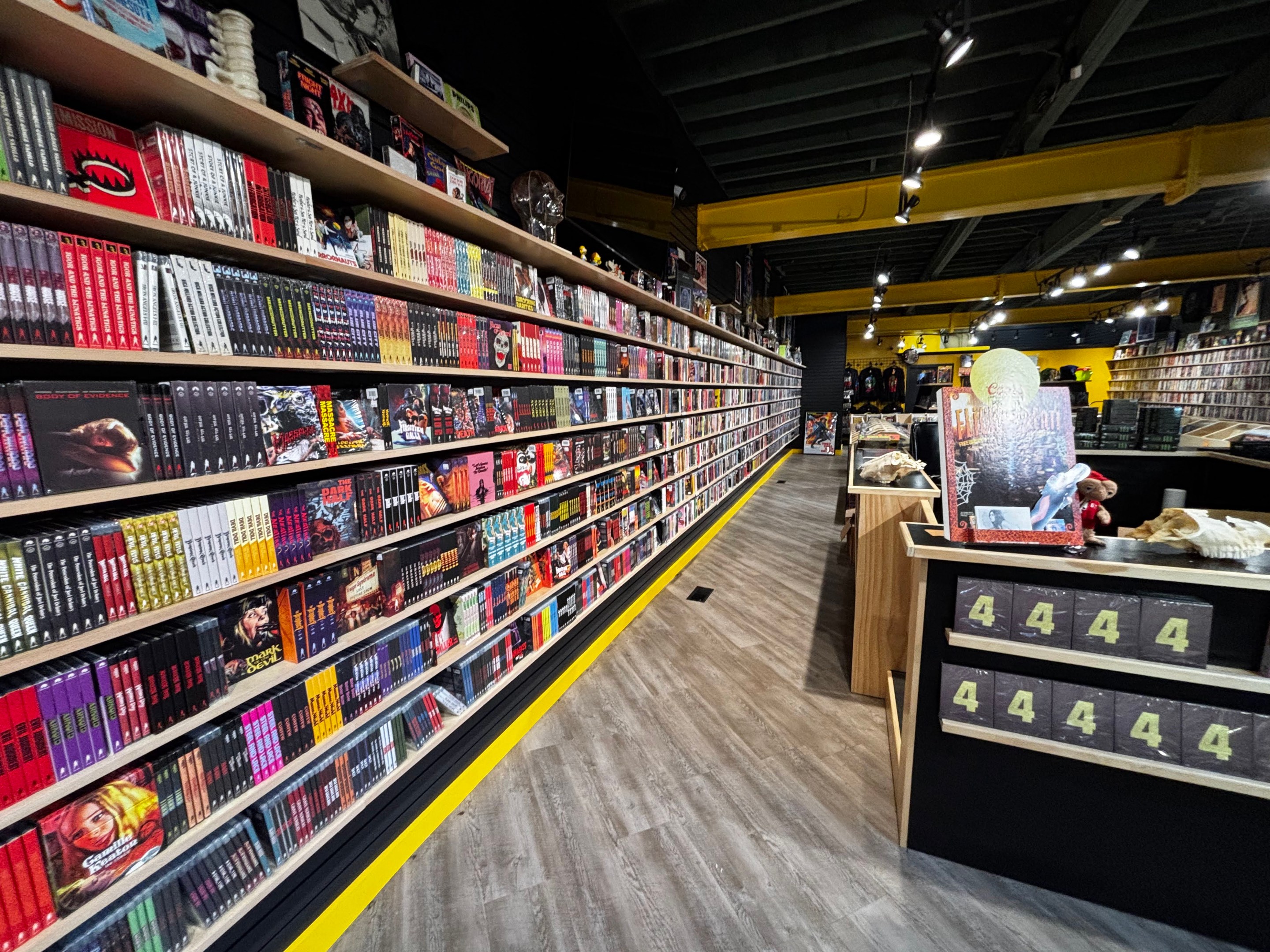
What one new store in Dinkytown supposes is that movies like this should be just as much a part of the cinematic conversation as any blockbuster or august, well-awarded drama. That these films should be presented in the best quality possible. And that these films, no matter how large or small, should be accompanied by supplemental and critical materials that enrich the experience of watching the movie. Beginning during its soft opening this Friday at 11 a.m., Vinegar Syndrome will bring this brand of cinephilia to 1312 Fourth St. SE1, halfway between I-35W and the Gophers’ stadium.
Founded in 2012 in Bridgeport, Connecticut, Vinegar Syndrome2 is your favorite movie nerd’s favorite movie label. From the outset, the founders of “VinSyn” focused on restoring and releasing mouldering, out-of-circulation exploitation films, whether they be titles from the “Golden Age of Porn,"3 ultra-low budget horror films, or blaxploitation features long left on the shelf by mainstream audiences4. Some of their releases were previously considered lost films, or at least consigned to aging VHS releases traded at conventions or film reels sold for exorbitant sums on eBay. Applying an archivist’s mindset and critical curiosity to important but out-of-fashion parts of film history, Vinegar Syndrome built a well-earned reputation for expert and loving treatment of obscure films.
Today, VinSyn’s catalog has reached over 230 titles, whether under the Vinegar Syndrome name or their sub-labels dedicated to specific film niches5. Releases run the gamut from schlock classics like Mac and Me or Troll 2 to cult comedies like I'm Gonna Git You Sucka or Cannibal! The Musical to out-there horror like Reptilicus, Ticks, or Mountaintop Motel Massacre.
They’ve released underseen works by masters, such as Robert Altman’s feminist reckoning with midcentury nostalgia Come Back to the 5 & Dime, Jimmy Dean, Jimmy Dean, Elaine May’s pitch-black rat-a-tat rom-com debut A New Leaf, and Martin Scorsese’s first non-student feature, Boxcar Bertha. They’ve been ahead of cultural trends, releasing blaxploitation films from the company’s earliest days, including a notable 2018 release of the Melvin Van Peebles classic Sweet Sweetback's Baadasssss Song, scooping the Criterion Collection’s acquisition of the film three years later which only occurred a year after a much-discussed New York Times article criticizing Criterion's dearth of Black films. And they offer an enviable slate of cornerstones of the new cult canon: Road House, Showgirls, The Amityville Horror, Congo.
Lest those examples seem like a frenetic mish-mash of incongruent titles, engaging with Vinegar Syndrome’s oeuvre reveals an intelligible principle at work. There is in fact a logic which clearly connects Last Tango in Paris to Redneck Zombies. The key hallmarks of a Vinegar Syndrome release are thus: 1) an underseen film with some fascinating artistic perspective; 2) an exquisite audiovisual presentation; and 3) lavish packaging. VinSyn’s model of releasing a relatively small number of each film in deluxe, limited edition packaging, with boxes and booklets a plenty, has led to both appreciation and criticism, sometimes from the same person in the same sentence. In my estimation, a joke tweet from 2024 sums up the VinSyn phenomenon best:
As a personal example symbolic of the whole, I’m particularly fond of VinSyn’s release of the Norm MacDonald-starring Dirty Work. I owned Dirty Work on DVD over 20 years ago, given to me by some friend or relative at some unclear point in my early teens. And across so many viewings in attics, garages, and friends’ bedrooms, I came to love it. Dirty Work is an oddity in many ways, as Bob Saget’s directorial debut, Chris Farley’s last film role, and one of the only times Norm was ever trusted at the center of a movie. It’s a shaggy, sketch-driven late-’90s attempt to fashion a star vehicle for a defiantly anti-commercial and anti-comic actor. For years it was only available on that muddy, decades-old DVD or an out-of-print Blu-ray which could go for $50 or more on eBay.
Of course, Vinegar Syndrome restored it and released it in pristine 4K quality, even unearthing and including the famed “Dirtier Cut,” which never saw the light of day despite the 2000s craze of director’s cut DVDs. I love this release, and Vinegar Syndrome greased me for $42.99 (plus shipping) when I pre-ordered the limited edition because I just had to have it.
As befitting a company committed to restoration of films, Vinegar Syndrome seems to be interested in rebuilding the culture of film through place. At a time when brick and mortar feels like it’s in perpetual decline, Vinegar Syndrome has four retail locations6 in addition to the new Dinkytown store. Four of the five locations have opened since 2022. And in addition to selling their own titles, VinSyn’s stores sell new and used movies and music of all kinds. In fact, the email announcing the Dinkytown store’s soft opening offered to buy patrons’ “Blu-rays, DVDs, VHS tapes, LaserDiscs, vinyl records, CDs, cassettes, and posters.”
In the run-up to the opening of Vinegar Syndrome Minneapolis, VinSyn co-founder Ryan Emerson answered questions via email about his personal and professional connections to Minnesota, VinSyn’s work broadly, the specific decision to open a store here, and what the future might hold for Vinegar Syndrome in the Twin Cities. The questions and answers have been (very lightly) edited for formatting and grammar, and occasional hyperlinks have been added to provide resources for the reader.
Racket: You said you grew up in the Twin Cities area. Did you have early experiences with film in Minnesota that shaped your work?
Ryan Emerson: I actually grew up in northern Iowa, very close to the Minnesota border, so Minneapolis was always a big part of my world.
In high school I had two jobs: one at a multiplex called Cinema IV and the other at one of the coolest record stores in Iowa, City Sound. One shift I’d be threading up a 35mm print of The Crow or That Thing You Do!, and the next day I’d be across the street at the record store, fielding a call from Dani Filth asking how his record was selling. I miss the ’90s.
I found myself in Minneapolis constantly, going to the Electric Fetus or Cheapo, seeing shows at 7th Street, and basically soaking up as much of the culture as I possibly could. Minneapolis had a tremendous impact on me, and eventually I even moved there for a bit in the early 2000s before heading to film school.
Are there any specific places in Minnesota—video stores, theaters, other venues, etc.—that fostered a love of film for you?
In terms of record stores, I already mentioned the Electric Fetus and Cheapo, but there was also a place called Treehouse and a great one called Let It Be downtown. I remember them fondly.
You could walk into a record store or video rental store and find something completely unexpected. That feeling of digging around and discovering something you didn’t know existed is something we’ve always tried to recreate with Vinegar Syndrome, especially with our physical stores.
How would you describe Vinegar Syndrome to someone who’s not a physical media devotee?
I’ve always described Vinegar Syndrome as a means to an end. Home video is the product that helps fund the more ambitious work we really care about: finding, rescuing, preserving, and restoring films.
That’s not to say we don’t love producing home video releases. We absolutely do. But for us, the disc is often the final step in a much larger process.
I’m not sure the casual film fan realizes just how many movies have disappeared over the last 50 years. Lost films aren’t just a silent-era problem. In some ways, the situation was even worse during the golden age of exploitation, when a lot of these movies were treated as completely ephemeral. Prints were discarded, negatives were lost, companies disappeared, and sometimes the only surviving elements are sitting in a basement, warehouse, or abandoned film lab somewhere.
So the home video release is important, but the real goal is making sure the film still exists at all.
Has Vinegar Syndrome’s approach to releasing changed over the years? If so, how?
The scale has changed enormously, but I’m not sure the basics have.
When we started, we were working with much smaller budgets, much smaller audiences, and usually much more obscure films. Today we can work with major studios and filmmakers, tackle complicated 4K restorations, and put together releases that would have been completely unimaginable for us in 2012.
But the underlying idea is still pretty simple. If we think a film is interesting and we can do something meaningful with it, we want to treat it seriously. That applies whether it’s a well-known studio picture or a movie that virtually nobody has seen in 40 years.
The packaging has gotten fancier and the projects have gotten bigger, but I’d like to think the core of VS is basically the same.
How has the physical media market changed since 2012?
Our home video operation actually started as an offshoot of our film scanning and restoration business. Even back then, we were already managing a pretty substantial film archive and beginning to tap into it for restoration projects.
Originally, we considered licensing those restorations to other releasing companies. I had registered VinegarSyndrome.com a while earlier thinking I might start a film blog, which thankfully never materialized. We quickly realized that the best way to control the quality was to control every part of the process, so we decided to launch our own releasing company.
In those early days, physical discs were still very much represented in major department stores, and they were viewed more as a format than as a collectible. For better or worse, that has obviously changed.
The overall audience might be smaller now, but the engagement and excitement are way up. People care deeply about the restoration, the source materials, the packaging, the extras, and the overall presentation.
Do you think movies on physical media are making a comeback? If so, why? What do you hear from your customers?
I don’t know if “comeback” is exactly the right word, but there’s absolutely a renewed and growing enthusiasm for owning movies in a physical form. We’ve seen that firsthand.
Streaming is fine for most people, and I completely understand why it’s become the preferred way to watch movies. But it’s still limited by bandwidth and shoddy compression, and from a pure quality standpoint it can be a pretty significant step backward from physical discs. It’s the classic convenience-versus-quality argument.
You also don’t get the same sense of discovery by mindlessly scrolling through a seemingly endless pool of content. And there’s the very legitimate concern over censorship and what I’d call “version washing.” We’ve seen numerous cases where a studio wants to push its preferred version of a film, and in the process the version audiences actually saw theatrically becomes harder to access or disappears entirely.
Our goal has always been to recreate the original theatrical viewing experience as faithfully as technically possible, from the restoration and color grading to the framing and the actual edit.
If anything, I think more of our customers are beginning to embrace that same philosophy. They’re not just buying a movie because they want to watch it. They’re buying a specific presentation of that movie because they want to know that version is preserved and available to them.
Are there any recent trends you think physical media fans are missing or things they misunderstand about the business?
These days, physical media customers are actually pretty plugged into the process. They educate themselves incredibly well, and honestly, we get some really great feedback from them through our website.
I think, specifically with Vinegar Syndrome, what people might not realize is just how DIY our organization really is. We quite literally handle everything ourselves: film archiving, scanning, digital restoration, color grading, product design, warehousing, fulfillment—the whole process. All of that work is performed in-house by the VS crew.
Some of our staff are classically trained, went to film school, or worked in the film industry for years. Others started out in shipping and worked their way into management, restoration, or other parts of the company.
I couldn’t be more proud of the team we’ve assembled, and I’d really love for our customers to understand just how many incredibly talented people are behind every release we put out.
One of Vinegar Syndrome's partner labels (Saturn's Core) has released a few Michael W. Johnson films, but otherwise the VinSyn catalog is light on the local angle. Are there any Minnesota (or Minnesota-adjacent films) you've pursued in the past that you can discuss?
This is always a tricky subject to answer, but in short, yes.
There have been Minnesota-connected projects we’ve pursued that, for one reason or another, just couldn’t get off the ground. Some films are incredibly complicated from a rights and legal standpoint, and sometimes there are simply too many moving pieces to make a project happen.
I’m optimistic, though. Every once in a while, something that seemed impossible a few years earlier suddenly becomes possible. Hopefully one day we’ll be able to thread the needle and make one of those projects happen.
What made you first decide to get Vinegar Syndrome into retail?
Honestly, when we first opened our retail store The Archive in Bridgeport, Connecticut in 2017, I just wanted to get back to my roots of working in a funky record store in the ’90s.
We originally launched it as an “experimental” store. We really didn’t know what the response would be, but it was amazing. Since then, we’ve grown well beyond the “experimental” moniker, and retail has become something much larger for us, with a very clear purpose.
The stores give us a place to showcase all forms of physical media. Not just our own labels, but releases from other companies that we personally collect and are fans of ourselves. It’s a way to create the kind of store we still want to walk into.
What is it that makes you stop and think “let’s open another brick-and-mortar store”?
Brick and mortar may have started as an experiment for us, but we quickly realized it could grow into something much bigger and more meaningful.
We have customers all over the world, and obviously most of them may never have the opportunity to visit one of our stores. But they still follow the openings, watch the videos, see what’s happening on social media, and become invested in them from afar.
So even remotely, these stores have an impact on our customer base. They’ve become a very special kind of real-world, slightly unintentional marketing for Vinegar Syndrome. They make the company feel tangible in a way that a website never really can.
Once we realized that, opening more stores started to make a lot of sense.
What do you look for when deciding to open a new store?
A lot of things have to line up. The city needs to have the right culture, but just as importantly, we need to find the right neighborhood and the right building.
We like areas with independent restaurants, record stores, bookstores, and other businesses that naturally attract the kind of people who might also wander into a Vinegar Syndrome store. And we’re drawn to locations with some character. Our Denver store, for example, is in the same shopping complex as Casa Bonita, the restaurant made famous by the South Park guys. That kind of slightly unusual setting feels much more appropriate for us than dropping the same store into a generic shopping center over and over again.
Whenever possible, we also like to own the property. That changes the way we look at an opening. We’re not just thinking about whether a store works for the next few years. We’re thinking about whether we want to be part of that neighborhood for the next 10, 20 years or longer.
Ultimately, when the city, neighborhood, and building all click at the same time, that’s usually when we start getting serious.
In short: Why Minneapolis? Why Dinkytown?
Honestly, the biggest reason is that we found the right building.
There are a lot of cities with great film, music and collecting cultures, and Minneapolis is certainly one of them. I also have a personal connection to the city, which made it especially appealing. But neither of those things alone would have been enough.
For us, the building and the neighborhood have to click. When we found the Dinkytown property, it felt like something we could build a real Vinegar Syndrome store around, not just a retail space with our name on it.
We also purchased the building, which was important to us. We’re not testing the market with a short-term lease. We own the property, we’re investing in it, and we’re planning to be part of the neighborhood for the long haul.
What kind of experience are you hoping the store provides to both newly curious and hardbitten physical media fans?
I want it to feel like the kind of store I loved discovering when I was younger.
For the serious collector, there should be enough depth that they can spend a long time digging and still find things they weren’t expecting. But I also don’t want it to feel intimidating to someone who has never bought a boutique Blu-ray in their life.
The best record and video stores always had that balance. You could walk in knowing exactly what you were looking for, or you could walk in knowing nothing and leave with something that completely changed your taste.
That feeling of discovery is really what we’re trying to create.
If someone is walking into Vinegar Syndrome Minneapolis and their last experience with physical media was a binder of dorm-room classic DVDs, where would you tell them to start?
You don’t need to immediately start with a blind buy. Start with something you already love.
Those of us of a certain age have movies we’ve watched countless times but may have never experienced beyond a subpar VHS presentation. That’s where I’d start. Grab an old favorite, soak in the newfound A/V clarity, dig into the bonus features, and start making discoveries and connections to other films and filmmakers. Then put it on the shelf. Rinse and repeat.
Eventually, go all in and pick up something you’ve never heard of based purely on the cover or the releasing studio. Take a chance, and let the trouble begin.
Do you have a personal favorite release from the past few years? Is there an upcoming release you're particularly excited about?
It’s a few years old now, but it would probably have to be The Beastmaster. Honestly, it might be my earliest movie memory. I vividly remember seeing the ear-parasite scene at a very, very, very young age. It gave me goosebumps and completely skeeved me out then, and I’m happy to report that it still makes me squirm all these years later. Also, getting to work closely with director Don Coscarelli on that release was a true honor that I'll never forget.
Bringing back the “Dirtier Cut” of Norm Macdonald’s Dirty Work was incredibly rewarding too. Really, what we do is just a lot of fun. One month we might be working on the ultimate presentation of something like The Amityville Horror, and another project might involve bringing 10 completely unknown, previously lost films back into existence. It’s hard not to feel incredibly lucky doing this.
As for what’s coming next, yes. There are two absolutely massive films we’re announcing on November 1 that I still can’t quite believe we’re releasing, especially in the same month. I desperately wish I could say more than that, but I can’t.
Can you share how you manage stocking limited editions at your retail stores? Do you reserve some stock for retail, or is anything on the shelf fair game for e-commerce as well?
We absolutely reserve stock specifically for our brick-and-mortar stores and conventions. In-person retail is something we very deliberately prioritize.
In fact, in many cases when one of our limited editions sells out online, you can still find copies at our physical stores. We want there to be a real benefit to walking into a Vinegar Syndrome store, digging through the shelves and seeing what’s still there.
So if something disappears from the website, that doesn’t necessarily mean it’s gone. There’s a pretty good chance somebody walking into one of our stores can still find it sitting on the shelf.
Vinegar Syndrome has had a great running series with The Heights Theater in Columbia Heights. Can you share anything about other potential partnerships with local theaters?
The Heights relationship has been fantastic, and it’s exactly the kind of thing we’d like to do more of.
We actually have some history working with Minneapolis organizations. Many years ago, we partnered with the Walker Art Center on our restoration and release of Dennis Hopper’s The American Dreamer. At the time, it was a fairly ambitious restoration project for us, and the best-known surviving film elements were made available through the Walker’s film archive. So that relationship was really meaningful to us.
One of the things I’m most excited about with having a permanent presence in Minneapolis is the opportunity to build more relationships like that. Not just with theaters, but with archives, festivals, filmmakers, record stores, and other independent organizations.
I don’t have anything specific to announce yet, but I’d be very surprised if The Heights series ends up being the only thing we do locally. We want the store to become part of the film culture here, not just a place where we sell movies.
Finally, there's a joke tweet about Vinegar Syndrome that's much beloved among physical media fans broadly and VinSyn fans alike. [See the tweet pictured above.] Is it something you feel unfairly misses the mark? Or do you read it and think "Yeah! That's the point!"
I know people probably think that’s just a joke, but in all honesty, that’s our reality. We find ourselves in that exact position all the time.
Oftentimes, a creator has a difficult time separating themselves from the work. They may have been striving for a completely different direction, or even a different genre, than how the film was ultimately received by audiences. The way a film is received generally improves with time, but filmmakers still remember those early negative reviews and reactions. It's like a gut punch to them.
So yes, I absolutely get the joke and agree with it. The filmmaker might want the movie to remain “forgotten,” and we’re over here saying, “Great. Where’s the negative?”
And of course we also want to interview your cast and crew, dig up everything we can find, and maybe even end up spending more time and capital restoring the film than you originally put into producing it.
Yup. That’s us in a nutshell.
Footnotes
- The former site of the Erik’s Bike Board & Ski.Return to content at reference 1↩
- The name comes from a slang term for the acidic smell of decaying film stock.Return to content at reference 2↩
- The era from the 1960s to 1980s when the line between adult and mainstream entertainment blurred, both sides of the industry influenced one another, and creativity flourished as a result.Return to content at reference 3↩
- A stray line in an early New York Times article covering Vinegar Syndrome has given rise to an understanding that VinSyn was originally focused solely on adult film restoration and distribution. VinSyn co-founder Ryan Emerson disputes that characterization, not to disclaim the company’s then-and-ongoing commitment to erotic films but to emphasize that Vinegar Syndrome was founded “to restore and release all types of Exploitation and Forgotten films, not just Golden Age Porn.” (Emphasis his.)Return to content at reference 4↩
- Like Cinématographe, generally dedicated to underseen New Hollywood and Indie Boom films, or Degausser, dedicated to films originally shot or edited on tape.Return to content at reference 5↩
- In Bridgeport, Connecticut; Denver, Colorado; Toronto, Ontario; and Pittsburgh, Pennsylvania.Return to content at reference 6↩