


Earlier this summer, I set out on foot in south Minneapolis in search of dinner and a place to watch the Minnesota Lynx game. My partner and child were out of town, meaning I had a rare evening alone. It was too hot to cook and I was eager to watch the game, one of Napheesa Collier’s first back after a nine-month hiatus recovering from double ankle surgery.
At the first bar I enter, the TVs are showing Jeopardy! and the Twins game. When I ask if they'd put on the Lynx, the host replies with a half-hearted, “I guess, if we can find it.” I resist the urge to note that the Lynx are 22-6, compared to the Twins’ record of 53-54.
The host offers an open seat at the bar. When I walk over, I see that the stool is situated between two men, both of whom are manspreading their legs, leaving little room to squeeze in. Neither one makes any effort to create space for me. When I ask if I could wait for another seat or a table, the host responds, “Sorry, it’s a busy bar, we get cozy here.”
Uneager to cozy up between two men on a sweaty day, I decide to walk 20 minutes across the neighborhood to another bar. Here the TVs also show Jeopardy!, along with a men’s basketball skills contest. There is plenty of room at the bar, so when the bartender tells me he’d look for the Lynx game, I snag an empty seat close to a TV.
The bartender grabs the remote and I try to guide him toward the Lynx game. We quickly discover that the TV lacks the app for Victory+, the streamer that shows most Lynx games. We are 28 games into the Lynx being at the top of the league, and this is a bar that regularly shows sporting events. Still, I am grateful he takes the time to find and install the Victory+ app.
Just as the screen flashes a QR code to create a free Victory+ account, the bartender gets called back to bar duty. For the next five minutes, I debate whether to use my phone to log into my own Victory+ account, be patient for him to return, or give up and walk home to watch the game alone in my basement. Right as I'm about to call it a night, a server walks over and points her phone at the TV.
In a flash, she logs in and the Lynx game appears onscreen. “I’m a W fan,” she says with a wink as she walks back to clear a table.
Crisis averted; I order a burger and a beer.
As I wait for my food to arrive, the man next to me starts to make small talk about the game. It becomes clear very that he knows nothing about women’s basketball, Lynx or otherwise. I give a tight smile and answer his questions politely. Yes, the Lynx are good this year—the top of the league, in fact. Our best player is Napheesa Collier. How good is she? She’s been the runner-up MVP for the past two years.
As we talk, I shift my body away from him and toward the TV. He is perfectly kind, but his tone is borderline condescending as he asks questions about the game. I start to make the calculations that women know all too well. Is this a kind man just interested in talking about hoops or is he angling for something more? Is he picking up my vibe that I want to watch this game in peace? Do I have enough room to deliver this message clearly without getting called a bitch?
I glance down at my hand, wondering if there’s a way to wave my wedding band at him. Not for the first time in my life, I curse my past insistence on avoiding a diamond engagement ring.
Undeterred by my body language, he presses on, asking what school Napheesa Collier attended.
“No wait, don’t tell me,” he interrupts. “UConn.”
“Yep,” I say dryly.
I want to tell him that yes, Huskies coach Geno Auriemma still produces top-quality WNBA players, but he’s not the only show in town. That Indiana Fever superstar Caitlin Clark went to Iowa. That Lynx rookie sensation Olivia Miles went to Notre Dame and TCU. That UCLA had a record-setting six players selected in the WNBA draft this year. That South Carolina Gamecocks coach Dawn Staley has coached 21 WNBA players, including 13 first round picks, including and four-time WNBA MVP A’ja Wilson of the Las Vegas Aces.
Mostly though, I don’t want to talk to him at all.
Despite myself, the “not all men” chorus pops up in my head. Maybe this is indeed just a nice guy. He’s interested in the league—isn’t that what we want? He’s allowed to ask questions, right? Shouldn’t I act as an unofficial ambassador to the W, encouraging him to root for his brilliant hometown team?
To be a woman in this world, though, is to navigate so many different outcomes of this exact situation. Sometimes he is just a nice man interested in women’s basketball. Just as many other times, the night goes south quickly. There are men who put their arms around you, uninvited, touching your shoulder or your ass. Men who invite you to the next bar, then call you a bitch when you politely decline. Men who make lewd jokes about the athletes. Men who ask you 1,000 technical questions so you can prove you really know the sport. Men who call the players dykes and not in a “reclaiming the term” kind of way. Men who say that women can’t shoot. I could go on.
So yes, not all men—and in fact, on my block I know a handful of dads who are Lynx superfans, my partner among them. But also, and especially in the context of a stranger at a bar, you don’t know till you know. I’ve paid the price for being friendly too many times to give anything but “leave me alone please” vibes in this situation.
Eventually, this man pays his check and leaves, though not before asking me which team Caitlin plays for. I smirk and tell him she plays for the Fever, leaving him to Google the state on his own. (By the grace of the goddesses, this guy who seemingly knows and cares nothing about women's sports didn't contribute to the bigoted national discourse on how important it is to keep trans people out of women's sports.)
To be clear, this is far from the worst women’s sports viewing experience I’ve had. I grew up watching women’s hockey in the 1990s. I’ve endured ruder and harsher, more belittling and condescending, more times than I care to remember.
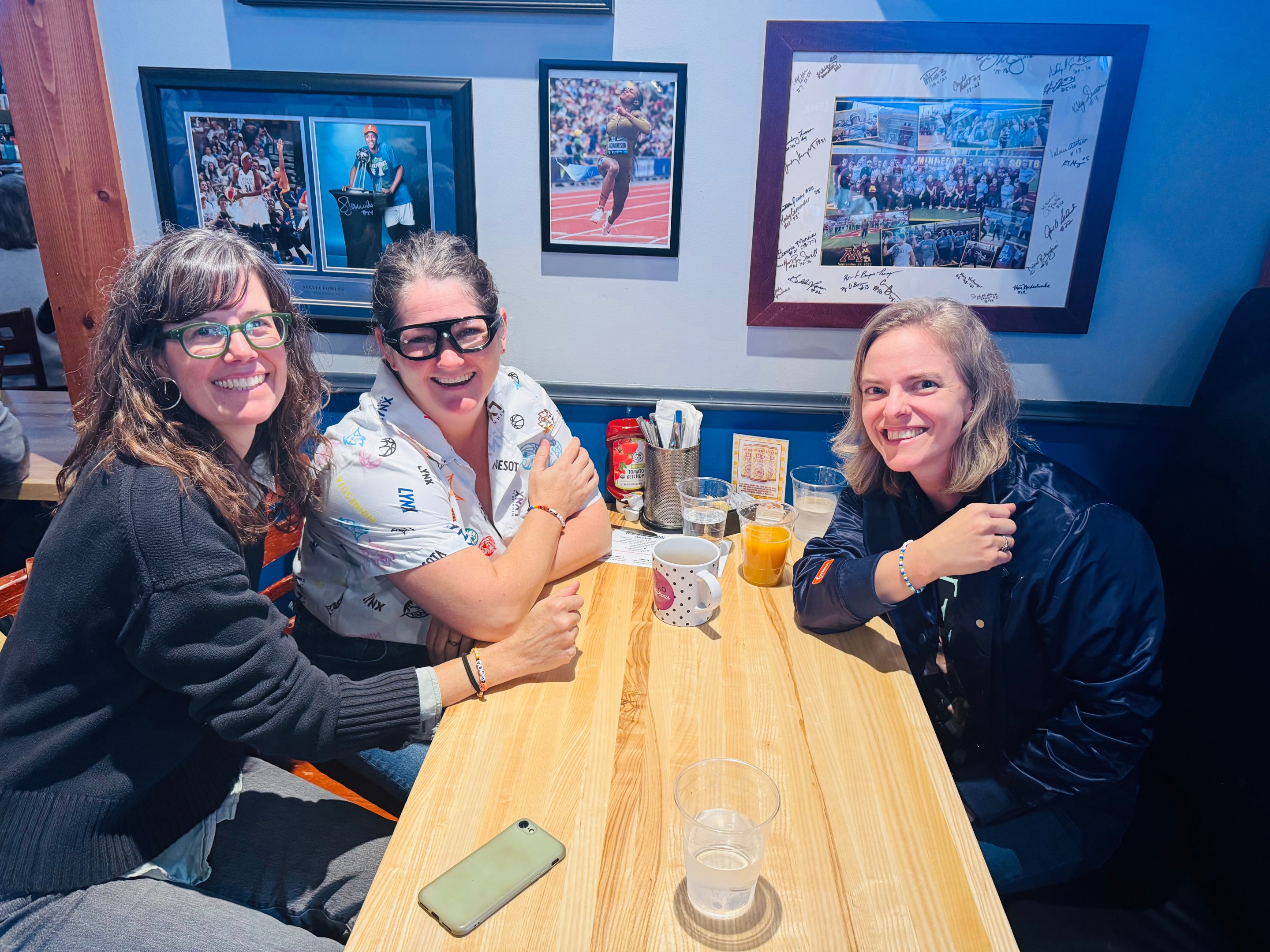
Still, as he walks out the door, I can’t help but think how much better this night would have been if I had just gotten into my car and driven to A Bar of Their Own—our Minneapolis women’s sports bar, which was recently voted the No. 1 sports bar in America.
This subpar experience made me appreciate how much ABOTO founder Jillian Hiscock and her team really have created a bar of our own. A place where we don’t have to ask the waiters to put the game on. A place where the person sitting next to me is as obsessed with the W and the Lynx as I am. A place where I don’t have to explain why Phee is a goddess. Who A’ja Wilson is. Or why Liv’s rookie season has been historic. A place where I don’t feel the need to justify how good these players are or tell someone why they should care about the WNBA. A place where I can just be a fan.
It’s a bar where everyone knows Phee’s name. And Liv’s. And Court’s. And Mac’s. And Ola’s. I could go on.
There are men at A Bar of Their Own, but it’s a women- and queer-forward establishment. To date, I’ve never had an experience of managing and calculating my conversation with a fellow patron in the way I did that night. Within ABOTO’s walls, I’ve never felt pressure to act as an unofficial ambassador for women’s sports, answering strangers’ questions politely because I want to encourage more folks to watch the game. Everyone there is already watching.
A Bar Of Their Own clears all those low bars, but it also offers so much more. It’s a space of unabashed joy and community. A space where we celebrate women athletes and the amazing things they do. A space where I can relax and watch a game in peace, putting down the armor that I built around myself when I started to play traditionally male-dominated sports over 30 years ago.
I love that when I take my daughter there, she sees pictures and memorabilia of women athletes all over the bar. That she gets to participate in an entire room of people losing their minds over the women athletes that we love and support.
A Bar of Their Own has given me the chance to feel, for the first time in my life, what it is to be a fan in an unabashed, unfiltered way. (Ya know, like how men have experienced fandom since the invention of the ball.) What a gift. What a joy.
As I walked home that night, I swore to myself that I’ll never watch a Lynx game anywhere else again.