


There’s something perversely life-affirming about being surrounded by thousands of ecstatically smiling young women softly singing “This is gonna kill me” in unison.
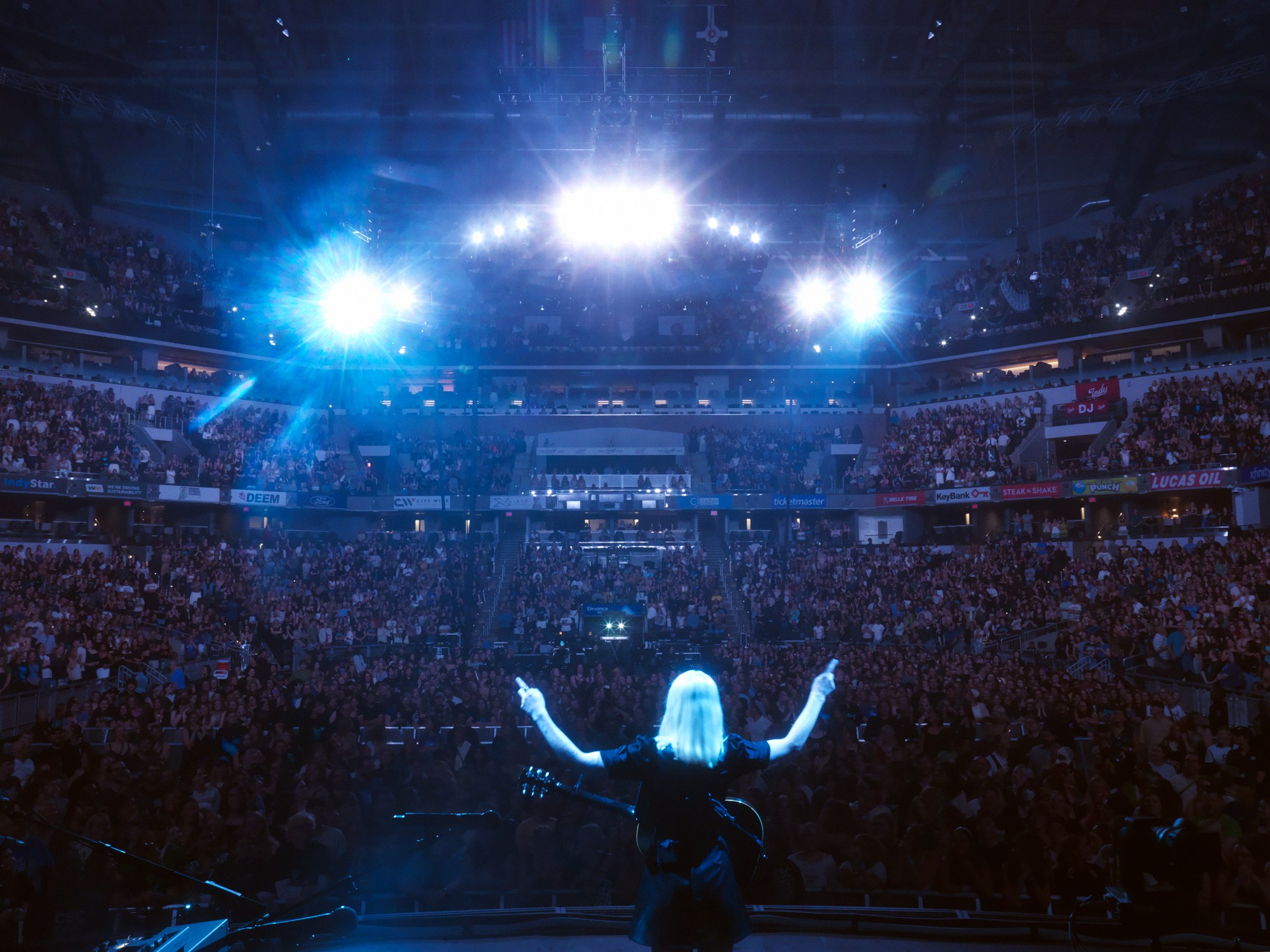
Phoebe Bridgers filled St. Paul’s Grand Casino Arena on Thursday night with these fans, some of them not yet of showgoing age when this hockey shed was still the Xcel Energy Center just two years ago, almost none of them likely to agree with what this irrelevant 56-year-old man (boo!) will have to say about the show, other than that it was a triumph.
Bridgers’ latest (and somehow only third) album, Lost Weekend, is her first since the sensitive teengirl quarantine soundtrack Punisher dropped in June 2020. I can only pretend to imagine how the music that was absolutely the most important to me when I was 16 would have sounded if I’d been stuck at home during a global pandemic. Six years of chaos has followed, and those once-homebound kids were more than ready to cut loose on a tour that began just four nights earlier in Indianapolis.
Maybe they were even younger than I thought? Late in the show, Bridgers introduced “Georgia” as a song she’d written at 15. It was an age, she said, when we have dreams of happiness that would make us miserable if they’d come to us. (“My manifestation almost killed me,” she added cryptically.) When she asked if anyone in the crowd was still 15, the response seemed a little exaggerated based on my amateur demographic appraisal, but hell, like at my advanced age I can possibly pinpoint how old anyone under 30 looks.
The night began, as Lost Weekend does, with “The Outside,” the singer’s voice electronically splintering and then reconstituting to form the lines “Crying in a suit and tie/But you should see the other guy,” a pretty gutsy (and funny) joke about a funeral. Her dad’s, that is, but if you can’t joke about your dead parents, who can you joke about? It’s not called a no-fun-eral.
While a light show misdirected our attention to the smaller B stage at the center of the arena, Bridgers and her band were concealed beneath a large futuristic dome on the main stage. That felt psychologically fitting—I can imagine her as someone who fantasizes about life in a hermetically sealed dome life on occasion. (Who among us…)
That hemisphere rose from the stage and tilted backward, creating a ring that sometimes displayed moons and planets, sometimes cast video of what was on stage, and sometimes just took on a raw Sauronic tinge. Smoke filled the stage and at first the elfin-featured singer, despite her striking black dress and platinum hair, was hard to spot among her nine-piece band, which included a string section as well as Melina Duterte, better known as indie rocker Jay Som, and Madden Klass, the drummer for Bridgers supergroup boygenius.
Bridgers was crowd-savvy enough to lead with an oldie: “Motion Sickness” from 2017’s Stranger in the Alps, a much better song about Ryan Adams being a creep than Ryan Adams deserves (or could ever write). A great opener, even though I feel like the songwriter she’s become would now toss off “I have emotional motion sickness” as a one-liner rather than lean on it for a chorus.
OK, fine, let’s get my personal tastes out there right away: With Lost Weekend, I’ve gone from respecting Phoebe Bridgers’ talent to enjoying her music. Though many of the songs were written at what she called “an impossible time in my life, when I became scared of people,” the album nonetheless brims with connection to people, to those who have kept her alive and to the memory of those who’ve left her. This is an artist’s leap of faith into the next stage of her career.
As for what inspired this, confirm your bias and take a guess. The lingering camaraderie of her collaboration with Julien Baker and Lucy Dacus as boygenius, whose raucous tour freed Bridgers of the half-chosen, half-inflicted Sultana of Sulk persona? The (sorry!) love of a good man, in the form of comic/musician Bo Burnham? Therapy? Quitting Twitter? Quitting therapy? Plain old maturity? Maybe Bridgers just sensed, as artists with an intuitive feel for the needs of their audience do, that it was time to write songs that would be effective at this larger scale, so she unmuted her anthemic impulses and took the plunge.
The new material was expertly suited to an arena setting. “Lost Boys,” which she wrote with show opener Alex G, had fans leaping higher than might have been safe on the narrow ledges of a multi-tiered arena and singing loud enough that I maybe could have joined in without getting weird looks. (Personally I kept mum out of respect for my younger neighbors, who don’t need that shit.) Like a lot of sharp lyricists, Bridgers has leaned a little too heavily on her words in the past, but fuller melodies and more varied band dynamics heighten the impact.
And though maybe no fan under the legal drinking age will agree with me, this focus has improved her writing as well. Lost Weekend has become one of those records I just delight in quoting, in part because Bridgers knows how to headfake you with an opening line and then swerve 90 degrees with its followup. “Baby, if you leave me/Can you take me with you?” “The government isn’t trying to kill you/They just don’t care if they kill you.” “You were made in the image of god/But you look like your mom.” And, let us not forget, “I was the belle of the Governor’s Ball/Hiding in the bathroom like Shelley Duvall.”
The last of those begins “The Governor’s Waltz,” which you can hear as Bridgers sourly casting Gracie Abrams as her usurper in a sadgirl All About Eve, an apology of sorts to former BF Paul Mescal for being such a drag, or just the long, weary sigh of a depressed, newly famous musician wondering how to disappear completely, as Michael Stipe and Thom Yorke learned to decades earlier.
The melody is tricked up, as many of Bridgers’ best tunes are, with what I think of as “Elliott Smith chord changes.” I’m so frustrated by my inability to nail down what I mean by this that I’m tempted to yank my guitar out of the closet and fiddle around till I know. I think it involves resolving on a minor chord when you expect a major or vice versa but don’t quote me on that. Anyway, Smith’s an influence, for better or worse, and we’ll get back to him later.
Bridgers is also a more agile singer live than her recorded voice suggests, the precise delicacy of her delivery disrupted by the need to project. On album, her voice often seeks out a narcotic placidity that this depressive recognizes, that sense of feigned calm we hope will trick ourselves into mistaking it for how we really feel. In life, as in art, it’s a way to hedge your bets.
The alto Pasadena drawl of Bridgers’ speaking voice also humanizes her. “Whatthefuckisup?” she asked early in the evening, before confessing that “It does not become normal ever.” What’s it? Being Phoebe Bridgers, I suppose.
Bridgers played 14 of Lost Weekend’s 16 songs Thursday night (sorry, fans of “Other Plans” and “Lost Parade”). But there was plenty for those who miss the old Phoebe (cry in the cold Phoebe?), including a stretch of “DVD Menu” into “Garden Song” into “Moon Song.” I say she’s better than “If I could give you the moon/I would give you the moon,” which not even her songwriting nemesis Eric Clapton (who played that very stage just two nights earlier) would stoop to. (OK, he would. Has.)
“Sick light show” is not necessarily something I’d expected to say about a Phoebe Bridgers concert, but her first set out on the satellite stage was on some real Laser Floyd at the planetarium shit. An orb resembling both a waterborne mine and an illo of the coronavirus hovered above, and it began refracting beams into shifting shapes that suggested a broken mirror, then lightning flashed against the crowds and we were caught up in a veritable lighting design storm.
If we’d had our phones handy, TikTok would be clogged with so many shitty videos that failed to capture this moment. But as you may have heard, all portable electronic devices, as the flight attendants say, were magnetically sealed in Yondr bags. We were “in the moment.” Without phones, some fans resorted to raising lighters aloft, just like their parents had done in the prehistoric days of Journey concerts.
(Oh, and speaking of rejecting modern convenience: Because I am now one of those people who has to constantly talk about how they don’t have a car, let me quickly say that I took the B line all the way from Uptown to the gates of the GCA, and back again. #WarOnCars)
After singing “Lost Weekend” to her late dad, Bridgers exhumed “Funeral,” which is not about his. Now, as patronizing as the “sadgirl Phoebe” tag is, let’s face it: “Funeral” is a fucking bummer. A well-crafted bummer, to be sure, the kind that if you hear at the right time somehow neutralizes your pain by accentuating it.
But the thing about depression is, you can’t articulate your way out of it. Depressed guy here: There are moments in your life when you need to acknowledge depression (particularly when those around you say “there’s no reason” for it), and there are moments when you need to deal with it. And at a certain point, an artist decides whether to remain the resource listeners turn to in their darkest moments—which is artistically and, I gotta imagine, personally limiting—or whether to broaden out to the full range of emotions they feel.
Bridgers influence Elliott Smith (back to him) chose the former path. (He also taught a generation to overrate George Harrison’s solo material, but that’s an argument for another night.) And while I wouldn’t be crude enough to draw life lessons from his artistic decisions, I think we’re all better for the fact that Bridgers is feeling her way forward instead.
At 23, Bridgers wrote “Jesus Christ, I'm so blue all the time/And that's just how I feel/Always have and I always will.” Now a wise 32, she sings, “I have no secrets, only feelings/And I know those go away” (on the country shuffle “Haunted”). I’m sure the former still often rings true to her. Which is why I’m glad she wrote the latter.
“Sad songs say so much,” as Elton John once sang in a song that was not sad and said almost nothing. I, a very sad man, am hardly immune to the allure of very sad songs, though I have little personal need for songs about being sad, if you can grasp the strands of the hair I’m splitting here.
But songs about dead parents and new relationships do get me misty. The latter category includes the giddy new “Bobby,” for Bridgers’ current (forever?) beau Mr. Robert Burnham, and which (knowing PB’s low opinion of John Lennon) I’ll be a dick and call Bridgers’ very own “Oh, Yoko.” (Though Ono, unlike Burnham, didn’t have a co-writing credit.) “This could be the end of wanting,” Bridgers sang weightlessly, and though of course it isn’t we all need moments that feel that way.
When Bridgers announced a surprise song and then played “Savior Complex,” the women behind me and in front of me exploded in screams and hugs of an intensity that would startle Price Is Right contestants. Basking secondhand in this communal acknowledgment of sadness, I recalled the instruction Laurie Anderson once received from her Buddhist teacher, relevant here is some way I can’t quite nail down, “to feel sad without actually being sad."
Still, after the more sprightly anhedonia of “Kyoto” (“I wanted to see the world/Then I flew over the ocean/And I changed my mind”), “I Know the End” was a bit of an epic comedown as a finale. But then there was The Scream. Bridgers prepped her ladies for it, and they did not disappoint. This was not a “woo.” This was a primal, bloodcurdling, final girl scream from the depths of innumerable alveoli, as though it had been stored for a lifetime, waiting for release.
For an encore, Bridgers returned to the B stage, now wearing a lighter colored dress, as though emerging from some Gandalfian rebirth, and bid one last farewell to her pop with a reprise of “Lost Weekend.” Then it was back again to old times with “Scott Street.” As the crowd waved their arms in unison, the concert began to resemble a worship service. I had scattered thoughts of how modern arena rock and Christian contemporary music overlap in style and effect, and the view was both endearing and unsettling.
The band played Bridgers off to Lost Weekend’s final track, “Never Going Back!” (the way it used to be is not the way it is”—hell yeah, Phoebs) and we dashed off into the arms of those harried staffers outside the arena tasked with unlocking our Yondr pouches. If a whole night without our phones hadn’t killed us, nothing could.
Setlist
The Outside
Motion Sickness
Kill Me
The Governor's Waltz
Lost Boys
DVD Menu
Garden Song
Moon Song
Liberty Tree
Panorama
Lost Weekend
Funeral
Graceland Too
Haunted
Still Standing
As Above
Bobby
Sidelines
Georgia
I Can't Wait
Savior Complex
Kyoto
I Know the End
Encore
Lost Weekend (Reprise)
Scott Street
Never Going Back!