


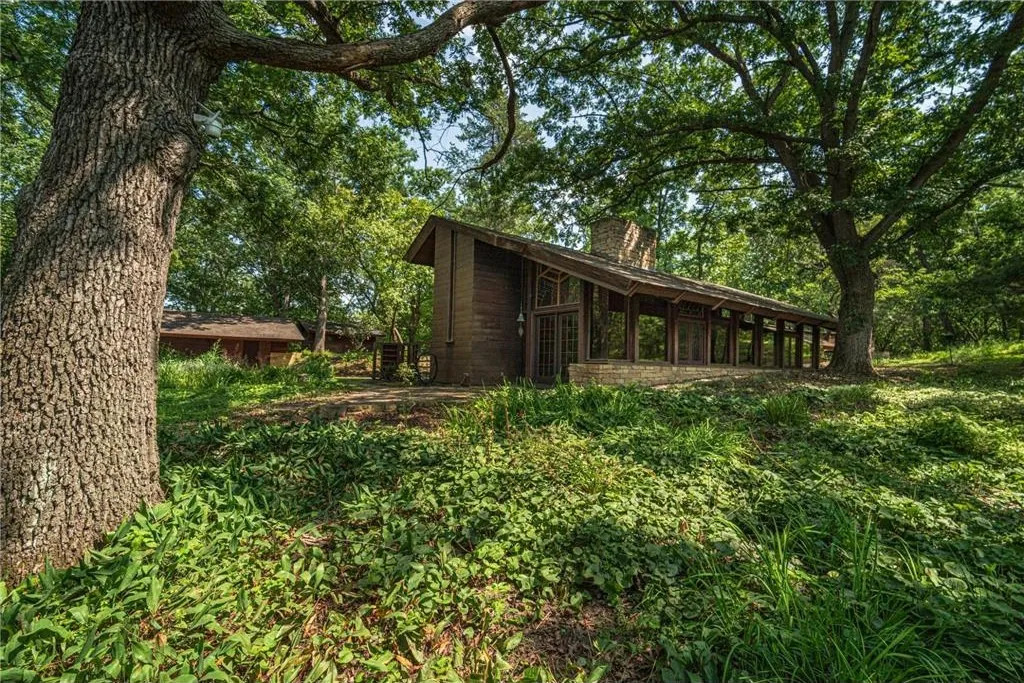
If you're determined to stay in the Twin Cities, yet you demand total wooded isolation, historically significant architecture, and the freedom to clop around 11+ acres on horseback... your options are limited.
Limited, perhaps, to just 9350 Blaylock Cir., a Prior Lake property that sits inside the boundaries of Murphy Hanrehan Park. Completed in 1968, the 3-bedroom, 2.5-bathroom, 2,866-square-foot stunner was designed and built by John Howe, right-hand man to architecture titan Frank Lloyd Wright for almost three decades. It hit the market Monday for $830,000 via Chad and Sara Huebener of Edina Realty.
"These are so rare, and this house is so unique; it's like literally going back in time," says Sara Huebener, who actually sold a Burnsville Howe house in 2018. "This will be a niche buyer. I think it's going to somebody who loves untouched nature, likes to be left alone, but still doesn't want to be completely off the grid—this home is literally 10 minutes from Cub and Target."
Among the breathtaking features: a floor-to-ceiling statement fireplace made from 16 tons (!) of limestone; original built-in furnishings, including the primary bedroom bed; leaded stained glass windows; and a sanctum off the primary bedroom that spills onto a second-level deck. The grounds were originally laid out with horses in mind, and Huebener notes that a future buyer could trot down the driveway to meet Murphy Hanrehan Park's 13 miles of riding trails. "It's smack-dab in the middle of the park," Huebener says with a chuckle.
The place was sold last fall for $825,000 by the family that had lived there since '68—$25K over the original listing price. The next owner, just its third, will inherit a piece of history.
Born in Evanstan, Illinois, Howe linked up with FLW fresh outta high school in 1932. He studied under the Usonian-style visionary, quickly worked his way up to master draftsman, and they remained teamed together for 27 years until Wright's death in 1959. (Howe's career took a detour when he served three years in a Sandstone, Minnesota, prison for being a conscientious objector during World War II.) In 1967 Howe relocated his own firm to Minneapolis, and over the years he'd build 120+ homes across the Upper Midwest. Howe, who died in 1997, flew "under the radar" compared to peers like Ralph Rapson, Edina historian Jane King Hession told the Star Tribune in 2015.
"He carried on Wright's tradition, but he also had architectural principles of his own," Hession said to the Strib while promoting her 2015 book, John H. Howe: From Taliesin Apprentice to Master of Organic Design. "His architecture became very Minnesotan. It was designed for the specificity of this landscape and this climate, and some of the harsh realities of it."
Howe refused to alter the natural state of his build sites; he wouldn't begin drafting plans until he walked and mapped the surroundings. "A lot of Howe homes feel as if they've grown out of the landscape," Hession noted.
Let's take a photo tour of Howe's Prior Lake masterpiece, courtesy of Edina Realty and Denise Houk Photography.