


This story was originally published in Heavy Table’s Substack newsletter for April, 17, 2026 and was made possible by its paying subscribers.
Sushi in Minnesota is usually about as good as you’d expect it to be, with a few rare exceptions.
There’s a massive gap between the James Beard Award-nominated Kado No Mise and most of the rest of the Twin Cities sushi scene. There are a handful of other restaurants with very good sushi, but most places seem to be focused on sauce-covered rolls with quirky names. The popular Billy Sushi has good fish, but can feel like a club more focused on attracting influencers and finance bros in puffy vests than the quality of the sushi.
However, there’s a local chef quietly making some of the best sushi in the country right here in Minneapolis. He just needs to find a place to serve it.
Learning to Make Sushi (and Speak English)
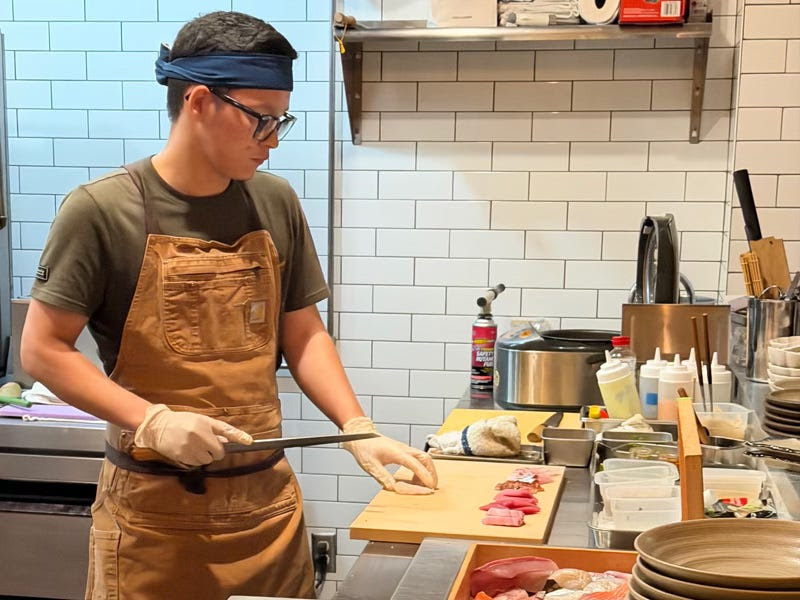
Baasandorj Tegshbileg, who goes by the nickname “Baaska,” moved to Minnesota from Mongolia in 2014. He got a job as a dishwasher at Sushi Fix before working his way up through the kitchen ranks, slowly learning English along the way. “I only knew, ‘Hi, how are you?’ I could say my name and age, very basic stuff. The guys in the kitchen started teaching me English,” Baaska says.
After a few months, he graduated to a kitchen prep role that he called a “sushi helper,” pre-cutting vegetables and other secondary ingredients for the sushi chefs to use. It took a year and a half before he was trusted to cut fish, but eventually he found his way behind the sushi counter and started to excel there.
Benchmarking himself against the other sushi chefs, Baaska would quietly compete with them on speed and quality. “I love being creative,” Baaska explains, “and I started doing omakase on my own, too, just with customers who were at the counter.” Omakase loosely translates in Japanese to "I’ll leave it up to you," and is essentially entrusting the sushi chef to make up a multi-course meal for you based on what they think would be good that day.
Usually an omakase dinner will consist of about a dozen or so small plates—most of which are single pieces of sushi—so Baaska could experiment with a small percentage of the dishes without much risk. “Looking back, it was such a fun time learning,” he recalls.
Eventually Sushi Fix was sold, and Baaska started a sushi food truck called Bibuta with its former owner. The food truck was less fun than the sushi bar, and Baaska left after a disagreement with his partner, who sold the truck soon afterward. (Baaska won’t comment on the details other than to say he didn’t really understand contracts very well at the time and felt taken advantage of.) He enrolled at St. Cloud State University, where he met his now fiancée and took some business classes.
His fiancée (still his girlfriend at the time) graduated in the summer of 2020 and they moved back to Minneapolis. Baaska needed work, which was tough to find in the restaurant industry during the height of the pandemic, so he put aside his differences with his former food truck partner and started work as a sushi chef at the newly opened Billy Sushi in Minneapolis's North Loop neighborhood.
“I thought, 'let’s try it again,'” Baaska explains. “I asked for work and he said, ‘Yeah, come work with me.’ At that time he definitely needed people because he was short on sushi chefs.” Within six months Baaska was managing the kitchen operations as the chef de cuisine. Baaska stayed on as chef de cuisine until the summer of 2022, but eventually he and the owner had another falling out and Baaska started out on his own.
Secret Omakase, Homakase, and Pop-Ups
Shortly after leaving Billy Sushi, Baaska started doing private catering. Cobble Social House would host “secret omakase” dinners prepared by Baaska as well as other small events. That’s where up-and-coming French-trained chef Brooke Faudree was first exposed to Baaska. She was impressed with what he was doing: “I just told him, ‘hey would you want to do a French-Japanese pop-up?’ and we ended up doing two dinners together,” she says. Both events sold out.
“I’ve done collaborations with other chefs where it’s like ‘you stay in your corner and I’ll stay in mine,’ but Baaska was very open to collaboration,” Faudree says, noting that for Baaska, “it’s definitely about the food, and I appreciate that.” The pair put out multiple 10-course dinners, alternating between Japanese and French dishes, including one fusion dish they invented together: magret de canard sushi roll with demi glace. “He was just really collaborative and open and just wanted to learn,” Faudree says. “It was really fun.”
Around that time, Baaska bumped into a former sushi bar regular, Aaron Spiteri, walking on the street in Minneapolis. The Australian native is a former professional jockey who’s raced horses in places like Singapore, Macau, India, and all over the globe, developing a taste for sushi along the way.
Spiteri thinks highly of Kado No Mise in Minneapolis, but has found Minnesota to be mostly lacking in terms of sushi quality—so much so that he and his wife once flew to New York just to have omakase at Sushi Noz on the Upper East Side, where he says they sat next to Samuel L. Jackson. Spiteri ranks Baaska up there with the best sushi he’s had.
“His creativity really got me,” Spiteri says. “There’d be some times, many times, where we’d sit down and we just wouldn’t order at all. His creativity was the real standout, and I just knew there was something special about him.”
Spiteri asked Baaska to cater a birthday party for him, but he also wanted to help promote Baaska’s new business to his friends and social media followers. “I said, ‘I’ll post the shit out of it,’” Spiteri exclaims. “I’ll invite some friends that have some influence, let’s see if we can get it up and running.”
“That was basically the start. It was the first big push for the business,” according to Baaska. Once friends and followers of Spiteri shared photos of Baaska’s sushi, he couldn’t keep up with the demand.
“Originally I planned on doing only four dinners a month, just enough to pay my bills, but it filled up really fast," he says. "Then I was doing four dinners a week, and within six months I was booked out six months in advance.”
Sushi By Baaska
Once Baaska was in control of ordering his own fish, he fixated on quality. He cycled through multiple vendors before landing on a small company out of Japan for most of his fish (he did not share the name of the company). Hotate (scallops), uni (sea urchin), and whitefish like hamachi (amberjack) all come directly from Tokyo to MSP (or occasionally through Chicago).
Baaska orders fresh bluefin tuna directly from Mexico and Spain, but usually isn’t able to serve enough sushi with his small team to buy a whole fish (except for when his Bar Brava residency was in full swing—more on that in a moment). He sources only North Atlantic salmon, mostly from Norway and Scotland.

What had started as a way to make ends meet was quickly becoming a real business, and Sushi by Baaska, LLC was formed in 2023. He started offering “homakase,” or omakase meant to be enjoyed at home. Minneapolis-based developer Sean Sweeney found out about Baaska through word of mouth after his wife’s cousin told them about his secret omakase pop-up.
“He would do takeout boxes and they were always great,” Sweeney says. “We decided to do Homakase for my birthday, and we had to have at least 10 people. We had it at my house and he came over like an hour or two before we started and prepared everything.”
Baaska’s sushi impressed the group. “It was unbelievable. The food was so good, the fish was so fresh, he was so pleasant and kind. It was great, such an amazing experience," Sweeney says. “All my friends who were there were like: ‘Oh my god, what is this?’”
Baaska’s homakase was so good the Sweeney family replaced their Thanksgiving turkey with his sushi platters the last few years.
Baaska started doing bigger parties, sometimes with over 50 people, but at the time he was still doing everything by himself. “I was doing 16-person parties with 10 courses all by myself: running food, cleaning, everything. I was very ambitious," he says. "A 10-course meal for 16 people is at least 160 dishes, plus small bites and extras.”
Running around town by himself with coolers full of fish was unsustainable. The business model shifted from a catering focus to more restaurant pop-ups and Baaska started to hire staff. Eventually he and his team launched their first official pop-up in 2024 at Picnic in Minneapolis's Linden Hills neighborhood. His sushi was becoming slightly more accessible, but it still wasn’t that easy to find. The only way to really know about the pop-up was to follow Sushi by Baaska on social media, and even then you had to be quick because reservations would fill up quickly.
Picnic is a small space with a handful of tables centered around a bar, but that bar isn’t set up for sushi, so Baaska and his team ended up making sushi in the back next to their hot dog roller. Hey, it was better than lugging coolers from house to house.
By this point a loyal following started to chase Sushi by Baaska pop-ups all over the city. “We told all our friends about him and started following him around the city,” Sweeney says. “One of the best dining experiences in the Twin Cities, not just sushi, everything. If he had a standalone restaurant it would be consistently viewed as top 10 in Minnesota.”
A restaurant takeover event at Vinai in northeast Minneapolis led to Baaska’s team being overwhelmed. It was great to have so many customers, but it was too much to handle that quickly.
“Vinai was like, 120 seats,” Baaska says. “We were able to fill Vinai, and that gave me confidence that we could run a restaurant with 70 seats or more.”
Finding a Longterm Spot, Then Losing it Because the Owner Supported ICE
Most of the pop-ups were short stints: a few days here and there, often on days of the week when the host restaurant was normally closed, but they were always busy. Baaska negotiated a longterm residency at Bar Brava in Minneapolis that started in November of last year and was supposed to provide some stability as Sushi by Baaska continued to grow.
“Literally one week into our residency at Bar Brava, my sous chef sent me a screenshot from Instagram," Baaska says. "It was something the owner had posted.”
Bar Brava owner Dan Rice had posted a screenshot of President Trump talking about sending federal immigration agents to Minnesota, adding the caption, “Today is the beginning of the end for Somali gang violence.” Baaska reached out to Rice and asked him to apologize and take the post down, but Rice left it up for weeks without apology. At the time, ICE activity in Minneapolis was rapidly increasing. Baaska’s staff was constantly receiving notifications of ICE agents abducting people near the restaurant. They were already on edge and started utilizing a buddy system to take out the trash or even walk to their cars after work.
In January, they were forced to close the restaurant for a week due to ICE activity, making both their staff and customers afraid to leave the house. The social media post was still up.

Baaska reached out to Rice again. “While we were closed, I kept asking him if he was going to apologize or do something about it," Baaska says. "Instead he kept going online and arguing with everybody on Reddit, Instagram, Facebook, everything.” Rice didn’t apologize and instead doubled down on his comments, justifying them to Baaska privately via text. “He sent me a bunch of nonsense on text too, and I said, all right, I’m done. We’re leaving," Baaska says.
When asked for comment, Dan Rice of Bar Brava said, “It was unfortunate how it ended and we wish Baaska the best,” and referred to the Star Tribune article on what took place.
The residency had been so successful that Rice had been pushing Sushi by Baaska to extend their six month stay to a full year. Instead, Baaska packed things up and left about two months into the residency. “I had put something like $25,000 of my own money into moving into the residency. I had basically zero money left,” Baaska says. “It sucked, but it also gave me a lot of confidence about opening my own restaurant. If we were able to stay that busy in that location through a residency, then it showed me people would support us.”
Finding a Permanent Restaurant Space
Now without a home, Baaska and his seven employees (three full time, four part time) were once again not sure where they’d be working from week to week. Despite a growing following of loyal customers, outside forces put them right back where they started; they were again lugging coolers of fish around the Twin Cities. They were able to find space at some of their old pop-up locations, and both Vinai and Picnic have been hosting Sushi by Baaska pop-ups since they abandoned their Bar Brava residency a few months ago.
There was a silver lining to the chaos, though: proof of concept.
If they could fill someone else’s restaurant night after night during Operation Metro Surge, they were probably ready for their own location. The problem now was capital. Even though there are a number of empty restaurant spaces around the Twin Cities metro, most landlords don’t care that people like your food. They want to see historical financials and cash reserves that guarantee the lease.
Baaska is in negotiations to take over a vacant Minneapolis restaurant space and hopes to have an agreement soon. He’ll likely need to raise a six-figure sum to get approved for the lease—not the kind of cash he has on hand. He plans to fundraise for some of the money needed to launch his own restaurant, but doesn’t want to take on investors because being beholden to someone else means he’s right back where he’s always been. “It’s kind of embarrassing to try to raise money," he says, "but really I’m just trying to start the restaurant with a minimal amount of investment.”

Baaska’s subtle elevations are perhaps what’s had the most impact on his growing popularity. Where Kado No Mise tends to be more conservative and traditional with their sushi, Baaska isn’t afraid to be “chaotic” at times if it doesn’t take away from the flavor. “My style of sushi is that when you have really good fish, there’s not much you should do to it, because you don’t want to bury the flavor of the fish,” Baaska says. “So the touches I add are very subtle. I like to keep the fish the way it is, but just add enough of a twist. Not overdo it.”
It’s easy to overdo it with yuzu, but Baaska adds just enough to compliment the fish without the citrus becoming overpowering. Lots of sushi chefs will throw on a dollop of caviar, but Baaska adds just enough so that it’s not falling off the nigiri but still feels abundant. An amount of shiso leaf and truffle so delicate that you only taste it when you exhale after you swallow. A reckless indifference to what most people would consider a reasonable amount of uni. Even with a high-quality piece of fish Baaska thinks about the details: “maybe there’s a chance to add spice, or sweetness, or texture. Texture is really important to me.”
Those finishing touches are what separate Baaska from everyone else making sushi in Minnesota right now. Baaska’s attention to detail takes something very simple and turns it into something great. “If you know your nigiri, you know it’s all about the rice game,” says Aaron Spiteri, who puts Baaska’s sushi on par with the best he’s had around the globe. “Just how he plays around with the rice, using different levels of acidity, and vinegar, it’s very unique.”
“He’s a gem, he’s an absolute gem. Minnesota’s lucky to have him,” adds Sean Sweeney, who has become an evangelist for Sushi by Baaska.
“I hope we can support him so he’s able to stick around,” Sweeney continues, even though he knows more people finding out about Baaska could make it harder to get a dinner reservation in the future. “I’d be lying if I said there wasn’t a selfish reason for me to help him: I want to keep eating his sushi.”
As Baaska continues to search for a space that’s both big enough to hold his growing fan club but still small enough for him to afford, there’s no guarantee that his popularity will translate to long-term success. The only thing that’s really certain is nobody is making sushi like Baaska in Minnesota right now.