

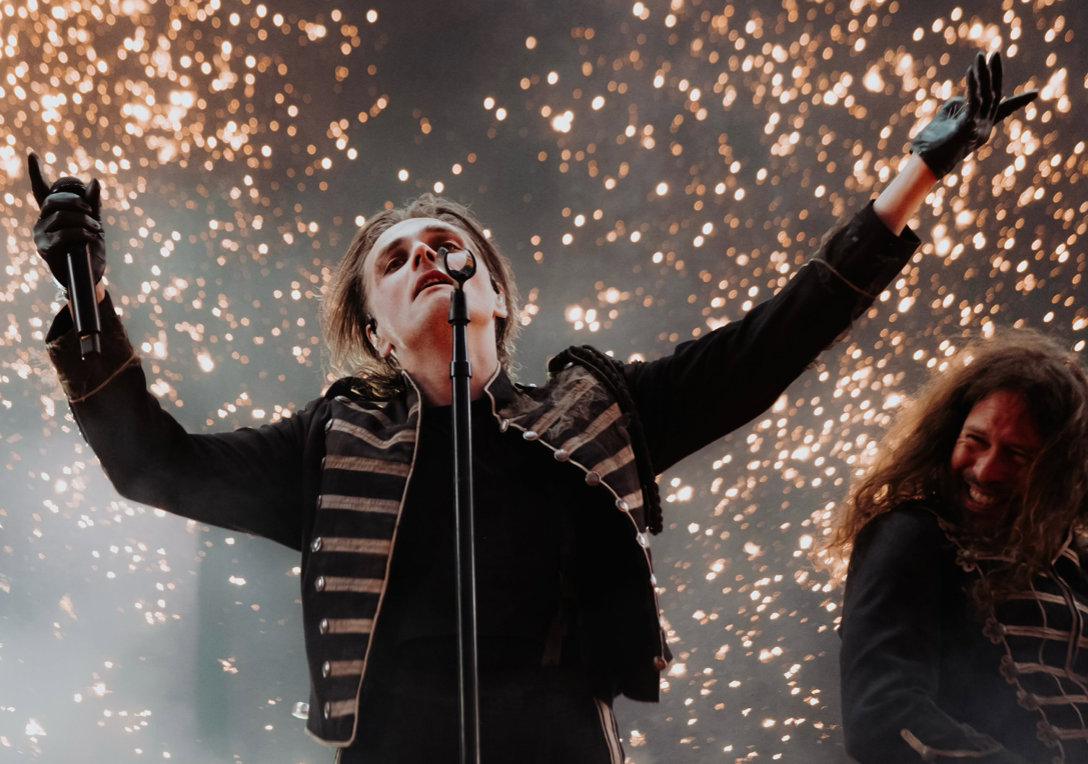
Fake blood is on display everywhere at a My Chemical Romance show, from fans’ sanguine adornments to arterial-spewing executions onstage. But what flowed the freest Monday night at Target Field in Minneapolis was sincerity.
As time marches forward, the creep of legacy casts a shadow over any artist. I’m of two minds about the inescapable glut of anniversary tours: The cynic in me sees a shortcut for easy profit, but the open-minded enthusiast does her damnedest to reacquaint herself with the old material, to use the passage of time to recontextualize why specific records still resonate with listeners.
There are few aughts records, particularly at the arena level, that seem more apt for this reassessment than MCR's 2006 LP The Black Parade. Though their lyrics and style would often be taken to heart by those mall goths with a penchant for LiveJournal lyric-posting and charcoal-flair eyeliner, MCR never seemed to chase trends. Their first albums (2002's I Brought You My Bullets, You Brought Me Your Love, and 2004's Three Cheers for Sweet Revenge) leaned on the hard and heavy riffs and choruses of post-hardcore; they turned to concept-oriented glam rock on The Black Parade and Danger Days: The True Lives of the Fabulous Killjoys. It just happened to be that the group’s avenues for expression landed adjacent to their peers, and got co-opted by shallow imitators.
At least that’s the story I tell myself as I try to understand why it took me so long to really appreciate My Chemical Romance. I am… *GASP*… a latecomer to the band’s virtues, despite growing up during their rise to ubiquity. Though I rocked “Welcome to the Black Parade” on my iPod in 2006, I scoffed at MCR, considered them beneath me, and never gave them the proper time of day in my preteen years. For, what exactly, in exchange? Avenged Sevenfold? None of our tastes were ever perfect, but... yeesh.
Only in my 20s did the entirety of The Black Parade pierce me, once I'd learned to love the extravagance of glam and rock operas. In the years since, that appreciation has held strong; if pressed now, in my 30s, I’d likely say that Three Cheers is my current favorite entry in the MCR catalog, for its adoption of the most furious energy of its post-hardcore forebears and ruthless knack for melody.
But there’s another side to this answer: MCR have always struck me as an intensely earnest band. Their music has never shied away from large emotions, and even their most tongue-in-cheek moments—the fake-out bridge of “I’m Not Okay (I Promise),” the anti-commercial kiss-off of “Vampire Money”—come from a place of deep conviction. The band’s healthy persistence proves an axiom a colleague told me recently: “Nothing ages as well as sincerity.”
With Long Live the Black Parade, the tour celebrating The Black Parade's 20th anniversary, the band takes a more theatrical approach than on its fairly straightforward 2022 reunion tour. The first act runs straight through the entire record, but as though performed in the midst of the authoritarian government of Draag (haha) by “the 52nd Regiment of the Black Parade.”
That outfit includes the core MCR members—vocalist Gerard Way, guitarists Ray Toro and Frank Iero, bassist Mikey Way—alongside drummer Jarrod Alexander, percussionist Tucker Rule, keyboardist Jamie Muhoberac, violinist Kayleigh Goldsworthy, and cellist Clarice Jensen. Various auxiliary figures to the narrative come and go between songs: a clerk (Charlie Saxton) delivering messages to Gerard Way, a blind opera singer (Lucy Joy Altus), and a laconic dictator whose hobbies include draping a leg over an oversized armchair backstage and crushing cans of Coors.
In shifting their attire and personas between records, MCR has always demonstrated a Bowie-ish yen for flamboyant projection. But Long Live the Black Parade centers the group’s perennial fixation on rock-opera scale; between the antifascist satire and the reprisal of “The End” to bookend the set, the obvious touchpoint is Roger Waters’s various stagings of The Wall.
This is the easiest way to justify a tour centered around this record: Turn the whole thing into a pseudo-musical, set familiar songs in a new storyline, go hard on the scale, fake execute some cast members, and set others on fire for good measure. All the classic beats. In turn, you get to root the whole thing in a grand tradition of big rock shows from elder statesmen, placing MCR closer to their legacy prog-fathers than the 2000s alt-rock nostalgia circuit.
That helps explain why the music of The Black Parade continues to have such a chokehold—its gestures sound far less dated when anchored by moves like Ray Toro’s flurrying guitar solo on “Dead!” or the Queen-ish sweep at the climax of “Welcome to the Black Parade.” While it’s easy to dismiss MCR and their fans purely for their black-and-blood-red aesthetics, their compositions and melodies feel practically tailored for this large-scale live setting. The further out we get from the epicenter of the scene My Chemical Romance once belonged to, the easier we can hear the classic rock components that contemporary reviews often overlooked.
The band still sounds in top form, even in their mid-to-late 40s and after a decade-long hiatus. Toro, Iero, and M. Way carry themselves with a contagious sense of exhilaration, especially in their interplay with one another, while G. Way prowls the stage with ferocious energy, even traipsing in the wings beneath towering LCD screens. His voice, even when deliberately avoiding the utmost high notes of the band’s initial tenure, remains formidable and expressive, with remarkable confidence in both his playful flourishes and harsher screams.
It was in the staging that things got a little less rock solid. In changing the conceit of The Black Parade from a Dantesque journey through the afterlife to an outright authoritarian satire, you could expect a few bumps. Some of the less pronounced details fared the best—shift your gaze slightly up from the stage and you’re met with giant screens of the dictator’s watchful gaze at all times. But the more pointed attempts to redesign the show for “the current moment”—the use of overtly Soviet-era lettering, a cut to said dictator on the lyric “your misery and hate will kill us all”—could feel thin and jumbled.
And unless you’d read up on a tremendous amount of lore, revealed across several shows, this particular performance could feel like a collection of brief vignettes and interstitial set dressings, more pageantry than polemic. Fun as an ending that involves all four core band members getting their throats slit before the killer blows himself up can be, that finale only illustrated how under-explored the concert's conceits had been so far.
But my waning interest in the proceedings of the nation of Draag (again, haha) led me to fix my attention toward something far more potent. To come back to the subject of sincerity: The Black Parade is easily the most earnest of MCR’s records, a deeply capital-F Felt album about frayed interpersonal ties and familial baggage, about confronting mortality and persisting with this sometimes shitty trial we call life regardless.
The band’s move toward a more theatrical sound on the album works in part because their subject matter shifts to match: You’ve grown out of the angstiest stages of young adulthood and now you’re trying to make sense of what you’re up against for the rest of your life. Maybe this is why it’s still an album I hold in fairly high regard among its contemporaries—it’s as clearheaded and open-hearted and ardent as anything that decade produced, not just in its own genre.
The moments that struck deepest would have been just as poignant even with all the conceptualism torn away—the extended pseudo-post-rock build to the intro to “Sleep,” 20 minutes of Jensen's evocative cello between sets, the anthemic final beat to “Famous Last Words” offering all in the crowd to scream that they were not afraid to keep on living, Gerard Way’s assurance at the top that, “If you look in the mirror and don’t like what you see/You can find out firsthand what it’s like to be me.”
That latter couplet landed with more feeling than ever before, considering MCR’s fervent queer fanbase was on full display at Target Field. More touching than the large swaths of queer and trans listeners was seeing how intergenerational the whole night was. My walks through the crowd took me past trans and nonbinary kids, middle-aged queers and trans folks reliving their youths, and sometimes entire queer families dressed to the scene equivalent of the nines. I spotted all kinds of genderfucked riffs on various Gerard looks over the years, people in full fursuits in 80 degree heat, and someone dancing on the floor with a trans flag that read “MCR SAVES TRANS LIVES” draped across their back.
Much as anyone could assume that this was a band of a specific moment, here was living, breathing proof that their ripples carry on, and it was present among the tens of thousands there that night. It is hard to kill a piece of sincerity—proclaimed with enough passion, it can travel forward in time indefinitely, reaching so many not even present for its initial utterance.
Over at the B-stage, during the show’s second set, MCR shed their soldier jackets and ashen face paint. Packed around the small platform, now transparently themselves, their emotions in every action, every word, emphatically their own, they ripped through a set primarily from Three Cheers and Danger Days, with Gerard Way darting to each side of the stage, never letting any angle feel too neglected, his presence as inexhaustible as ever.
The final refrain of the night was as bittersweet as it was affirming: “We are the kids of yesterday.” My Chemical Romance knows sincerity only lives as long as it can be passed along. In that moment, it was our turn to carry it on.
Setlist
Set 1
The End.
Dead!
How I Disappear
The Sharpest Lives
Welcome to the Black Parade
I Don’t Love You
House of Wolves
Cancer
Mama
Sleep
Teenagers
Disenchanted
Famous Last Words
The End. (Reprise)
Blood
Set 2
From A to B
Vampire Money
It's Not a Fashion Statement, It's a Fucking Deathwish
I’m Not Okay (I Promise)
The World is Ugly
Helena
Planetary (GO!)
Cemetery Drive
To The End”
Na Na Na (Na Na Na Na Na Na Na Na Na)
The Kids From Yesterday