

As the enshittified internet of 2026 careens along as an increasingly unusable, grotesque mutation of AI graphics, spammy popups, gambling, and pornography, you can never be certain about the realness of anything.
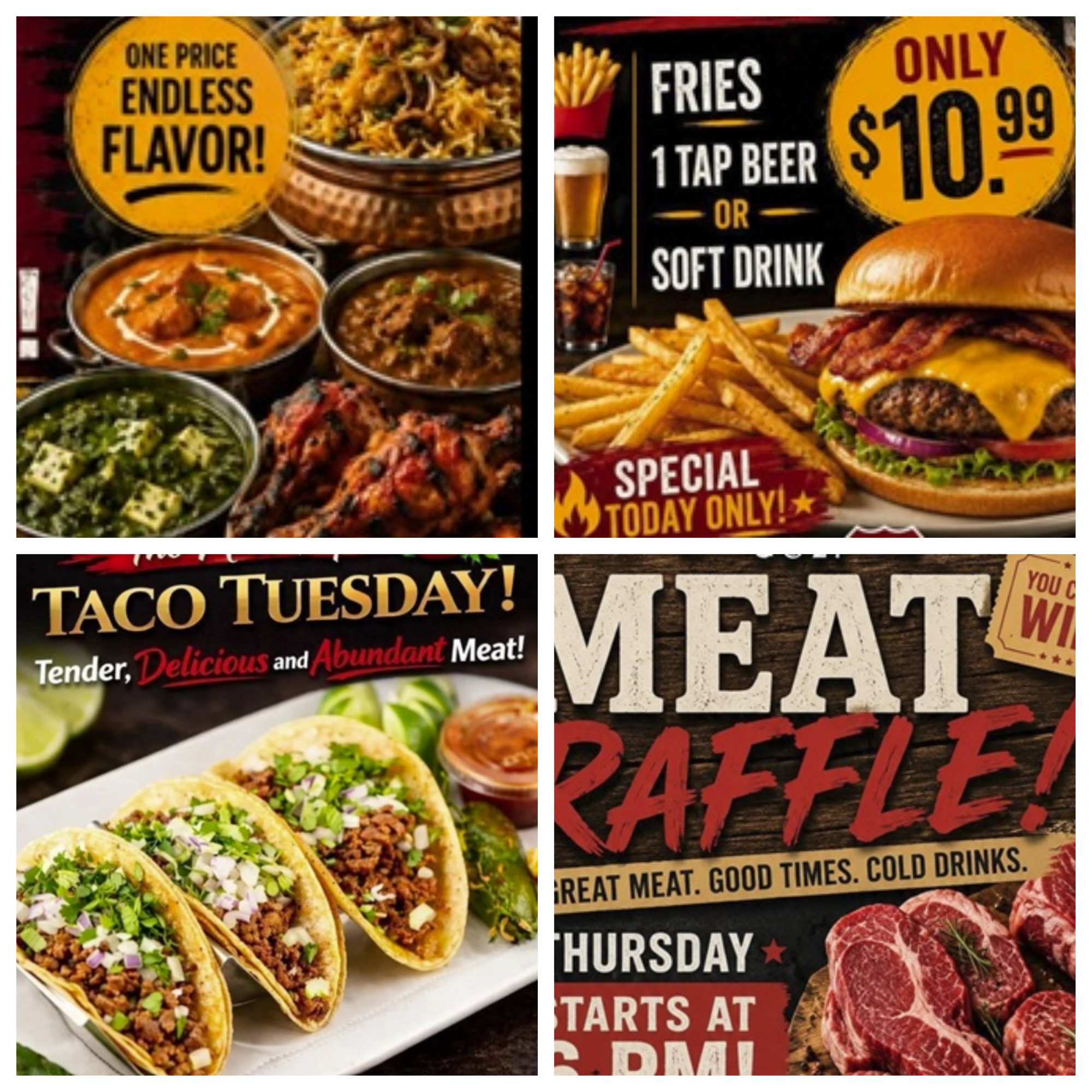
At the same time, ubiquitous AI slop presents uncanny indicators of its phoniness—em dashes, trashy fonts, finger discrepancies, bullet-point emojis, digitized sheens. And, if you're anything like me, most of your Facebook activity these days revolves around Marketplace and local food groups, the latter of which have become dumping grounds for AI-authored fliers advertising LLM-regurgitated images of menu items.
The draw for mom 'n' pop restaurants is obvious: They're subjected to a constant AI marketing blitz that promises instant, free, and professional-looking graphic design specified to their limited-time offerings, sales, and/or events.
Should time- and cash-strapped restaurateurs spend days pondering Pope Leo's recent 42,000-word encyclical on human dignity in the age of AI before prompting the bots to hawk taco specials? Probably not! But as anti-AI sentiment grows, and the regulatory landscape around the tech begins to take shape, we wondered whether it's even legal to promote photorealistic foodstuffs that don't exist in carbon-based form. Moreover, are sloptastic renderings of glitchy cheeseburgers repellent to the very customers they're supposed to attract?
For expert insight into all of that, we connected with Timothy D. Sitzmann of Minneapolis-based Winthrop & Weinstine, a lawyer who specializes in trademark and brand protection. The convo that follows has been edited for length and clarity, which sounds like the kind of disclaimer an attorney would advise.
Racket: As we head through the AI frontier, how should we think about how it's used to market, in this case, food? I'm sure it stretches into every other realm of culture and society.
Timothy D. Sitzmann: That's true, and like most things AI right now, there aren't clear guidelines. But nothing is ever truly new, so there are a whole bunch of other similar situations that came before it. Your main concern was false or deceptive advertising, right? Where you see something and are like, "Oh great, I can't wait to go eat that," but it's AI-created?
Yeah, where are we in that capacity?
I haven't seen anything specific to AI, but there's a whole line of cases all about food styling—you know, all of the professional photo shoots for McDonald's and other restaurants. We've done a lot of work for food companies in the past, and I got to go to one of our client's photo shoots for pre-packaged frozen food entrées. They're all really careful, and put a lot of time into it, but there are rules and guidelines that have come up over the years through lawsuits and regulations around false-advertising claims.
For McDonald's, Wendy's, and all these fast-food companies, the general rule is that you can only use actual ingredients that could have been on there; you can't make the perfect burger using the most beautiful farmer's market lettuce. They'll go to a McDonald's or the warehouse and pick out actual lettuce, burgers, and buns that would've gone to a McDonald's. The difference is they pick the very best of everything they can find. There are other tricks, like undercooking the burger so it looks bigger. They'll sometimes not cook the veggies as much, because they tend to look gross afterward.
So there are rules about it, but there are also a bunch of catch-all defenses that courts have applied, too. When you pursue a legal claim, either a judge decides the facts of the law or the judge will decide the law and then put the facts to the jury. So either the jury or the judge will be looking at this, and the test isn't, you know, "Were you the plaintiff confused of deceived?" It's: a reasonable customer under these circumstances—is it likely they would have been deceived? It's not just, "I was confused because I'm a dummy and I didn't realize burgers don't actually light on fire."
That's so interesting applied to AI, because for centuries cartoon hamburgers have been used to sell a burger or whatever. But what you're telling me is that a reasonable person would make the distinction that you're dealing with a cartoon you can't eat. But with the AI-rendered stuff, you can't really tell.
Yeah, that's right. And it's really fact- and context-specific. Courts have sometimes issued rulings where they'll say, "Well, no reasonable consumer would expect that a fast-food restaurant that is quickly and hurriedly working for budget purposes, that they'd be able to make the perfect-looking burger every single time." Every reasonable consumer understands that it's essentially a line, hook, quick-service—it won't be perfect every time.
There's sort of this weird situation where if everybody is using AI, and everybody realizes that it's obviously AI, it's hard to say that you were confused. I would tell my clients it's probably not worth the risk… because even if you win, at a minimum you probably spend $10,000 to deal with the initial response. If you were to compare that to: "Hey, let me just make one really good burger one day, and take a photo of that." If you're going to do it, at least put an AI-generated disclaimer, but those restaurants also don't want to do that because there are 10% of customers that want to support actual photographers and artists or have environmental concerns. There's that push and pull of how honest you want to be and how risk-averse are you with respect to legal claims.
Another legal issue that sometimes comes into play is: You also have to have an injury, and most of the time that's just the financial harm. So, OK, how many people are actually going to sue Restaurant X because they paid $20 for a burger that doesn't look like the perfect photograph? It'd be one thing if, instead of triple-pounder burger, you got a half-gram, crappy, undercooked turkey burger.
It's hard to say that you were actually deceived and that you actually suffered an injury.
So the annoyance that inspired this article—me encountering mom 'n' pop restaurants using this tech—makes me a little hesitant, because they don't have, I don't know, a team of lawyers like Burger King does vetting the legality of advertisements. These are just proprietors taking a shortcut that's being sold to them by tech giants. You mentioned we're in sort of a wild west with AI regulation and laws, where do you forecast this specific realm going as it becomes more baked into everyday life?
Unfortunately, with how hard it is to get any AI regulation going right now, I doubt there's going to be anything specific to false advertisement. They'll be more focused on ownership issues, data privacy issues, and clearer guidelines about opting in or out. Because right now everyone's just like, "Oh great, I can make a punk rock song about my boss—it's Blink-182 but with Broadway lyrics about how he's a jerk…"
This feels very specific. Have you done this with your boss?
No. [Laughs.] I'm trying to think of something that almost makes sense. But yeah, I think there'll be more focus on putting restrictions on what the AI companies have to disclose to their users on how they gather and utilize that data, but then also how third parties can pull information out of it. You're starting to see some activity from specialized industries—music stars, actors, celebrities. They're uniquely vulnerable groups that also have the money to push for regulations and legislation.
So as we hurtle into the unfettered era of AI hamburger art, the argument to restaurateurs should be: You have delicious food, you have a camera, take a photo of it. And what you're telling me, from a legal standpoint, is that argument is compelling if you're extra cautious about the legality, although... you can probably just do whatever you want and not get into trouble.
If you look at just the public relations standpoint, there are risks to using AI. The last thing you need is somebody who's really loud on Yelp talking about how your portions are terrible and you were deceived.