


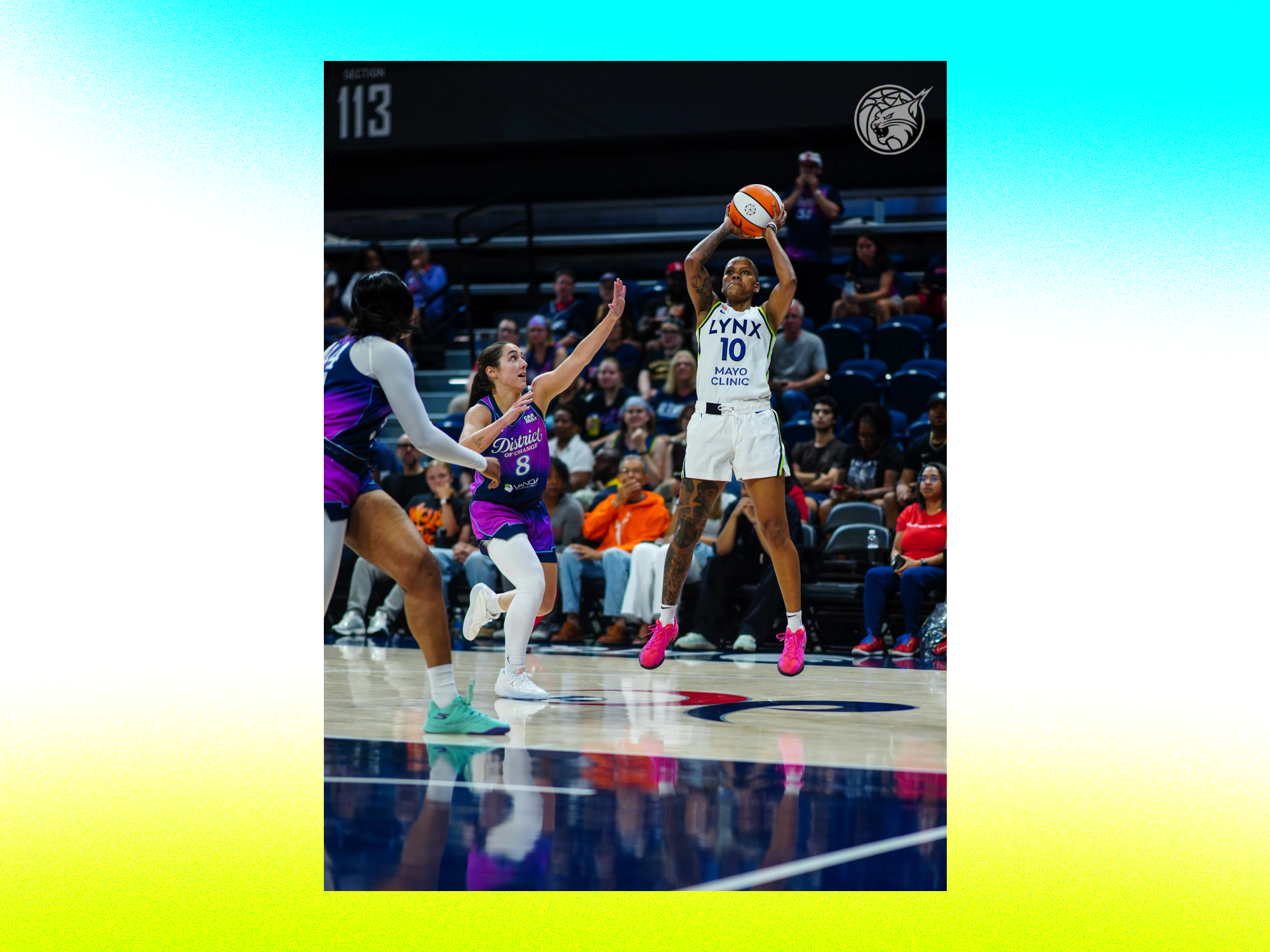
The Minnesota Lynx lost for just the second time in their past 18 games Monday night and there was nothing accidental about it.
The Golden State Valkyries have their own nifty success story going. In their second season of existence, the Valkyries have already slotted in as the second-best team in the WNBA in 2026, and owned a 25-11 record coming into Target Center. But they had never, ever, beaten the Lynx in their brief history, with nine straight losses spread out over four in the 2025 regular season, two in the playoffs, and three this year, including a double-digit defeat last week in front of their raucous home crowd after a pair of better-played close encounters back in June.
Even without Courtney Williams—Minnesota’s deadly midrange sharpshooter, fearlessly adept rebounder, and feel-good emotional milkshake—who was sidelined with an injury (sprained foot) for the first time since 2022, the Lynx had ample cause for serene confidence coming into Monday's contest.
But the proud, passionate Valkyries were on a mission, diversifying the schemes and ramping up the physicality of what was already the league’s stingiest defense. They disrupted the precocious gifts that have made point guard Olivia Miles an amulet of wizardry for the Lynx offense this season.
Miles has an innate distaste for the ordinary pass, preferring to goad the aesthetics as well as the efficiency of her team’s scoring with feeds that are theoretically risky and visually surprising, ambushing our expectations with a decisive aplomb that is central to the genetic makeup of any artist. Crossing midcourt on the dribble, she loves to survey the options as her four teammates and the five defenders spontaneously choreograph the prelude to her next orchestration.
But on a significant smattering of possessions, Golden State dropped back into zone coverage, using their length, discipline, and connectivity to sew down the seams that are typically opened via pick-and-roll plays or unbalanced formations designed to isolate a shooter and defender in man-to-man coverage.
The best way to beat a zone is through crisp and steady ball movement—a rapid series of passes. Ordinary passes. Miles turned them down, stubbornly dribbling and surveying, searching for better music. When she tried to zip the ball through the narrow seams, there were more deflections and outright steals than assists. By the time she eventually defaulted to the ordinary, the offense had lost its rhythm and the shot clock was ticking toward zero. Too many shots were hurried, driving down the accuracy. Meanwhile Golden State spotted the zone coverage in with a mix of quick traps and diligent rotations to keep Miles and her teammates guessing, siphoning away that serene confidence.
Miles also deferred to herself, taking a team-high dozen shots and making only three; she was just one of five when launching from three-point range. She got to the line but twice, and nearly matched her five dimes with four turnovers. The Lynx were -12 during her 27:49 minutes on the court.
When I asked Cheryl Reeve about Miles’ disdain for the ordinary and refusal to take what little the defense was giving her with appropriate haste, the coach nodded her head and replied, “I want games like this for Liv as a rookie. We need games like this so there’s learning that happens. That’s the kind of stuff that makes us a better team.”
Napheesa Collier doesn’t have the excuse of inexperience. Since returning from multiple surgeries on her ankles halfway through the 2026 season, Phee has made a surprisingly great team prospectively elite: The Lynx are now 9-2 when she plays and 22-6 when she doesn’t. She is shooting 50.7% from the field, 47.5% from three-point territory, and 86.5% at the foul line. On a per-game basis, she is tied for second on the team in points, second in rebounds, second in blocks, third in steals, and fourth in assists.
Yet she has not yet lived up to the moniker by which she is announced: “MVPhee!” That player, the one second in the MVP voting in both 2024 and 2025, would more obviously be a factor on the rare nights like Monday, when the Lynx need to be rescued from a particularly talented and inspired foe. If there is a specific way to describe how she has been lacking (compared to the incredibly high bar she has set for her performance), it would be that she hasn’t surged to the fore with statement plays in times when the team loses its equilibrium or is otherwise flailing.
Maybe this is because she’s trying to be a selfless and synergistic teammate, ceding alpha status to Miles, the team’s MVP contender this season as a rookie. Or maybe all the rust around her game isn’t knocked off yet, or the ankles are still on the mend.
Whatever the underlying reasons, Phee yielded too frequently to the Valkyries bruising physicality on Monday. They knocked her around off the dribble, on the boards, and on torrid screens and traps with or without the ball, at both ends of the court. She was frequently guarded (straight up or on switches) by Golden State’s Veronica Burton, comparatively undersized at 5-foot-9 and 155 pounds (Phee is listed at 6-foot-1 and 182 pounds), but who plays like she’s from a family who played professional football (true), blatantly rugged and resiliently annoying. Burton had five steals Monday, at least three of them forcefully breaking up entry passes into bigs like Phee and Natasha Howard near the basket, a tenet of the Lynx offense Reeve said in her postgame interview was a point of emphasis—getting mismatches in the paint. Though when the bigs didn’t aggressively contend for those passes, Burton and her teammates blew up the play.
When she did wrest possession down in the paint, Phee was just 2-for-6 on shots within seven feet of the hoop, typical of the entire team, who were a collective 11-for-29 from two-point range. She had just nine points overall, three in the second half. But aside from her seven rebounds (all on the defensive glass) her inability to impact the fray was reflected in the other counting stats. Despite logging 31:39 minutes of playing time, she had zero blocks, zero steals, zero free throws, and zero personal fouls.
After all that said, it is probably counterintuitive for me to rejoin that we shouldn’t put too much stock into Monday’s defeat. But this was a game mostly governed by human nature. More than a handful of the 16 Lynx wins in their previous 17 games were closely contested down the stretch until Minnesota prevailed with the sort of seamlessly resourceful energy and judgment that comes naturally when you are on a roll. Bottom line: Winning was becoming too automatic, and having beaten the Valkyries on the West Coast just five nights earlier, it was hard not to assume the same effort would produce the same result.
But human nature had the Valkyries primed for vengeance. A loss on Monday would have been a Lynx sweep of their four-game regular season matchups, a continuation of them never beating this foe, and, as a final insult, would have had the Lynx clinching the top playoff seed in the WNBA, with more than a month left to go in the season (admittedly including the 18-day layoff for the international FIBA tournament).
So a message was sent. The Lynx were held to their lowest point total (16 points apiece in the first three quarters and then 18 in a fourth period finished by bench personnel) and worst shooting percentage of the season. The Valkyries and the Lynx proudly rank No. 1 and No. 2, respectively, in the W for the best differential in points off turnovers (points scored minus points allowed), but on Monday Golden State ran roughshod, scoring 21 points off 18 Lynx turnovers while Reeve’s team only garnered three points from nine Valkyries miscues.
As guard Maya Caldwell (who started in place of Courtney Williams) said after the game, “They played hard. They wanted it more than we did.”
The Lynx don’t play again until Sunday, their last game before a long break for the FIBA tournament. During a pregame press conference, I asked Reeve what she will concentrate on in this relatively luxurious amount of time she has to hone the team for the home stretch and then the playoffs.
“I think we’ll take it as a chance to spend a lot of time on our rotations; not defensive rotations but the rotations of our players [plans for subbing in bench personnel] and getting them more reps in this time,” she answered, an acknowledgment that the team’s primary vulnerability is a lack of reliable depth. “Certainly you are going to see a couple of players tonight you don’t ordinarily get to see,” she continued, a prediction that panned out in the season debut of Chloe Bibby and time for other end-of-bench names.
“And as we go into the [FIBA] break, we’ve got a couple of things that we know we don’t do well. But that’s the space that we live in. We want to be in the top four of every [statistical] metric," Reeve said. "Well, we’re not getting there at the free throw rate. [They don’t draw enough fouls.] That is probably more systemic—I don’t know if I can change that with the personnel and the way that we play. [But] the things we can fix that we don’t like; those will be our focus.”
Earlier Reeve had referenced rebounding, particularly a tendency to allow too many second-chance points by opponents by failing to grab the defensive rebounding. As of Monday, the Lynx ranked 12th in the 15-team league in defensive rebounding percentage.
So, top-four in every category is the bar, and consistently striving for it has resulted in the Lynx being in position where their next win (or a loss by the Valkyries and/or Las Vegas Aces) will provide them with the top seed in the upcoming playoffs. Not too shabby for a team expected to finish in the middle of the pack this season.
As for the rebounding, get well Courtney Williams, you pint-sized rebounding dynamo. There are goals left to conquer once your foot heals.