


Editor's note: Britt Robson, veteran local hoops writer par excellence, will be writing a Minnesota Lynx column for Racket every other week for the remainder of the 2026 season. Enjoy, sports fans.
For the first 22 games of the 2026 Women’s National Basketball Association season, the Minnesota Lynx have not only been the best of the league’s 15 teams, but the most captivating to watch.
For veteran viewers of the “W,” part of the allure has been the sheer ambush of it all. At the start of the season, the Lynx were pegged to mire in mediocrity. Their clarion star, the 2025 MVP runner-up Napheesa Collier, has been waylaid this entire season after sustaining a controversial injury in last year's playoffs, when an opponent tore three ligaments and a shin muscle in Collier’s left ankle while stealing the ball without being whistled for a foul. (It was the second year in a row the Lynx season ended with acrimony toward the refs, whose inability to see a travel flipped the outcome of a closeout playoff game in 2024.)
As Collier (who also had surgery on her right ankle this past winter) worked hard to shed her crutches, some key components of the 2025 Lynx were cashing out, thanks to a lucrative new collective bargaining agreement that dramatically boosted league salaries.
Two starters, center Alanna Smith (the WNBA’s co-Defensive Player of the Year in 2025) and forward Bridget Carleton (the first player taken in the expansion draft this spring), signed veteran maximum contracts (a step below the “supermax”) with Dallas and Portland, respectively, that raised their average salaries nearly tenfold, to more than $1.2 million per season. The top two players off the Lynx bench, Jessica Shepard and Natisha Hiedeman, likewise received exponential boosts to their income to play in Dallas and Seattle, respectively.
That’s four players gone from the top seven in the Lynx rotation, and a fifth, Collier, still without two playable ankles more than two months into the season. Given the carnage, the best-case scenario back in May seemed to be that the Lynx would tread water until Collier returned and then try to make some noise in the postseason despite a low playoff seed.
Hah.
The 2026 Lynx have dovetailed the spectacular with the clinical in a manner that tickles the hedonists and purists at the same time. They are enacting a visual textbook, sent to the synapses in neon hues, on the selfless splendor of resilient, intentional teamwork at both ends of the basketball court.
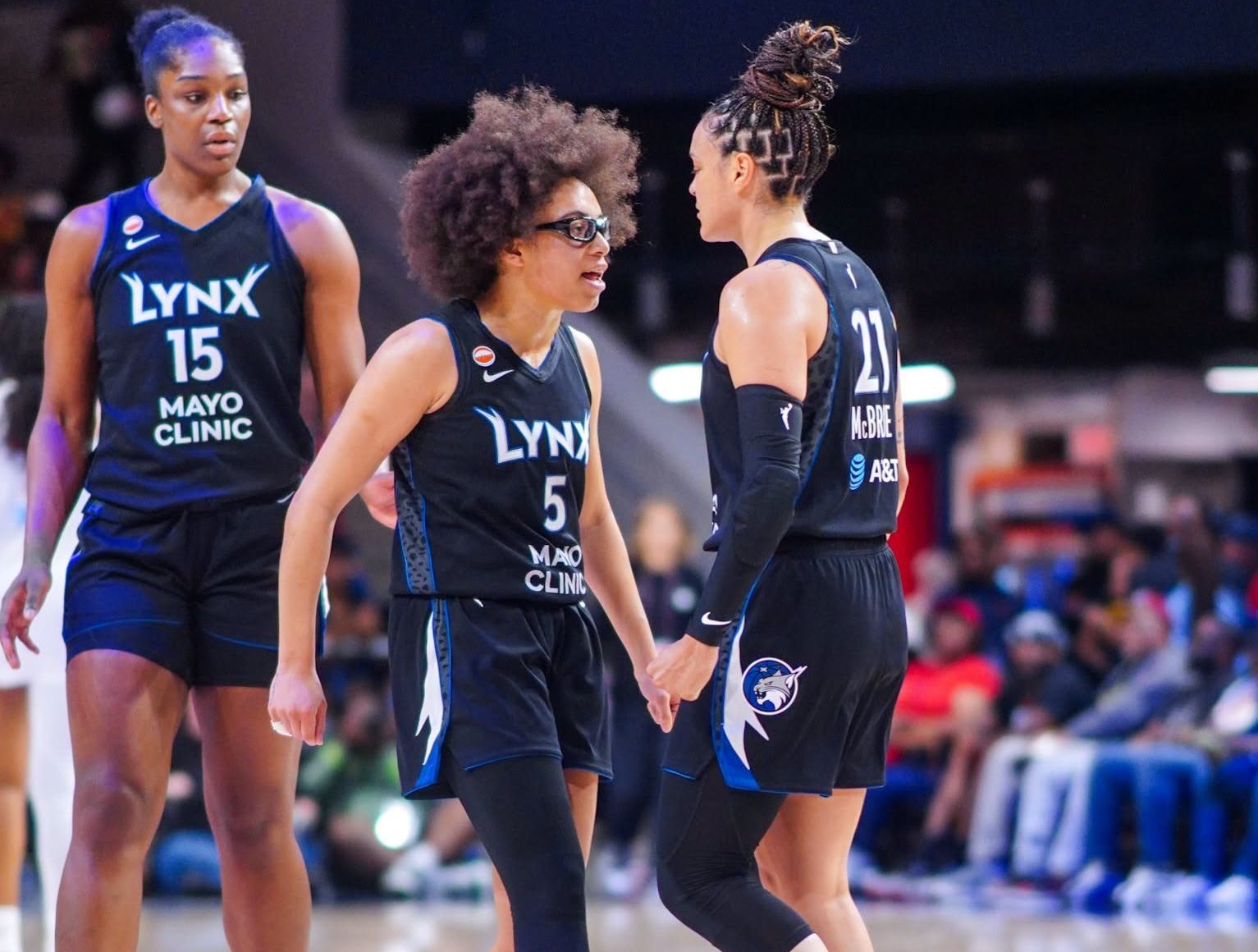
The plaudits have to begin with point guard Olivia Miles, already the greatest Lynx rookie since the deservedly sainted Maya Moore. With her thick goggles and signature coif, Miles has the visage of a PBS cartoon character, but the rectifying swagger by which she orchestrates the offense is primetime HBO.
It is easy to typecast Hall of Fame coach/general manager Cheryl Reeve as a perpetually angry emoji (not true) and a control freak (accurate). But her parlay of taking Miles with the second pick in this year’s draft, and then entrusting her with the keys to the offense, is brilliant wisdom that almost immediately redefined the Lynx season, raising the trajectory of the franchise for at least the next few seasons.
But even with Miles fully up for the challenge, this vividly decipherable textbook required a sage pick-and-roll partner, which Reeve secured by signing 34-year old veteran Natasha Howard to a two-year, $1.4 million deal—less money than any of the departing quartet of rotation players received.
In return, Howard has delivered ridiculously good value. Losing Smith and Shepard to free agency and allowing time for the 6-foot-5-inch, 190-pound Dorka Juhász to mend from injury has compelled Reeve to play the 6-foot-2-inch, 171-pound Howard as a woefully undersized center. But precious few of the larger opponents who try and guard her can stymie the pick-and-roll chemistry she has with Miles.
Pick and roll is basketball’s most fundamental cog of teamwork on offense. Howard, who played under Reeve for the Lynx in 2016 and 2017 and has changed teams six times in her 13-year career, has drilled herself into mastery of this bread-and-butter play. Her precise calibrations on when and where to set the pick, at what angle for how long, and then the path and speed with which she ends the pick and rolls to the hoop, all provide a more available target for Miles to deliver the ball.
How successful has it been? Howard currently leads all WNBA players in points scored in the paint at 13.4 per game. And while the most dazzling of the 114 dimes Miles has dropped this season usually are scampering down the floor in transition, driving and kicking to the corners for three-pointers, or flashing a no-look pass to a weakside cutter, the most frequent source of her assists are some form of pick-and-roll with Howard. Specifically, Miles has successfully dished to Howard 35 times, all but two of them baskets scored in the paint. The next highest recipients are Nia Coffey, with 22 baskets off of feeds from Miles, and Kayla McBride with 20.
Howard is also a savvy, if occasionally overwhelmed, defender who currently ranks fifth in the W in steals per game. She and Miles were both recently, and justifiably, named as starters in the All Star game to be played later this month.
Another coup for Reeve as GM was signing Coffey for the bargain price of two-years at $717,500. Nia is the daughter of Richard Coffey, notorious as a 31-year old forward for the University of Minnesota (he had extended eligibility after military service as a paratrooper) and a single season with the Timberwolves. Nia is a native Minnesotan who became a McDonald's All-American while playing for Hopkins High School.
But after college at Northwestern, Coffey has bounced around—the Lynx are the sixth WNBA franchise in a decade-long career. It’s a feel-good story thus far, as she has been an invaluable role player—“she sets the tone” Reeve says—who is posting career highs in blocks, assists, rebounds, and steals while playing with the type of grit and hunger that is an antidote to team inconsistency, a fiber that fortifies character.
Not surprisingly, the bedrock of the 2026 Lynx are the holdover starters from the previous two seasons, combo guard Courtney Williams and wing forward Kayla McBride. Williams is arguably the best midrange shooter in the W as well as the most prolific; she's fearless and accurate on pull-up jumpers in transition. That’s just one of a troika of extraordinary skills. At just 5-feet-8-inches and 147 pounds, she remains a remarkably adroit rebounder, who invariably makes an efficiently quick decision—a follow-up shot or concise pass if it is an offensive rebound, a tromped-throttle dribble up the court if it is a defensive rebound—after securing the carom.
And Williams is a joyful player, optimistic and encouraging, but also a cut-throat competitor who seeks engagement in high-stakes moments.
McBride warrants increasing admiration the more assiduously you watch her in action. She has made an art form out of drawing legitimate fouls both at the center of the play and well off to the side. Her three-point attempts are replicas of beauty—the technique from catch to shoot is a solved, tongue-in-groove puzzle of footwork, torso framing, and rapid-fire release. Her trademark scoop layups are also preordained for positive outcomes, ripe for drawing fouls or delivering paint-centric putbacks by not straying far if they miss. She compensates for a relative lack of athleticism through savvy and diligence, hallmark qualities that extend down the roster of these 2026 Lynx.
After starting the season 13-3, the Lynx have split the past six games. This stretch includes home losses to the Washington Mystics (10-10 on the season) and the Connecticut Sun (5-17), each time immediately followed by a road victory against the same foe. They were also handily beaten by the New York Liberty. Nevertheless, the Lynx 16-6 record is currently the best in the W, and the statistical measures of their play indicate both that they are overachieving and that this success is not a fluke.
On the contrary, the statistical snapshot is one of team synergy, strong and balanced at both ends of the court. The Lynx are third in offensive rating—the amount of points they score per possession. They are first in defensive rating—the amount of points they allow per possession. They are first in net rating—the amount of points scored minus the points allowed per possession.
Why is the defense so efficient? Even though they are undersized, the Lynx battle to defend the area where larger players typically thrive. Opponents attempt more than 20 shots per game “in the restricted area” right beneath the hoop—the seventh most frequent number among the 15 WNBA defenses, but only the Golden State Valkyries allow a lower percentage of makes on those shots. Move it out slightly, to the paint areas beyond the restricted zone, and the Lynx allow the lowest field goal percentage of any team from that distance.
On midrange shots, the Lynx defense again is stellar, second to the Mystics in terms of lowest field goal percentage by their opponents. They are second to the Valkyries on three-pointers by opponents from the left corner, and best in the W at reducing opponent field goal percentage from the right corner. On three-pointers “above the break” away from the corners, they “fall” to fifth among the 15 teams. While achieving this admirably low rate of opponent’s shooting percentage from different areas of the court, the Lynx commit the sixth fewest fouls, indicating their rotations and closeouts are relatively crisp and efficient.
The team is scrappy. They are second in steals per game, third in blocks per game, and have the second-best disparity between blocking shots and having their own shots blocked. Boxing out and getting after rebounds is a team-wide endeavor. The Lynx don’t have a player in the top 10 in rebounds per game (Howard is their leader at 13th in the league, but the team is third in offensive rebounds, fourth in defensive rebounds, and second in overall rebounding.
There are ways to improve, especially with respect to offensive efficiency. The Lynx lead the W in three-point accuracy yet rank third-to-last in three-point attempts. And they draw the fewest fouls and thus get to the free-throw line less often than any team than Dallas.
There are concerns. Going 3-3 in their last six could be a sign they're wearing down, although it's important to note that Miles missed the last two games that the Lynx split with the lowly Sun. Their relative lack of length was clearly a factor in losses to the Liberty and the Sun, when exceptionally large and talented foes like Jonquel Jones and Brittney Griner had their way most of the time. On the flip side, Wednesday night’s win over the Sun (albeit without Griner playing) represents the most influential contribution by the Lynx bench players of any game this season.
Most people would concede that the Las Vegas Aces and the New York Liberty have more talent on their respective rosters than do the Lynx. Recent defeats to both of those opponents would endorse that. But the enormous X factor is the return of Collier; how quickly she can be integrated into what has been an impressive fabric of continuity; and how disruptive, in a positive as well as negative way, her stellar and variegated skill set edits the textbook.
However it turns out, this first half has been a gloriously unexpected ride.