


In journalism, the rule is to refer to the subject by last name, a formality that bestows respect. But it feels farcical to refer to Conrad Sverkerson by his last name, and not just because it’s a little unwieldy. He was Conrad—plain Conrad. Except, of course, that little about him was plain.
Nearly every musician who played the First Avenue Mainroom interacted with him. Starting there in 1988 as a doorman and working his way up to stage manager, or more formally, production manager, in 1990, the tall, flaming-haired Scandinavian Minnesotan had piercing eyes and a voice as craggy as his face. For years, he wore his hair in long dreadlocks; when he finally cut them off in 2006, he told Mpls.St.Paul Magazine, they weighed four and a half pounds.
Conrad was a fearsome presence, and an impressive one. Even if he intimidated you at first—and he certainly did me, when I worked at First Ave briefly in the late ’90s—Conrad’s no-BS smarts were manifest even when he was barking orders to his team.
And as many of the testimonials below attest, he softened the closer you got to him. He inspired loyalty. In a workplace where constant physicality comes with the terrain, the stage crew does the toughest work over the longest hours, and for three-and-a-half decades, Conrad was their undisputed leader.
Nightclubs everywhere tend to turn over employees like a paddlewheel. But the stage crew of First Avenue (and now, its associated venues) has been its bedrock, and Conrad was much of the reason why. His role as First Avenue’s first point of contact for touring acts made him a legend far beyond Minnesota.
Since he died of cancer last October, the number of tributes—from his coworkers, from venues around the country, from musicians around the world, from the state of Minnesota—have not stopped piling up. First Avenue itself will be celebrating him this Sunday (see info below).
Here, then, are 31 more testimonials—not complete, no such thing, but highly prismatic. (They’ve been edited and condensed.) While I reached out to many more people than I landed (c’est la vie), my biases do show: A number are from people I got to know while working in the same building as Conrad. The older I get, the luckier I feel for having seen, in close proximity, a master at work.
Mark Sverkerson, brother
We grew up in New Hope, Minnesota—about a half-hour from downtown, out toward Plymouth, northwest of Minneapolis. The oldest boy is Lee. Then came Billy, then Conrad, and then me. And there are six sisters sprinkled throughout, too.
When there’s 10 kids, there’s a lot of activity. My mom’s dad had a hobby farm out there, and gave my mom and dad four acres of the land to build their house on, so we kind of had our own playground. And adjoining our yard was this wooded area with a creek that ran through it. So we didn’t have to go far to find things to do—places to build a tree fort, to just have fun.
Con was an athlete when he was younger—tall and skinny. All the boys played golf, because our dad played golf. That was something that he and I especially picked up fairly easily. In his prime, I’d say he was about a 4 handicap.
We caddied at Golden Valley Country Club when we were young. We would bike there in the mornings when we weren’t in school. We would carry the clubs of who we perceived to be rich guys, and they’d give us five bucks—or 10 bucks, it came to be. That was a lot of money back then for four hours’ work.
Before the First Ave years, he pounded nails. He was a carpenter. He would get up early every morning and go to the job site and work on building houses. Over time, he became pretty efficient and good at that. I wouldn’t call him a MacGyver or anything like that—but practical, persistent. He was probably at his best when things needed to be directed and choreographed, in a way.
I was in Minneapolis three weeks ago. I went by the club. At two in the afternoon, the garage door was up, where Con would usually be. A kid named Evan was there. We had played a round of golf together. Evan gave me a big hug. He said, “Just walk around. Go wherever you want to go, act like you own the joint, and spend as much time as you need here.”
He unlocked Con’s little office. I sat in that office for a while because it still had a lot of his memorabilia and photos. And then I went upstairs, sat up on the balcony. Con had hosted a surprise birthday party for me on my 40th birthday. This would have been March 19, 2001. It was in the big room that was the Record Room, or the Prince room. When we had that party, the club was closed, except for us. You had to have a password to get into the side door to go upstairs. We had the Jayhawks play; we had Run Westy Run play; we had the Boquist brothers, Jim and Dave Boquist; Dave Pirner played. There were probably maybe 150 people—my whole family and then friends. It was all thanks to Con. He built a little stage up there, just for that.
I poked my way back in that area, and there was a door four inches ajar. There were people sitting in this big room, all at their own computers, eight or 10 of them. I stepped into the room and I said, “I have a question: Who are you people?” They said, “We work for the club. We do social networking and marketing.” And those people let me stand in the middle of that room for about 10 minutes and tell a few stories about Conrad. I was crying and emotional, but that was something I personally needed.
Mason Jennings, musician
Conrad was the best. I probably played First Avenue 30 times over the years and he was there every single time. There to greet me when I got there and the last one there with me at the end of the night in the garage. But my favorite of each night was when he’d come on stage right before the show started. We’d be tuning up behind the curtain and he would come right up and hang with me and we’d listen to the crowd in the dark and he’d lean in and say: “Are you all set, Mase?” And I’d say yeah. And he’d say: “Remember, have fun.” And then he’d give the signal for the curtain to rise. Conrad was the best. First Avenue will never be the same.
Victoria Legrand and Alex Scally, musicians (Beach House)
Conrad was a character . . . a road fixture . . . a totem pole you would reach on tour. Always kind, quiet, and ready to hang. An echo of lost times. And who could forget his beautiful head of hair . . . he will be sorely missed. They don’t make ‘em like that anymore. Rest in peace.
Chris Johnson, musician (Rifle Sport)
When my kids were little, I would bring them down to the club, and Conrad would give them a full tour. My kids still remember that. We’d start at Conrad’s door, the side load-in door, and then he would take us throughout the club. He would show them the stage, show them the dressing room, show them where the tour buses park. My kids were just like, “Oh, wow!” That was huge for them. My daughter, who is 16 now, plays drums, plays guitar, plays piano, and she still talks about it.
Fred Darden, First Avenue employee (1984-88)
I was a stage manager, and I think I worked with Conrad for about a year before I moved to Chicago. He was on the periphery—he would fill in for guys every now and then, and then he became more regular before March of ‘88, when I moved to Chicago. I’ve been at the Vic Theater here in Chicago now for 13 years. I’d always say to bands, “If you’re going to Minneapolis, you’re going to First Avenue, say hi to Conrad.” It was a mutual back-and-forth that way.
Maggie Macpherson, First Avenue employee (1980-85)
I don’t know if there was anyone in the country that was as smooth at his job as he was. He knew what you needed coming in, he figured out how to make everything happen while you were there, and he got you out with the utmost of ease. He took it past so many other people’s levels. I thought I did an OK job as production manager at First Avenue. It was a job that I grew into. There were different people doing [various aspects of] the production before that. It all got rolled into one during my tenure, and then Conrad just literally pulled it all together.
I’ve talked to tour managers and other people who have come through Minneapolis, who would always say you could just walk in the room and relax—all those little things that you have to figure out and make happen, he had either done it already, or he made sure it got done. It made everyone’s job so much easier, and made every musician that ever walked on that stage feel like a king.
He was able to be that person that bands could count on to shut down the back room, so they weren’t inundated. That’s a hard thing to do when it’s a local band that’s starting to do really well, and 2,000 people want to be backstage. He was always able to do that really well without being an asshole, which people really appreciated. People in this town can carry a grudge. I don’t know anyone that carried a grudge against Conrad. There will be shout-outs to Conrad coming from that stage for many, many years to come.
Yeah, it’s going to be like Prince now.
[laughs] Yeah, Conrad really is the Prince of stage managers.
Alan Sparhawk, musician (Low, Black-Eyed Snakes)
I remember going to First Avenue when I was young and being very intimidated by the rough-looking red-dreaded stage manager that seemed to lord over the space—a shadow more vivid and memorable than any artist who took his stage. Flash forward and this same specter is at the side of that stage with my infant daughter in his arms as Mimi and I and Zak soundcheck. He would become a dear family friend and savior for many occasions. Meeting his family has deepened that bond and love. It’s an honor to know him.
Kraig Jarret Johnson, musician (Run Westy Run, Golden Smog, the Jayhawks)
I met him at the 400 Bar, back when he was working there. He was also still a carpenter, and I remember when Run Westy Run, my old band, bought an ambulance, and I drove it over to Conrad’s house. He got out all these carpenter tools and built a loft in our ambulance. And it was in that band forever.
He used to have everybody over to his house to watch the football game, and he would cook—like, if we were playing Chicago, he’d make Chicago-style hot dogs. There was a group of, like, eight people that would go over to his house every Sunday, and he’d always be cooking.
When Conrad got sick and was in the hospital up there toward the end, Al [Sparhawk] went in there with his guitar and sang to him. He was looking at me, and I could tell he was just like, “You know what? I’ve had a lot of great friends, I’ve had a lot of great times, but this is just kicking my ass, and I can’t take it.”
I frequently find myself saying, “Oh, I got to call Con and tell them this.” And now the phone calls are just a little bit different, but I’m still connected with him somehow.
Woody McBride, DJ/promoter
Conrad did not discriminate against electronic music. In fact, he would always sink his teeth into whatever we had going and made sure that it happened to the club’s expectations, as well as ours. The first time, I was a little intimidated that this Motörhead monster with such a giant reputation was in the same room as us—and pretty nervous that we were gonna offend him with our giant sound systems and everything put into overdrive. He didn’t even flinch. He was there for quality control and to let everybody know that they were in the Great Church of First Avenue.
Craig Finn, musician (the Hold Steady)
I went to First Avenue pretty much anytime I could—if I had the five dollars, I would go. And at some point, I remember being aware of Conrad. He was always a presence. He was very kind to Lifter Puller. I remember one time playing in the Entry, and out of the smoke comes Conrad—front row center at a Lifter Puller show. I took that as a huge compliment. It felt really good.
As a guy who’s toured for a long time now—things come and go in most places. First Avenue has not come and gone. It is an institution. And within that institution was the institution of Conrad. There is a real comfort in a touring situation where you’re coming out of some chaotic show, thinking, “At least today will not be chaotic. The PA is going to work.”
Conrad could have easily been a tour manager, should he have chosen. But he was a club guy. First Avenue is a launching ground for touring crews. Conrad raised a generation, a couple generations, of guys that went out into the world—many of whom I’ve seen at festivals in Europe. That’s part of his legacy.
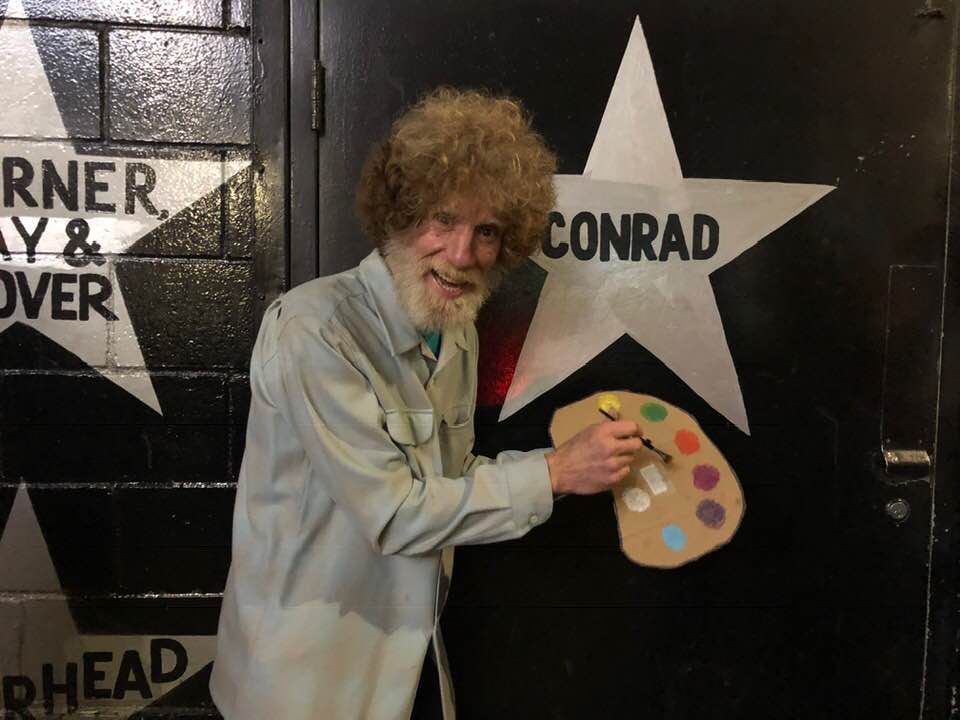
There’s really no one like him in this business. He was the first face of First Avenue for so many musicians and road people. You don’t always meet the booker. You always met Conrad. There’s no other club that has a star on the door for their stage manager.
Randy Hawkins, First Avenue employee (1989-present)
I knew Conrad before he worked at the club, when he was the door guy at the 400 Bar. He was the only door person, when I was a regular at First Avenue, who wouldn’t let me into the Entry for free. [Laughs.] They all let me in, except for Conrad: “No way! Go over there! Pay!” [Pouting] “Man, dude with the dreadlocks.”
We hit it off when I started doing production. When he became production manager, stage manager, I became a stagehand. He was the smartest guy I ever met about some of that stuff—always knew the right thing to do, always had a way to point you in the right direction, always could call out an asshole when a band had a prima donna—which was quite a skill. [Laughs.]
I’ve been in production now for a long time, 38 years, and I’ve learned a lot of the behaviors of Conrad. I just got back from Europe with Atmosphere, and on the tour before this, in the U.S. and Canada, I met all sorts of people who were like, “Oh man, we heard.” Because he was an institution. And as far as bands that are coming through—everybody has a story about him. He’s made quite an impact.
Annie Sparrows, musician (Soviettes, Panel), First Avenue employee (1995-98)
The first time I met Conrad was while working there. I was doing security. Within a couple of weeks, I thought that the stage crew was really cool, and I was like, “Hey, you should train me in.” He was like, “No way.” I think that he thought I wasn’t a serious person. I made him laugh, because I was so ridiculous—I was five-foot-six, 115 pounds soaking wet, wearing plastic, shimmery skirts, bright red pigtails. I think it was funny to them that this teeny girl was like, “Yeah, let me get in there. I’ll help you lift that bass cab.” But over time, he softened to me and let me hang out, push gear around. I really like hard work, and I also was interested in seeing how everything works.
He gave me a lot in terms of confidence for setting up a stage and understanding how the microphones are wired. Later on, when I started touring, the first person I would go talk to is the sound guy. Knowing what I was talking about, having respect for the people that are guarding backstage—it gave me such a big leg up.
Afterwards, anytime I went to First Avenue, I would go find him to say hi and give him a hug. When the Lemonheads played, probably three years ago, I went to the show with a friend of mine, who I didn’t realize at the time was very drunk. He hocked a beer on the stage—it was total chaos. And Conrad came up to him, grabbed his arm, walked him outside—like, “Goodbye.” Even my friend said, “That was the most civilized kicking-out I’ve ever experienced.”
Allison Locey, First Avenue regular
I always felt cared for and looked out for by Conrad. I can’t remember which show—many years ago—but a car hit the building pretty hard, and First Avenue immediately went into evacuation protocol. He grabbed the back of my manual chair and took me out a side door before I knew what was happening.
Myles Kennedy, First Avenue employee (1989-present)
I got along with him pretty much right out of the gate. He was legendarily known as a little gruff and rough around the edges, but we hit it off.
Back in the old days of the club, we were putting Band-aids on everything to make that building work. It was rough back then. We spent a lot of years just trying to make sure the doors stayed open. We did every little thing that we could in-house, from building things to fixing things. How are we going to handle this? How are we going to handle that? Is there a fashion show in the middle of a rock concert? How do you come up with a runway from the stage for the models to walk through the crowd? And he was the guy that would fix a lot of that.
I was one of those guys that would come in and say, “I’m gone for a month. I will see you in two weeks, because we’re traveling through while we’re on tour, and we play at First Avenue in the middle of the month.” On my first really big tour, I got to load-in, and he walked to the load-in door, and he had [one of his] long red dreadlocks laid down in front of it and said, “I’m giving you the red-carpet treatment, Myles.” I really needed that. I’d been having kind of a crazy tour, and I needed a little bit of home, and that’s what I got—a little bit of tough love.
Fancy Ray McCloney, comedian
I can’t really remember going down there and he wasn’t there. There’s something about his presence that was strong, powerful, beautiful, calm. He was highly respected. And he maintained that authority. Through his stoicism, if you will, there was a gentleness and a warmth I always felt. And I’m not the only one. He touched this city in a way that really can’t be put into words. He was an Allstate Man: You was in good hands with him backstage.
Cindy Lawson, musician
My most enduring memory would be in the early ‘90s. The Gear Daddies were doing farewell shows, and they were playing the Lounge Ax in Chicago. There was a whole gang of us from First Avenue that went down. After that, we all went over to Cabaret Metro. It was like First Avenue, where you had the shows, but then you also had the disco dance nights afterward, downstairs at Smartbar.
That was the only time I had ever seen Conrad out on the dance floor, swinging his dreads and dancing. There were all these young women around him. They treated him like a god, because he was big, Norse, red-haired. And it was hilarious, because you would never catch him doing anything like that at First Avenue.
I got married to [First Avenue GM] Steve McClellan, so I was at First Avenue a lot. Steve and I got divorced—different people take custody of the friends, so I felt like I was walking on eggshells around Conrad. But then, over the last several years, I’ve been doing the John Lennon tributes with Curtiss A. And Conrad would be there at the door, and it was just so amazing to see him every year.
Stage managing is a hard, physical job for someone older. It’s weird to see older people in those jobs: You must be in some kind of pain, you know? Going down to the club and not seeing Connie—it’s a huge loss. It’s conspicuous in its absence.
Daniel Corrigan, photographer and First Avenue employee (1994-2021)
I started shooting six shows a month in 1994, and I did that all the way up to the end, which was 2021. When my kid was on his way, I applied to the club and started stagehanding full time, and from 2005 I did that for seven years. That pace was so crushing that I switched over to days. It’s hard on you. I mean, Conrad was kind of beat up from the job that he did. If you looked at him, he walked like a cowboy who’d been thrown a couple too many times.
The first time that we actually sat down and had a beer together, I’d probably known him for, god, eight years by that point. And he goes, “I gotta just tell you, first thing: I hate photographers.” [Laughs.] And that was the start of a long, lovely relationship.
He hated when people disrespected the house equipment. I don’t remember the band—it was an opening act—that was using our mic stands and mics, and after being warned, still treated the equipment very poorly. We took all their equipment off the stage and literally threw it into a pile in the garage. That was Conrad going, “You know what? Fuck you guys.”
He was a huge Twins fan. The door with his star, that’s the Conrad door. There was a chair there. Whenever there was a day game, Conrad was with his little transistor radio sitting in one of those chairs, listening to the Twins game. Just a favorite memory of mine.
When the club closed, there was that brief period when the ownership changed hands, we went down there to basically close the building. All the lights were off. It wasn’t totally black because the emergency lights came on. And when we left the place, Conrad turned on the trouble lights. That was a fitting, fitting moment.
Louie Solomon, First Avenue employee (1990-2002)
He actually was pretty amazing as a stage manager. He handled himself really well. He was cool under pressure. He had the incredible ability to time manage. It’s almost like he saw the problems before they happened, and he’d start there. He ran schedules, everything in his head. He had it down to a science. You could get on his bad side by being late. Conrad was definitely an “On time is early, and if you show up on time, you’re already running late” kind of guy.
We had bands who’d trash dressing rooms. It’s not like we had the finest of dressing rooms. It always ended up coming out on their end anyway. Some of the early ’90s bands—I know we had problems with the Mighty Mighty Bosstones and Sick of It All. But even after those problems, when they would come in and play, things would go off tense, but they would go off well.
I was really honored to be one of the few people to ever give Conrad a day off. That basically meant I got Metal Massacre, the multi-act shows that Conrad didn’t want to do. But he kept a really smooth-running ship for a really disorganized crew.
Golf was a pastime for a lot of us bartenders, whether we’re good at it or not. But Conrad was an amazing golfer. He probably could have qualified for a lot of major tournaments. Seeing Conrad walk up to the first tee, you would think, “Oh my god, what am I getting myself into?” You know, dreadlocks down to his ankles. And he’d get up there and crank a drive about 272 [yards], 90 [miles per hour], down the middle, and people would just shake their heads.
If you remember the KFAN sports radio station, Conrad would actually call in on occasion. I’m almost certain he had the nickname Beaver Kale Divot Guy. He definitely would smack up a considerable amount of earth.
John Casey Awsumb, musician; First Avenue employee (1992-2000)
The first time I ever met Con, I was opening for Warren Zevon, 1992. I was so naive. I thought that Warren’s voice might be raspy from the road, so I brought him a towel so I could take him over to the Arena Club. I told Conrad, “I got a towel for Warren. Come on over. Take a sauna. Good for the lungs, good for the pipes.” And Conrad said, “Stay away from Warren, John.” [Laughs.]
He knew every tour manager in the world. He could get tickets wherever, because he was so tight with all the promoters. He’s world fucking famous in the music world. But he was a homebody. He loved Minneapolis so much. He used to call it “Mayberry with tall buildings.”
It wasn’t like you’d go over to his house and listen to records—never—because he was a live music guy. How many bands do you suppose he saw? Say it’s three per bill, five per week—15 a week times 52 weeks. Come on, you’re looking at 30,000 to 40,000 bands, probably.
He loved the ‘Q—loved NRBQ. He loved Wilco, of course. He loved the Jayhawks, Soul Asylum, the Westies. He was really loyal to the Minneapolis team. Loved Supersuckers, that whole Seattle cowpunk deal. Fucking loved the Silos—anytime they were in town, we’d have to go to the Silos. And I like to think he enjoyed my stuff, too.
We always used to have so much fun thinking of old bands. We’d be golfing, and he’d just look over and say, “Hey, Johnny: Big Red Ball.” [Laughs.] Like, “Give me another ’90s gonna-make-it band,” you know? We knew each other so well that we could just say one word and know exactly what the whole story was—like Ole and Lena jokes, where you just tell the punchline.
I certainly miss him terribly, especially as the Masters was going on. We never missed a Masters. We played a lot of golf together, hundreds of rounds over the course of our friendship. We golfed with all these bands, anybody that came through town. We golfed with Ween. They were great golfers.
Conrad first asked me if I golfed when I started working stage. I was like, “Do I look like I sell insurance?” Next thing you know, I was out there. His whole family taught me how to play. His brother Mark was the pro at Fox Hollow. His brother Lee was a really good golfer. I played some golf with his dad. I had no clue what I was getting myself into. Here we are, 30-plus years later, and I’m still rabid about the game.
His favorite course was Theodore Wirth. He always talked about having his ashes spread on No. 16 green. I think we’re going to get some ashes at some point and honor him by throwing him on 16 green.
There’s no other Conrad. It’s like Beyoncé: one word.
Walter Salas-Humara, musician (the Silos)
He was so striking back then, with red hair and huge dreads. [Laughs.] It was like, “This guy has definitely got it going on here, you know? I want to move this person.” He engendered a lot of respect by projecting respect for the artists. You always felt like it was a collaboration with him to put on a great show. As well as being firm about certain things that you had to do, he was also like: “Am I doing a good job?” He was the ultimate stage manager—absolutely the best. He was able to communicate to every type of person. He had a regal element to him that not a lot of people have.
Danielle Valenciano-Tardino, First Avenue employee (1985-95)
Way back before cell phones, both of my grandfathers had died. I was taking my one grandma to see my other grandma. One lived in St. Boni, near Minnetrista; the other one lived by Duluth. We took my grandfather’s car, and the fan belt broke on our way back. This is on a Sunday, and there was nothing open to fix the car. I happen to get a hold of Conrad. He comes in his pickup truck, and he picks up my grandma and I and brings us home. That’s when he had his dreadlocks—and she hadn’t met him before. She loved him after that. She’d always ask about him.
Conrad and I both loved the State Fair, so every year I’d come into town [from Los Angeles] for it. We’d meet at Knucklehead Corner, near the Tilt-a-Whirl, where the chairs are. We called it Knucklehead Corner because that’s where you saw all the knuckleheads coming from the Midway. [Laughs.]
I have four kids, and people would look at him, because he’s got these really long dreads, pushing this double stroller around the State Fair. He loved going to the Grandstand to, like, get a back scratcher. We always used to ride the Giant Slide. We’d be at the side stages, and he’d always know the sound guys. Did people recognize him? Oh yeah! All the time! All the time! It was like being with a celebrity.
He came out here—I think it was New Year’s Eve. We’d do the museums. I think he golfed down in Palm Springs. Did they recognize him in L.A.? Yeah! They frickin’ recognized him a hundred times! Just on the street! One time, we went to Riot Fest in Chicago—same thing! And I gotta say, most of the people that came up to him, he did know who they were. Because these people, he dealt with them personally. It wasn’t just a job.
You know about the time he fell? I think he was out at Whitey’s, and he was insistent on not getting a ride home. Somehow, he left there by himself, and he woke up on the bank of the Mississippi River. He had fallen down, and there were some guys down there, and they helped him up. He had broken his back. They had to cut his dreads off because it was too heavy. He didn’t get out of bed for a while. He had a steel rod in his back.
I knew he was mean to people, because I heard. But he was never mean to me. The only time he did get mad at me was when he stopped drinking. I was talking to him, like: “You really should do rehab.” He was like, “Stop it. I’m gonna do this on my own.” And he did it. He stopped on his own.
Tim Wink, First Avenue employee (1997-99)
I think Conrad was guided by his ability to read people. Sometimes we would get people in and he would be like, “I don’t think these guys know what they’re doing.” He might share that with his crew, just to make everyone aware. But he placed his faith in people. I think that was a big part of the reason why I felt a loyalty to him, because he would empower his people by placing faith in them. He didn’t over-manage them. He’d be like, “I believe in you. I know you know what to do,” and just leave you to it. That was an empowering feeling, you know?
I don’t think that he was intentionally intimidating. I think that he was an introverted person who was maybe visually intimidating. He was actually a really sweet guy. But he could use that to his advantage if he needed to. He could bark something, and people would jump. That served him well at times.
One time, Semisonic was playing. “Closing Time” had just come out—that was an international hit. And when they played “Closing Time,” Conrad wandered over to game bar [where the coat check is now] and he just threw up the house lights, as if the club were closing—a neat effect to emphasize the theme of the song.
Having worked a lot of shows, there were relatively few disasters. Every time I go online, I hear about shows [in other venues] where the sound was terrible, and they got upset. You hear those sorts of stories all the time. You don’t hear those stories about First Avenue.
Gregory Parks, First Avenue employee (1995-2000)
He was always juggling a lot. You could not do Conrad’s job to the level that he did it and not be a people person. He could not have garnered that much respect without being a people person, without having those so-called soft skills. Working stage, you got to know exactly how much he cared about everybody who worked at the club. Anybody he could tell cared about the job that they were doing—he respected you, as long as you weren’t in his way. He had things to do.
His depth of knowledge, his frame of reference, his sense of recall and how he applied it, was pretty marvelous to watch. He didn’t often forget band members or people. Like: “Oh yeah—they played in, I think, ’85, and they had this sort of setup. That day was absolutely hell, and this is how we solved it.”
I got to see him joking around—plenty of times that I’d seen Conrad smile or heard him laugh. He wasn’t tightly wound. Whenever he was stern about something, it was because he cared. He wanted everybody from band to audience to club staff to have a good experience.
Heather Deatrick, First Avenue employee (1996-2000)
There was a show—Kool Keith. Conrad radioed up: “He wants chicken.” Zartan [Chris Olson, a manager] went and got fried chicken from the north Minneapolis KFC. It had to be wrapped in plastic. And Kool Keith was throwing it out to the audience. They were getting pelted in the head with chicken. They didn’t seem to care. They were drunk. Some of them were eating it. Just the look on Conrad’s face—on the side of the stage, standing back, arms folded: “You want to buy him chicken so he can throw it off the stage? That’s on you.” He wanted nothing to do with it.
Once, I was down by the side [of the stage]. Conrad was there. We were, as workers, trained to always check on the trouble light. But I got distracted. All of a sudden, Conrad’s like, [indicates trouble light with thumbs]. Main bar! Main bar! But he did it in such a cool, calm way: “I’m not moving.”
El Larson, a.k.a. “Liz 2,” First Avenue employee (1999-2001)
In 1999, I worked in the office and would always see Conrad bumping around. We never worked-worked together. Our jobs didn’t intersect at all. But we just instantly connected. He was just so warm, but still with an edge. Like, you don’t want to see Conrad mad. You don’t want to piss off Conrad. He’s got that fiery Scandinavian flare to him. But he was totally a big brother. He took me under his wing. It was very much like a sibling relationship.
We would go around the corner—the Irish bar, Kieran’s Pub. We would sit at the bar and he’d have a glass of Knob Creek to cap off the evening. We would call it “Bonk”—I saw the bottle tipped upside down—and I would drink a little bit of brandy with him.
I would tease him about wearing golf clothes and cropped pants. I was like, “Oh, golf, whatever—that’s cute.” When we talked about golf, that was the crux of the conversation—was what he wore, and how ridiculous and amazing he looked in it. I had heard that he had cut the dreadlocks off. I had told him, “If you ever cut one of those off, I get one.” And, of course, I didn’t. Otherwise, it would be hanging up in my room somewhere.
Dan Turnlund, First Avenue employee (1986-93, 1995-2002, 2025-present)
Conrad was a pretty stern taskmaster, but he knew what needed to be done. If you weren’t part of his inner circle, he could be pretty standoffish. He expected that everybody knew their jobs and knew what to do, and didn’t have a lot of patience for people that couldn’t pull their own weight. Which is understandable. It can be a grueling job. I remember loading in Limp Bizkit’s DJ turntable setup. It was the front hood and fenders from a World War II-era Jeep. That fucking thing weighed 500 pounds! We had to lift it and carry it off the trailer into the club and up the ramp to the stage. It took at least six people.
When I was unceremoniously canned from the Eagles last August, I sent Conrad a text looking for work. He called me back five minutes later. I had no idea that he had cancer. He was looking forward to going back to work before the end of the month. This would have been early October.
In the meantime, First Avenue put out an open application on Indeed. I threw my resume in. They wrote to me and said, “Why don't you come in for an interview?” It turns out Conrad died the day before I was supposed to go in. What a bummer. But we left on good terms, and I’m grateful for that.
At the interview, I told them, “I thought for sure you guys would have rescheduled.” And they’re like, “Conrad would have wanted the show to go on.” I was like, “Yeah, you’re right.”
Steve McClellan, First Avenue general manager (1973-2005)
I was there when he was at the hospital in Duluth. I went Wednesday, and I was going to come back on Thursday or Friday, but he passed before I made it back there. When I showed up, I was saying, “Well, he doesn’t seem sick at all.” I kept thinking, “I think he’s gonna make it. He’s gonna pull through.” He was the calmest person on the lot. It put me in perspective about getting ready to die. I was surprised—he had some serenity going for him when everybody else was dashing around. And he had time for everybody.
They moved him from one floor to the next. And I remember they needed a security guy at the gate to limit the number of people in the hallway, because there were a lot of people that were going to visit him. I thought: He’s accepted this more than I have.
John Darnielle, musician (the Mountain Goats)
When you are touring, you are kind of a satellite. You pass through a bunch of places and you take brief impressions away. You can, over time, form relationships. But they’re generally not like normal relationships, like everything else in music. It’s not normal.
I had no idea who he was when I first pulled up. He just said, “Hey, I’m Conrad, good to meet you.” Very quiet, incredibly gentle-seeming man. Gentleness is a quality that is precious in the world, and you don’t really know this until you get older—you need more gentle people in your life. It was a quiet and restorative energy.
Tour fucks you up, makes you very unhealthy. And that sort of gentleness was so welcome. It was important to him that the bands in his club have a good night. Now, that sounds like a small thing, but it’s not if you’re the band, and it’s not if you’re the audience. The reason you get so many legendary shows at First Avenue is because of the staff. The bands obviously get the final credit for their performance. I’m sure there’s been plenty of bad shows at First Avenue. But we’ve had nothing but great ones.
The last thing I ever did with him is especially bittersweet. I asked him who he had coming up—probably the third or fourth time we played. He said, “Shellac is going to be here in a couple of nights.” I said, “You know, Steve [Albini] liked my book. Here’s my new one. Would you give this to him?” And I signed it and left it for Steve.
Steve and I had a conversation after that. When I was quarantining with Covid in Alabama, we were trying to make plans to do a poker game to raise money for charity. But he died, and that was the book he was reading when he died, somebody told me. Conrad is the guy who got it to him. That’s symbolic, for me, of who Conrad was. He’s the guy who would make a connection that was important if you couldn’t make it yourself.
One thing, when a person like Conrad dies, that we can do is go, “Who else is out there Conrad-ing?” There’s other Conrads out there in smaller markets who, when they go, may not be commemorated. It does make you want to go, “OK, who else is doing me a solid that I want to remember? Whose name should I know?”
Dina Bizzaro, partner
Conrad’s world was built on music and celebrities. Mine revolved around animals and grading papers. We loved our jobs, we were happy in our own lives—and somehow, we were happy together, too. Most people were surprised that two people from such disparate environments could fit so well. I think that surprise said more about them than it did about us.
We met at Dusty’s, an establishment in northeast Minneapolis. I had only been to First Avenue twice before dating Conrad, so I had little sense of what that world looked like up-close. The first time I met Jeff Tweedy, he called me “Teach.” I knew right then that Conrad had been talking about me and I was important to him.
Early on, I was at his apartment and went into the freezer looking for ice. He told me there was a dead cat in there—clearly expecting me to recoil. (The cat was his pet Goldy; he had not yet had time to bury it.) Instead, I asked if I could have it. I was teaching forensic entomology at the time. He looked at me differently after that, I think.
I was not a performer, unless you count managing a classroom full of middle schoolers as performance art. My students were genuinely amazed that I had a potential boyfriend. They told me I was too mean for anyone to date. I explained that Conrad was a diva whisperer, and that we would be just fine. We were—right up until his passing.
Our schedules didn’t align in any conventional way. He’d be coming home as I was heading out the door for work. But summers were ours. When school let out and bands hit the road, we traveled to music festivals together. Those were our seasons.
In the beginning, I tried to learn to golf. I even took lessons from a pro. But I found golf too slow for me—patience in waiting is not particularly found in my skillset.
Conrad volunteered at my school—helping with dances and field trips—and introduced us to Toki Wright of Rhymesayers, who also became involved with our students. He brought his world to mine, quietly and generously.
He didn’t own a stereo when we met. We didn’t have a television. Domestication softened both of those things over time. He had one album when I first came into his life—a Little Feat record, the one with the tomato on the cover. He preferred live music, and he had a wide circle of friends to share that with.
First Avenue became our chosen family. They have shown up for us in more ways than I can count.
Conrad was a private person, and I want to honor that here. What I will say is this: Two people don’t have to come from the same world to build something real together. Ours was proof of that.
Jeff Tweedy, musician (Wilco)
Playing at First Avenue right after Conrad died, what was striking is how I could still feel his presence. Which, when I think about it, makes a lot of sense. Because he was never just a physical presence—he was always more soul and spirit than flesh and blood. A living embodiment of what makes First Avenue special. What makes Minneapolis special. What makes putting on a show special. And beyond that, what makes the world so worth being a part of.
I never heard Conrad play a note, but he was as much “like” music to me as any musician I’ve ever met. In the sense that music decorates time, and makes life more endurable. He was humble about it, but he was the guy you couldn’t picture making music without. And that’s the part that will stick with me forever.
During my last Minneapolis show, I realized it was the first time in 30-plus years that I didn’t get the warm hug and smile I always looked forward to. Yet I really didn’t feel like I was performing—or playing—without him. I could feel his embrace. His soul still fills up the room. Hell, I think it fills up the state of Minnesota. Maybe even the universe.
He will be missed. But never forgotten. Conrad lives where the music lives—in the air around us, and the community breathing it in. Long live Conrad!
Celebration for Conrad
Where: First Avenue, 701 First Ave. N., Minneapolis
When: 3 p.m. Sunday, May 24
Tickets: Free; but email for ticketing accommodations; more info here