


Scott Berger is a suburb-raised but city-awakened multi-modal enthusiast proudly based in St. Paul. A year-round cyclist and rider of Bromptons and e-bikes, Scott is secretly also a car enthusiast and purist who has somehow lived car-free through the Minnesota winter and in rural France. He is a Union Park District Council Board Member. The views expressed are his own.
I've earned the right to have this opinion. For 10 years, every workday—even during January—I've taken a lunch and podcast walk through Stillwater.
I don’t usually go through downtown, though. I typically trek up the north or south hills, where the sidewalks aren't choked, busy street crossings are minimized, and you can hear yourself think. Main Street, for all its charm, isn't actually where you go for a walk if walking is what you're there to do.
That's the first thing I'd want a visitor to understand, and it's the thing the city of 19,394 seems least willing to admit.
By most measures, Stillwater is lovely. A mostly preserved 19th-century river town, it appears to check nearly every box for a vibrant, walkable destination: historic houses and storefronts, boutique hotels, a lively restaurant and bar scene, and a picturesque setting on the St. Croix River. The new Chestnut Plaza has (partially) reclaimed space once given fully to cars, the many famous stairs are awesome, and the city's calendar—the World Snow Sculpting Championship, Lumberjack Days, weekend festivals—keeps downtown buzzing (perhaps too buzzing).
But Stillwater isn't successful because of modern planning. It's successful in spite of it, riding the coattails of its historic core and its natural setting. To the extent the city works, it works on the strength of antique bones, not 21st-century decisions.
There is an underlying pattern to the decisions being made, and it’s spelled P-A-R-K-I-N-G. Somehow, visitors are encouraged to store their cars right on the riverfront itself. A state highway doubles as the main pedestrian street. Sidewalks and crossings appear designed by someone who’s never strolled or crossed a street themselves.
The good news is that none of this is unfixable, and recent moves prove the city can do better when it chooses to. The harder question is whether it will.
Cars First, Second, Third. People… Fourth.
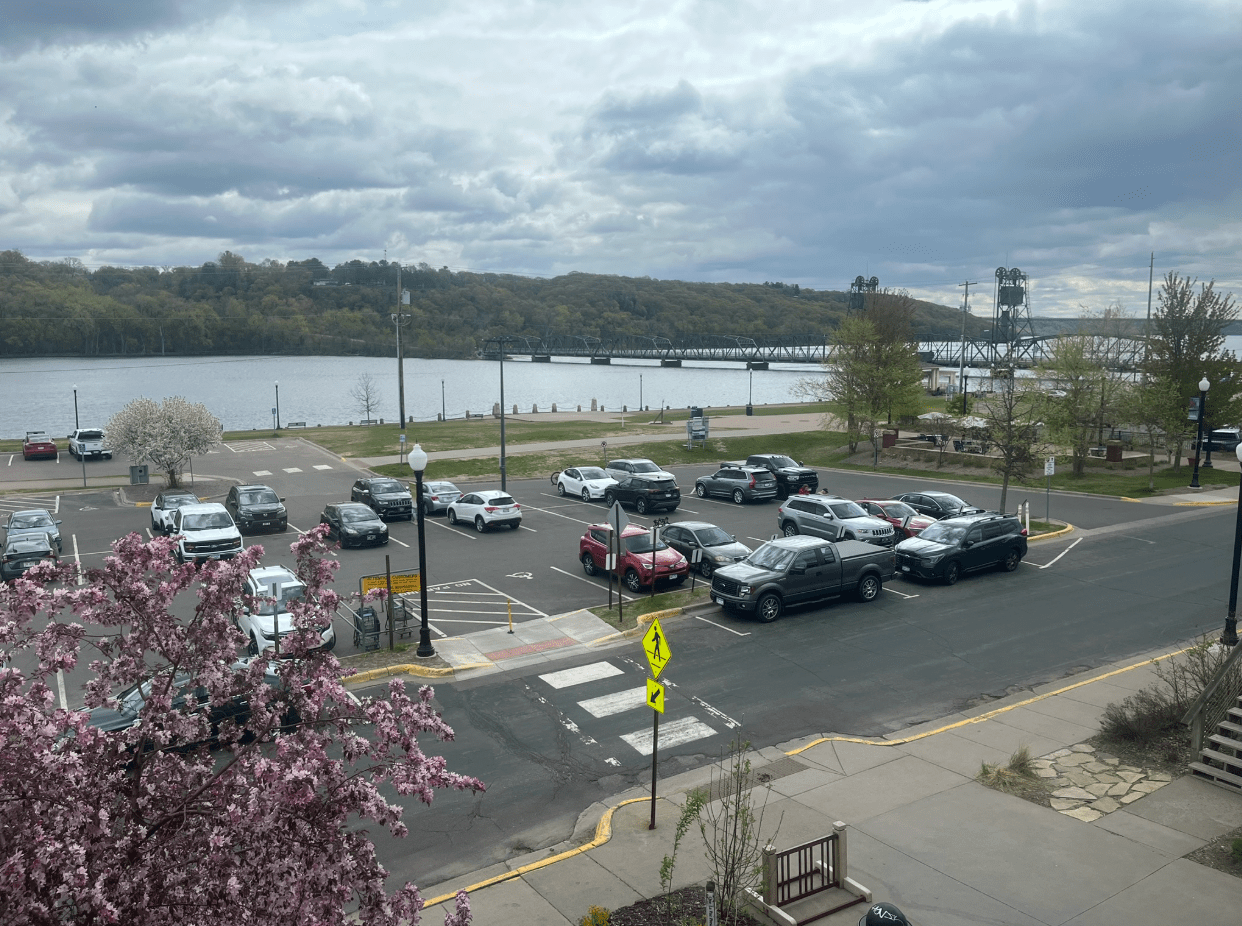
The riverfront, arguably the most valuable real estate in town, is dominated by asphalt, concrete, dirt, and scrub grass. There is virtually no shade, which becomes painfully visible on busy days when families cower behind a token sapling at Lowell Park. The few trees there prove only that trees could grow along the waterfront. They mostly haven't, presumably because each one would take a parking space or block a corner of the almighty bridge.
“Walkable” Main Street is a state highway—literally MN-95—and it functions like one. Loud trucks and weekend cruisers use it as a through-route. (Would you like a few straight-piped Harleys with your al fresco lunch?) Sidewalks are so narrow it's hard to pass a single leisurely walker. Crossings are long, and sightlines are blocked by SUVs parked too close to corners. Visitors sheepishly scamper across mid-block more than they use the marked crossings, because the marked crossings are mediocre too.
This is why my walks go uphill. After a decade of choosing between a downtown stroll and a real walk, the hills win every time. They're quieter, the sidewalks are passable (at least where they aren’t missing), and the parking spaces up there sit empty most days.
That brings up something I've watched from above for a decade: A lot of the car traffic isn't even going anywhere. It's circling for parking. The very thing the Downtown Parking Commission exists to protect is generating much of the congestion that makes downtown unpleasant in the first place. Meanwhile, entire residential blocks of curb space sit unused a few hundred feet uphill.
Yes, diminutive Stillwater has a Downtown Parking Commission, the very existence of which in a town this size says it all. I've attended its meetings, once to plead for EV charging at Lowell Park, where ideal high-power 240V outlets already exist for festivals (denied, because a charging bay would "remove" a space), and once to ask about rules for oversized trucks that spill into multiple stalls (no rules exist).
Some view Stillwater as a biking mecca, and the trails earn it. But the experience collapses once you reach actual destinations. Route wayfinding and bikeways disappear. Bike parking is in odd spots, rarely in front of the actual destinations people are riding to.
I do give credit for the seasonal on-street bike corrals—they're the right idea, and proof the city can do this when it tries.
Decisions Being Made Right Now
The most damning evidence isn't historical. It's current. Stillwater (and Washington County) is making the wrong choices at this exact moment on projects that will lock in car-first design for another generation.
The Gas Station at Myrtle and Main Street
The Amoco station is being rebuilt right now, in the heart of downtown, and it somehow passed historical preservation review. It’s pushed to the back—and even puts the pumps on the Main Street side, making it quite clear where its priorities lie. Some stone veneer does not a historically sensitive structure make. Rebuilding a gas station here is doubling down on poor planning decisions made in years past.
Key Arterial Roads, Including Olive Street (County 5) and Myrtle Street, Are Being Reconstructed...
…and from what I can find, meaningful bike infrastructure isn't on the table. Public details are sparse, but it appears that either outdated on-street bike lanes or no bike lanes at all are still being implemented, despite the fact that people come to Stillwater even today specifically for the off-street (protected) bike trails. This is a remarkable unforced error given the cycling demand Stillwater already attracts. The Brown's Creek Trail, the Gateway, and the St. Croix Loop bring droves of recreational riders into town on every nice day. Olive and Myrtle are exactly the connectors that should welcome those riders into the core. Instead, these rebuilds treat bikes as an afterthought, if that.
These aren't legacy mistakes Stillwater is stuck with. These are choices being made today, by people who could choose differently.
What Stillwater Could Actually Be
The fixes aren't complicated. Three changes would transform Stillwater.
Pedestrianize Main Street
Convert it to a woonerf—Dutch for “living street”—which allows pedestrians to use the full width of the road, or even a pedestrian-only mall. At minimum, restrict vehicles after 10 a.m. to local deliveries. Time-restricted streets are routine in Europe, and the towns that have them are doing fine.
The oldest, most appealing stretch of Main Street in Stillwater was built before cars and has no vehicle entrances anyway. There are alternative routes around downtown in several directions. Main Street being a state highway is a historical accident, not a necessity, and the truck traffic that uses it as a shortcut has plenty of other ways through (provided at least one would be designated an official truck route).
Plant Trees, and Put Out Seating That Invites You to Stay
Stillwater's leaders seem to view the iconic Lift Bridge as a billboard the town must serve above all, and anything that blocks the view is suspect. This has it backwards. Trees and new structures don’t impede the experience of being downtown; they create it.
Nobody needs to see the entire Lift Bridge from every square foot of the city. (Might I also suggest burying the unsightly power lines that actually do obscure the views?) People like nature, and they like sitting under it. The city's current solution, cold steel benches scattered along bare pavement, does the bare functional minimum and nothing more, especially in the shoulder seasons and winter. Anyone who's tried to sit on one in February knows what I mean.
Reclaim the Waterfront
This is the most glaring one. A meaningful portion of the surface parking directly in the riverfront viewshed should become parkland: flexible event space, real plantings, a playground, pickleball, outdoor games, patios, public art. Anything but a sea of oversized trucks and SUVs. The parking that gets displaced exists in abundance two blocks up on Second Street and on the residential streets climbing the north and south hills, where it is rarely full. The city also keeps forging ahead with expensive structured parking near downtown. Parking prices could be adjusted in premium spaces to motivate able-bodied visitors to leave key spots for those who actually need them.
A few smaller fixes follow naturally: broaden sidewalks, narrow vehicle lanes, shorten crossings, and pull street parking back from corners so drivers can actually see pedestrians in time to yield. When MN-95 next gets rebuilt, or ideally downgraded from a state highway to a city or county street, the existing right-of-way is wide enough to give a couple of feet back to the sidewalks on each side without even removing parking. None of this is radical.
What I'll Miss, and What I Wish I Were Leaving Behind
Soon, my office is moving, and my midday Stillwater walks will end. I didn't push to keep us here. I couldn't, honestly. The office is far from the metro’s core, too far to even e-bike, and the transit options are poor enough that nobody on our team relies on them. A town that can't hold onto a daily worker who likes it has a problem the weekend crowds don't reveal.
Stillwater's charm—its gorgeous architecture, its natural setting, its deep history—has carried it a long time, and probably will keep carrying it for a while. But charm fades when it's wrapped in diesel fumes and earsplitting V-twin pops.
Most people experience Stillwater as an afternoon and weekend tourist destination. I've mostly experienced the weekday version, the workaday version, the January version. I've walked it in 90-degree humidity and in sub-zero cold snaps where the river steams. I've watched the same drivers loop the same blocks looking for the same waterfront spots while quiet streets sat half-empty a block uphill. I've watched nervous families flinch at intersections. I've watched the Chestnut Street Plaza fill up with ice-cream enjoying families on a sunny afternoon and remembered what's possible when the city actually picks people over parking.
What I'll miss is the Stillwater that already exists in glimpses: the stairs, the river, the plaza, the bones of the old town. What I wish I were leaving behind is the Stillwater that could exist if the current decisions went differently. A town where the “historic” Amoco became something worthy of the corner. A town where Olive and Myrtle invited the cyclists who already love this region to Main Street businesses. A town where the waterfront was for people, and Main Street was for walking and socializing, and the trees along the river were old enough to throw real shade.
That would be a Stillwater worth coming back to. And finally, one worthy of praise that isn't faint.