


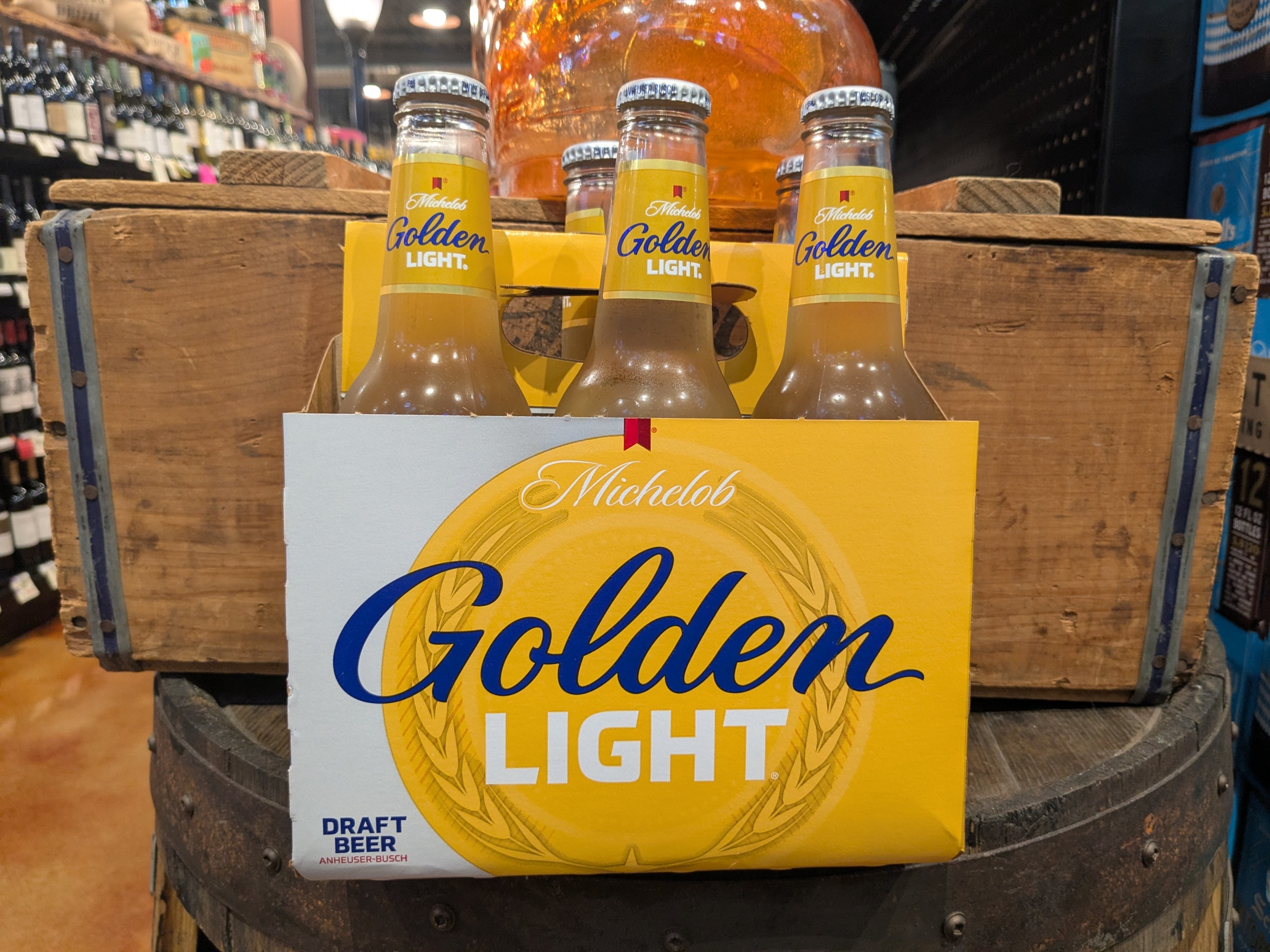
In Minnesota, Michelob Golden Light is just a given.
If you’re aboard a pontoon on Mille Lacs, there’s a sixer in the cooler. If you’re sitting under the sun at Target Field, there’s Mich Golden for sale in your section. The beer is so woven into Minnesota summer that they sell cases branded with the phrase “LAKE LIFE” as soon as the weather turns post-glacial.
But what’s lost in the everyday charm of Goldie, McGolden, or whatever you call the effervescent, straw-yellow light lager is how unlikely it is that such a beer would even exist. Much less here.
How is it that Michelob, producer the best-selling beer in America, makes a variant that pretty much only Minnesotans drink? How has a state of fewer than 6 million people stood as a critical market for Belgium-based Anheuser Busch InBev, the world’s largest brewing company, for over 35 years? How has a beer that’s brewed in St. Louis, and has no obvious regional ties to the Gopher State, found such a permanent place in the hearts of Minnesotans?
The story of Mich Golden is not just one of a quirky beer; it’s the tale of a corporate experiment run amok. It’s a fizzy cuckoo that started as an also-ran and became the darling of an entire region. In a land of 10,000 beers, a hotbed of craft brewing, this is how Michelob Golden Light became the most iconic Minnesotan beer.
From Challenger to Champion
In the 1990s, American beer producers were desperate to recreate the appeal of draft beer for at-home drinkers. At the time, canned and bottled beer had gained a bad rap as low-quality swill, and breweries began positioning draft (or “draught,” for even more perceived quality) beers as higher-quality alternatives that tasted truer to the on-tap experience.
Slowly, the big players began releasing draft alternatives. Miller Genuine Draft was the forebear, coming to market in 1985 touting a “cold-filtered" process that maintained the smoothness killed by the heat pasteurization used to can most beers. “Twist the Cap, Beer on Tap,” went their slogan. Around the same time, Coors began marketing Extra Gold Lager as “draft,” and by 1990, Budweiser was doing the same with Bud Dry.
Mich Golden Draft first debuted in 1991 alongside its lighter variant, Michelob Golden Draft Light. Jessica Potter, a former marketing exec at Anheuser Busch, brushed back questions about the beer being an entrant in the draft/draught trend, but the branding was unmistakable. Mich Golden Draft was sold as being “smooth over everything” and “pure cold.” Never mind the fact that the beers shared the same initials as Miller Genuine Draft and the signature black-and-gold color scheme.
“Michelob Golden Draft Lager was initially launched in the early 1990s nationally to provide consumers with a high-quality draft-style lager,” Potter told me in a 2019 interview while she was still with AB. “Of course we pay attention to what our competitors are doing in the market, but our approach has always been to simply brew the best beer possible.”
MGD was already immensely popular in its home market of Wisconsin by the time Michelob Golden showed up six years later. Naturally, AB started testing its challenger in the Upper Midwest, promising drinkers that it’d help them “capture the pure cold.” Maybe it was the sibling rivalry between the neighboring states driving the success, but it stuck. As MGD went national, AB cut back and focused on Minnesota and seven other states, including Iowa, Illinois, and the Dakotas.
MGD peaked in 1999, and by the late 2000s, the beer industry plunged into recession. MGD sales crashed, and the beer has been limping along ever since. AB tried to re-invigorate the brand with an edge-lordy 2021 rebrand, but MGD’s days of occupying fridge space are mostly over. No one touts the virtues of draft beer anymore. And yet, Mich Golden Light has survived not by emphasizing its cold filtration or proximity to draft beer, but by leaning into the folks who loved it.
“Minnesotans live an enviable life that simply works really well with Michelob Golden,” Potter said. “We are always assessing opportunities to expand regional brands into new markets, but Minnesota will remain our top priority even with expansion.”
A Minnesota-Marketed Macro
Doug Hoverson, a beer historian and author of Land of Amber Waters: The History of Brewing in Minnesota, calls Mich Golden a “nostalgia beer.” He recalls the brand’s heyday wistfully.
“It’s the ultimate beer that was brewed for refreshment rather than flavor,” he says, almost laughing. “For that group that came of age in the ’90s, [Mich Golden is] what someone had a warm case of in the back of their car.”
Hoverson balks at the idea that this nearly flavorless beer appealed to Minnesotans’ bland palates, or that there was some cosmic connection to the Minnesotan way of life. This beer style was once eminently popular across the U.S., and regional anagrams like Old Style, Schlitz, and Rainier serve the same function in cities like Chicago, Milwaukee, and Seattle. Most likely, distributors went after the Minnesota market and scored a surprise hit.
Over the years, AB has continued to market Mich Golden as a tenet of the Minnesota way of life, partnering with the Wild, selling Lake Cans every summer, and goading Instagram followers with hotdish appreciation posts. In Hoverson’s mind, this is the most unique aspect of the beer.
“It was a good example of a big brewery trying to act like a regional brewer and make something special for Minnesota, though it is available in other states,” he explains. “I strongly suspect that Mich Golden is actually one of their [AB’s] other beers in a Mich Golden bottle or can. A lot of those bigger brewers, especially the contract ones, when they’re making those nostalgia beers, they’re just putting one of their regular brands in cans and calling it Hamm’s or Schlitz.”
Christine O’Connell, director of beer and hard beverage at Total Wine & More, confirms that Total Wine sells more Michelob Golden at its 11 Minnesota locations than at any of its 250+ nationwide stores. While Mich Golden sales represent just a sliver of AB InBev's $59 billion annual revenue, the beverage giant keeps churning out the product, almost exclusively to satiate demand in Minnesota. To O’Connell, that targeted success comes down to the drinkers, not the brand. Despite Hoverson’s skepticism about the liquid itself, he’s just as susceptible to the brand’s unique combination of “familiarity, consistency, and value” as anyone else in Minnesota.
“Its enduring popularity in Minnesota highlights the power of local relevance,” O’Connell says. “It proves that consumers often form deep connections with brands that reflect their culture, traditions, and lifestyle.”
Remarkably, that sterling brand seems to be a bottom-up phenomenon, the product of associations drinkers themselves made since the early days of Mich Golden. As Racket explored in-depth with the doomed Lakemaid Beer, cabin-life marketing—or pandering, you decide—doesn’t guarantee success. Mich Golden may spend a lot of time on Instagram crafting a case for itself as the de-facto lake companion, but that idea was created in the days Hoverson reached for a warm one in the trunk of his pal’s car. The beer has always been at the lake, and the ads only amplified what drinkers here already knew in their marrow.
“Michelob Golden Light is part of a handful of regional beer success stories that continue to thrive across the country,” O’Connell says. “Its enduring popularity in Minnesota highlights the power of local relevance, proving that consumers often form deep connections with brands that reflect their culture, traditions, and lifestyle.”
Outside of O’Connell, Potter, and the draft-crazed drinkers of the 1990s, few are convinced of Mich Golden’s quality as a beer. The beer is, quite simply, bad. Over at BeerAdvocate, the largest website for drinker-sourced beer reviews, Mich Golden boasts a 59 out of 100 score. “Awful,” per BA’s metrics. “Not much here but the brew is wet at least,” reads one of the more charitable reviews. The epithets make Mich Golden’s success all the more unlikely. But Minnesotans have come to see it for what it is—corn soda, a beer to be guzzled at high volume with low expectations.
There are legions of similar beers that could fit the bill. A Grain Belt fits in your boat’s cupholder just as well as a Goldie; a Hamm’s cuts through the lawnmower dust just as cleanly. Mich Golden’s resonance is deeper than taste.
Mich Golden isn’t made here. But it’s here. If you didn’t know to look for it, you’d never find it, but once you do, you see it everywhere. Minnesota has stolen a piece of the largest beer company’s heart, and they guard it with the pride only a flyover state could muster. That’s why they spend so much time on the internet reminiscing (and dismaying) over the brand’s signature ribbed cans. That’s why they’ve started plunking olives in their pints. The beer chooses itself. As Redditor mustardsuede put it back in 2020, “Why get bud light/miller/coors when you can get something ~special~ that only we can get?”
Marketers and historians can try to explain that sentiment, but they’ll never capture it better than that. It’s special because it’s special. Even if you don’t like the taste of Mich Golden, there is something in the Minnesota heart that calls you to respect it. It’s blood-borne.
Plant a dill spear in your glass and knock back a bevy that cannot be enjoyed—or truly comprehended—anywhere else in the world.