


Melvin Gibbs always knew he had a book in him. So has nearly anybody who’s talked to him a while—or even just watched him play.
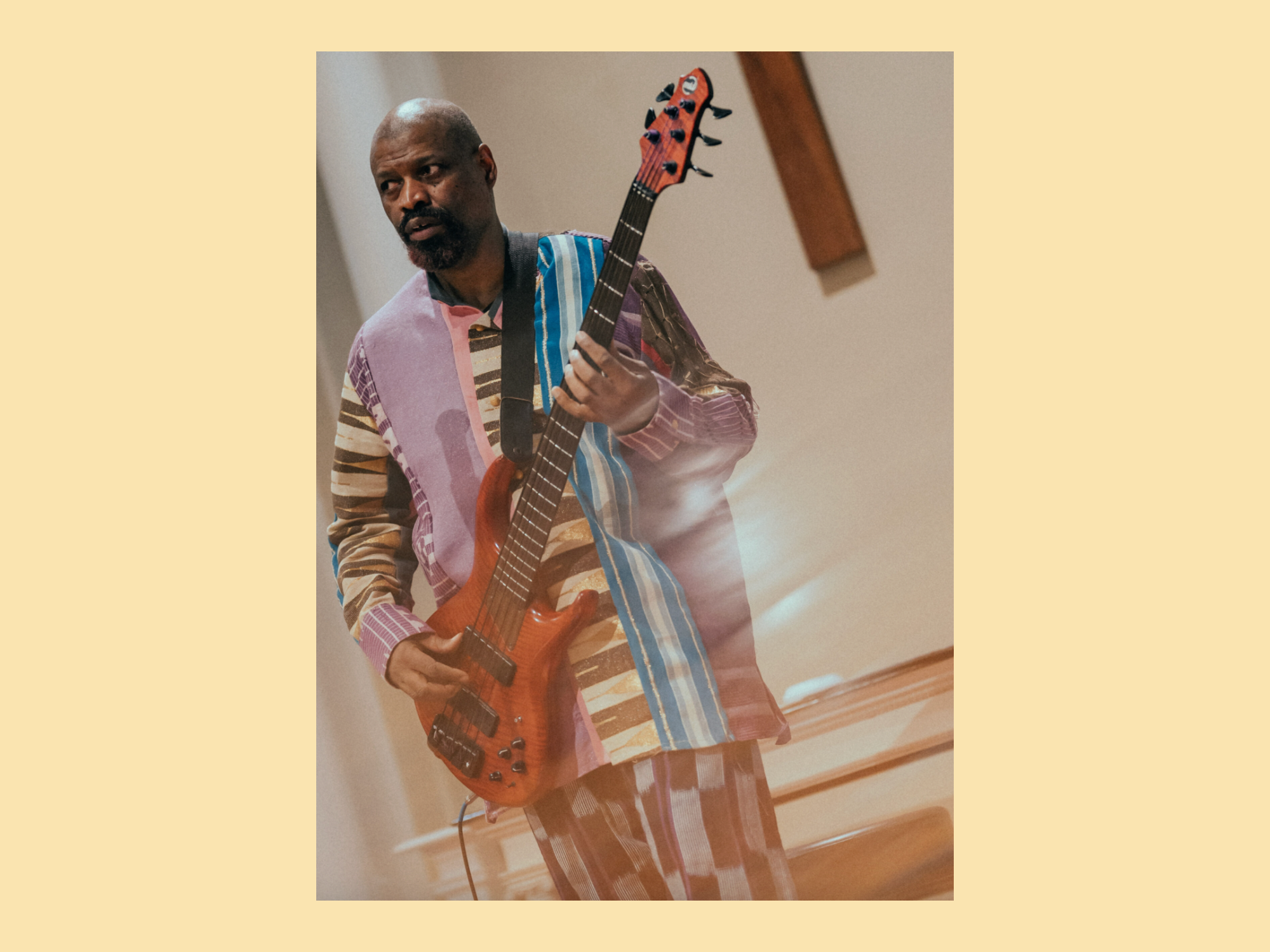
Take his appearance last September at the Walker Art Center, where the 67-year-old Gibbs played with Minneapolis composer Douglas R. Ewart & Inventions, a sextet, as part of the AACM @ 60 series. While he’s frequently a bandleader, Gibbs is also a first-call sideman, a world-class bassist fluent in a panoply of global styles, though he may be best known for playing avant-garde jazz.
During the Inventions performance, the poetry-reciting Ewart, vocalist Mankwe Ndosi, and dancer Lela Pierce typically held the spotlight. But the way the tall, bald, and intense Gibbs watched over the proceedings—a running commentary unfolding from his eyes as much as his instrument—exerted an equal pull.
That hyper-awareness emanates from every page of Gibbs’s How Black Music Took Over the World, which came out last week via Basic Books. It’s a feast of a book, synthesizing history, musicology, and autobiography with a storyteller’s flair and a scientist’s deep inquisitiveness. Gibbs specifically approaches Black music as a science. “The best business-oriented researcher is the one who finds the best answer,” he writes. “The best scientific researcher, on the other hand, is the person who finds the best question.”
We learn that Gibbs was a science buff as a kid—and that he maintains a working relationship with the theoretical cosmologist Stephon Alexander, who is also cited within. He’s not alone among his musical cohort, either. “With a lot of the quote-free jazz-unquote [players], there’s a lot of actual commonality of thought between what you’re doing and what people are thinking about when you’re thinking about quantum physics,” Gibbs notes over lunch at Post Modern Times.
“The idea of collating what I know in a systematic way has been growing for a long time,” he tells Racket. “The book aspect of it came more opportunistically. But yes, thinking in terms of a system is something I’ve been doing for a while.”
Still, Gibbs didn’t want to make his first book too heady. The mix of the anecdotal with the historical and musicological, he says, “came pretty quick. I realized that a pure theory book was going to be kind of boring to read, and a pure memoir was—I mean, why would anybody read it?”
That answer’s easy: Gibbs, who for the past two years has split his time between Minneapolis and his hometown of Brooklyn. has lived a singular, distinctive musical life. But he was right to combine these approaches. Clearly and engagingly, he offers sharp and highly developed ideas about how Black music works, its social and musical functions, and why it continues to matter. And he does it in just under 300 pages.
How Black Music Took Over the World connects an enormous number of dots—sometimes literally, as when Gibbs utilizes clocklike circular figures to denote the many rhythmic workings under discussion. (These are adapted, as he notes, from the Rhythm Necklace App.) Sometimes the book is forthrightly musicological, but even when details occasionally went over my head, I never felt lost reading it.
Gibbs’ book is apt to reshape the reader’s view on a lot more than just music. “In music, simplicity is a costume that complexity often wears to hide,” he writes. Just as incisively, he points out that when Africans came to America, “They had to construct a culture that served the mission of reinstituting the humanity of the millions of people who were deemed to embody everything that opposed that concept. Every trope in African American culture that seems to be oppositional has to be seen in that light.”
As a young man, Gibbs played bass with jazz organist Doctor Lonnie Smith at Harlem’s Breezin’ Lounge, and had what he felt was a strong grasp on playing the blues for a Black audience. Then he was called in to back up Left Hand Frank, a Chicagoan from the South Side, and had to adjust his style completely. The baritone saxophonist Hamiet Bluiett spent an hour after rehearsal schooling Gibbs on what to play, “repair[ing] a major hole in my musical knowledge,” Gibbs writes. The blues are far from musically monolithic, he explains, but rather are intensely community-based.
Gibbs enumerates key differences between African tuning and Western tuning, and thereby in musical philosophy. “When African American singers or musicians worry a note”—varying it, often with vibrato or melisma—“the resulting tone breaches the European tuning system,” he writes, adding later: “African-American musical practice doesn’t just worry pitch. It also worries Western harmonic categories.”
Gibbs has been flouting categories for as long as he’s played bass. Very early on, he gigged with a country band; his first bass teacher handed Gibbs the job after a few lessons. By his early twenties—and, he says over lunch, to his surprise—he was playing with Ronald Shannon Jackson and the Decoding Society, part of a teeming Ornette Coleman-inspired school of players. As Gibbs memorably tells it, Shannon Jackson was also a fan of stinky cheese, which altered the scent of the band’s luggage while on tour.
By the turn of the ’80s, Gibbs was splitting his time between avant-garde jazz in the early lineup of Joseph Bowie’s band Defunkt, and no wave, as part of the piquantly named James White and the Blacks, led by James Chance. In the latter world, Gibbs befriended the trio DNA, whose guitarist-yeller, Arto Lindsay, would become a major player in Brazilian pop, with Gibbs a frequent collaborator to this day. (Local angle: Arto’s 1996 version of “Erotic City,” led by Gibbs’s bass, is one of the great Prince covers.) In the late ’80s, Gibbs was a founding member of the Black Rock Coalition, co-founded by his Decoding Society bandmate, guitarist Vernon Reid, later of Living Colour.
How Black Music Took Over the World opens with a remembrance of the author’s daylong march through Salvador de Bahia alongside Banda Olodum, “a contingent of 120 drummers,” during Brazil’s Carnival. At one point in the book, Gibbs notes he’d played with musicians from five continents. At Post Modern Times, he ups the estimate to six. “I must have played with an Australian at some point,” he says with a laugh.
Gibbs maintains a full musical schedule. He plays regularly with two New York bands, the post-rock outfit Body Meπa, with guitarists Sasha Frere-Jones and Grey McMurray and drummer Greg Fox, and the improv/dub/jazz trio Harriet Tubman, with guitarist Brandon Ross and drummer/percussionist J.T. Lewis. The latter just released Electrical Field of Love, a collaboration with L.A. vocalist Georgia Anne Muldrow. With her input, Gibbs notes, “I guess you could call Harriet Tubman two bands now.” And there’s still loads more—not least Gibbs’s own projects as a leader.
He’s even made some hits. One of Gibbs’ many collaborations with Arto Lindsay resulted in the Rio de Janeiro singer Marisa Monte’s “Baija Eu,” which went to No. 1 in Brazil. And when the bassist joined Rollins Band, led by the punk icon Henry Rollins, in the mid-’90s, one of the first songs Gibbs worked up with the group was what the book describes as a “reinterpretation of a classic ’70s soul-ballad trope,” with “a bridge where the lead singer switched from heartfelt singing to heartfelt conversation” before hitting them with the chorus again.
This Isaac Hayes/Millie Jackson-style number? That’s right: the screaming “Liar,” Rollins Band’s biggest hit, not to mention a Beavis & Butt-head favorite. Few who’d heard it on the era’s modern rock radio could have traced it back to its source. Learning what that source was just makes the song cool again. As an example of Gibbs’s book-title conceit, that one’s pretty hard to beat.
Nevertheless, Gibbs stresses that calling the book How Black Music Took Over the World wasn’t his idea. “The title is not a one-to-one relationship to what’s in the book,” he explains. “I didn’t pick the title. But what’s happened in the past few months is, the world has justified the title, in a way, more than I would have thought.”
He illustrates his point with a recent experience: “I was checking out Brass Solidarity when they were playing at the site where Alex Pretti got murdered. Their repertoire was all soul music. Everybody in the audience knew all the songs, and they were singing along. As I say in the book, music was created for a community, to be useful to the community. And that’s how Black music took over the world—by being useful to the community that way.”
How Black Music Took Over the World
With: Melvin Gibbs, in conversation with Philip Bither
Where: Magers & Quinn Booksellers, 3038 Hennepin Ave., Minneapolis
When: 7 p.m. Monday, April 20
Tickets: Free with registration; more info here.