

Cara Letofsky is a longtime Minneapolis resident working at the intersection of community organizing and policymaking. She writes Field Notes from America, a newsletter about her observations on the American experiment through the lens of economic inequality, systemic racism, and history. The views expressed here are her own.
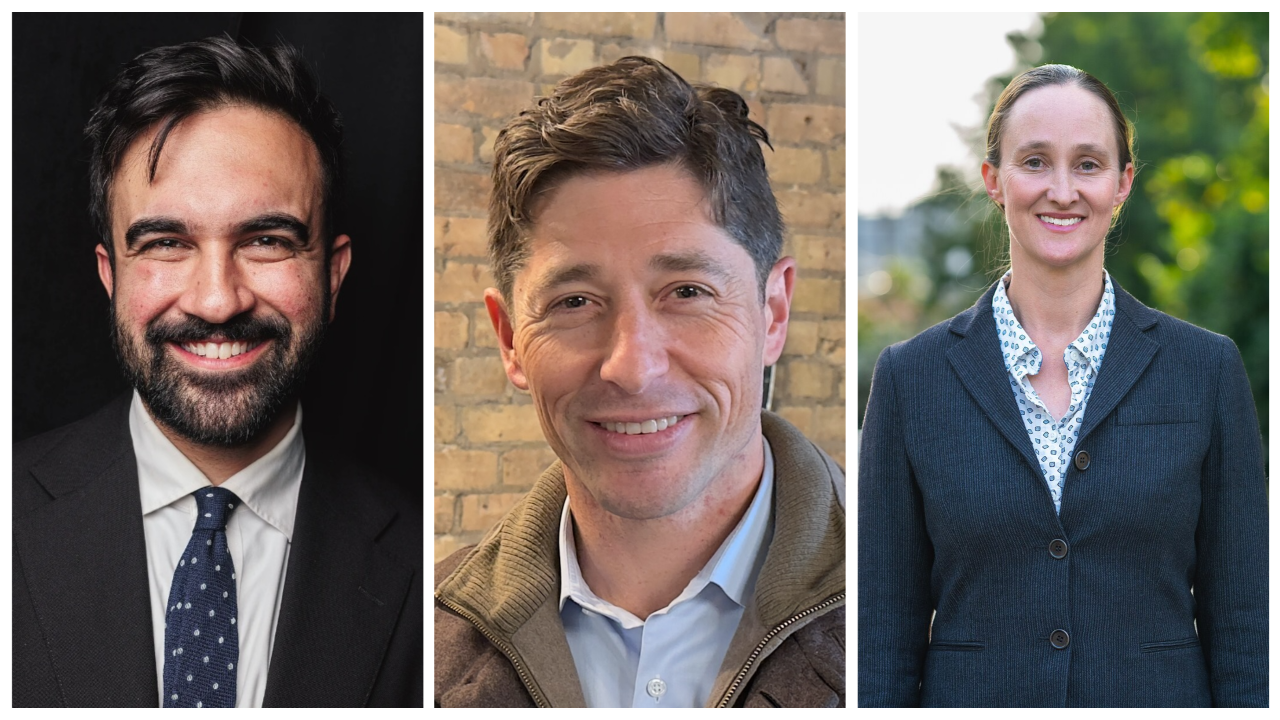
In the run-up to last fall's elections, I wrote about what the races for mayor in New York, Seattle, and Minneapolis could tell us about the generational divide within the Democratic Party coalition, and how we can unite for a better future.
At the time, headlines screamed about how the more progressive candidates in those cities would make their cities hellscapes, while their centrist challengers—Andrew Cuomo (NYC), Bruce Harrell (Seattle), and Jacob Frey (Minneapolis)—would protect us from that fate. Supporters of the more progressive trio were hopeful that new perspectives on their respective cities’ challenges would make their cities even better places to live, especially for the working class.
The voters spoke. New York and Seattle voters elected the lefty options, while Minneapolis voters opted for more of the same.
Now that we’ve passed the first 100-day mark, it's a great time to check on how they are doing.
In New York City, Mayor Zohran Mamdani has been relentless during his first 100 days. Eight days into office, the 34-year-old mayor stood alongside New York Gov. Kathy Hochul to announce an expansion of the city’s free childcare program, a top campaign priority. In early February, he announced hearings for renters to testify on how to hold bad landlords accountable. At a rally marking his 100th day in office, Mamdani revealed the location of the first public grocery store, making progress toward another campaign promise of publicly owned, affordable grocery stores in each borough.
Mamdani is an expert at picking locations that amplify his values and vision. He took the oath of office in an abandoned City Beautiful-era subway station to remind New Yorkers that it used to build beautiful things for average people. The East Harlem location of the first public grocery store is where Mayor Fiorello LaGuardia opened a market in Depression-era New York in 1936, to harken back to the promise of the New Deal, when the government helped people obtain material needs—what a concept.
Then, on Tax Day, a smirking Mamdani advanced closer to another campaign promise: taxing the rich. One such tax will apply to New York’s non-primary residences—known as pieds-a-terre—worth $5 million or more. It is projected to bring in $500 million annually, which will help pay for other items in Mamdani’s proposed budget.
His viral video promoting the tax sent shockwaves of fear through the billionaire class. In it, he called out hedge fund billionaire Ken Griffin’s $238 million penthouse, which stays empty most of the year. But Mamdani remains on message, taking any opportunity to reiterate his vision of a city that works for everyone.
Of course Mamdani has detractors, mostly Wall Street execs, developers, and real-estate tycoons. During the campaign, his opponents and their supporters used Mamdani’s affiliation with democratic socialism against him, warning of a collapsing city if he were to win.
That’s not happening.
Mamdani isn’t shying away from his ideological principles, even embracing the term “sewer socialism.” That turn of phrase comes from the early 20th century, when Milwaukee’s governing socialists focused on building sewers and water systems for their city's growing population of working people. As the New York Times writes, for Mamdani, leaning into sewer socialism means improving the day-to-day lives of New Yorkers’ by focusing on public services.
On the other side of the country, the term "sewer socialist" was also applied to Katie Wilson while she ran successfully for mayor in Seattle.
Wilson, a community organizer and first-time candidate, beat first-term incumbent Bruce Harrell in a squeaker mayoral race. Wilson’s campaign was backed by community activists with whom she had worked side by side for years. She campaigned on a 10-point agenda covering issues from “get[ing] results on homelessness” to “Trump-proof[ing] Seattle” to “climate action and environmental justice” to “progressive revenue.”
“This is the first time in years that a truly progressive candidate has won the mayor’s office in Seattle,” Alex Olson of Washington Daily wrote after the election.
At the three-month mark, some of Wilson’s most ardent supporters were already protesting in the streets. While her office’s press release on her first 100 days highlighted progress on top goals, the local FOX station claimed she’s “trading the picket line for the mayor’s desk.”
Some of Wilson’s campaign supporters led a “Communities Not Cameras” rally outside of Wilson’s office, criticizing the mayor for her action—or rather lack thereof—on the use of police surveillance cameras in the city. But once in office, Wilson only paused the planned addition of police CCTV cameras, opting instead to pursue an audit into their potential harmfulness to marginalized groups before making a longer-term decision about removing them.
Former Wilson supporters reported feeling like “she’s kind of backtracked on what she said during the campaign.” And while her call for an audit “may not have been a literal departure from campaign promises,” it was a “thematic” one. Washington Daily’s Olson, who was so enthusiastic when she won, wrote: “After 100 days in office, Katie Wilson is running out of campaign promises to break.” .
And yet, Wilson seems to be approaching the job with a community organizer’s sensibility, including taking time to understand the various sides of an issue and building relationships with people who were most opposed to her candidacy.
Her pledge to open 1,000 new shelter beds a year for four years is a good example of her style. Just days into her term, she issued an executive order to create an interdepartmental team to bring focus to the task. With the support of City Council members, Wilson pushed a set of legislative changes to speed the development of new shelters, expand the capacity of existing shelters, and reallocate unused funds for immediate deployment. Two of the three components have already passed through the council.
While Wilson doesn’t have Mamdani's rare charm and messaging prowess (gaffes are common), she does have a working relationship with her City Council partners on behalf of their shared Seattle constituents. Even without sharing the same activist base, Wilson works with council members to pass legislation and announce new initiatives important to the city. She even found an alternate nominee for an administrative appointment when the council pushed back on her first choice.
And that gets us to Minneapolis Mayor Jacob Frey.
Frey was first elected mayor in 2017, after serving one term on the Minneapolis City Council. He was reelected in 2021, one year after the police murder of George Floyd. In that election, Minneapolis voters also passed an amendment to the city’s charter giving the mayor’s office more power over city operations. And, last November, the biz-friendly moderate was reelected for a third time.
Early in this term, which he says will be his last, Operation Metro Surge exploded. The deaths of Renee Good and Alex Pretti, combined with residents rising up to fight the deadly federal occupation, put Frey in the national spotlight. He scored good marks for saying “fuck” in front of cameras while demanding ICE agents leave the city. At the height of the crisis, Frey worked with council members to protect residents from lawless federal agents.
But by the time the 100th day of Frey’s latest term arrived, OMS had waned, and headlines about Frey threatening to veto yet another council action were back.
This time, the issue was the reappointment of Frey’s Community Safety Commissioner, Toddrick Barnette. Under the city’s charter, mayoral administration appointments—and reappointments—require City Council approval. The reappointment is in limbo; is it even possible to veto a no vote? But the issue has triggered another round of efforts to consolidate power in the mayor’s office, and the city’s Charter Commission debating a change to remove the City Council’s role in approving mayoral appointments. This saga inspired a Star Tribune opinion writer to hyperbolically call for the end of civic self-governance altogether.
Frey’s veto was on brand: He has vetoed more council votes than any previous mayor. But his action was quite the opposite of what he laid out this past January in his third inaugural address, when he called for “a unity that does not search for the fault line, but for the bridge that spans it.”
The mayor’s combative approach to those City Council members he doesn’t align with is longstanding. Some cite its roots being established when, soon after George Floyd’s death, protestors showed up outside his home and asked him if he would defund the police. His noncommittal answer led to chants of “Go home, Jacob, go home!” and “Shame! Shame!” Others attribute it to his training as a professional long-distance runner, noting that it is an individual sport, rather than a team one.
In either case, Frey’s ambitious 2017 promises to end homelessness and take accountability for police failures remain unfulfilled—and seemingly forgotten—during the first 100 days of his final term as mayor.
This ability to partner with others to govern may be the biggest difference between the three mayors. Mamdani and Wilson come from community organizing backgrounds, and they seem driven by a belief that the government can be a vehicle for uplifting residents’ lives, rather than relishing the strength of the position.
In that way, Frey’s reelection last November was a loss for the city. Like New York and Seattle, Minneapolis faces serious challenges: homelessness, along with the mental illness and public drug use that underlie it; the collapse in value of downtown commercial properties and the shifting tax burden to residential properties; and, of course, the pressure the federal administration is putting on the budget and rights of residents. To meet these challenges, cities need elected officials who work together on solutions. And that’s just not Frey’s way.
Instead, we’ll be seeing more vetoes, and it will be déjà vu all over again.