

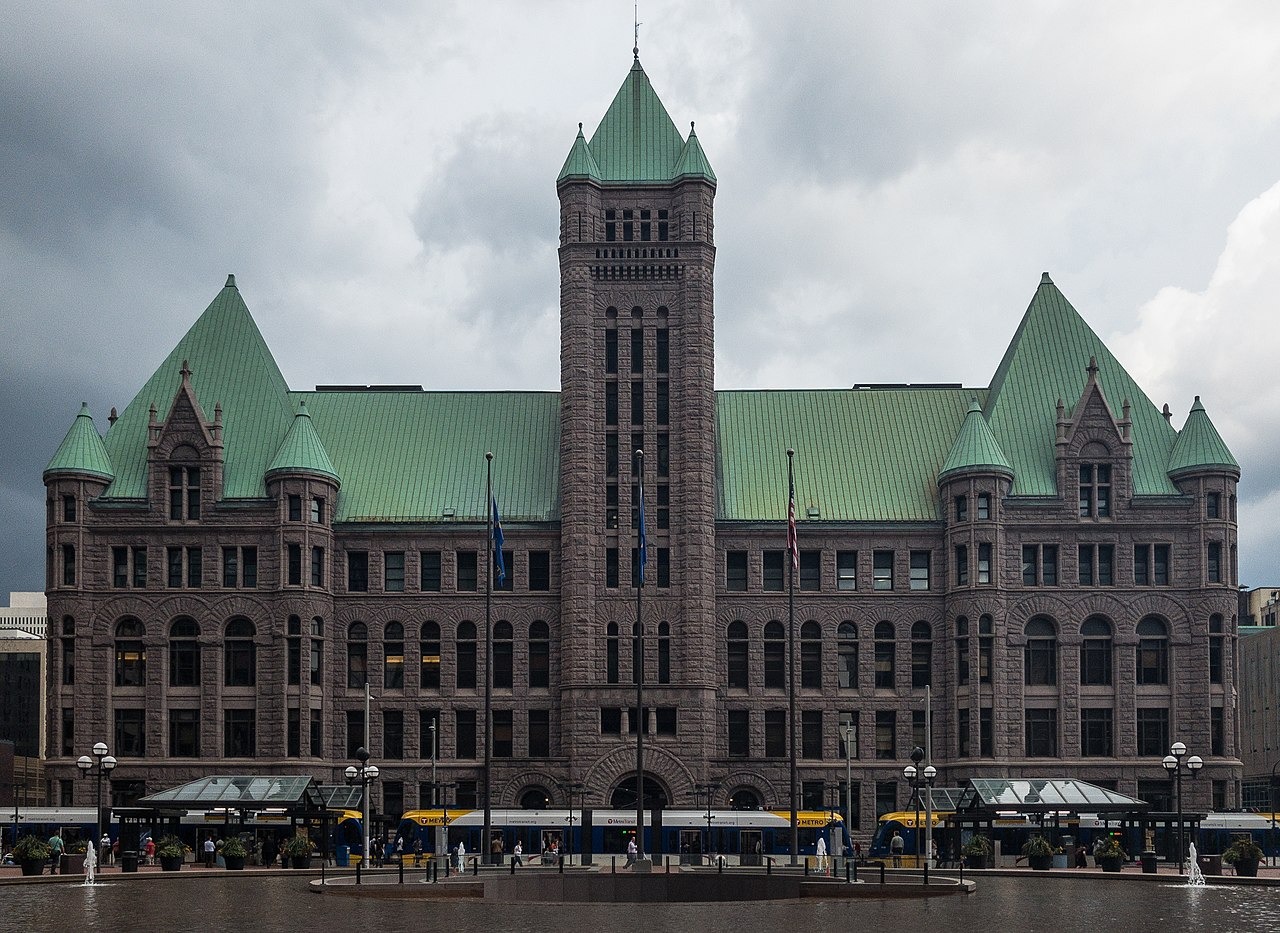
On Wednesday afternoons, Ryan Campbell walks from his downtown Minneapolis home to City Hall. He passes through the marbled atrium to the sensibly carpeted Legislative Department to hand-deliver letters.
It’s not that Campbell’s just really opinionated about local politics. These letters, addressed to city officials and offices, don’t represent his personal views. Instead, they show the tallied opinions of various other residents who’ve expressed support or opposition to upcoming City Council votes using a new website Campbell built called Live Democracy.
Campbell describes Live Democracy as his attempt at creating something that should already exist—a civic tool that shows “every bill that could hit a single person” before that bill goes to a vote.
“A lot of the way people find out about things is in reverse—it's after the vote, when something hits,” Campbell says. “I like to think that being able to understand what legislation is coming at you, at your business, at your family, at your lifestyle, will be helpful… It gives people knowledge ahead of time and time to plan, think, and organize.”
On the site, users can enter their ZIP code to see a curated feed of upcoming legislative votes that could affect them specifically, pulled from meeting agendas and calendars for different levels of government. Though the site will create a feed for anywhere in the U.S., the search currently works best in Ramsey County, Hennepin County, and in Illinois’s Cook County because Live Democracy has special granted access to city and county government data in those locations.
Users can click on a proposed bill to see a summary of the legislation, a link to the bill itself, and an option to signal if they oppose or support the proposal. These “signals” are automatically gathered into aggregate reports and emailed weekly to the relevant offices, or, in the case of Minneapolis, delivered to City Hall by Campbell.
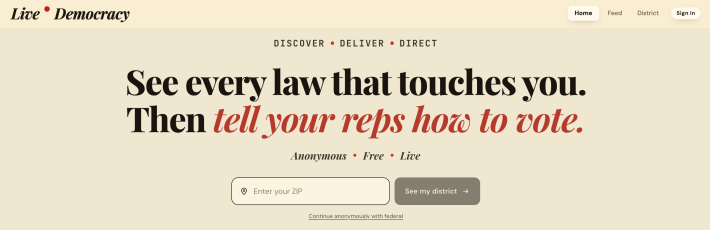
“It’s really an attempt at creating political action with a single click, and what I hope that does is really decrease the entry barrier to democracy for folks who can't be attending city hall or county board discussions, or making communications to their state legislators,” Campbell says.
Being a perfectly aware citizen is hard. Locating an agenda on a janky government website is a slog, and when you do finally find the right document, then comes the horrible task of parsing through it. According to a Pew Research Center report from 2024, “Americans also do not widely see it as easy to find the news and information they need to take part in the local political process.” And voter literacy has plenty of room for improvement. Fewer than 20% of Americans can name their state legislators and one third can't name their governor, according to a 2018 study from John Hopkins University. Campbell wants Live Democracy to make the process of discovering that information easier.
The idea of what he calls “a better form of direct democracy” has been on Campbell’s mind for years, but this passion project started in earnest in late last year with encouragement from friends who helped him figure out how to approach developing a website for the first time.
A friend’s suggestion that Campbell consider using AI tools was particularly impactful. Campbell is not crazy about AI, but he did decide to use Anthropic AI tools to help build the website and to enable the site’s legislation summaries.
A statement on the “About” page of the Live Democracy website reads, “I don't believe AI, on balance, is helping people more than it's hurting them right now. But it's becoming too powerful a part of technology to ignore, and while it earns companies billions, almost none of that is aimed at the everyday person.”
With the Live Democracy website, Campbell is trying to use AI for egalitarian ends, to make government legalese more accessible. In addition to summaries, the site also creates a personalized briefing on which bills were passed in the previous week and what’s coming up in the next week.
But using AI responsibly is a difficult task. AI summaries can be inaccurate, biased, and questionably sourced (so be careful with those Google AI overviews).
“I've noticed that even without instruction, or sometimes even with instruction, the voice [of the AI text] comes back with bias,” Campbell says. “So the goal [with the AI summaries] is to keep everything really short, really simple, and to always link the full legislative piece so that people can see it.”
Campbell also clarified that user data is kept away from the AI tools. A whole page of the website is dedicated to a detailed explanation of how user data is protected. Without selling user data, a free website can only lose money. Still, Campbell doesn’t want to make people pay, saying that he will “never push costs to people [and] would never create a premium tier or anything along those lines.” For now, he is planning to pursue grant funding.
“The way I think about it, this should be a piece of infrastructure that’s just available to people… certainly not a venture capitalist startup thing,” he says.
Campbell sees Live Democracy as a starting point. He hopes it can be an example of what could exist and that people use the site as inspiration for further research and action. The website is also full of disclaimers telling users that the tool is imperfect and should be used critically.
“There will always be a time where one of the AI summaries is inaccurate. There will always be a time when the signal can't make it to the reps, when an email bounces,” Campbell says. “I will always be transparent about that, and I would always love to know any feedback that comes from anyone.”
Campbell also acknowledged that, because the site doesn’t currently have comprehensive access to local data nationwide, Live Democracy primarily targets a few urban areas. He further mentioned that the project isn’t able to support democratic accessibility for people with limited internet access. But Campbell says he’s OK with starting small.
“I would be happy if there was a decent group of people in Minneapolis, say 50 people or so, who, if [the website] went away, they would be disappointed," Campbell says. "Where it could go? I'm not sure, but I just think that I’d like to spread the idea of Live Democracy and what it could be as a concept… if it continues to grow and people find it useful, I will continue to grow it and build as best as I can."