


I like to think I’m getting a little better at this every year.
When I first started this exercise in 2022, I was admittedly feeling my way in the dark. Now, as the Minneapolis-St. Paul International Film Festival enters its 45th year, and this feature celebrates its fifth, I feel almost like I know what I’m doing.
Every year MSPIFF brings more than 200 films to the Main Cinema and assorted other area theaters—this year that includes the Edina Mann, the Landmark Center, the Capri Theater, Mia, and Pop’s Art Theater in Rochester (which I’d really like to visit sometime). My job, as I see it, is to help you choose wisely and well from that abundance.
But here’s the tricky thing. Though the Film Society provides me with as many screeners as they can, studios are often reluctant to share them. (Do I look like I know how to pirate a film? I’m lucky if I can remember my Criterion password.) And I don’t even have time to watch as many of the handful available as I’d like. That’s where the guesswork comes in.
Now, if you’ll excuse me a little self-indulgence, let me talk a bit about (ahem) “my process.” If nothing else, maybe you’ll pick up a few tips for how to go about this yourself.
The first stage is pretty simple. I watch the trailers, and whatever screeners look promising, and I ask around to friends who’ve seen some of these movies at festivals. I look out for favorite directors and actors. All basic stuff. Duh.
Then I proceed to the dreaded review aggregators. Rotten Tomatoes and Metacritic are bad for multiple reasons I won’t get into here, but a big problem with the former is that many of the critics they aggregate just plain suck. Also, they are very generous about what constitutes a “good” review. So I look past the stupid Tomatometer score to see who is actually saying what. I also check out Letterboxd, where the Film Society makes a list of all their feature films.
Of course, my taste is my own. Looking at my recommendations, few if any could be described as “fun.” Still, I try to account for what might appeal to less Keith-minded audiences as well. And I do put in the gruntwork—I research every last damn feature film here. It’s maybe the most fun project of my year, and (sorry, co-workers) certainly the least efficient use of my time. My mini-mania is rooted in pure selfishness: I hate the feeling of knowing I’m missing out on a better movie than the one I’m currently watching.
As always, I’ve gone a bit overboard this year, spotlighting 40 films, very few of which I’ve actually seen. I’ve broken my recommendation into seven categories: The Big Guns (opening night, closing night, and other featured films), Rescreenings (older films that get cycled in to this year’s schedule), Locally Angled (Minnesota filmmakers or topics), Most Anticipated (no explanation needed), Notable Docs (because I tend to give these short shrift in my anticipated category), Not Quite For Me (but maybe for you), and Wild Card (movies I plan on seeing but have my reservations about).
And of course as soon as I publish this I’ll think “Goddammit, I forgot about…”
This year, the process has been a nice distraction as the world burns around us. But it also got me thinking about the category of the regional “film festival” as a way of organizing art and politics.
The high-minded international film festival, offering a range of perspectives from around the world, through documentary and foreign film, is a cherished liberal institution. As such, it feels more necessary than ever right now, and also more insufficient to meet the challenges of the moment.
At their worst, such festivals pander to us. Socially conscious documentaries ease the conscience of well-heeled patrons, allowing us to mistake empathy for action. Filmmakers make festival-friendly artistic choices, less-than-delicately plucking our heartstrings and providing easy answers.
But even at my most cynical, I can’t say these flaws outweigh the genuine contributions of a regional film festival. On Tuesday (and maybe whenever you're reading this), as the possibility of U.S. genocide against a nation with a rich film history seemed very real, I couldn’t help but acknowledge how much of what I know about Iran is due to its film greats. Humanist empathy is a muscle that must be consistently exercised.
So here’s my little contribution to that effort. I only hope that if it’s useful for me, it’s useful for you too.
THE BIG GUNS
Paralyzed by Hope: The Maria Bamford Story
Duluth comic Maria Bamford is a hero to depressed freaks everywhere (raises hand), not to mention her own colleagues like Stephen Colbert and Judd Apatow. Along with Neil Berkeley, the latter directed this look at Bamford’s life, which kicks off this year’s MSPIFF and made a splash earlier this year at Sundance. She’ll be in attendance, as will Berkeley.
Lucky us—this year we get two opening night movies. While we’ve all still got opposition to racist immigration enforcement on the brain, let’s enjoy a film about how the people of Glasgow banded together in 2021 to protect their migrant neighbors from the government. Sound familiar?
The latest from Steven Soderbergh (dude just does not stop making movies) has a great cast: Michaela Coel, Ian McKellen, and (oh well, can’t win ’em all) James Corden. Hope he changes his mind about generative AI though.
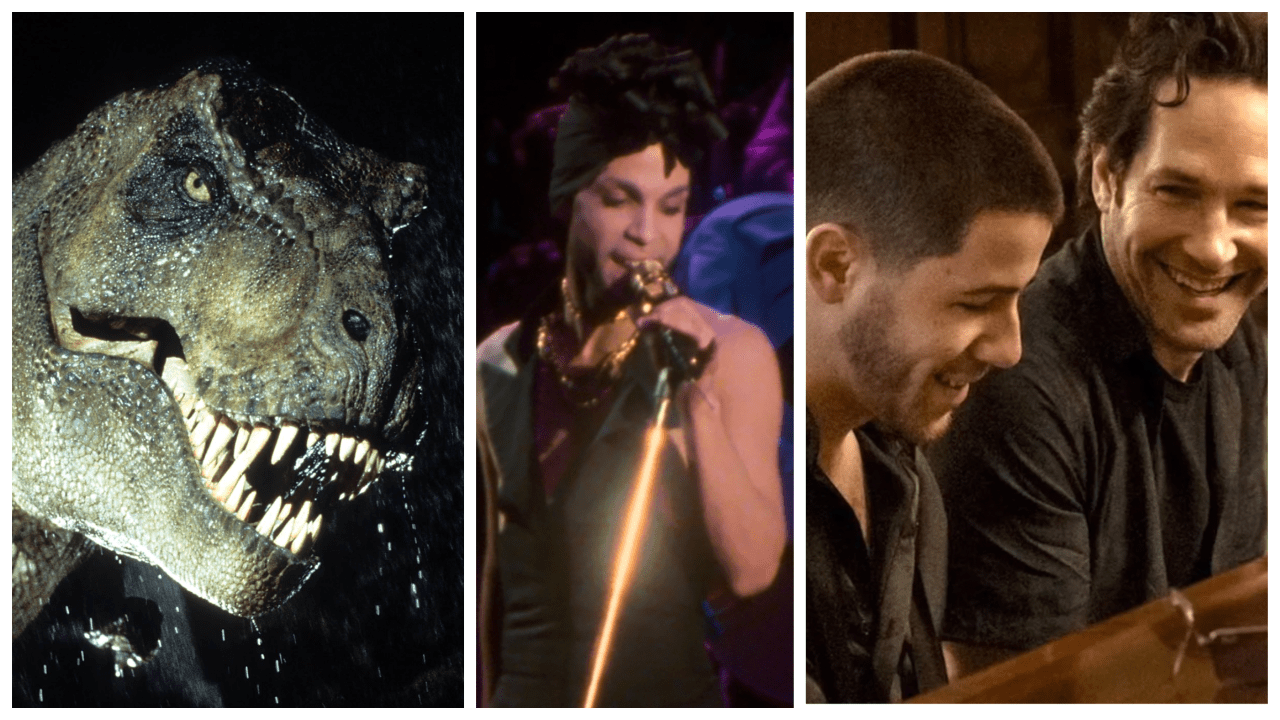
Paul Rudd is an aging wedding singer; Nick Jonas is an aging boy band member. They unexpectedly bond one evening, but then one betrays the other. The latest from John Carney (Sing Street, Once) is due for a wide release, but you can see it here first.
Prince & the New Power Generation Live at Glam Slam
The festival’s closing night film isn’t exactly new: Some version of this film, which captures opening night of the "Diamonds and Pearls Tour" in January 1992 at Prince’s short-lived downtown Minneapolis club, has been available online for years. But director Scott McCullough has been tinkering with the footage and I believe this is the most “finished” version.
RESCREENINGS
Barbara Kopple is best known for her rousing documentary of coal-miner union action Harlan County U.S.A. Her film about the 1985-6 walkout against Hormel in Austin, Minnesota, is far more ambivalent about organized labor. Though the film has been critically acclaimed, many Minnesota activists despise the movie, saying it misrepresents the events and their results. Among them is Peter Rachleff, professor emeritus of history at Macalester College, who’ll be part of what’s certain to be a lively panel discussion after the film.
Mia is getting in on the act this year as well, screening the second film in Satyajit Ray’s Apu Trilogy. The follow up to Ray’s wonderful childhood film Pather Panchali follows the village boy Apu after his family moves to the city.
Benita Raphan, From the Beginning
Screening along with Benita, a new documentary about late experimental filmmaker Benita Raphan, are six of her “lyrical, diaristic” shorts, including her final work, Great Genius and Profound Stupidity, which was commissioned by the Walker.
Escape From New York (1981)/Jurassic Park (1993)
Not movies you’d expect to see at a fancy film festival like this, huh? But Dean Cundey, the cinematographer for both films, is this year’s recipient of the fest’s Milgrom Award, named for crotchety longtime Film Society director Al Milgrom. (Cundey will be present at the Jurassic Park screening.) Which of these movies do you think Al loved more?
Robert Redford’s directorial debut is now (perhaps unfairly) notorious for trouncing Raging Bull at the Oscars, which Scorcesiacs have never forgiven the Academy for. I bet the number of folks under 50 who have seen it is miniscule—I haven’t myself—so this is a good chance to catch up. Also, there’s a local angle: The film is based on a novel by Minnesotan Judith Guest, who’ll attend the screening.
LOCALLY ANGLED
Local filmmaker Jayendra Ganta riffs off a Nordic folktale as an elderly woman’s mother returns, except she’s younger than her daughter. Looks spooky and thoughtful.
Local filmmaker Mohammed Sheikh tells the story of a 9-year-old rural Somali girl who vanishes after a wedding, and of her sister’s quest to find her.
Echoes in the Night: The Search for Jacob Wetterling
The disappearance of 11-year-old Jacob Wetterling in 1989 became a defining Minnesota news story for parents and children alike. Director Chris Newberry begins his film 26 years later, after the abductor is finally caught.
How do I not already know about Joybubbles? Born blind, able to manipulate telephones by whistling at age four, the founder of the Church of Eternal Childhood works as a “phone phreak” in the Twin Cities, “using telecommunications technology to spread joy.” I hardly understand what half of that means!
RADIOHEART: The Drive & Times of Kevin Cole
Prince’s favorite First Avenue DJ in the ’80s launched upstart alt station Rev105 in the ’90s, then moved to Seattle and revolutionized adult alternative radio at KEXP in the ’00s. Cole will attend both screenings.
Source to the Sea: A Winter Migration
Director Cory Maria Dack, an Indigenous Ecuadoran woman raised in northern Minnesota, travels the length of the Mississippi River, beginning at Lake Itasca, documenting her relationship to the river as she travels.
MOST ANTICIPATED
Director Sophy Romvari’s first feature, which draws from the same family memories as her remarkable 2020 short Still Processing, is maybe the most critically anticipated film of the year. It follows a family of Hungarian immigrants whose son starts acting out when they move to Vancouver in the early ’90s, and it’s “semi-autobiographical.”
In the latest from director Gabriel Mascaro, elderly Brazilians are rounded up and sent to camps; instead, 77-year-old Tereza (Denise Weinberg) takes off down the Amazon River for freedom. An arthouse Logan’s Run? (Probably better than that.)
Shot on 16mm, Ondrej Provaznik’s reimagining of sexual abuse in a real-life Czech girls’ choir has been praised for its nuanced examination of trauma.
Unless I’ve missed it, this year’s MSPIFF doesn’t have one of those three-hour “meditative” foreign films that nerds like me can’t resist. So I’ll settle for Hungarian director Ildikó Enyedi’s study of three lives quietly affected by a ginkgo bilbao tree.
The prolific French director François Ozon isn’t the big arthouse draw he once was, but he’s attracting attention once more with his black-and-white adaptation of Camus’s definitively existential novella. It looks gorgeous.
Stalinism anyone? During the Great Purge, a young, idealistic Soviet prosecutor bonds with a political prisoner and fights to free him. He ends up older and much less idealistic. Don’t we all? The latest from Donbass director Sergei Loznitsa.
NOTABLE DOCS
I’m a little ashamed to say that I really didn’t know much about the life of E. Jean Carroll, the longtime Elle columnist who successfully sued Donald Trump for sexual abuse and defamation.
Can anyone really understand their father? Karla Murthy makes an attempt with this probing, loving investigation of her own dad, an Indian immigrant who attempted multiple business endeavors. You will cry.
Documentarians Liz Garbus and Elizabeth Wolff tell the story of Billie Jean King as part of ESPN’s excellent 30 for 30 series.
Knife: The Attempted Murder of Salman Rushdie
Alex Gibney (Enron: The Smartest Guys in the Room, Taxi to the Dark Side) adapts Rushdie’s memoir about his recovery from a brutal 2022 attack, with the novelist himself providing the voiceover.
Directors Itab Azzam and Jack MacInnes document a decade in the life of a Syrian girl named Isra’a, whose family moves to Germany when she’s 10 years old. Probably the best-reviewed doc at MSPIFF.
Dawn Porter tells the story of the Harlem Park Three, Baltimore teens who spent 36 years in prison for a 1983 murder they did not commit, and the witness whose testimony helped convict them.
NOT QUITE FOR ME
This Vietnamese romantic drama about a translator (Lien Binh Phat) who falls for the titular innkeeper (Do Thi Hai Yen) in post-war Saigon is clearly a labor of love for writer/director/producer/editor Leon Le. But the yearning between the two characters stays on a low simmer that never quite boils.
There are possibly people on Earth less excited to watch an official documentary about Saturday Night Live creator Lorne Michaels than I am. Maybe we should all hang out sometime. Directed by Morgan Neville (Won’t You Be My Neighbor?, 20 Feet From Stardom) so expect a profesh job.
An already nervous Lebanese-Candian man gets jitters before his wedding day but learns about the importance of friendship in this light, charming comedy. In other words, a perfect MSPIFF film if you’re meeting your parents or some friends you haven’t seen in a while, or possibly for a first date.
I like Bob Odenkirk. You like Bob Odenkirk. And his latest, directed by action comedy pro Ben Wheatley, is based in Minnesota (though shot in Winnipeg). It’s got Henry Winkler as the mayor of a small town that’s made a deal with the yakuza. But though Normal has its bloody fun moments, I’ve had my fill of “quirky” action flicks.
Writer/directors Travis Wood and Alex Mallis have a clever little setup: The buddy of a guy who works for the airlines grows dependent on using his pal’s travel perks and freaks out that he might lose them to a new girlfriend. But despite a decent cast there’s only so far this premise can go.
WILD CARD
A burglar on the lam hides out with his loony brother. The good news? Mads Mikkelsen plays the brother. The eh-I’m-not-sure news? The brother thinks he’s John Lennon. Will The Last Viking please please me? Or will it go nowhere, man?
A guy wishes for his crush to fall in love with him, and you can guess where things go from there. I saw the trailer for this spring’s buzziest new horror flick before I knew of its reputation, and it looked kinda like Blumhouse product to me. But now I’m intrigued.
Director Mark Jenkin’s Enys Men was an atmospheric but wan take on folk horror, and I find actor George McKay to be very “we’ve got Harris Dickinson at home.” But people are very excited about this moody tale of fishermen heading out to sea on a boat with a dark history, and I’d love for both Jenkin and McKay to win me over.
I am a Lesley Manville superfan, so of course I want to see her play a professor visiting Warsaw as martial law is declared in 1981, in an adaptation of a Olga Tokarczuk short story. You’ll have to judge for yourself.
I don’t know much about this new Iranian film besides the plot (a widowed single mother’s teenage son gets in trouble with the law) and the fact that director Saeed Roustaee’s last film got him sent to prison. So this recommendation is in solidarity with the people of Iran.
I used to anticipate a new Dardenne brothers movie; now I see the Belgian filmmakers’ work out of obligation. They’re never bad, but they teeter close to what I think of as “film festival refugeesploitaion”—using displaced characters to illustrate problems rather than tell honest stories.