


The internet might suck these days, but there’s always Wikipedia.
I’ve had a Wikipedia fixation since I was 10 years old, whiling away spare hours on the living room iMac by learning crowdsourced factoids as baffling as they were useless. Did you know that 7 Up’s original marketing claim was that it contained mood-altering amounts of lithium? I sure did. And I mentioned it a lot for some reason!
I am, and always have been, an insufferable nerd. Of course a seemingly endless crowdsourced encyclopedia written by other insufferable nerds would be my jam. And it’s those other anonymous nerds—the actual editors of Wikipedia, the brave few who know how to properly format a table and flag pages for cleanup—who have always both intimidated and fascinated me.
A large language model—or, hell, even a decent editor—would never spit out an entry on an interesting mathematical concept like Goldbach’s conjecture as impenetrable and beginner-unfriendly as Wikipedia’s. But neither would it give you something as funny as the entry on Diana Ross’ “I’m Coming Out,” where main section headers jump abruptly from “LGBT Significance” to “Trombone Solo.” Wikipedia is beautiful because, for better or worse, it’s a very human website on an increasingly machine-generated internet.
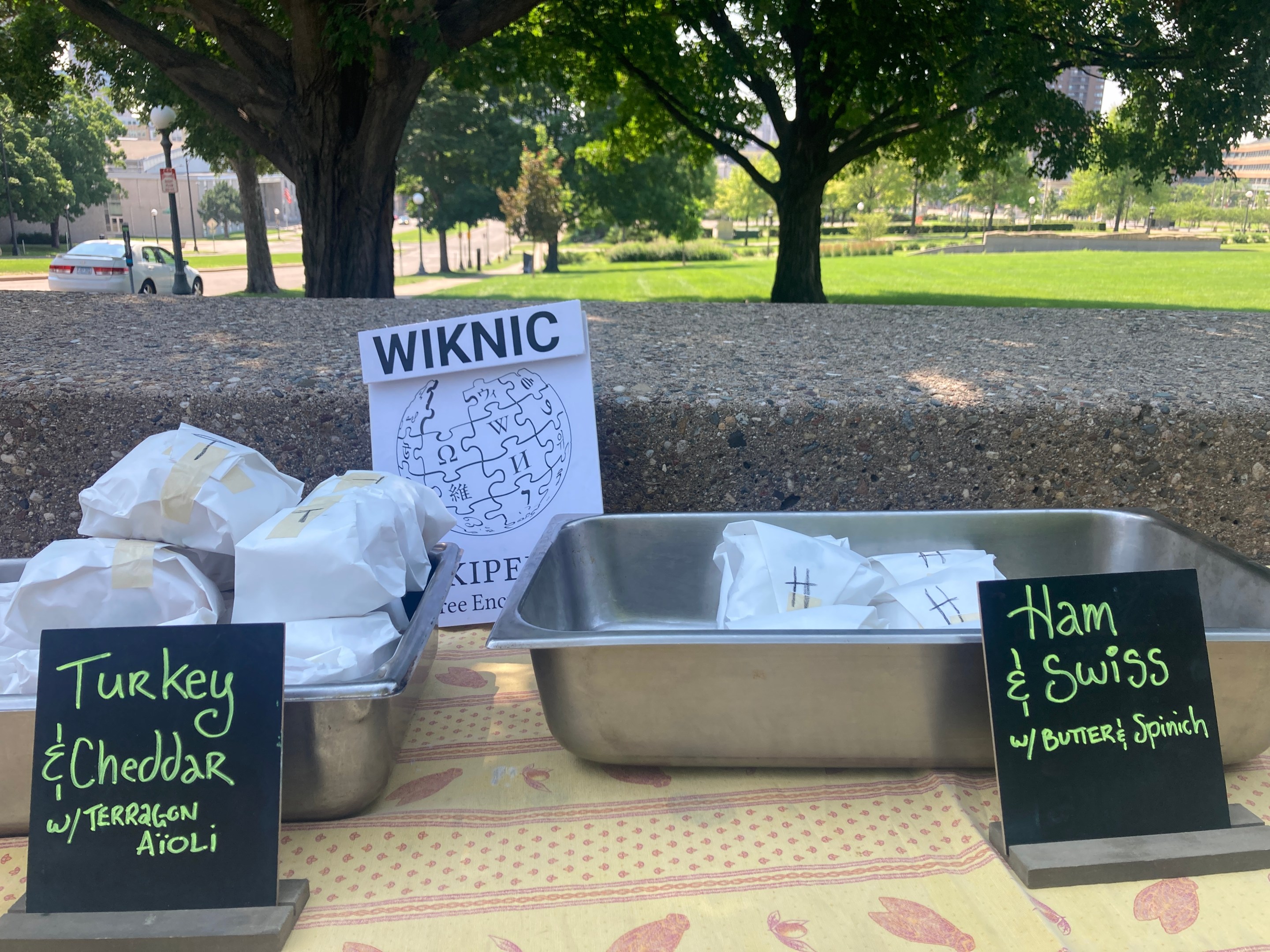
Still, as I biked over to the second annual Minnesota Wiknic on a hot but blessedly smoke-free Saturday morning, I found myself weirdly anxious about meeting the actual humans who make up the Twin Cities’ local Wikipedia scene. While I’d been invited by a queer woman friend, I still had an idea of Wikipedia editors rooted in childhood memories of Weird Al’s “White and Nerdy” video: straight white dudes who worked in IT and didn’t get out much.
And while technically open to all Wikipedia enthusiasts, last weekend's meetup was clearly geared toward the site’s editors. I may clean up the occasional comma splice, but I’ve never gone so far as to actually write substantial copy on a Wikipedia page. Would I be entirely out of my depth, a baby nerd among all-knowing giga-geeks?
As it turned out, I had nothing to worry about. The meetup, a shady picnic at the Minnesota Women’s Suffrage Memorial, certainly boasted its fair share of white guys with tech jobs, but the participants skewed queer, femme, and on the younger side. One of the meetup’s organizers, local super-editor Kari, or Minnastronomer, is, in fact, just 20 years old; I felt the icy hand of Hades rest itself on my shoulder when she casually mentioned she’d been in middle school when Gov. Tim Walz took office.
And the Wikimedians of Minnesota User Group, which organized the picnic, is deeply invested in making sure the site, and its editors, reflect the diversity of the state. Meetup co-organizer Joe Hoover, a 20-year Wikipedia veteran under the handle Myotus, with a day job at the Minnesota Historical Society, took the floor early on to talk about his work building out a greater Wikipedia presence for Minnesota’s Native American and Hmong communities.
Minnesota Wikipedians are blessed with a wealth of sources to draw on in writing articles about historically underserved groups: We’re the only state in the union with a historical society in every county. In turn Wikipedians help those historical societies serve additional people, as Wikipedia directs more visitors to the Minnesota Historical Society’s website than any other web traffic source.
Hoover mentioned the many difficulties in writing new articles about women, people of color, and other members of underserved groups on Wikipedia. The site’s emphasis on citing reliable national news sources means that it’s often hard to find high-enough-quality citations for the people those national outlets tend to underrepresent. Still, it’s a challenge Wikimedians of Minnesota is eager to take on.
Another of the user group’s goals is to get more Wikipedia lurkers to edit the site. I’d been dead wrong in my assumption that the Wiknic would be primarily a hangout for veteran article-writers. The majority of Wiknic attendees I spoke with were people just like me: long-time Wikipedia fans who’d only occasionally dipped a toe into editing. By getting us Wikipedia addicts together to chat, the thinking went, we might feel a bit less intimidated when the time came to actually write something on the site.
And chat we did. In between the standard summertime Twin Cities topics of conversation (lake swimming, air quality, whether the Walker’s exhibits are worth the ticket price), we gabbed about our favorite Wikipedia minutiae: Emily St. John Mandel’s surprisingly difficult fight to get her marital status changed on Wikipedia; the three different Defenestrations of Prague that share a single article; the epic edit wars over whether a photo of economist Guy Standing sitting down should be titled “Guy Standing sitting.” In these fellow obsessives, I found kindred spirits: people who love Wikipedia not just for its high-quality, human-sourced information but for the copyediting flame wars and bizarre user-uploaded audio files that make it weird and special.
The appeal of Wikipedia at the Wiknic, though, went beyond a shared set of memes. When I talked to my fellow Wikipedians about what they love about the site, they tended to mention a set of high-minded civic ideals.
“I like Wikipedia because it’s independent and community-supported,” mentioned an editor named Andrea. “It makes politics more accessible,” said Jaime, who’s written the pages for a number of local and state-level politicians. “My favorite thing is how well it functions as a model of democratic self-governance,” added Olivia (disclosure: a friend), a frequent lurker who finds the site’s talk pages fascinating. (As Wikipedia is a primarily pseudonymous site, all sources save Hoover requested to go by their handles or first names only.)
Everything that once marked Wikipedia as mildly disreputable—its refusal of a top-down approach to creating content, its policy allowing even logged-out users to edit articles, its insistence on direct democracy and open argumentation—today makes it politically aspirational. Wikipedia might not save the world from fascism, but at the very least it can model a different way of existing in community, one based in mutual respect and curiosity.
Listening to my fellow Wikipedia fiends talk about why the site is special to them, I realized that I’d never once in my life heard people talk about a website with this kind of reverence. I’m a child of Web 2.0, someone whose online presence overlaps almost completely with the emergence of toxic megaplatforms like Facebook, Twitter, and Instagram. I’ve often heard those older than me describe Wikipedia with a melancholic air as one of the last bastions of an older, better internet. Though as someone who never knew that internet, Wikipedia is less a sign of the depressing failure of the corporate web and more a hopeful emblem of what we might build in its wake.
It’s easy to have that hope when listening to people like Kari talk about Wikipedia. As she mentions on her user page, she used her interest in astronomy to build hundreds of new articles on the topic over the span of less than a year. She’s also a proud amateur Minnesota historian; she wrote and maintains Wikipedia’s page on the history of the DFL. When she led our motley group of encyclopedia nerds on a lively tour of the Minnesota State Capitol, her enthusiasm for everything Minnesota was infectious, and it all came from the curiosity Wikipedia fosters in its enthusiasts. When I asked her for her favorite thing about Wikipedia, she instantly rattled off four: “You learn stuff. Other people learn stuff. It’s cool. It’s fun.”
I’m inclined to agree with her, especially on the first two points. (While I certainly think Wikipedia is “cool,” that’s not exactly a consensus opinion.) It’s the push and pull of curiosity-driven learning, the delight of being taught and teaching in turn, that makes Wikipedia such a valuable community resource.
Now that I’ve Wiknicked with the best and brightest editors in the state, I’m inclined to get over my anxieties and get to work on the teaching half of the equation by learning how to properly edit the site. Hoover recommends starting with small edits on already-existing pages, then moving up to working on community-led projects like Women in Red to diversify the site. When I asked Hoover about what he loves about Wikipedia, he waxed rhapsodic about Minnesota’s storied history of cooperative movements. From the 19th century to the present day, he said with a smile, “Minnesotans collaborate.”
You can be a part of that collaborative spirit, too. This year’s Wiknic may be over, but Wikipedia, in all its nerdy, messy, utopian glory, could always use another editor.