


This past Saturday marked the end of one of the more stressful weeks of my life.
I got caught in a freak thunderstorm while on a hike Up North, worked dawn-to-dusk for a few days to make up for the time I’d taken to go to the Boundary Waters, and then got hit by a driver while biking home from a trip to the pharmacy. (I’m physically fine now, but it really sucked!) My wife and I had decided to try and capture a bit of normalcy by heading to the Minnesota State Fair, but my lingering aches and pains from the crash, the muggy weather, and the crush crowds of a record-breaking year conspired to kill the vibes. Sweating under the August sun, trembling from exhaustion, I was left with one thing to do, the only thing I could do.
It was time for me to ride Ye Old Mill.
My obsession with the State Fair’s oldest, lamest, and worst-smelling ride, despite its childlike intensity, has nothing to do with my Obama-era trips to the fair. My parents were, perhaps understandably, put off by the Mill’s “pool closed due to biohazard incident” odors and its proximity to the scowling sexagenarian white guys who always seem to be stationed outside the Republican Party booth; we made do with the gentle, staticky pleasures of the Giant Slide.
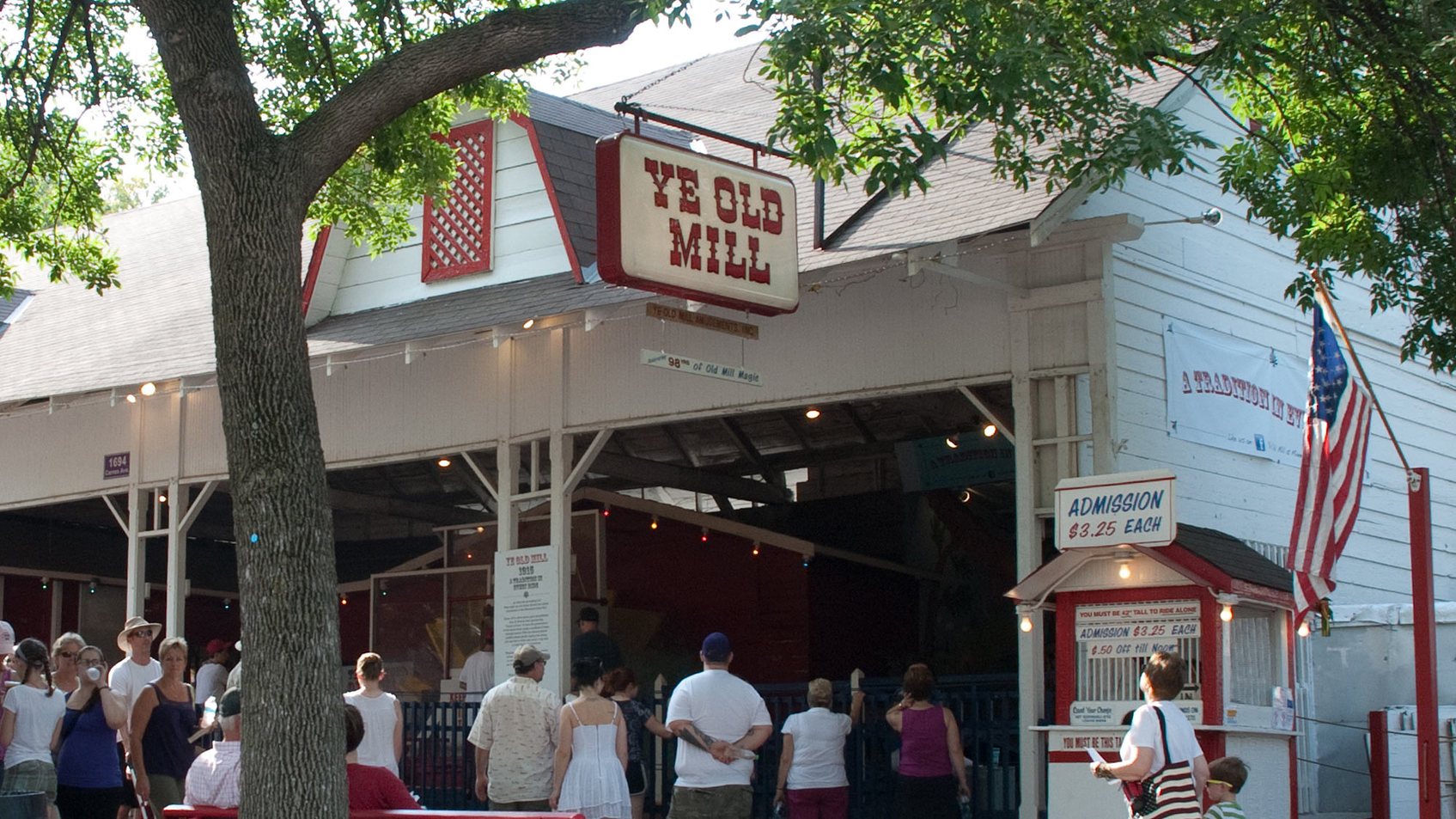
It was in 2022, when I’d moved back to the Twin Cities for grad school, that my love affair with the 111-year-old Mill finally began. Having seen a video essay about old mills—turn-of-the-century dark rides that served as the site of countless depraved sex acts during the Coolidge administration—I was delighted to remember that my own local state fair was equipped with a chintzy-looking, boat-based attraction of its own. I dragged my wife, siblings, and parents to the horribly chipped white cottage that stood a mere block from the equally distinctive-smelling Miracle of Birth Center, insisting that we at least try it once.
My mom, who’d just had her highly traditional order of cheese curds, was worried that it would be too thrilling to ride on a full stomach. My wife gave me an askance look after noticing a bored-looking carny (working at Ye Old Mill instantly transforms any ordinary State Fair employee into a born-and-bred carny) mop some kind of substance out from the boat before we sat down. But, sniffling a bit from the caked-on dust and overchlorinated water, we boarded our boat and, propelled by a rush of neon water, entered the tunnel.
And here is the thing about Ye Old Mill: It is basically just a tunnel. You will, every hundred yards or so, see a door that I guess you’re supposed to swim to if there’s an emergency. On four occasions, you will see the cheapest and dirtiest-looking diorama you can fathom poking out from behind a chain-link fence. For the rest of the ride, though, you will be enveloped in darkness so complete it feels like you have skipped past life into one of its eternal bookends: the womb or the grave.
That darkness feels thick and anxious and infinite, accompanied by a cool Stygian wind blowing in, seemingly, from nowhere. Occasionally, the haunting shimmer of a red-glowing EXIT sign or a voice from the boat behind you will emerge from the eigengrau, and yet such things feel less like features of the Mill than fellow interlopers from the now-vanished world above. The boat steers itself by bumping into dilapidated concrete walls; the current draws you along, blind and dumb, hearing not your pleas. It is difficult to believe there is a fair out there, in part because it is difficult to believe there is anything out there. You ride Ye Old Mill and believe that you have accidentally trespassed into the formless land that lies beneath hell itself.
More practically, you cannot see your own arms, much less the face or bra straps of the companion you probably brought into the Mill for the purpose of neckin’. God only knows how the hormonally insane teenagers of the Gilded Age managed.
And it is from this primordial absence that the show scenes emerge. You notice their flashing light, beacon-like, before you see them. It is unclear to me, in all honesty, why cardboard cutouts of the Three Little Pigs require the same lighting setup as the USS Enterprise going to Red Alert. Maybe a lighting designer in the years before rural electrification was trying to warn the pigs, who are engaged in normal piglike activities like eating corn, walking, and reading a novel about the hungry wolf standing three feet to their right. And though the pigs do not move, porcine smiles firmly ensconced on their plywood faces, you can feel their panic radiating out toward you as your boat rushes past their cracking cement enclosure and back into the Void.
So it goes, too, for the gnomes playing a tune on banjos and guitars, and for the not-legally-Bambi fawn who casts a cryptid-like shadow on a visibly water-damaged mural of the woods. These dioramas invite many questions. Do you think, for instance, that horny Depression-era high schoolers actually paused their make-out sessions to look at the Three Little Pigs? Were they impressed? Did these ever look good? Have they been dusted? If so: before or after the invention of the personal computer? Is it a sign of honesty or shame that even the official State Fair website calls these “some kitschy vignettes”?
After what feels like a reasonable amount of time to be on a ride, you will see the sun dappling the Gatorade-blue water beyond your boat. Do not assume this means you are soon to be free from the Mill! This is a landmark in Ye Old Mill I call the Fool’s Release. You pass behind the loading area, see a wooden sign that reminds you that you are presently (and perhaps eternally) riding Ye Old Mill, and then descend once again into the outer darkness, where there is weeping and gnashing of teeth. You still have what I assume is two-ish minutes of Old Mill to go; I wouldn’t know, as linear time appears to be suspended inside the Mill’s domain.
When you finally do emerge into the sun, you will have approximately three seconds to clamber off the boat before the carnies begin to scowl at you. There is a convenient Tom Thumb Donuts location near the exit at which you may ponder the abyss you just gazed upon.
In my years of Old Mill fandom, I have cultivated a number of other modestly enthusiastic Ye Old Mill enjoyers. They tend to be, like me, people with a high capacity for ironic enjoyment and a low fear response to extremely dark enclosed spaces. Every time I go to the fair, I’ll ask my friends to Mill with me, and they’ll typically take me up on it.
And yet I am always the person who asks. There is some special hold this ancient, horrible ride has on me and me alone. What could it possibly be?
For one thing, I have a deep and abiding love of things that suck that nonetheless insist on screaming their own importance at you all the time, and Ye Old Mill has some truly self-involved opening patter about what the Mill meant to your parents and grandparents that plays while you wait in what is typically the fair’s shortest line. For another, I’ve tried in recent days to turn my contrarian impulses away from being a knee-jerk hater and toward loving the boring, dorky things that other people can’t stand. And I can’t ignore the old saw—unsubstantiated to the best of my understanding, but it sure feels true!—that your brain eventually stops understanding the distinction between irony and sincerity, especially if you’re the kind of person who’s seen The Room, like, 30 times.
But also, I think there is something sincerely lovely about Ye Old Mill’s obstinate and somewhat baffling refusal to be in any way exciting. It is perhaps the lamest ride one could imagine, devoid of both thrills and the kind of loving detail that can characterize well-made dark rides. The whole thing is a relic of an era in which the average American’s idea of high-adrenaline excitement was driving a car 25 mph. At a fair that is always reaching for more—more decadence, more stimuli, more ways for O’Gara’s to fuck up a perfectly good potato—there’s something beautiful about a place so perfectly still.
Your parents—your grandparents—rode and perhaps did unspeakable things atop the same waters your fair ship now traverses. The bells of the Midway and the gastric pain of the Dairy Building will still be there when your boat docks once again. But for now, there is just the calm black nothing of the Mill, the throb of your own heartbeat in this eternal cavern where history pauses for just a moment before beating ceaselessly onward. May it last another 111 years, and may no one ever shine a blacklight in there.