

Jason Garcia and Christin Crabtree had an idea.
Back in December, a principal at a Minneapolis public school mentioned that Burritos El Patron on East 42nd Street was struggling amid the ongoing federal invasion. That made them think: What if they held a fundraiser that would support an immigrant-owned business and their unhoused neighbors at the same time?
They decided they’d ask for small donations to purchase a bunch of burritos, which would be distributed via organizations that support the Twin Cities’ unhoused communities. A win-win, they figured, and an easy way to help a business and neighbors in need.
Crabtree and Garcia initially set a goal of $500, which would have let them purchase and distribute 50 El Patron burritos at $10 apiece. Then the donations started flowing in; the fundraiser quickly netted more than $2,000, and the total continued to climb.
“We have now raised over $10,000,” Crabtree says. “Which is awesome, because that means we can support even more of our neighbors whose businesses are suffering.”
If you’ve spent any time on social media since the Trump administration’s Operation Metro Surge began in December, you have seen a version of this story play out. An everyday person puts out an ask for something—groceries, funds for an immigrant support group, even cardboard boxes—and the donations pour in.
Andrew Shields simply fired a group text off to a dozen of his immediate neighbors in the Minnehaha neighborhood to gather money for the Minnehaha Food Shelf on 37th Avenue and 50th Street. “Forty-eight hours later, we had over $1,000,” he says.
Laura Mitchell’s neighbor welcomed a newborn baby to the family, but didn't have any diapers or baby clothes because they hadn't felt safe enough to leave home for weeks. “Within 30 minutes of the ask coming in, two huge boxes were delivered to them with diapers, baby clothes, burp cloths, sleep sacks, laundry detergent, and personal care items for the new mom—all from neighbors who had what this family needed and were happy to share,” she says.
“We DO NOT need another coat. Not a single one!” writes Sade Young in a January 26 Instagram post. She’s standing inside Relish restaurant in front of a mountain of winter wear collected for detainees leaving the Whipple Federal Building—all of it donated in less than 48 hours. “I am speechless by how the city showed up, not surprised, but speechless," she says. "In awe.”
In times of crisis, people across the Twin Cities and beyond throw themselves into mutual aid work. Tattooers are doing flash events to raise mutual aid funds; fiber artists and ceramicists are hosting raffles and fundraising giveaways. One ICE observer has raised over $100,000 for dashcams to help protect the folks tailing immigration agents. Bookstores, toy stores, breweries—it is hard to overstate the extent to which people who work in every field and operate every type of business are trying to support their neighbors right now.
But the federal immigration invasion is ongoing, and the needs are constant. As Minnesota’s corporate and political leaders fail to meet the moment, residents continue stepping up to help, hosting donation drives and starting GoFundMe campaigns to support neighbors in need.
We spoke with a number of folks about the success of their mutual aid efforts and the ongoing needs—and how those who want to help can donate, support, or host a drive of their own.
Whether it’s a fundraiser or a food drive, local organizers emphasize the importance of using the tools and abilities you have at your disposal.
Naomi Osborn, the movie-trivia host and blogger behind Film Friends, says that while she’s been an activist for over 20 years, she has no formal background in mutual-aid organizing. But as a freelance strategist and producer who hosts film events, she does have experience mobilizing people and resources quickly on a grassroots level.
“This moment felt less about expertise and more about responding quickly and kindly,” says Osborn, who put out an ask for funds to her large social media following.
“To say my wildest expectations were met would be an understatement,” Osborn says. “Over the course of two days, 33 people donated a total of $2,365. People from all over the country wanted to materially support immigrant and marginalized neighbors here in Minneapolis.”
She was able to deliver 552 pounds of donations, purchased from immigrant-owned grocers, to the Ralph Reeder Food Shelf in Mounds View, which she chose because the organization serves immigrant and refugee neighbors.
A sizable social media presence can help get the message out—but it’s by no means a requirement.
“As an artist, I was trying to use the tools that I have to raise some money and decided to do a printmaking fundraiser,” says Minneapolis-based mural artist Audrey Carver. “I have a small social media presence, so I was expecting a chill, low-key event, and was totally blown away by the huge response.”
Hundreds of people showed up to Wandering Leaf Brewing in St. Paul, waiting over four hours in line to print a shirt. “We had to start turning people away only an hour into the event, and it still took six hours of printing to get through everyone,” Carver says. The brewery event raised more than $5,000 for Community Aid Network MN (CANMN), and she’s planning to host more printing fundraisers in the future.
For their part, the folks at CANMN have been overwhelmed—in a good way—by the support of fundraisers like Carver’s. “It’s like CANMN super-mega edition,” chuckles organizer KP.
When it comes to hosting a successful drive, Osborn’s advice is to start local and start practical. Identify specific food shelves, mutual aid groups, or neighborhood organizations in your community so that people know exactly where the donations are going.
“If you’re donating money, ask an informed and trusted person on the ground where to direct support to create meaningful impact,” she says. “If you’re sharing information, be thoughtful and accurate. And if you’re not in a position to give financially, paying attention and amplifying credible local efforts genuinely helps.”
“It’s so easy to start locally,” agrees Jason Garcia. “If there’s a business in your neighborhood that you know is immigrant-owned, they’re probably suffering right now.”
Garcia adds that specificity is helpful in all things related to the fundraiser. How much are you hoping to raise? What need is this addressing? What will you purchase, or how will the funds be otherwise distributed?
“We had a specific goal in mind that we named from the beginning; that makes it easy for people to be like, ‘OK, $500. A burrito is $10.’ It’s easy for them to break that down,” Garcia says. “If somebody is like, ‘I can donate $20,’ they know that they’re going to be providing two people a meal.”
But the folks we spoke to for this story are emphatic that the ask doesn’t have to be perfect. If there’s a family in your neighborhood that needs help, or an immigrant-owned grocer you want to support, just ask.
And yes, there are a lot of mutual aid drives out there at the moment—there are a lot of people who need help. That’s something allison anne, a front desk manager at James Irving Salon in Uptown, says they were wary of when organizing a fundraiser to help a group of out-of-work Latino restaurant employees pay their rent.
Initially, anne and their colleagues at the salon hoped to raise $800 per family, or about $4,000 total—and even at that, “I worried that might be too big a goal with so many urgent needs across the metro,” anne says. And still, the fundraiser brought in $7,000 in about 48 hours; in total, they’ve raised more than $18,000 in direct aid in the span of two weeks.
“There are so many people who want to help, who can plug in and get involved in some way because you were vocal about something important,” anne says. “There are so many strong community ties that began to build during the early pandemic and the uprising in 2020 and have been tended to since then, and so many more folks getting plugged in now.”
You don’t even have to be in Minnesota. KD Hack, who lived in south Minneapolis for a little over six years and now resides in Viroqua, Wisconsin, asked friends still in the Twin Cities about how they could best help from afar.
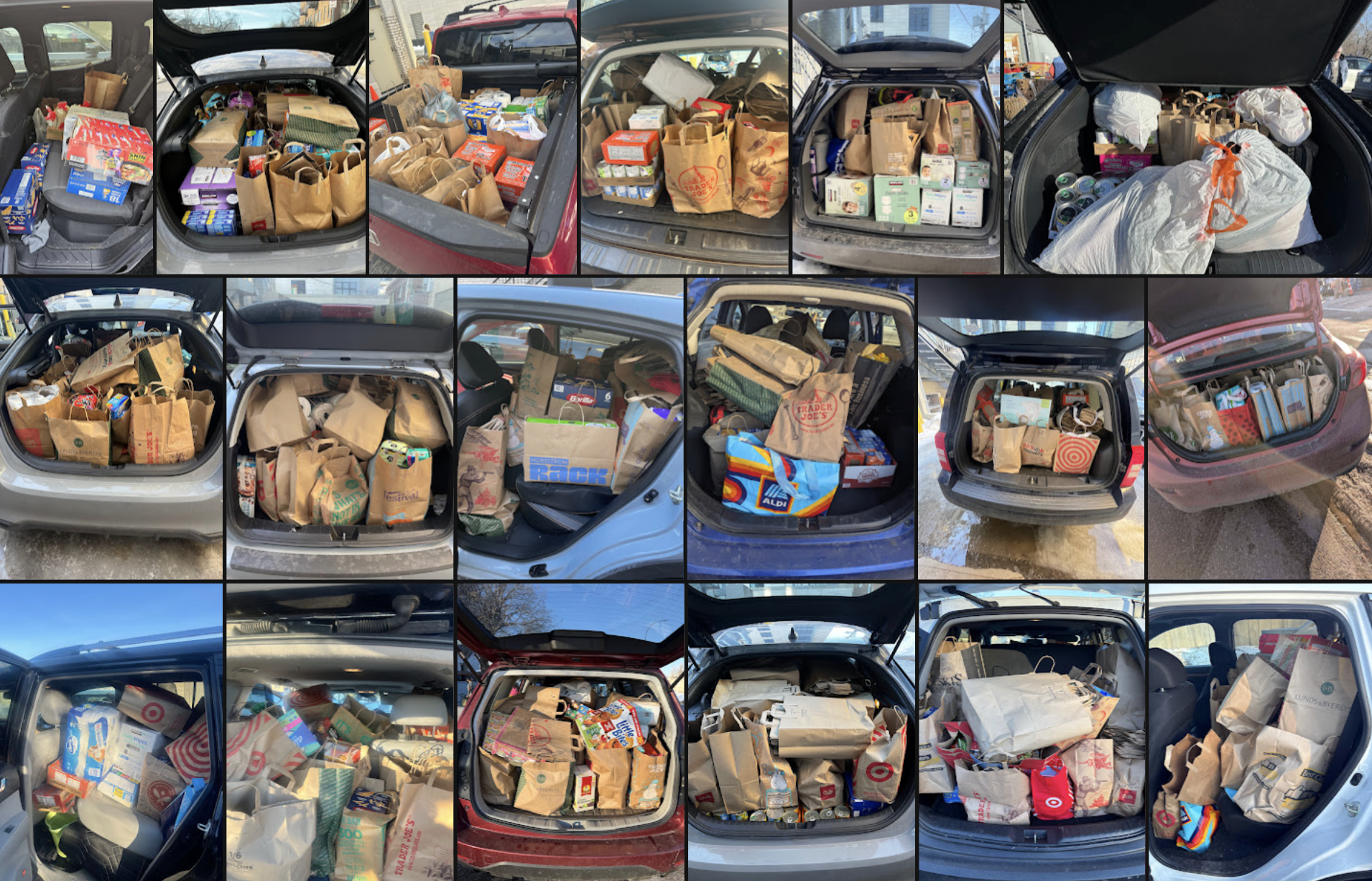
“What started as a call to just fill my vehicle exploded fast,” Hack says. “The response was swift, and in less than 48 hours we were able to collect and distribute around 10 carloads of supplies all over the metro, as well as close to $4,000 worth of cash and gift cards to mutual aid.”
“[Something] I found myself repeating a ton with folks who are new to movement work (and internally) is I am quite literally just a guy—no one is uniquely qualified to do mutual aid,” they continue. “You listen, then you act.”
Earlier this month, Ashley Fairbanks set up a website, Stand With Minnesota, to help people near and far figure out where to direct their donations.
The site includes organizations and nonprofits doing work on the ground as well as mutual aid funds for everything from diapers to pet supplies. But right now, she says, rent is the greatest need. Many immigrants have lost their family’s provider or have been out of work for months, and February 1 is fast approaching; the Walz administration does not appear willing to move on an eviction moratorium, despite pleas from the City Councils of Minneapolis and St. Paul.
“If people aren’t connected to a support network already, there’s not an easy pathway into the system. And one can’t be built, because—there’s the list that ICE wants, right?” Fairbanks says. “I just think this week is going to be one of the hardest, because we don’t have easy answers for people.”
She emphasizes that mutual aid is the best solution right now: If you have neighbors who can’t pay their rent, the best and fastest way to help them with that is to make a GoFundMe, which you can send to Fairbanks, who will add it to the website.
And if you’re among those who haven’t yet found your place in the movement, it’s never too late to start.
“Even small, practical actions can help people feel less powerless,” Osborn of Film Friends says. “Seeing others step up reminds us that values are not just something to admire in theory—they are something we practice and can embody every day.”
“I saw a post that was like… ‘The thing is, you just have to get really good at continuing,’” Garcia adds. “That’s something that I’ve really been focusing on the past few weeks: We just have to get up. We just have to keep doing things.”
Fairbanks admits that she’s a bit of a cynic, but she added a section to the Stand With Minnesota website where people can send a “love note” to folks on the ground in Minnesota. Thousands of notes have poured in from people around the world—you can read them here—and throughout the struggle, they’ve provided some much-needed warmth and light.
“Mutual aid, as much as it’s a resource thing, it’s also a love and energy thing. People need support—they need cheerleaders, they need people to hug, they need their neighbor to make them a bowl of soup,” Fairbanks says. “It doesn’t have to be organizing a whole network. It can literally be bringing dinner to your neighbors.”