

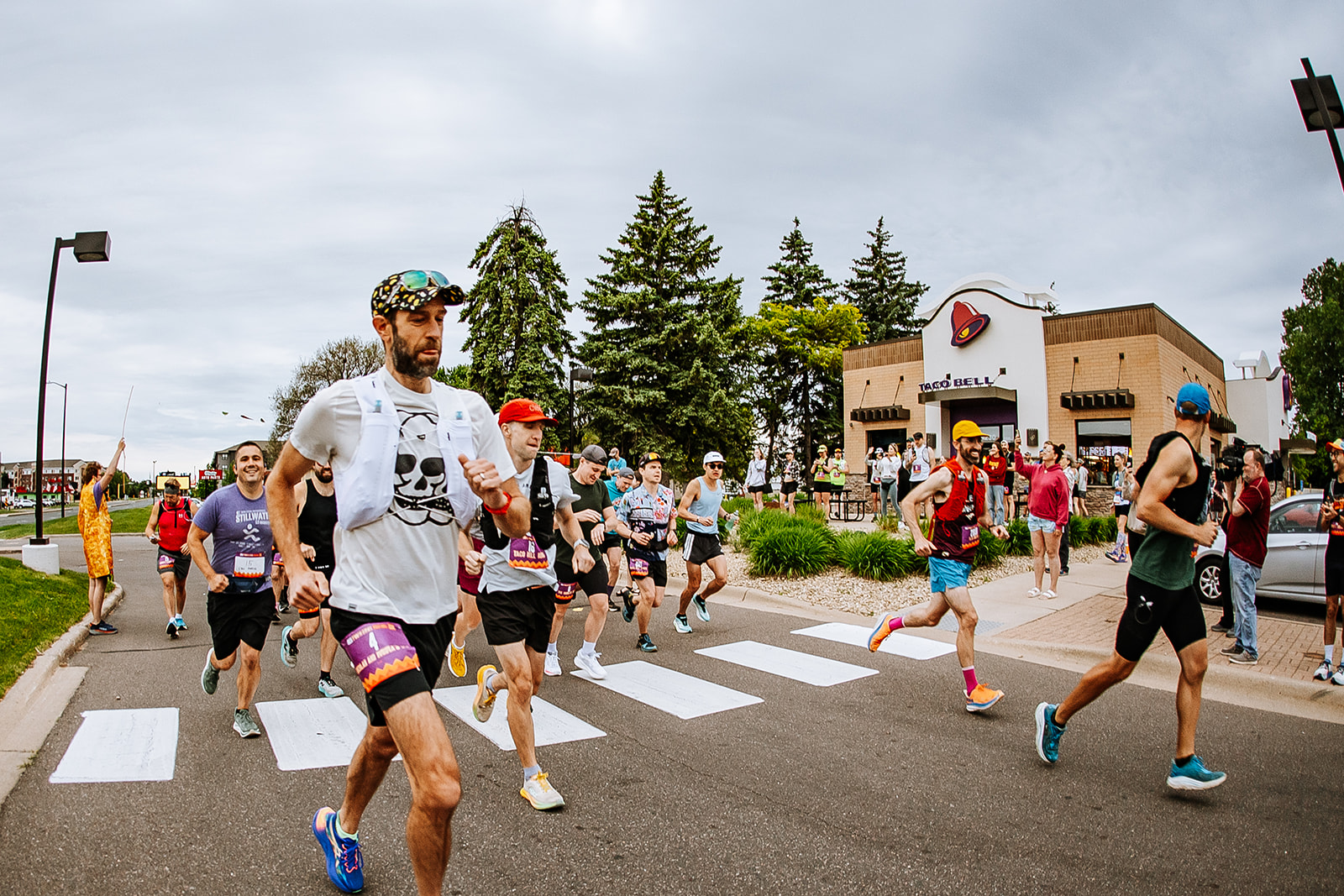
It’s a test of fitness, bravery, endurance, and gastrointestinal fortitude. The strong survive; the diverse gut biome havers prevail.
We’re talking, of course, about the Taco Bell 50K.
On Sunday, if you saw runners around the Twin Cities sporting bibs with names like “Taco Belle,” “Chalupa Chaser,” or “The Dorito Kid,” those were courageous participants in the second-annual Twin Cities Taco Bell 50K. Runners started in Bloomington and ended in Oakdale, stopping to eat at least one menu item at seven total Taco Bells in Richfield, Edina, Minneapolis, and St. Paul along the way.
The original TB ultramarathon was held eight years ago in Denver. Local runner Julie Knopp organized a Minnesota installment last year, making it the first “more robust spinoff” of the Colorado event. Since then, athletes in D.C., Orange County, and other U.S. cities have organized their own chalupa challenges for fast-food lovers who want to think outside the run.
Knopp says she isn’t the world’s greatest runner and isn’t super involved in the local running community. Ahead of 2025’s first-ever local Taco Bell 50K, she posted about the race in a few Facebook groups and on her own social media, thinking a handful of people would come out.
Instead, the interest was so overwhelming that she had to turn people away. One woman came from Alaska; she said it was cheaper to fly to Minnesota, stay in a hotel, and run the race than to sign up for many of the ultras in her home state.
So… how does one go about training for an ultra like the Taco Bell 50K?
“When I started training for it, I had done marathons before, but I was totally new to the kind of gastric elements of this race,” Knopp says. Since she doesn’t live near a Taco Bell, she started heating up frozen burritos whenever she was getting ready for a long run, wrapping them in foil and popping them in her CamelBak to eat at some point on her route.
Knopp has heard from other runners who incorporate Taco Bell stops into their training runs or who check out segments of the course ahead of time. Some runners even crunch(wrap) the numbers, figuring out the calories and carbs and sodium in various Taco Bell menu items to best fuel on race day. “And some people are just like, ‘You know, I’m gonna see what happens,’” she laughs.
Hey, like any training regimen, it’s all about knowing your body. No one got sick during the race in 2025, as far as Knopp knows, and just one person experienced some, uh, internal distress during this year’s 50K.
“The most common joke that I get about this race is, ‘How many porta-potties are there?’ First of all, zero, you’re on your own—this is an open-course race,” she says. “But second of all … I don’t think as many people are getting sick as you might expect, so that’s, I guess, good news.”
A Taco Bell defender myself, I have always belonged to the school of thought that anyone who can’t handle a little Teebs in their system isn’t getting enough fiber in their day to day life or isn’t pure of heart. Possibly both. Although Knopp notes that eating strategically is never a bad idea; beans, rice, and chips and guac are pretty safe bets, as race fuel goes. “I’m eating nutritious—well, OK, maybe that’s a stretch,” she says. “But there are nutritious elements!”
As for what draws people to an offbeat ultra like this? Knopp actually asks people about their reasons for running when they sign up, and the responses are varied. Some see the race as a sort of bucket list item—it’s fun to say you ran a Taco Bell 50K right?—while others seem to love leaning into terrible life choices. “This is one direct quote: ‘My top two strengths are running and consuming Taco Bell,’” she laughs. “‘This is my event.’”
The Taco Bell 50K is also pretty affordable, as ultras go. Last year, entry was priced at $25 (Knopp lost money), and this year the entry fee was $85, with proceeds going to the nonprofit Compassionate Action for Animals, where she’s on the board.
Knopp has been blown away by the passion of participating runners. “I was like, ‘You know this isn’t a real race, right?’” she chuckles. The Taco Bell 50K isn’t chip timed (no pun intended), and roads aren’t closed. Still, people have been eager to race, get involved, and give back. She didn’t ask for sponsors this year, but had lots of people ask about sponsoring the event or running an aid station.
Knopp thinks participants are drawn to the rogue nature of the race, which again attracted runners from outside the Twin Cities (California, Indiana, Michigan) in its second year. It’s small and less formal; last year registration was capped at 50, and this year there were just 75 runners. Running is experiencing a general renaissance—more people are running than ever—but there’s something especially enticing about novelty runs like this one, where folks bond with one another over the weirdness of the experience.
Knopp has heard people use words like “diabolical” and “gritty” to explain the race. She sees it a little differently: “It’s a beautiful invitation to be a kid again, to play.” It gets people off of their phones and into a totally unique setting, and she says that for many participating runners, it’s their first 50K.
Plus, “You don’t get boring people doing a Taco Bell 50K,” she says. It’s a fascinating group of folks like Travis Meier, who this year “portage ran” the entire 31.1 miles with a canoe to raise awareness about protecting the BWCA.
“In reality, I feel like I’m escaping the gritty, hellish elements of our society,” Knopp says. “I’m out here, I’m running, I’m not responding to texts, I’m eating fast food with friends. I feel like I’m 13 again and my parents are out of town.”
And there’s something about the silly nature of the race that makes it feel safe. If it turns out you can’t run the 50K, if you “fail,” who cares? It was a Taco Bell 50K. At least you got a Crunchwrap and a Beefy 5-Layer Burrito out of it—and maybe you made a few new friends.
“Even though the Taco Bell 50K is obviously very goofy by nature, there’s also this really powerful element of community engagement that has surprised me,” Knopp says. “I think there’s something really meaningful about having real experiences in the real world right now. It shakes up the grind of everyday living, and I think that’s part of what people are hungry for. Pardon the pun.”