

I’m sitting cross-legged on the freezing bathroom floor on a Friday night. All the lights are off, and a bootleg TOOL quilt is stuffed across the door’s floor gap, keeping out every last photon of light. I hadn’t overindulged, but I had gotten sloppy: I’d ripped a finished roll of film inside an antique camera. I need to get it out, undamaged, in total darkness.
I slide a grinding metal latch. Tightly wound film unspools in an invisible arc across the room, skittering across the coarse laminate flooring. The Clarus MS-35 has just claimed its second victim.
Right now, Twin Citians can take photographs using a camera built in Minneapolis. The catch? It’s 80+ years old.
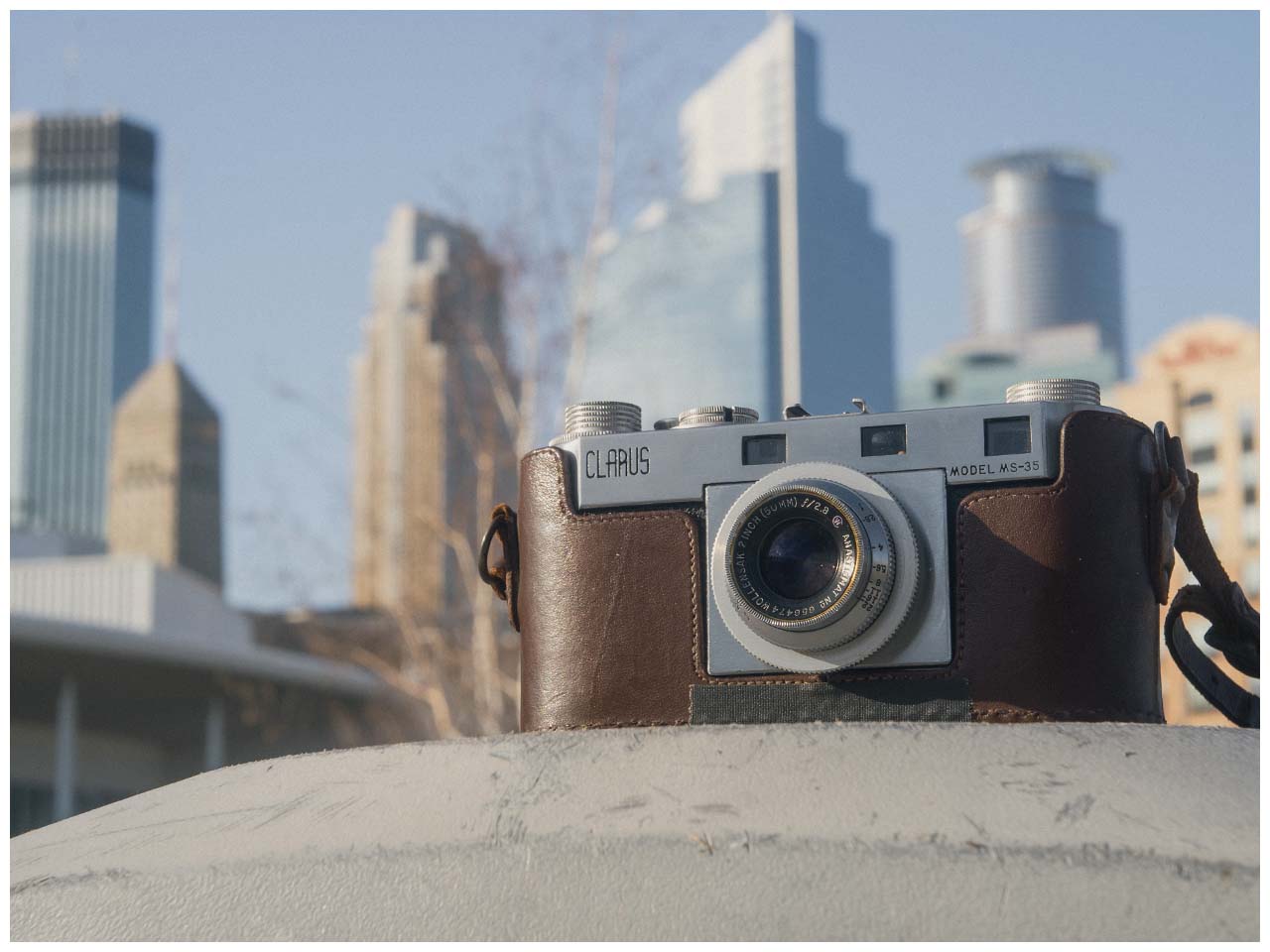
Operating out of a former bootlegging site, the Clarus Camera Manufacturing Company of Minneapolis built exactly one model of camera: the MS-35. Launched in 1946, the simple yet solid contraptions rolled out of the Nicollet Avenue factory for an additional six years. The cameras are still around, and some even work. Amid rising interest in film photography, does choosing a Clarus camera make any sense?
To find out, I spent almost a year snapping photos with a Clarus MS-35. Using one today is literally seeing the world through a different lens, and it provides clues as to why the Minneapolis camera was ultimately a failure.
Clarus Camera Mfg. Co.
So, what kind of camera did they make in Minneapolis?
The Clarus MS-35 is a fully-mechanical 35mm rangefinder-style camera. Its name means “clear” in Greek, and each Clarus is branded prominently across the faceplate.
When it launched in 1946, the MS-35 featured great specs on paper: Each Clarus came with the camera body, a 50mm f/2.8 lens, and leather “ever-ready” case. Initially retailing for around $133 ($2,376.84 in 2026) an all-metal Clarus was a premium option over its popular domestic contemporary, the $75 Argus C-3 rangefinder ($1,340.32 in 2026).
Demand for 35mm cameras was high after production delays caused by WWII. Clarus manufacturing started in May of 1946 from the factory at 1554 Nicollet Ave., about a block toward the freeway from the current 19 Bar. Workers in Minneapolis produced most of the 300+ parts in each camera, with the exception of the lens.
It was these workers who drew the company to the Twin Cities in the first place. Clarus manager Matt Broms explained to the Minneapolis Morning Tribune that "the quality of the local labor supply surpassed that of Chicago." During its first year in business, the company employed about 30 people. By 1948, the Morning Tribune reported, there were over 100 and the company was doing $1 million per year in business—$13.7 million in today's dollars. For nearly six years, new Clarus cameras were shipped to every major market on this side of the Iron Curtain.
The good times didn’t last for Clarus, if they ever really began. Ads for the MS-35 plot a precipitous price decline for the company’s flagship product. By 1951, the MS-35 had been marked down to $69.50, while the plastic Argus C3 was holding steady at $69.95.
An early and enduring reputation for unreliability clung to the MS-35 despite many design refinements, and no follow-up model ever made it to market. Worse yet, new competition from German and Japanese cameras applied increasing pressures to all U.S. camera manufacturers. An October 1, 1953, job posting in The Minneapolis Star (seeking: “GRINDER MAN”) is one of the last public mentions of the Clarus factory at its Minneapolis address.
The Clarus Camera Mfg. Co.’s time was up, but its troubled, over-built cameras remain out there to this day.
This Thing Still Works in 2026?
You betcha! The MS-35 uses the same 135 format 35mm film still sold and developed today. Color, black and white, slide film—whichever kind you want. Thirty-six-exposure film rolls are available for purchase and development locally, too. I've had great experiences with Basement Lab, Fast Foto, and West Photo, where single rolls start around $7 and basic development runs $20+. Wait times are now measured in days or weeks, but the delayed gratification is a feature, not a bug.
As for the camera, ordering a “working” vintage camera online is an adventure in vague guarantees and musty smells; be sure to enjoy the process. Before you shop, remember: The MS-35 had a reputation for unreliability when it was new. Be ready to lower your definition of success. I paid about $75 for an “as-is” example that just needed some cleaning.
Photography with old mechanical cameras is just like taking pictures in “manual” mode on a modern camera, but with a few extra steps. Besides needing a roll of film to get started, there are no electronics whatsoever in the MS-35, so you’ll need a light meter app (usually free) or a clip-on meter (rarely free) to measure your exposure. It’s not fast, but how cool is it that any of this works at all?
Making Photos With a Cinderblock
After loading the film and setting your frame count to 0, you are ready to take pictures with the camera made in Minneapolis. You can choose to adopt a focus phrase to get your creative juices flowing. “Skol,” “Fuck ICE,” “You Betcha”—all good options.
While a full run-down on how to take a manual photo is beyond the scope of this geek-out, this is how a midcentury rangefinder camera like the Clarus functions.
In any particular order:
- Turn the film knob to advance the film and wind the shutter (tactile, fun, probably looks really cool)
- Separately from the camera, measure the light where you want your picture (science, hell yeah)
- Set the shutter speed dial (delicate)
- Set the lens aperture (small and way out in the front)
- Focus on your subject using the split image in the focusing viewfinder (awkward pause)
- Frame your photo in the framing viewfinder (awkward pause continues)
- Make sure the lens is not blocked by fingers, straps, or parallax errors (each photo can be $1+)
- Finally, press the shutter release button (tactile but awkwardly positioned)
- Repeat this LESS than 36 times (see Problem: The Shutter below)
Now, let’s go over the ways this process can get messed up. Folks, that’s the entire next half of this article. Steel your nerves with this photo of a pup on a boat:
Problem: The Body
When there are issues with a camera body, it really doesn’t matter how fancy your lens or film are. Camera body problems mean light leaks and ruined photos. Bummer!
The body design of the Clarus camera has one glaring flaw. Like a Vikings defense, the film door on the MS-35 likes to open up at the worst possible time. Enthusiasts and reviewers documented multiple revisions to the film door’s latch design, which indicate a persistent problem in this area. My film door opened un-commanded once, ruining a roll of film—and this particular Clarus had the newer revised latch design.
Another gripe: Rangefinder cameras are supposed to be small. MS-35s are not only large, but solidly hefty at 38.3 ounces—that’s over 2.3 Grain Belt tallboys. There are no lugs on the body to attach a camera strap, which makes the whole contraption ungainly, like a heavy bike sold without a kickstand. I found the leather case (kindly refurbished by D&J Glove Repair) surprisingly helpful because it both clamps the camera body shut and has a strap already attached.
For fans of the Clarus, the heft is actually a benefit. Scott Bilotta, admin of the archived Clarus Camera Forum, praised the solid feel of the MS-35: “I’m more steady with a heavier camera than a lighter one.” Steady photos it is, then.
Problem: What the Hell Am I Looking At?
With three windows in the front and two viewfinders in the back, it’s fair to wonder: What kind of six-fingered AI slop is this?
You’re not seeing double. On the Clarus, focusing the lens and framing the image are separated into two inconvenient steps. The Minneapolis-made camera uses tiny angled mirrors from two separate windows to triangulate focus. It is literally a local angle. Clarus referred to this as “syncro-loc focusing.” Beneath the marketing, this made the MS-35 a coupled rangefinder camera design. This popular camera layout (typically) boasted small size, accurate focusing, and sharper images. You may recognize the design in many versions of the camera emoji: 📷.
To start your syncro-loc focusing adventure, you need to look at your subject through the rangefinder window. You’ll see a magnified image split into top and bottom halves with the aforementioned tiny angled mirrors. Turning the lens moves the upper half of the image, and when the two halves meet, your subject will be in focus. This isn’t fast or convenient, but experience shows it’s still remarkably accurate.
Framing your photo takes place in the second viewfinder, which shows an approximation of what the standard-equipped 50mm lens will capture. The view is clear and bright, but if your subject moves, return to the rangefinder window and start over. Do not pass go, do not collect $200. Re-focus and try again.
Needless to say, this system is not ideal if you’re trying to photograph anything that’s moving.
While focusing the lens, you may worry that this non-Minnesotan component is contaminating the Clarus’s North Star State bonafides. Worry no longer: The maker of the MS-35’s standard lens, Wollensak Optical, was later owned by 3M.
Problem: The Shutter
I saved the biggest problem for last. The MS-35 will absolutely eat your film. Surprise!
When you’ve finished your roll of film, the Clarus has no dedicated film rewind button. Unhelpfully, you can only release the film spool by pressing the shutter button. If you lose track or try to squeeze in an extra photo, your film can run out mid-wind, while the shutter button is locked up. There’s no reversing out of this situation. You can only keep turning the winder, ripping the film in one or more random places and trapping it inside your camera.
I ignored online warnings of this problem and paid the price: I don’t recommend spending a pitch-black Friday evening fishing film out of an antique. The real-life wizards at Basement Lab kindly nursed my torn film through the development process, resulting in some happy accidents:
Who is the Clarus MS-35 for?
People expect a camera to deliver images that reliably capture the moment. Not enough Clarus cameras did that in the 1940s, and I don’t think any still do in 2026. That’s not really what they’re for anymore.
Using a Clarus camera, specifically in Minnesota, was an especially daydreamy experience. Seeing the present day portrayed with the looks of yesteryear makes both eras more relatable. This feels more true when seeing the modern, mundane scenes I personally saw reproduced on old-timey physical media. It’s like some sort of reverse Forrest Gump-ing, where the modern world looks misplaced in the nostalgic colors and texture of film.
So if you’re understandably feeling municipal pride right now, you’re in the one situation where the MS-35 makes any sense at all. Throw an MS-35 in your cart and document your summer quest to find the Jucy-est Lucy. Struggle to focus on slow-moving parade floats in Powderhorn Park. Smear the lens in cheese curd grease as you awkwardly carry it down Dan Patch Avenue. Discover this on your lab scans two weeks later. You can do it using an actual piece of your city’s history, through the flawed and quirky Clarus MS-35.